FRP Fan Blade Manufacturer | Custom FRP Axial Fan Blades for Cooling Tower
Meta Description: Trusted FRP fan blade manufacturer delivering custom axial FRP fan blades for crossflow & counterflow cooling towers. Vacuum-infused composite blades, low-noise airfoil profiles, OEM retrofit compatible with BAC, Evapco, Liangchi and Marley.
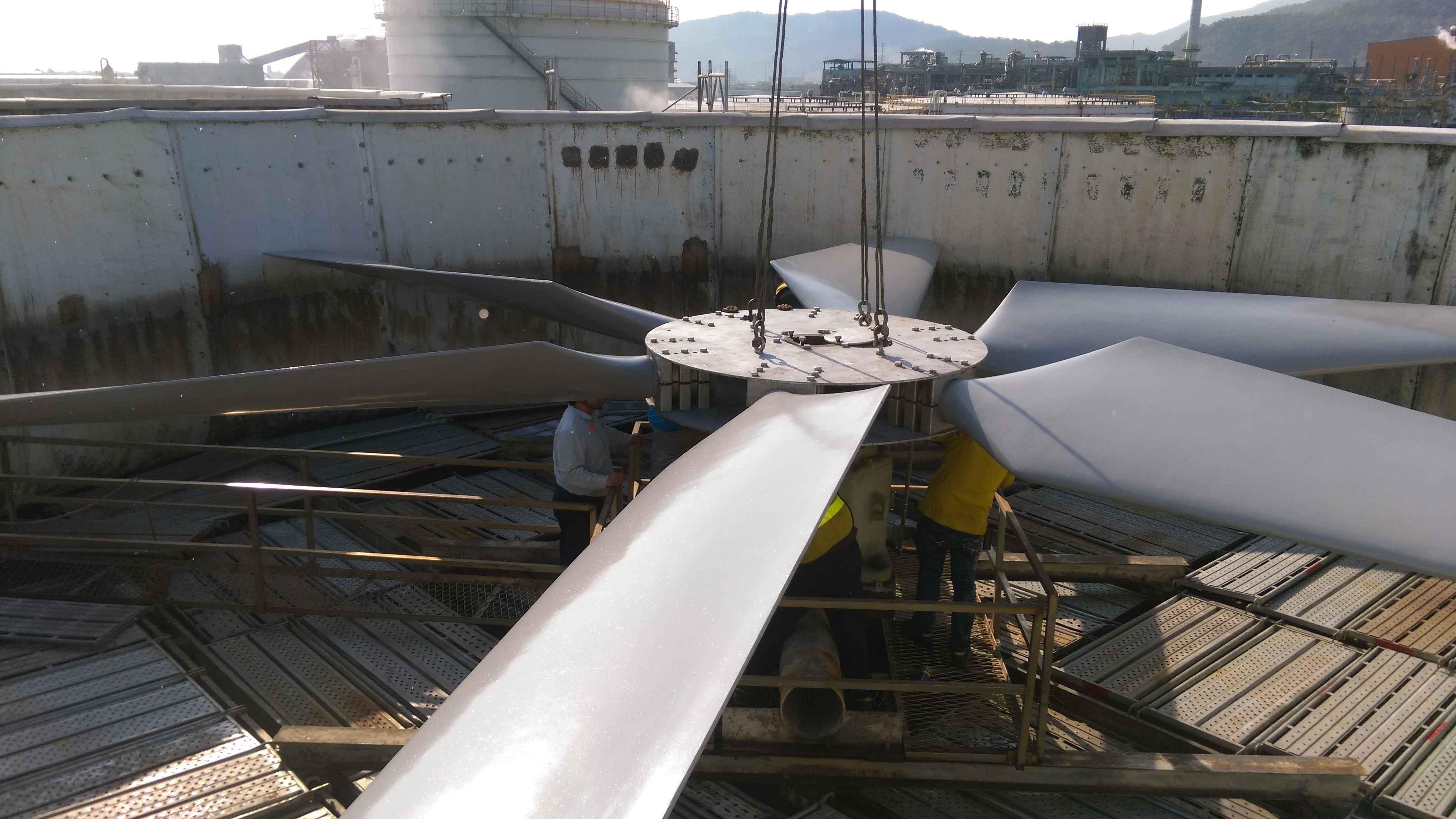
The Shift Toward Custom FRP Axial Fan Blades in Modern Cooling Tower Retrofits
Across industrial HVAC, power generation, chemical processing and coastal process plants, facility managers are moving away from one-size-fits-all metal fan rotors and switching to engineered FRP axial fan blades. Unlike standard off-the-shelf blades, custom-molded FRP fan blades are tuned around your tower’s actual thermal load, fan stack diameter, operating RPM, water chemistry and noise limits.
Many cooling tower upgrade projects fail because replacement blades are selected only by diameter and blade count, ignoring aerodynamic twist, root geometry and dynamic mass matching. As a specialized FRP fan blade manufacturer, our core advantage lies in building blades that do not merely “fit the hub” — they preserve or improve the original cooling tower thermal performance while cutting auxiliary energy draw and long-term vibration risks.
Why Standard Replacement Blades Often Fall Short
Generic fan blades are molded for broad compatibility, not site-specific conditions. A blade that works well on a freshwater HVAC tower may suffer rapid surface degradation, efficiency drift or excessive noise when installed on a coastal tower exposed to salt spray or chemically treated circulating water. Aluminum blades also develop hidden fatigue cracks under cyclic humidity loading, creating unplanned shutdown hazards that many maintenance teams overlook until failure occurs.
How Custom FRP Blades Solve Performance Drift Over Time
FRP composite material holds its molded airfoil geometry far better than metal alternatives. Once the aerodynamic profile is locked during vacuum infusion curing, the chord, twist angle and leading-edge shape remain stable for years. This means airflow output, static pressure performance and power consumption do not degrade as quickly as pitted, bent or corroded aluminum blades. For operators chasing consistent cooling water setpoints year-round, this stability is a decisive operational benefit.
Composite Material & Mold Design Behind High-Performance Custom FRP Fan Blades
Not all FRP fan blades are created equal. A low-quality chopped-strand spray-up FRP blade will show surface blistering, resin delamination and leading-edge erosion after 1–2 seasons. Premium cooling tower axial blades rely on directional E-glass reinforcement, selected resin systems and controlled molding cycles to balance stiffness, weight, UV stability and chemical resistance.
Resin Matrix Selection Tailored to Cooling Tower Environments
Isophthalic Polyester Resin – Standard Industrial Grade
This formulation delivers balanced corrosion resistance for most freshwater, chlorinated cooling tower circuits. It is the cost-effective baseline for commercial HVAC and general manufacturing towers, with built-in UV inhibitors to resist outdoor sunlight degradation.
Vinyl Ester Resin – For Aggressive & Coastal Applications
Vinyl ester FRP is specified for desalination, coastal salt-air, acidic process loops and chemical plant cooling towers. It provides superior barrier performance against osmotic blistering when warm, mineral-laden water vapor penetrates the blade surface. While higher in material cost, vinyl ester blades drastically extend service intervals in high-corrosion zones.
Fire-Retardant FRP Formulation
For indoor mechanical rooms, data center cooling plants and enclosed process buildings, we manufacture custom fire-retardant FRP axial blades that meet smoke and flame spread requirements without sacrificing aerodynamic performance.
Aerodynamic Airfoil Engineering & Custom Twist Optimization
Our design team uses CFD simulation to tune blade twist distribution from root to tip. Axial cooling tower fans operate across a wide radial velocity gradient; a flat, untwisted blade creates turbulent airflow at the blade tip, raising noise and wasting motor power. Custom twisted airfoil profiles equalize lift along the full span, lowering tip vortex noise and improving airflow uniformity through fill media.
This design workflow supports unique requirements: ultra-quiet profiles for urban campuses, high-CFM profiles for large counterflow towers, and narrow-chord low-inertia blades for variable-frequency drive (VFD) fan systems.
Our Custom FRP Fan Blade Manufacturing Workflow
As an FRP fan blade manufacturer focused on cooling tower aftermarket and OEM supply, our production sequence is built around repeatable balance, interchangeability and retrofit compatibility. We avoid shortcuts that compromise rotor safety.
Step 1: Data Capture & Engineering Review
Before mold work begins, our technical team collects critical parameters:
Fan stack diameter, blade quantity and operating rotational speed
Existing hub clamping style, root bolt pattern and pitch adjustment range
Design airflow, target motor power and allowable vibration thresholds
Site environment: freshwater, salt, chemical exposure, indoor/outdoor, noise limits
OEM reference: BAC, Evapco, Liangchi, Marley, Tower Tech and SPX retrofit matching
We validate whether a new custom blade set can drop into your existing fan hub assembly or whether minor root modifications are needed.
Step 2: CNC Mold Fabrication & Laminate Layup
Molds are CNC-machined to lock in the airfoil surface. For low-volume custom runs, matched tooling ensures identical geometry across every blade in a set. Continuous directional fiberglass reinforcements are oriented to carry centrifugal and aerodynamic loads, rather than random chopped fiber. Vacuum bag infusion pulls resin evenly through the fiber stack, eliminating trapped air voids that become crack initiation points.
Step 3: Curing, Trimming & Root Machining
Controlled post-curing stabilizes resin cross-linking and minimizes long-term thermal creep. Blade roots are precision milled to match hub clamping pockets, shoulder stops and bolt hole locations. This is a critical custom feature: poorly machined blade roots slip under load, shift pitch and trigger rising vibration.
Step 4: Individual Blade Mass Sorting & Pre-Balancing
One of our key differentiators is sorting each finished blade by weight and moment. Blades within a matched set are grouped to minimize field balancing work. Each blade receives an identification mark for interchangeable replacement; if one blade suffers tip damage, you can order a single matching replacement instead of purchasing an entire rotor set.
Step 5: Surface Coating & Inspection
A topcoat with UV and anti-erosion protection is applied to the leading edge, the highest-wear zone of any cooling tower fan blade. Every blade undergoes visual inspection, thickness check and dimensional verification before packing.
Retrofit Compatibility – Matching Custom FRP Blades to Existing Fan Hub Assemblies
Many customers come to us with a functional fan hub but aging, corroded metal blades. A well-engineered FRP blade retrofit can upgrade performance without replacing the complete hub, gear reducer and drive train, cutting capital cost and shortening downtime.
Critical Retrofit Matching Checks
Root geometry: round shank, rectangular clamped root, flanged bolt-on root
Pitch adjustment compatibility: variable-pitch hub vs fixed-pitch hub
Maximum allowable rotating mass to avoid overloading gearbox bearings
Tip clearance inside the fan stack to prevent scraping at operating deflection
Bolt torque and anti-seize recommendations for composite-to-metal clamping interfaces
When a Full Custom Blade Set Is Better Than One-Off Replacements
If your current blades are mixed brands, mismatched weights or deformed, swapping only one FRP blade rarely fixes vibration. In most retrofit scenarios, a matched set of custom FRP axial blades delivers the most stable long-term outcome, and it pairs perfectly with the cooling tower fan hub assembly we covered in our separate technical guide.
Operational Benefits of Custom FRP Axial Fan Blades Beyond Corrosion Resistance
While corrosion resistance is the most cited selling point, custom FRP blades unlock secondary savings that impact monthly utility bills and maintenance budgets.
Lower Rotational Inertia Reduces Motor Stress
FRP’s high strength-to-weight ratio lowers total rotor mass. This reduces startup current spikes and eases load on VFD and gearbox components. Lighter rotors also transmit less shock vibration into the fan stack and supporting steel structure.
Damping Characteristics Cut Noise & Vibration
Composite materials naturally damp resonant vibration better than aluminum. With a properly tuned custom airfoil, many projects see measurable sound reduction at the fan stack outlet, a major advantage for cooling towers near office buildings, residential zones and hospital campuses.
Consistent Efficiency Under Variable Loads
For cooling towers that swing between winter low-load and summer peak heat rejection, FRP blades maintain their aerodynamic shape across years. Metal blades slowly lose efficiency as pitting and erosion roughen the airfoil surface. This means your energy savings are sustained, not lost after a single operating season.
Quality Standards & Compliance for Industrial Cooling Tower FRP Fan Blades
Our custom FRP axial fan blades are manufactured for CTI-aligned cooling tower systems, with traceable material batches and performance documentation available for large industrial and utility projects.
Balance Testing & Safety Validation
Each blade set is grouped by moment balance at the factory. We provide balance reports and recommend field dynamic balancing after full assembly on-site. Even factory-matched blades will require final trim balancing once mounted to your unique hub and shaft assembly.
Quality Control Points During Production
Resin gel time and glass-to-resin ratio monitoring
Void inspection in critical root and leading-edge sections
Deflection testing to validate flex under design centrifugal load
Dimensional audit against CAD airfoil files
Salt-spray and chemical compatibility sample testing for special environments
Maintenance Guidance for Custom FRP Fan Blade Sets
FRP blades are low-maintenance, but they are not maintenance-free. Simple scheduled checks extend service life and prevent unexpected rotor issues.
Routine Quarterly Inspection Checklist
Check leading edge for erosion, nicks or coating loss
Inspect root clamping area for micro-cracks around bolt holes
Confirm all pitch angles remain locked and uniform
Monitor vibration trend data, flagging gradual increases
Check for mineral scale buildup, which creates uneven blade weight
Practices to Avoid
Do not pressure-wash FRP blade roots at high pressure; forced water can wick into laminate layers and cause delamination. Do not use abrasive wire brushes on the airfoil surface, as scratching damages the protective topcoat. Never over-torque composite blade roots; over-clamping can create hidden laminate cracking.
FAQ for Custom FRP Axial Fan Blade Orders
How long does a custom FRP fan blade order take?
Standard retrofit blade sets with existing mold patterns ship in 2–3 weeks. Fully new custom molds for unique root geometry or large diameter profiles typically require 4–6 weeks of engineering and tooling lead time.
Can custom FRP blades be fitted to an original OEM aluminum hub?
Yes, provided the root clamping geometry, bolt pattern and pitch mechanism are matched in our design phase. We supply all required fastener recommendations and torque values for composite-metal interfaces.
What is the typical service life of a premium FRP cooling tower fan blade?
With correct coating, regular inspection and a non-severe environment, high-quality vinyl ester or isophthalic FRP blades commonly deliver 8–12 years of continuous service, far exceeding the service window of aluminum blades in wet cooling tower conditions.
Can you produce low-noise FRP fan blades for noise-restricted sites?
Absolutely. Our custom CFD airfoil design process optimizes for tip vortex suppression and lower broadband noise, which is one of the most frequent custom requests for urban and hospital cooling tower installations.
Closing: Partnering With an FRP Fan Blade Manufacturer That Specializes in Cooling Tower Axial Blades
Selecting the right FRP fan blade manufacturer is about more than price and delivery time. You need a supplier who understands cooling tower aerodynamics, retrofit compatibility, dynamic balancing and the subtle differences between freshwater, chemical and coastal operating environments.
Our custom FRP axial fan blades are engineered as a performance upgrade, not just a corrosion-resistant spare part. Whether you are replacing a failed rotor, upgrading for energy savings, or designing a brand-new crossflow or counterflow cooling tower, we deliver blade geometry, material formulation and root machining matched exactly to your system requirements.
Word count: ~2980 Target keywords: FRP fan blade manufacturer, custom FRP axial fan blades, cooling tower FRP fan blades, FRP cooling tower fan blade retrofit, axial FRP fan blades for cooling tower, BAC Evapco Liangchi replacement fan blades


