Industrial Cooling Tower Fan Blade: Types, Selection & Maintenance Guide
Meta Description: Complete guide for
industrial cooling tower fan blades. Learn blade types, material comparison, key selection criteria, installation tips, routine maintenance, common faults and replacement rules for induced & forced draft cooling towers.
Introduction
The fan blade acts as the aerodynamic core of every evaporative cooling tower. Without properly matched, well-maintained fan blades, cooling towers cannot deliver rated airflow, resulting in high power draw, excessive noise, unstable process temperature and frequent damage to gear reducers, bearings and drive motors. For plant engineers, EPC contractors and maintenance supervisors, understanding cooling tower fan blade types, mastering selection rules and building a standardized maintenance schedule is critical to cutting downtime and lowering total operating cost.
Cooling tower fan blades run nonstop in harsh conditions: high humidity, mineral mist, water treatment chemicals, UV sunlight and dust erosion. Different blade types and materials have vastly different service life and performance boundaries. Many facility teams only compare price during replacement and overlook aerodynamic matching, dynamic balance and environmental adaptability, which often leads to costly retrofits shortly after purchase.
This guide systematically sorts mainstream cooling tower fan blade types, explains practical selection workflows, shares inspection & maintenance routines, analyzes common failure modes and answers frequently asked buying and servicing questions. It applies to counterflow, crossflow, induced draft and forced draft industrial cooling towers used in chemical plants, power stations, data centers, food processing and commercial HVAC projects.
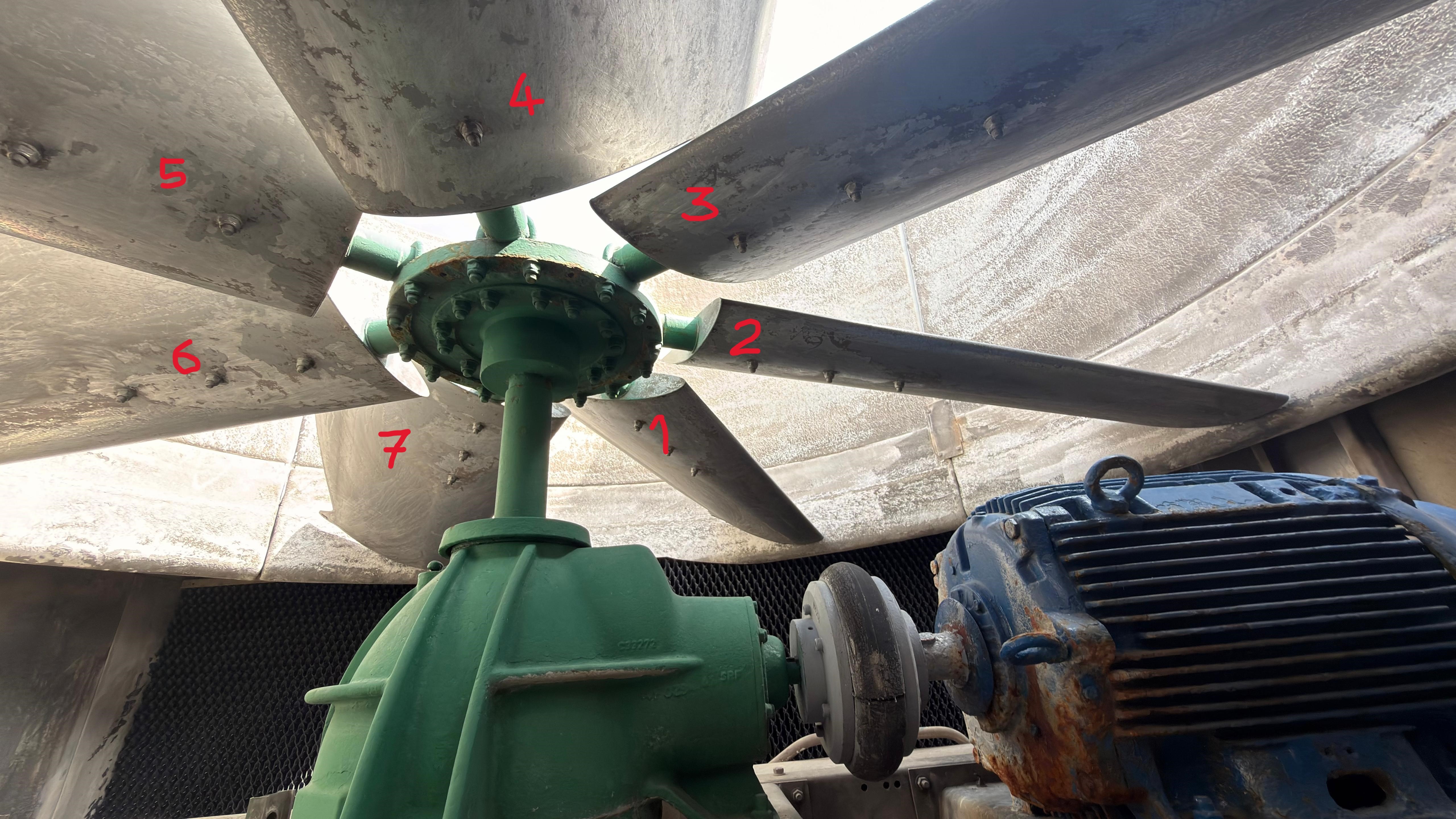
Main Types of Industrial Cooling Tower Fan Blades
Cooling tower fan blades are categorized in three mainstream ways: by manufacturing material, by aerodynamic structure, and by working configuration of the cooling tower fan. Each classification directly affects procurement decisions and maintenance plans.
Classification by Blade Material
FRP / Fiberglass Reinforced Plastic Blades
FRP blades are now the dominant high-efficiency option for modern industrial cooling towers. They are molded as one-piece composite parts, supporting twisted variable-chord airfoil profiles that aluminum extrusion cannot achieve economically. With UV stabilizer and optional vinyl ester resin, FRP resists chlorine mist, coastal salt spray and mild chemical vapors. Its low weight reduces rotating inertia and relieves cyclic stress on the whole drive train. The main downside is quality gap between suppliers: low-cost FRP blades may contain voids, poor resin saturation and weak bonding, which easily cause delamination and imbalance.
Aluminum Alloy Blades
Aluminum alloy blades are the traditional mature solution. They feature high rigidity, easy repair after minor impact damage and stable performance in dry inland low-corrosion environments. However, most extruded aluminum blades adopt simple flat airfoils with lower aerodynamic efficiency. In chlorinated or coastal environments, aluminum suffers pitting corrosion and metal fatigue under long cyclic loads, shortening its service cycle sharply.
Stainless Steel & Carbon Fiber Blades
Stainless steel blades are heavy and expensive, reserved for extreme aggressive working conditions such as seawater cooling and strong acid vapor environments. Carbon fiber blades are ultra-light and high-strength, mainly used for super-large diameter fans in power generation and offshore platforms; their premium price limits wide aftermarket adoption.
Classification by Aerodynamic Profile
Flat / Simple Curved Blades
Most old-generation standard blades use flat or single-curved profiles. They are cheap and easy to produce, but create obvious airflow separation and tip vortex loss. Energy consumption is high, and noise level is relatively large. They are mostly found on old legacy cooling towers.
Twisted High-Efficiency Airfoil Blades
Twisted blades have progressive twist angles from root to tip, equalizing aerodynamic lift across the whole blade span. CFD simulation optimizes tip geometry to reduce vortex shedding. This type can save 15–30% fan power while maintaining the required airflow, which is the preferred choice for energy-saving retrofit projects.
Classification by Installation Mode (Induced Draft vs Forced Draft)
Induced Draft Fan Blades
Induced draft blades are mounted at the tower top exhaust, pulling air upward through fill and drift eliminators. This is the most common configuration for large counterflow cooling towers. Blades work in warm, moisture-saturated chemical-laden exhaust air, so corrosion resistance becomes the top priority.
Forced Draft Fan Blades
Forced draft blades are installed at the air inlet of crossflow towers, pushing air into the tower. They directly contact ambient dust, sand and debris, so leading-edge anti-erosion coating is strongly recommended to slow profile wear.
Step-by-Step Criteria for Selecting Cooling Tower Fan Blades
Blade selection is a system matching task instead of a simple product purchase. Even the highest-performance blade will fail if it mismatches the hub, motor, fan ring and site environment.
Confirm Core Technical Compatibility Parameters
Before sending an inquiry, collect these data and submit them to the supplier:
Fan sweep diameter and blade quantity
Hub bolt circle, root shape, bolt hole layout
Rotation direction, viewed from the air outlet
Adjustable or fixed pitch angle and original pitch mark
Design RPM, rated motor power and static pressure of the tower
Visual similarity cannot guarantee fitment. Many OEM hubs use proprietary root structures; hub photos or original drawings are required for engineering verification.
Match Material According to Site Environment
Coastal / chlorinated water / chemical plant: Select FRP (vinyl ester upgrade for severe chemical exposure)
Dry inland, low mineral and chemical content: Aluminum alloy is acceptable
Dusty and sandy site: Choose blades with leading-edge abrasion protection
Urban areas near residential zones: Prioritize aerodynamically optimized low-noise FRP blades
Verify Aerodynamic Performance and Dynamic Balance
Ask suppliers for fan performance curves including airflow, static pressure and power consumption. Require ISO 1940 dynamic balance certification for every full blade set. Unbalanced blades will trigger continuous vibration, which can destroy expensive gearboxes and bearings within a short period.
Balance Budget, Service Life and TCO
Compare not only upfront price, but also total cost of ownership. Premium FRP blades cost more at purchase, but lower electricity bills and longer replacement cycles usually bring better long-term returns than cheap low-quality alternatives.
Standard Maintenance Schedule for Cooling Tower Fan Blades
Good maintenance extends blade service life and avoids emergency shutdown caused by sudden blade failure. Maintenance follows three inspection levels: monthly routine check, quarterly monitoring and annual overhaul.
Monthly Visual Inspection
Carry out lockout-tagout (LOTO) safety isolation before any inspection. Focus on these points:
Blade Surface and Leading Edge
Check for cracks, delamination, bubbling, chipping, fiber exposure and erosion on the leading edge. Clean mineral scale, sediment and biological slime accumulated on blade surfaces. Fouling changes airfoil shape and creates mass imbalance.
Blade Root and Fasteners
Inspect the joint between blade root and hub, check whether bolts are loose, rusted or missing. Retorque loose bolts following the torque specification sheet.
Clear Blade Tip Drain Holes
For hollow FRP blades, keep tip drain holes unblocked. Trapped water inside the blade causes imbalance and accelerates internal delaminationBaltimore ....
Quarterly Performance Monitoring
Record three key indicators during normal operation:
Fan vibration value at bearing points
Running motor current
Fan noise and cooling water outlet temperature
A gradual upward trend of vibration or current is usually the earliest warning sign of blade wear, pitch offset or fouling accumulation.
Annual Full Inspection During Planned Shutdown
Remove fan guards for full visual scanning of every blade
Recheck and unify pitch angles of all blades in one set
Retest dynamic balance if abnormal vibration appears after cleaning
Repair minor surface erosion with epoxy filler and recoat UV topcoat; replace blades with deep cracks or obvious delamination immediately
Special Inspection After Extreme Weather
After heavy storms, hail, ice or typhoon events, perform an extra inspection. Debris impact and ice strike easily chip or twist blades, even if no obvious fracture can be seen at first glance.
Common Blade Faults, Causes and Solutions
Abnormal Vibration
Causes
Uneven blade pitch, mixed new and old blades, debris sticking to individual blades, loss of factory balance, bent shaft or worn hub.
Handling
Clean all blades, readjust pitch to consistent angle; replace the whole set if new and old blades are mixed; carry out field dynamic balancing if vibration persists.
Delamination and Blistering on FRP Blades
Water penetrates the composite layer from surface scratches or poor topcoat, separating fiber and resin matrix. This defect often develops internally before visible cracks appear. Once large-area delamination occurs, repair is not reliable and full replacement is required.
Reduced Airflow and Declined Cooling Capacity
Common triggers: eroded leading edge destroying airfoil, pitch drifting smaller, heavy scaling, or blade twist deformation from long overload operation. Do not simply increase pitch blindly, which may overload the motor.
Corrosion Pitting on Aluminum Blades
Salt fog and chlorine produce pitting points on aluminum surface. Minor corrosion can be sanded and recoated; scattered deep pitting means the blade has entered the fatigue risk period and should be planned for replacement.
Maintenance Safety Rules You Must Follow
Lockout & Tagout (LOTO) Is Mandatory
Never enter the fan stack or touch blades without cutting power and hanging isolation locks. Accidental startup is the biggest safety hazard during maintenance workBaltimore ....
Do Not Repair Critical Defects On-site Casually
Simple surface scratch coating is acceptable. Cracks, root loosening and through delamination cannot be fixed by on-site glue repair; forced reuse may cause blade flying off during operation.
Do Not Run Fan with Missing or Damaged Blades
Even running temporarily with one blade removed will create severe destructive vibration that damages the whole drive assembly.
FAQ About Cooling Tower Fan Blades
Can I replace only one damaged blade instead of the full set?
It is not recommended. Old blades have different weight, surface roughness and fatigue state. Mixing new and old blades breaks the balance of the rotating assembly and brings continuous vibration risk. Only factory-matched batches support single replacement with rebalancing, which is rare in aftermarket supply.
How long is the normal service life of FRP cooling tower fan blades?
Well-maintained FRP blades in inland clean environments can work for 15–20 years. Coastal, chemical and wastewater cooling towers usually have a service life of 8–12 years. Aluminum blades in corrosive environments often require replacement within 6–10 years.
Can adjustable-pitch blades work with VFD variable speed drives?
High-quality twisted FRP blades are suitable for VFD. Flat aluminum blades often stall and vibrate heavily under low RPM, so they are not ideal for variable-speed energy-saving transformation.
What is the difference between OEM blades and aftermarket replacement blades?
OEM blades guarantee perfect fitment but carry high price and long lead time. Qualified aftermarket FRP blades can replicate or even upgrade aerodynamic profiles, with faster delivery and more competitive pricing. The key screening point is balance test certification and dimensional verification.
Conclusion
Industrial cooling tower fan blade selection and maintenance is a systematic work covering material selection, aerodynamic matching, balance testing and regular inspection. FRP twisted airfoil blades are the mainstream choice for most industrial projects for their corrosion resistance and energy-saving advantages, while aluminum blades still suit dry inland low-corrosion working conditions.
A stable maintenance mechanism helps you capture damage signals early, avoid unplanned shutdown and extend blade service cycle. When replacement is required, provide complete fan technical parameters and environmental information to your supplier to avoid compatibility mistakes and quality traps from low-cost unbalanced generic blades.
If you are sourcing replacement or new cooling tower fan blade sets, send us your fan diameter, blade quantity, hub photos and site working conditions. Our engineering team can confirm compatibility and quote dynamically balanced FRP axial fan blades matched for your cooling tower.


