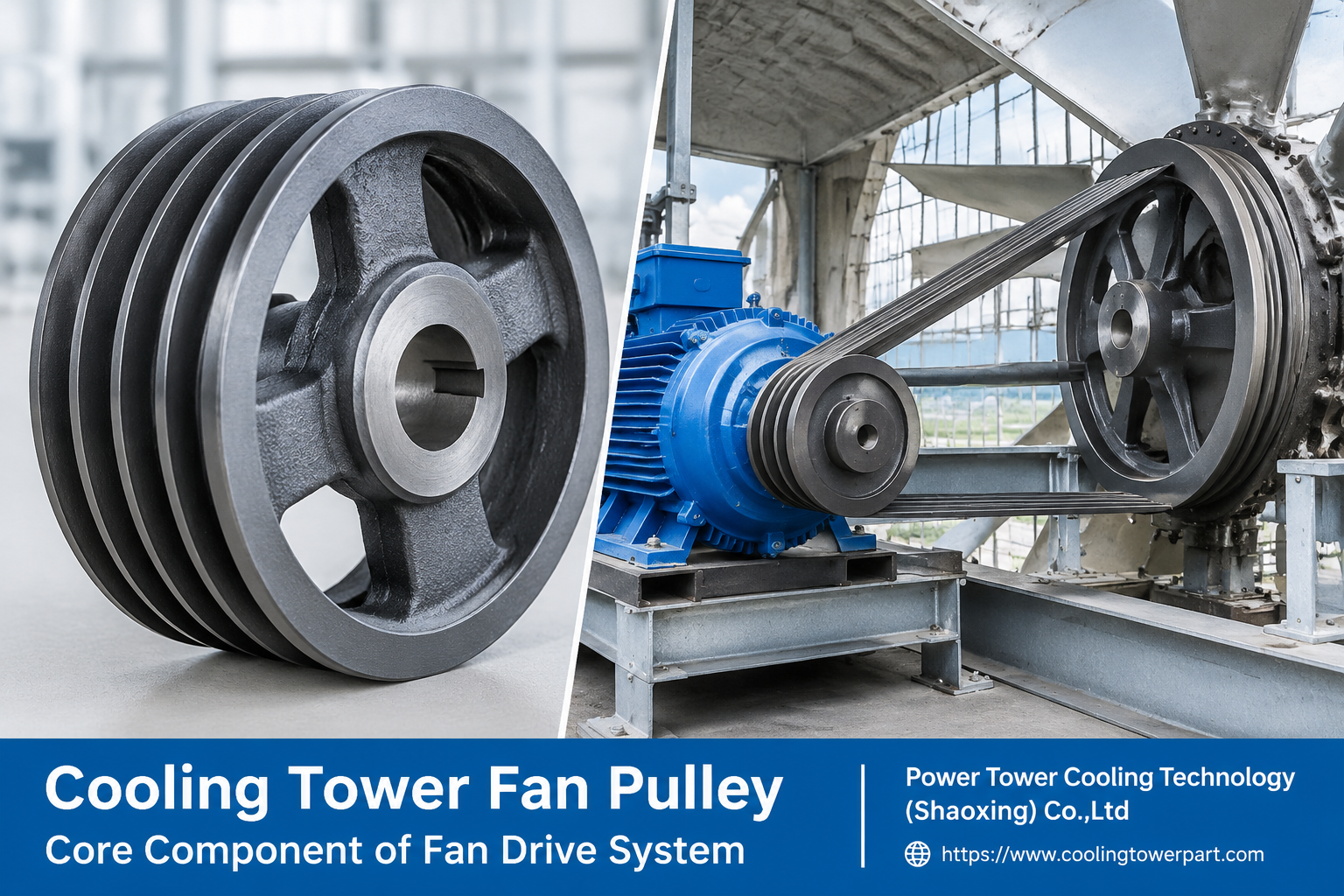
A cooling tower fan plays an essential role in industrial heat rejection, but have you ever considered what keeps it rotating at the correct speed? Besides the electric motor and fan blades, there is another important component that deserves attention: the cooling tower fan pulley.
Although a pulley may look like a simple mechanical wheel, it has a direct influence on power transmission, fan speed, airflow, and the overall operating efficiency of a cooling tower. A properly selected pulley helps transfer power from the motor to the fan, while an unsuitable or worn pulley can cause belt slippage, excessive vibration, energy losses, and unexpected equipment downtime.
For industrial cooling tower operators, maintenance engineers, and equipment buyers, understanding how a cooling tower fan pulley works is important when selecting replacement parts or maintaining an existing fan drive system.
In this guide, we will explore cooling tower fan pulley structures, working principles, materials, selection methods, common problems, maintenance requirements, and replacement considerations. We will also explain how to choose a reliable cooling tower parts manufacturer for your industrial applications.
1. What Is a Cooling Tower Fan Pulley?
A cooling tower fan pulley is a mechanical component used in a belt-driven cooling tower fan system. It is usually installed on the motor shaft or fan shaft and works with a drive belt to transfer rotational power.
In a conventional belt-driven cooling tower, two pulleys are commonly used:
The two pulleys are connected by one or more belts. When the motor starts, its pulley rotates and drives the belt. The belt then transfers mechanical energy to the fan pulley, causing the cooling tower fan to rotate.
The diameter difference between the two pulleys determines the transmission ratio and influences the fan's operating speed.
This arrangement allows engineers to match the fan speed to the cooling tower's design requirements without necessarily changing the motor itself.
2. Structure and Main Components of a Cooling Tower Pulley System
A cooling tower pulley system consists of several mechanical components that work together. Each component must be compatible with the others to achieve reliable power transmission.
2.1 Motor Pulley
The motor pulley is mounted on the electric motor shaft. In many conventional cooling tower drive systems, it is smaller than the fan pulley.
Its main function is to transfer motor power to the drive belt. Its diameter is an important factor in determining the fan speed.
When selecting a motor pulley, engineers should check the motor shaft diameter, keyway dimensions, groove profile, and required transmission ratio.
2.2 Fan Pulley
The fan pulley is installed on the fan shaft and receives power from the motor through the belt.
In a typical speed-reduction arrangement, the fan pulley has a larger diameter than the motor pulley. This reduces the fan's rotational speed while transmitting the required torque.
Because cooling tower fans operate under continuous mechanical loads, the fan pulley needs sufficient strength, dimensional accuracy, and structural stability.
2.3 Drive Belts
Drive belts connect the motor pulley and fan pulley. They transmit power through friction between the belt and pulley grooves.
Depending on the cooling tower design, different belt profiles and arrangements may be used.
Common belt types include:
The belt profile must match the pulley groove specifications. An incorrect combination can cause slippage, excessive heat, and premature component wear.
2.4 Hub, Keyway, and Mounting Components
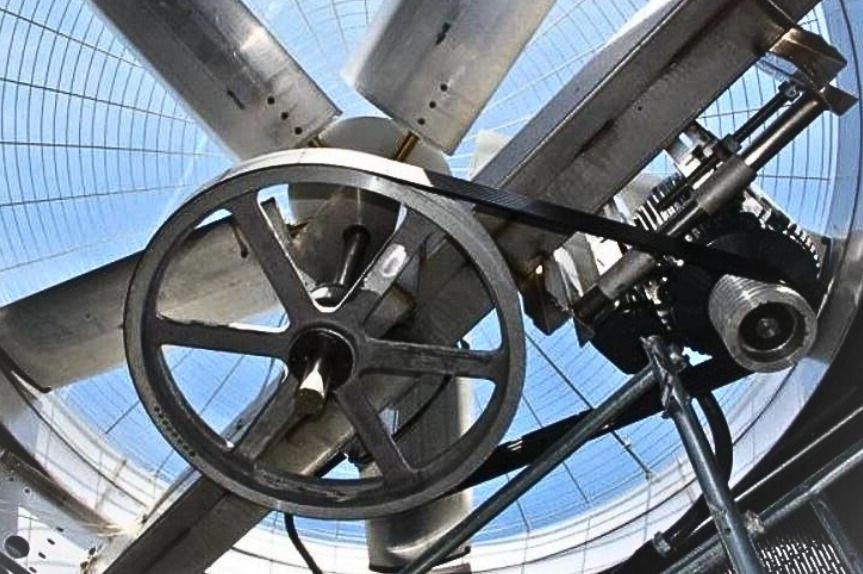
The hub connects the pulley to the shaft. A keyway may be used to prevent relative rotation between the pulley and shaft.
Some pulley designs use taper-lock bushings or other removable mounting systems, making installation and replacement more convenient.
Correct shaft fitting is essential. A loose connection can cause vibration, damage the shaft, and eventually lead to drive-system failure.
3. Why Is the Cooling Tower Fan Pulley Important?
A cooling tower fan pulley is more than a connecting component. It influences several important aspects of cooling tower operation.
3.1 Controlling Fan Speed
One of the most important functions of a pulley is controlling the speed relationship between the motor and fan.
By selecting different pulley diameters, engineers can adjust the fan's rotational speed to meet the required airflow conditions.
If the fan rotates too slowly, airflow may be insufficient, reducing cooling performance. If it rotates too quickly, the system may consume excessive electricity and experience increased mechanical stress.
The correct pulley ratio helps maintain the intended operating conditions.
3.2 Transmitting Motor Power
The pulley system transfers mechanical energy from the motor to the fan.
Its performance depends on several factors, including pulley material, groove accuracy, belt tension, alignment, and operating load.
A properly designed pulley supports stable power transmission and reduces unnecessary energy losses.
3.3 Supporting Cooling Tower Performance
Cooling tower fans move air through the tower, allowing heat to transfer from circulating water into the atmosphere.
If the fan drive system operates correctly, the fan can provide the airflow required by the cooling tower design.
A damaged or incorrectly sized pulley may reduce fan speed and airflow, affecting the tower's ability to reject heat.
3.4 Reducing Maintenance Costs
A high-quality pulley with correct dimensions and suitable materials can help reduce premature belt wear, vibration, and unexpected equipment shutdowns.
Although the initial purchase price is important, buyers should also consider service life, replacement frequency, and maintenance costs.
4. Different Types of Cooling Tower Fan Pulleys
Cooling tower pulley designs vary according to equipment specifications, motor power, fan dimensions, and drive configurations.
Understanding the main types helps buyers identify the right replacement component.
4.1 Fixed Motor Pulleys
Fixed motor pulleys have a specific groove and diameter configuration.
They are commonly used in conventional belt-driven cooling tower systems where the required fan speed is established during equipment design.
These pulleys are relatively straightforward to install and maintain.
4.2 Fixed Fan Pulleys
Fixed fan pulleys are mounted on the cooling tower fan shaft.
Their dimensions determine the speed reduction ratio when working with the motor pulley.
They are widely used in industrial cooling towers that require stable, continuous fan operation.
4.3 Adjustable Pulleys
Adjustable pulleys allow the effective transmission ratio to be changed within their designed operating range.
They may be used in applications where mechanical speed adjustment is required.
However, adjustable pulley designs are not suitable for every cooling tower. Their compatibility, power capacity, and operating limitations should be checked before installation.
4.4 Variable-Speed Drive Systems
Some modern cooling towers use variable-frequency drives (VFDs) to control motor speed electronically.
In these systems, fan speed can be adjusted by changing the motor's operating frequency rather than relying entirely on pulley diameter changes.
A VFD can provide flexible fan control and help reduce energy consumption under variable cooling loads.
The choice between a conventional pulley drive and a variable-speed solution depends on the cooling tower's design and operating requirements.
5. Materials Used in Cooling Tower Fan Pulleys
Material selection has a significant influence on pulley strength, weight, corrosion resistance, and service life.
Cooling towers generally operate in humid environments. Some installations are also exposed to airborne contaminants, chemicals, and changing temperatures.
Therefore, the pulley material should be selected according to the actual operating conditions.
5.1 Cast Iron
Cast iron is commonly used for industrial pulleys because of its rigidity, wear resistance, and vibration-damping characteristics.
It can be machined into accurate groove profiles and is suitable for many heavy-duty mechanical applications.
Its advantages include:
Good mechanical strength
Excellent dimensional stability in suitable designs
Good vibration-damping properties
Suitability for industrial power transmission
However, cast iron is relatively heavy and can corrode when exposed to moisture without adequate protection.
5.2 Aluminum Alloy
Aluminum alloy pulleys are lighter than cast iron alternatives.
Their lower weight can reduce rotating mass and may be beneficial in applications where weight reduction is important.
Other advantages include good machinability and useful corrosion resistance.
However, the strength and load capacity of aluminum alloy pulleys must be carefully evaluated before they are used in demanding industrial cooling tower applications.
5.3 Steel
Steel pulleys provide high mechanical strength and are suitable for certain heavy-duty applications.
Depending on the manufacturing process and surface treatment, they can offer excellent structural durability.
However, steel can corrode in humid cooling tower environments. Suitable protective coatings or other corrosion-control measures may therefore be necessary.
5.4 How to Choose the Right Material
There is no single material that is ideal for every cooling tower.
When selecting a pulley, consider:
Motor power and transmission load.
Operating speed and mechanical stress.
Environmental humidity and chemical exposure.
Pulley dimensions and structural requirements.
Expected service life and maintenance conditions.
The best choice is the material that meets the equipment's actual engineering requirements.
6. How Does a Cooling Tower Fan Pulley System Work?
The working principle of a cooling tower fan pulley system is relatively simple.
First, the electric motor produces rotational movement. The motor pulley transfers this movement to the belt. The belt then drives the fan pulley, which rotates the fan shaft and fan blades.
As the fan rotates, it creates airflow through the cooling tower.
The relationship between motor speed, pulley diameter, and fan speed can be calculated using the following formula:
Fan Speed = Motor Speed × Motor Pulley Pitch Diameter ÷ Fan Pulley Pitch Diameter
For example, suppose a cooling tower has:
The theoretical fan speed is:
1,450 × 150 ÷ 300 = 725 RPM
Therefore, the fan rotates at approximately 725 RPM, assuming no belt slippage.
This calculation is useful when selecting replacement pulleys or checking an existing transmission ratio.
Remember that actual operating speed may differ because of belt slip and other operating factors. Engineers should use pitch diameters rather than simply relying on outside diameters when calculating the transmission ratio.
7. How to Select the Right Cooling Tower Fan Pulley
Selecting the correct cooling tower fan pulley requires more than measuring its external dimensions.
A replacement pulley must match the existing drive system and meet the cooling tower's operating requirements.
Here are the most important factors to consider.
7.1 Determine the Required Fan Speed
Start by checking the cooling tower's original technical specifications.
You should confirm:
Do not assume that the existing pulley dimensions are correct without checking the original equipment specifications. Previous modifications may have changed the drive ratio.
7.2 Check Pulley Diameter
Pulley diameter directly affects the transmission ratio.
An incorrectly sized replacement may cause the fan to rotate too quickly or too slowly.
Before ordering, confirm the pitch diameter and compare it with the original design requirements.
7.3 Check Belt Groove Specifications
Pulley grooves must match the drive belt.
Important specifications include:
Number of grooves
Groove angle
Groove spacing
Belt profile
Pitch diameter
Even a small mismatch can affect belt seating and power transmission.
7.4 Confirm Shaft and Keyway Dimensions
The pulley bore must match the shaft diameter.
You should also check the keyway width, keyway depth, hub length, and mounting arrangement.
If the pulley uses a taper-lock bushing, confirm the correct bushing type and dimensions.
7.5 Consider Motor Power and Operating Conditions
The pulley must be capable of transmitting the required power under normal and starting conditions.
For large industrial cooling towers, engineers should consider mechanical loading, operating hours, belt arrangement, and possible load fluctuations.
7.6 Evaluate Environmental Conditions
Cooling tower components operate in environments where moisture and corrosion can affect service life.
If the installation is near the sea or exposed to aggressive chemicals, material selection and protective surface treatments deserve additional attention.
8. Common Cooling Tower Fan Pulley Problems
Even a properly manufactured pulley can develop problems because of improper installation, excessive loading, or inadequate maintenance.
Recognizing early warning signs helps prevent serious equipment failures.
8.1 Pulley Misalignment
Pulley misalignment occurs when the motor pulley and fan pulley are not positioned in the correct drive plane.
Common symptoms include:
Laser alignment tools or suitable straightedge methods can help technicians identify alignment problems.
8.2 Pulley Wear
Continuous belt contact gradually wears pulley grooves.
When grooves become excessively worn, the belt may no longer sit correctly, increasing the risk of slipping.
Inspect the groove surfaces for deformation, damage, and uneven wear.
8.3 Corrosion
High humidity and chemical exposure can damage pulley surfaces.
Corrosion may weaken the component and affect belt contact.
Selecting appropriate materials and protective treatments can help reduce this problem.
8.4 Belt Slippage
Belt slippage is another common problem in cooling tower fan drive systems.
Possible causes include:
Simply tightening the belt is not always the correct solution. Excessive belt tension can increase bearing loads and damage other components.
8.5 Excessive Vibration and Noise
A damaged, unbalanced, or incorrectly installed pulley may contribute to vibration.
However, vibration can also originate from fan blades, bearings, shafts, motors, or structural supports.
A complete drive-system inspection is necessary to identify the actual cause.
9. Cooling Tower Fan Pulley Maintenance Guide
Regular maintenance is one of the most effective ways to extend pulley service life and reduce unexpected downtime.
A practical maintenance program should include the following activities.
9.1 Perform Regular Visual Inspections
Check the pulley for:
Also inspect the belt condition and listen for abnormal operating sounds.
9.2 Check Pulley Alignment
Verify that the motor pulley and fan pulley are properly aligned.
Misalignment increases belt wear and can place additional stress on bearings and shafts.
Alignment should also be checked after pulley replacement or motor adjustment.
9.3 Inspect Belt Tension
Belt tension should follow the belt manufacturer's specifications.
Insufficient tension can cause slippage, while excessive tension can overload bearings.
Use a suitable belt-tension measurement tool instead of relying entirely on visual inspection.
9.4 Keep Pulley Grooves Clean
Dirt, oil, grease, and other contaminants can affect friction between the belt and pulley.
Keep the pulley grooves clean and dry.
Do not apply lubricant to belt-contact surfaces unless specifically required by the equipment manufacturer.
9.5 Check Mounting Components
Inspect the shaft connection, keyway, locking components, and mounting hardware.
Loose connections can create vibration and damage the pulley or shaft.
Always follow proper isolation and lockout procedures before performing maintenance.
10. When Should You Replace a Cooling Tower Fan Pulley?
A cooling tower fan pulley should be replaced when its condition no longer meets the mechanical and operating requirements of the drive system.
Typical replacement indicators include:
Visible cracks or structural damage
Excessive groove wear
Deformed pulley surfaces
Damaged keyways or mounting connections
Severe corrosion
Persistent belt slippage caused by pulley wear
Inability to maintain proper alignment
If the pulley repeatedly causes operating problems despite correct installation and maintenance, replacement may be more economical than continued repair.
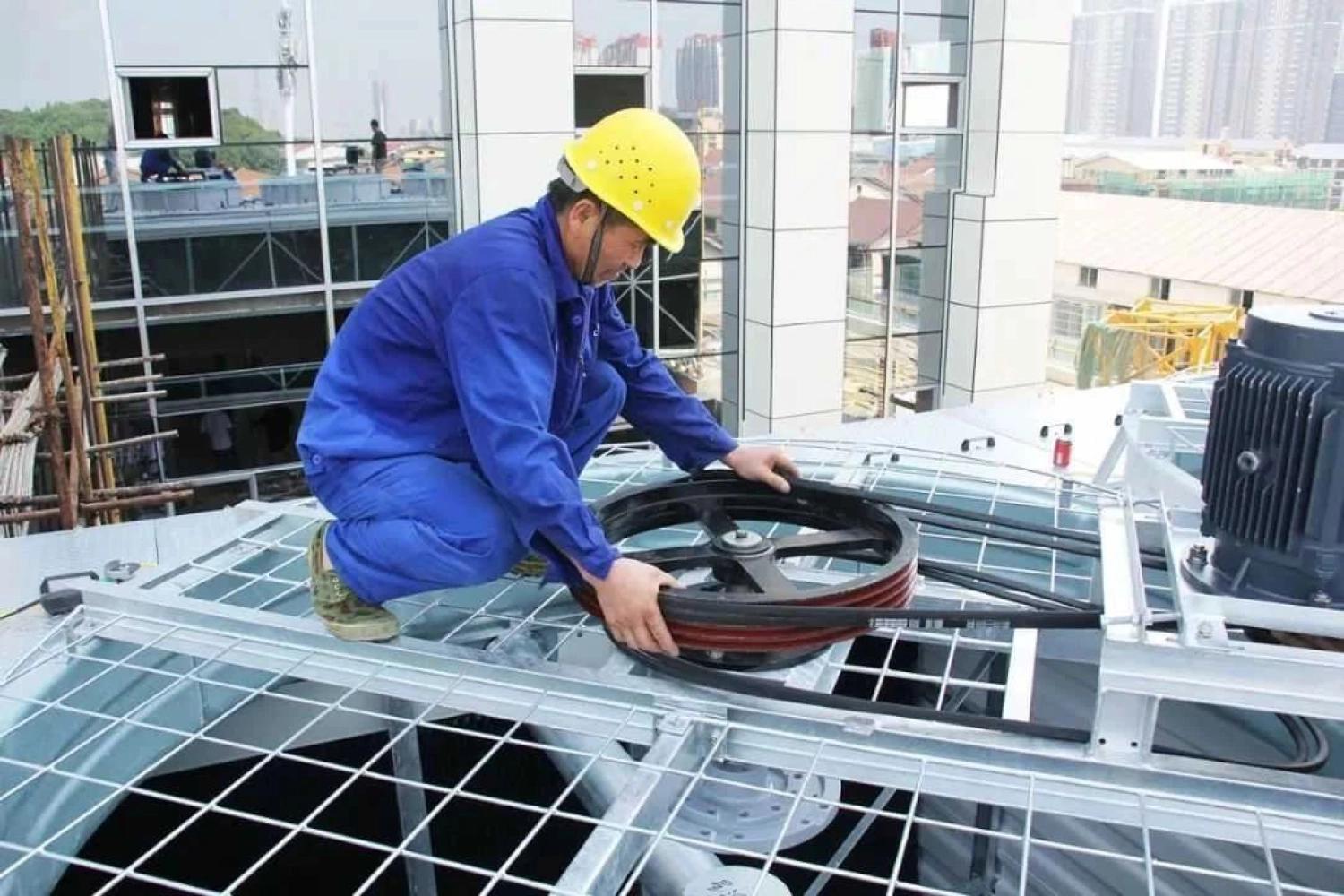
When ordering a new pulley, provide the original dimensions, shaft bore, keyway specifications, groove profile, material, and operating parameters.
Photographs, technical drawings, and cooling tower model information can also help the manufacturer identify the correct replacement.
11. Cooling Tower Fan Pulley vs. Direct Drive System
Not all cooling towers use conventional belt-and-pulley transmission systems.
Some modern cooling towers use direct-drive arrangements, where the motor connects more directly to the fan without a conventional belt drive.
Both systems have advantages.
Belt-and-pulley drive systems:
Allow mechanical speed-ratio selection.
Can be suitable for various industrial applications.
Provide flexibility for certain retrofit projects.
Require periodic belt inspection and replacement.
Direct-drive systems:
Eliminate conventional drive belts and pulleys.
Reduce belt-related maintenance requirements.
Can simplify certain drive configurations.
May require specialized motor and control arrangements.
Which system is better?
There is no universal answer. The right choice depends on equipment design, installation conditions, operating requirements, maintenance capabilities, and total ownership cost.
For an existing belt-driven cooling tower, replacing the pulley with a compatible component is often more practical than converting the entire drive system.
12. How Pulley Design Affects Cooling Tower Energy Efficiency
Energy efficiency is a major concern for industrial cooling tower operators.
Cooling tower fans can consume significant electricity, particularly in facilities where equipment operates continuously.
The pulley system influences energy performance by determining the relationship between motor speed and fan speed.
An incorrect transmission ratio may cause the fan to operate outside its intended design range. Poor alignment, worn grooves, and belt slippage can also increase mechanical losses.
One important engineering principle is the fan affinity law.
Under similar operating conditions, fan power demand is approximately proportional to the cube of fan speed.
For example, increasing fan speed by 10% may increase the theoretical fan power requirement by approximately 33%.
This is why increasing fan speed is not always the best way to improve cooling tower performance.
A correctly selected pulley helps maintain the required airflow without unnecessarily increasing motor loading and electricity consumption.
For facilities looking to improve energy efficiency, checking pulley dimensions, belt condition, fan speed, and overall system performance is a practical starting point.
13. Why Choose a Professional Cooling Tower Parts Manufacturer?
Choosing the right cooling tower parts supplier is important for equipment reliability.
A professional manufacturer should understand how individual components work together within the cooling tower system.
When purchasing cooling tower fan pulleys and related components, consider the following factors:
Manufacturing capability: The supplier should understand industrial component production and dimensional requirements.
Technical support: An experienced team should be able to review drawings, dimensions, and equipment specifications.
Product compatibility: Replacement components should match the original equipment configuration and operating conditions.
Material selection: The manufacturer should be able to discuss suitable materials and corrosion protection.
Quality consistency: Accurate machining and dimensional inspection help ensure reliable installation and operation.
Customization capability: Customized solutions may be necessary for older cooling towers or non-standard drive systems.
Choosing a supplier based only on the lowest price may result in higher maintenance and replacement costs later.
A reliable manufacturing partner can help reduce purchasing risks and improve long-term equipment performance.
14. Power Tower Cooling Technology (Shaoxing) Co.,Ltd – Your Cooling Tower Parts Partner
Power Tower Cooling Technology (Shaoxing) Co.,Ltd is focused on cooling tower components and replacement solutions for industrial applications.
We understand that cooling tower performance depends on the compatibility and reliability of individual components. From cooling tower fill and other replacement parts to supporting components for cooling tower maintenance, selecting suitable products is essential for stable equipment operation.
When sourcing cooling tower fan pulleys or related drive-system components, providing accurate technical information helps identify the appropriate solution.
Our team recommends preparing the following details before requesting a quotation:
Cooling tower manufacturer and model.
Motor power and rated speed.
Existing motor pulley and fan pulley diameters.
Number of pulley grooves.
Belt type and specifications.
Shaft diameter and keyway dimensions.
Required fan rotational speed.
Product photographs or technical drawings.
These details help reduce communication errors and make product matching more efficient.
Whether you are an industrial cooling tower operator, maintenance contractor, engineering company, or cooling tower parts distributor, we aim to provide practical product solutions based on your requirements.
Visit our website to explore our cooling tower products and learn more about our manufacturing business:
Website: https://www.coolingtowerpart.com
Contact Power Tower Cooling Technology (Shaoxing) Co.,Ltd to discuss your cooling tower parts requirements.
15. Frequently Asked Questions About Cooling Tower Fan Pulleys
15.1 What Is the Main Function of a Cooling Tower Fan Pulley?
The main function is to transfer mechanical power from the electric motor to the cooling tower fan through a belt. It also establishes the speed ratio between the motor and fan.
15.2 How Do I Calculate Cooling Tower Fan Pulley Speed?
Use the following formula:
Fan RPM = Motor RPM × Motor Pulley Pitch Diameter ÷ Fan Pulley Pitch Diameter
For example, a 1,450 RPM motor with a 150 mm motor pulley and a 300 mm fan pulley produces a theoretical fan speed of 725 RPM, assuming no belt slip.
15.3 What Materials Are Commonly Used for Cooling Tower Fan Pulleys?
Common materials include cast iron, aluminum alloy, and steel. The best option depends on mechanical loading, operating speed, environmental exposure, and equipment requirements.
15.4 How Often Should Cooling Tower Fan Pulleys Be Inspected?
Inspection frequency depends on operating hours, environmental conditions, and manufacturer recommendations. Visual checks should form part of routine maintenance, while detailed inspections should be performed during scheduled servicing or whenever abnormal vibration, noise, or belt wear occurs.
15.5 What Causes Cooling Tower Fan Pulley Failure?
Common causes include incorrect installation, pulley misalignment, excessive belt tension, groove wear, corrosion, mechanical overload, and inadequate maintenance.
15.6 Can I Replace a Cooling Tower Fan Pulley Without Replacing the Motor?
Yes. In many belt-driven cooling tower systems, the pulley can be replaced independently if the motor and other drive components remain in good condition.
However, the replacement pulley must match the required transmission ratio, shaft dimensions, belt specifications, and operating loads.
15.7 Does a Larger Fan Pulley Reduce Fan Speed?
Yes, when the motor pulley remains unchanged, increasing the fan pulley pitch diameter reduces the theoretical fan speed.
However, the final pulley selection must also consider the cooling tower's airflow requirements and the manufacturer's maximum allowable fan speed.
15.8 What Information Should I Provide When Ordering a Replacement Pulley?
Provide the pulley diameter, groove quantity and profile, shaft bore, keyway dimensions, belt specifications, motor speed, motor power, and cooling tower model.
Photographs and technical drawings are also useful for confirming compatibility.
16. Conclusion
The cooling tower fan pulley is a small but essential component of the cooling tower fan drive system. It transfers motor power, determines the transmission ratio, and helps maintain the fan speed required for effective heat rejection.
Choosing the correct pulley requires careful consideration of material, diameter, groove specifications, shaft compatibility, motor power, and environmental conditions.
Regular inspection, correct alignment, and proper belt tension can significantly reduce premature wear and unexpected equipment downtime.
For industrial cooling tower owners, maintenance engineers, and equipment distributors, understanding pulley performance is an important step toward maintaining reliable cooling tower operation.
If you are looking for cooling tower components or need assistance identifying suitable replacement parts, contact Power Tower Cooling Technology (Shaoxing) Co.,Ltd.
Visit https://www.coolingtowerpart.com to explore our cooling tower products and discuss your requirements with our team.


