1. Introduction: Why Pulley Ratios Matter
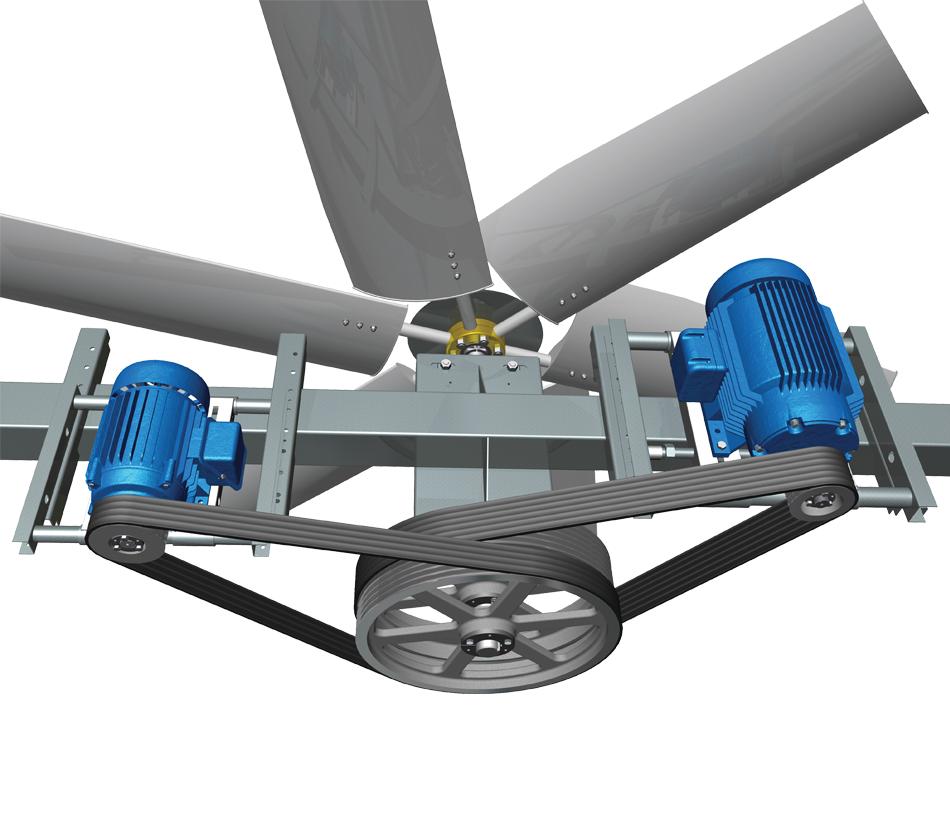
A cooling tower fan does more than simply move air. It helps remove heat from circulating water by drawing or pushing air through the tower. When the fan operates at the correct speed, the cooling tower can achieve its designed thermal performance while keeping energy consumption under control.
But what determines the speed of a belt-driven cooling tower fan?
One important factor is the cooling tower fan pulley ratio.
The pulley ratio controls how rotational power transfers from the motor to the fan. Even a small change in pulley diameter can affect fan speed, airflow, motor load, noise, and overall cooling performance.
If the fan runs too slowly, the tower may not provide enough cooling. If it runs too fast, the motor may become overloaded, energy consumption may increase, and mechanical components may experience unnecessary stress.
Understanding pulley ratios helps you select replacement pulleys, maintain existing equipment, and avoid costly operating problems.
In this guide, we explain how cooling tower fan pulley ratios work, how to calculate them, and how to choose the right ratio for your cooling tower system.
2. What Is a Cooling Tower Fan Pulley Ratio?
A cooling tower fan pulley ratio describes the relationship between the rotational speeds of the motor and the fan in a belt-driven transmission system.
Most belt-driven cooling tower fans use two main pulleys:
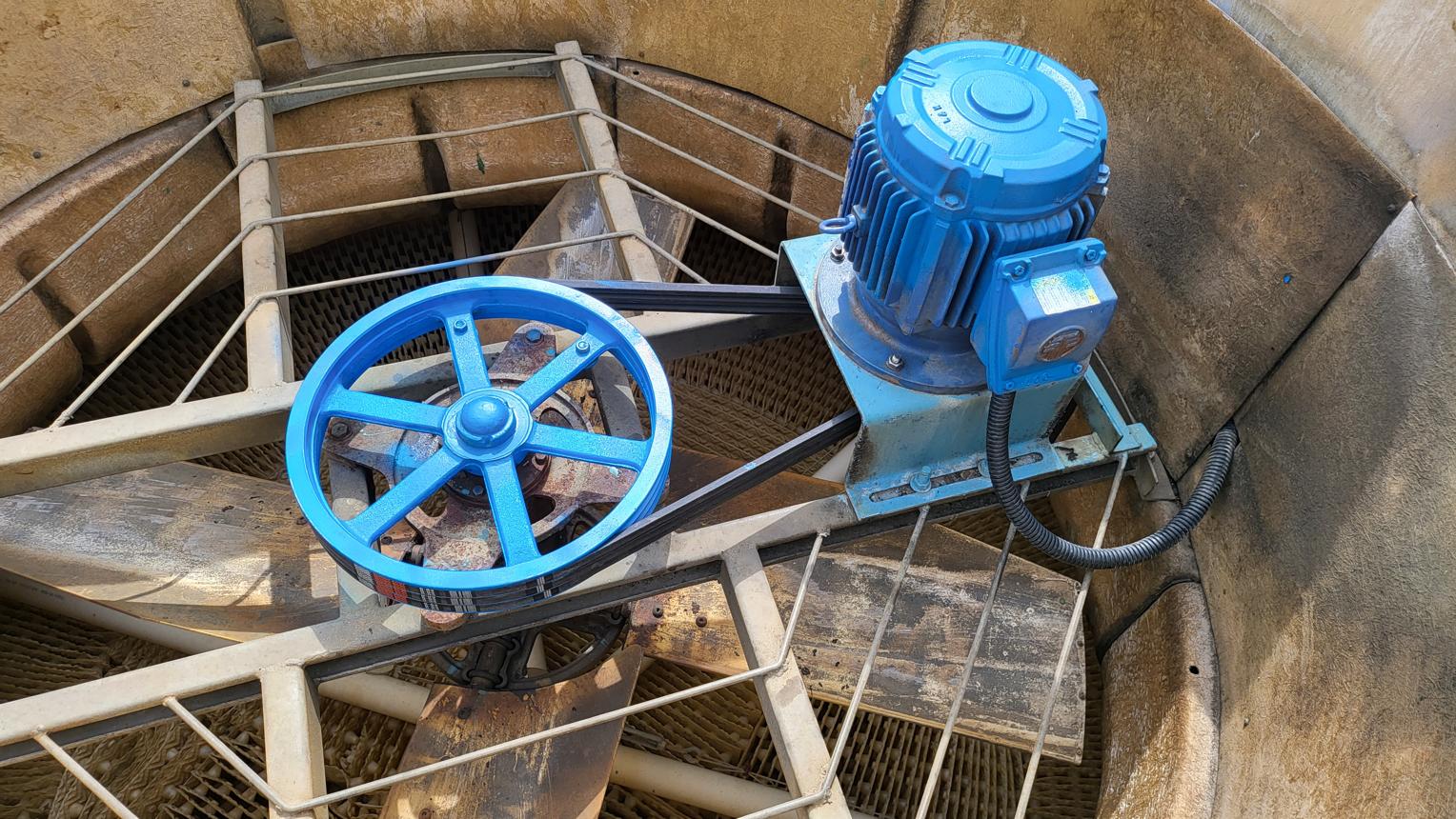
The belt connects these two pulleys. As the motor rotates, the motor pulley moves the belt, which turns the fan pulley.
The relative diameters of the two pulleys determine the fan's rotational speed.
2.1 The Motor Pulley and Fan Pulley
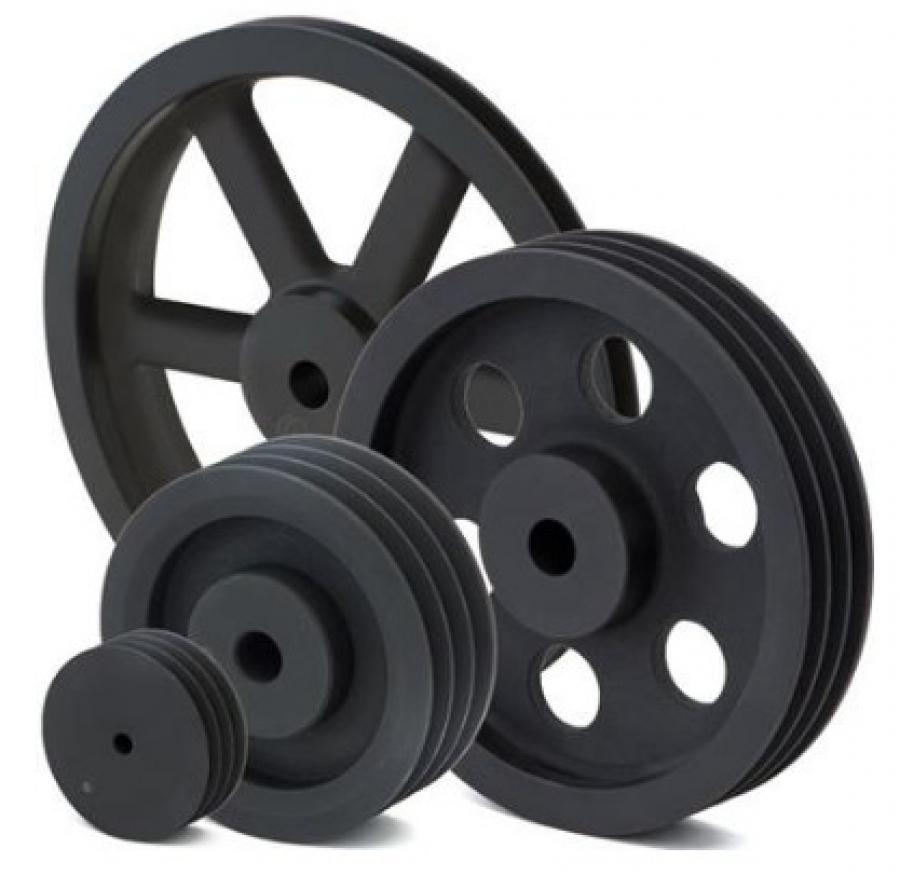
The motor pulley is usually smaller than the fan pulley in many cooling tower drive arrangements. This configuration reduces the fan speed compared with the motor speed.
For example, a motor may operate at 1,450 RPM while the fan operates at approximately 700 RPM. The difference is achieved through the pulley diameter relationship.
However, not every cooling tower uses the same arrangement. Pulley sizes depend on the required fan speed, motor characteristics, fan design, and transmission configuration.
2.2 How a Belt-Driven System Works
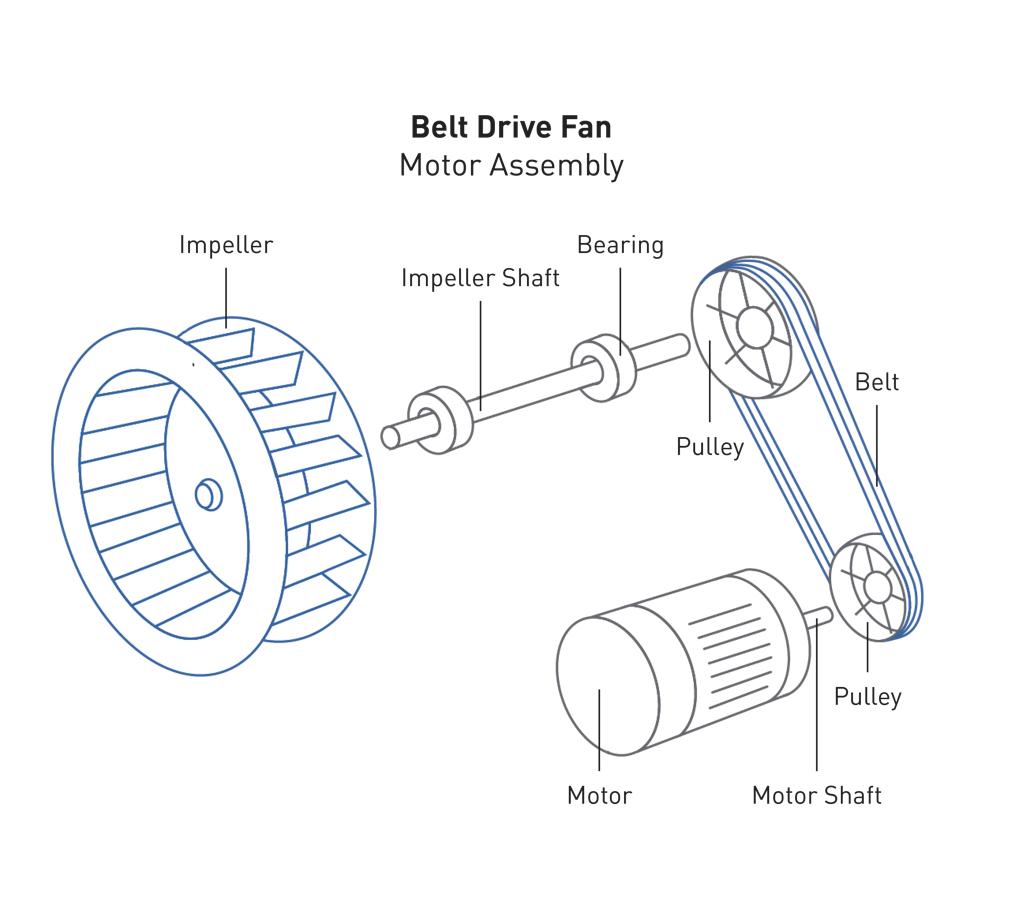
A typical belt-driven cooling tower fan system includes:
An electric motor that supplies rotational power.
A motor pulley mounted on the motor shaft.
One or more drive belts.
A fan pulley mounted on the fan shaft.
A fan shaft and supporting bearings.
A cooling tower fan that moves air through the tower.
Each component must work together.
Think of the pulley system as a bicycle transmission. Changing the gear relationship changes how quickly the wheel turns. In a cooling tower, changing pulley diameters changes fan speed and can affect the amount of air moving through the equipment.
3. How to Calculate a Cooling Tower Fan Pulley Ratio
Calculating the pulley ratio is not difficult once you know the pulley diameters and motor speed.
For a conventional belt drive, the ideal speed relationship is based on the effective pitch diameters of the pulleys.
3.1 The Basic Pulley Ratio Formula
When the motor pulley is the driving pulley and the fan pulley is the driven pulley, the approximate fan speed is:
Fan RPM = Motor RPM × Motor Pulley Pitch Diameter ÷ Fan Pulley Pitch Diameter
The corresponding speed ratio can be written as:
Pulley Speed Ratio = Fan Pulley Pitch Diameter ÷ Motor Pulley Pitch Diameter
For example, if the motor pulley has a pitch diameter of 150 mm and the fan pulley has a pitch diameter of 300 mm, the speed ratio is 2:1. The fan turns at approximately half the motor speed.
Always use the effective pitch diameter rather than assuming that the outside diameter is identical to the belt's working diameter. The correct measurement depends on the pulley and belt profile.
3.2 A Practical Calculation Example
Suppose a cooling tower has the following specifications:
Using the formula:
Fan RPM = 1,450 × 160 ÷ 320
Fan RPM = 725 RPM
The theoretical fan speed is therefore 725 RPM.
This calculation gives you a useful starting point when checking an existing drive or planning a replacement pulley.
However, the actual operating speed may be slightly lower because of belt slip, belt condition, installation factors, and other transmission losses.
3.3 Understanding Belt Slip and Actual Speed
The theoretical formula assumes that the belt transfers motion without slipping.
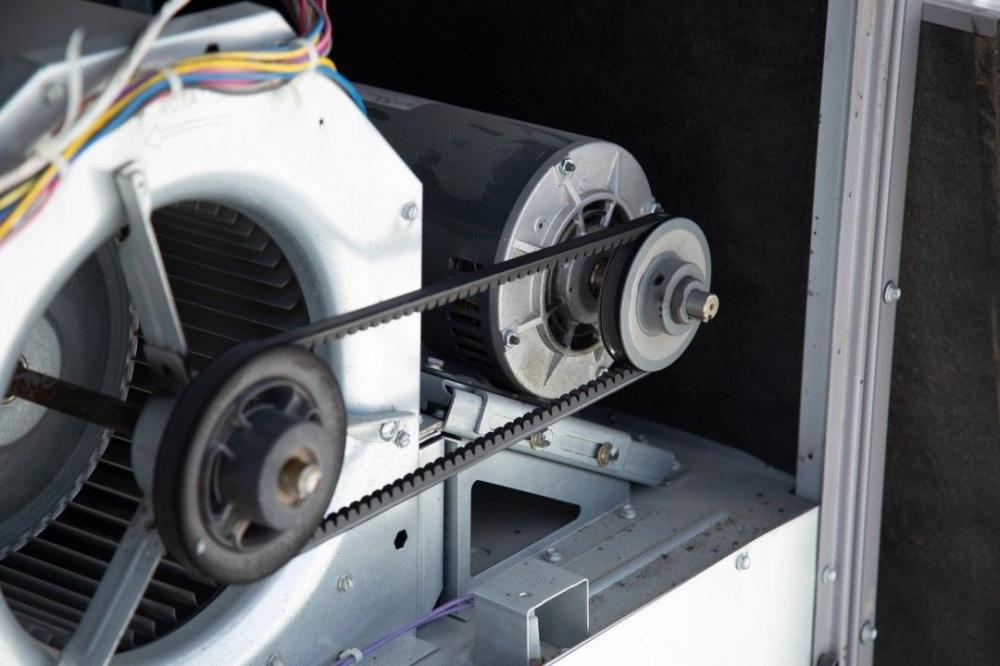
In real operating conditions, a belt may experience some slip, particularly when it is worn, incorrectly tensioned, contaminated, or overloaded.
A simplified practical relationship is:
Actual Fan RPM ≈ Theoretical Fan RPM × (1 − Slip Percentage)
For example, if the theoretical speed is 725 RPM and the effective slip is 2%, the approximate actual speed is:
725 × 0.98 = 710.5 RPM
This is only an illustration. Actual slip should be measured or assessed using suitable equipment rather than assumed.
For accurate maintenance, use a tachometer to measure the operating fan speed.
4. How Pulley Ratios Affect Fan Speed
Pulley diameter is one of the most direct ways to influence fan speed in a belt-driven cooling tower.
The relationship is straightforward: when the motor speed stays constant, a larger driven fan pulley reduces fan speed, while a smaller driven fan pulley increases fan speed.
4.1 Increasing Fan Speed
If you reduce the fan pulley diameter while keeping the motor pulley diameter and motor speed unchanged, the fan will rotate faster.
For example:
Motor speed: 1,450 RPM
Motor pulley pitch diameter: 160 mm
Original fan pulley pitch diameter: 320 mm
Original theoretical fan speed: 725 RPM
If the fan pulley pitch diameter changes to 290 mm:
Fan RPM = 1,450 × 160 ÷ 290
Fan RPM ≈ 800 RPM
The fan speed increases from 725 RPM to approximately 800 RPM.
This may increase airflow, but it also increases power demand and mechanical loading. You should never make this change without checking the fan manufacturer's maximum speed, motor capacity, and structural limits.
4.2 Reducing Fan Speed
Increasing the fan pulley diameter reduces fan speed.
This may be useful when a cooling tower is operating with excessive airflow, high noise, or unnecessary energy consumption. However, reducing fan speed too much can lower heat rejection capacity.
The correct setting should be based on actual cooling requirements and the equipment's design conditions.
A pulley adjustment is not simply a way to make a fan quieter. It changes the operating point of the entire air-moving system.
5. How Fan Speed Affects Cooling Tower Performance
Fan speed has a direct influence on how much air passes through a cooling tower.
Airflow affects the contact between air and water, which is essential for heat and mass transfer. When the fan speed changes, the tower's thermal performance can also change.
5.1 Airflow and Fan Speed
Under similar operating conditions, fan airflow is approximately proportional to fan rotational speed.
For example, if a fan's speed increases by 10%, its theoretical airflow may also increase by approximately 10%.
However, actual airflow depends on system resistance, fill condition, air distribution, drift eliminators, inlet restrictions, and the fan's performance characteristics.
A blocked air inlet or damaged fill cannot necessarily be corrected by increasing fan speed.
5.2 Fan Pressure and Power Consumption
Increasing fan speed does not affect only airflow.
It also increases the pressure developed by the fan and the power required to operate it.
For a similar fan operating in a comparable system, the basic affinity laws provide a useful estimate:
Airflow changes approximately in proportion to fan speed.
Pressure changes approximately with the square of fan speed.
Fan power changes approximately with the cube of fan speed.
This means a relatively small speed increase can create a much larger increase in power demand.
5.3 The Fan Affinity Laws
The fan affinity laws are important when evaluating pulley ratio adjustments.
For the same fan under comparable conditions:
Q₂ / Q₁ ≈ N₂ / N₁
P₂ / P₁ ≈ (N₂ / N₁)²
Power₂ / Power₁ ≈ (N₂ / N₁)³
Where:
Q represents airflow.
P represents fan pressure.
Power represents the approximate fan power requirement.
N represents fan rotational speed.
For example, increasing fan speed from 700 RPM to 770 RPM represents a 10% speed increase.
The theoretical estimates are:
Airflow: approximately 10% higher.
Pressure: approximately 21% higher.
Fan power: approximately 33% higher.
These are idealized estimates, not guaranteed field results. Real systems may behave differently because of system resistance, motor efficiency, belt losses, and operating conditions.
The key message is simple: increasing fan speed can improve airflow, but it may also increase electricity costs significantly.
6. What Happens When the Pulley Ratio Is Incorrect?
An incorrect pulley ratio can create several problems. Some are immediately noticeable, while others develop gradually.
6.1 Excessive Fan Speed
If the fan rotates faster than its permitted operating speed, several risks may appear:
Excessive motor current.
Increased vibration.
Higher mechanical stress on fan blades.
Greater bearing loads.
Increased noise.
Potential damage to the fan, shaft, or supporting structure.
Overspeed can also create safety risks, especially if the fan blades or hub are not designed for the higher rotational speed.
Never increase the fan speed beyond the manufacturer's approved limit.
6.2 Insufficient Fan Speed
A fan that operates too slowly may not move enough air through the cooling tower.
Possible symptoms include:
Higher cooling water outlet temperatures.
Reduced heat rejection capacity.
Difficulty meeting process cooling requirements.
Longer operating periods for associated equipment.
Poor cooling performance during high ambient temperatures.
Before changing the pulley ratio, check whether the problem is actually caused by fan speed. Dirty fill, poor water distribution, blocked air inlets, and incorrect water flow can produce similar symptoms.
6.3 Belt Wear, Vibration and Motor Overload
An unsuitable pulley arrangement can also cause mechanical problems.
For example, misaligned pulleys may make the belt run unevenly. Incorrect belt tension can cause slipping or excessive bearing loads. A pulley that is too small for the belt profile may also create excessive bending stress.
Motor overload may occur when a pulley adjustment increases fan power demand beyond the motor's available capacity.
These problems show why pulley ratio selection should always be considered together with belt specifications, shaft design, and motor performance.
7. How to Choose the Right Cooling Tower Pulley Ratio
Choosing the correct ratio requires more than comparing two pulley diameters. You need to understand the cooling tower's operating requirements and the limitations of its drive system.
7.1 Check the Required Airflow
Start by confirming the airflow required by the cooling tower.
Consider:
Cooling tower design capacity.
Water flow rate.
Water inlet and outlet temperatures.
Design wet-bulb temperature.
Fan performance data.
Current operating conditions.
If the tower is not cooling effectively, first determine whether the fan is operating below its intended speed or whether another component is restricting performance.
7.2 Confirm Motor Speed and Power
Check the motor nameplate and technical documentation.
Important information includes:
Do not rely only on the motor's nominal speed. Actual motor speed can vary with load and motor design.
You should also check the motor's available power against the fan's expected operating requirement after any pulley adjustment.
7.3 Measure Pulley Diameters
Measure the existing motor and fan pulleys carefully.
Record:
Effective pitch diameter.
Belt profile and groove dimensions.
Number of grooves.
Shaft diameter.
Keyway dimensions.
Hub and mounting arrangement.
Pulley alignment.
When replacing a pulley, matching the outside diameter alone is not enough. Two pulleys may look similar but have different belt profiles, groove spacing, or mounting dimensions.
7.4 Check Fan Speed Limits and Mechanical Compatibility
Before finalizing the pulley ratio, confirm the fan's maximum permitted speed.
Also evaluate:
Fan blade material and construction.
Hub and shaft strength.
Bearing operating limits.
Drive belt capacity.
Tower structure and vibration limits.
Manufacturer recommendations.
The pulley ratio must be compatible with the complete drive system, not just the motor and fan.
8. Cooling Tower Fan Pulley Materials and Designs
Cooling tower pulleys operate in environments that may involve moisture, temperature changes, vibration, and corrosion.
Material selection therefore matters.
8.1 Cast Iron Pulleys
Cast iron pulleys are commonly used in industrial power transmission applications.
Their advantages can include:
Good rigidity.
High compressive strength.
Resistance to deformation under suitable loads.
Compatibility with many conventional belt-drive designs.
However, cast iron is relatively heavy and may require appropriate corrosion protection in humid environments.
8.2 Aluminum Alloy Pulleys
Aluminum alloy pulleys are lighter than many cast iron alternatives.
Potential advantages include:
Their load capacity and suitability depend on the alloy, pulley design, manufacturing quality, and operating speed.
8.3 Fixed and Adjustable Pulleys
Fixed pulleys have a set diameter and provide a specific transmission ratio.
Adjustable pulleys allow the effective pitch diameter to change within a designed range. They can be useful for applications requiring limited speed adjustment.
However, not every adjustable pulley is suitable for large industrial cooling tower fans. Confirm the pulley type, power rating, belt compatibility, and permitted adjustment range before selecting one.
9. When Should You Replace a Cooling Tower Fan Pulley?
A damaged pulley can reduce transmission efficiency and cause repeated belt problems.
Common warning signs include:
Cracked or damaged pulley surfaces.
Worn or uneven belt grooves.
Excessive corrosion.
Loose or damaged hubs.
Keyway deformation.
Persistent belt slipping.
Unusual vibration or noise.
Visible pulley misalignment.
If a pulley has structural damage, replacing the belt alone will not solve the underlying problem.
When ordering a replacement, provide the supplier with the original pulley dimensions, shaft details, belt profile, groove count, and operating requirements.
If the original pulley is unavailable, a replacement should be selected through engineering verification rather than appearance alone.
10. Installation and Adjustment Tips
Correct installation is essential for stable operation.
Even a correctly selected pulley ratio may cause problems if the pulleys are misaligned or the belt tension is incorrect.
Follow these general steps:
Isolate the electrical supply and follow the site's lockout and safety procedures.
Confirm the motor and fan are fully stopped.
Inspect the motor shaft and fan shaft.
Check the pulley bores, keyways, and mounting surfaces.
Install the pulleys according to the manufacturer's instructions.
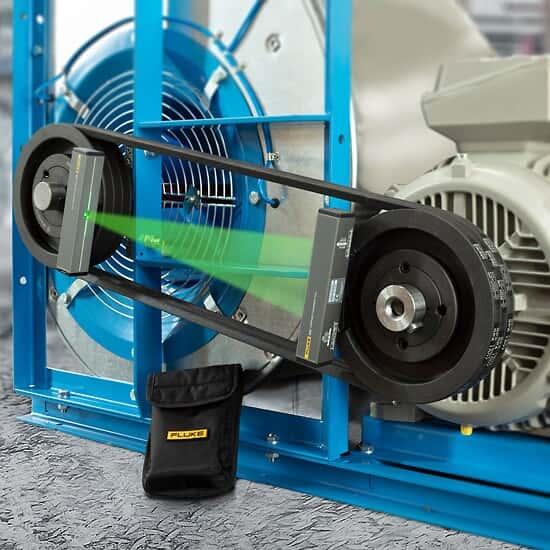
Align the pulley grooves using an appropriate alignment tool.
Install the correct belt type and size.
Set belt tension according to the belt manufacturer's recommendations.
Rotate the drive manually, where safe and permitted, to check for interference.
Reinstall guards before operating the equipment.
Test the system and measure fan speed, motor current, and vibration.
Never operate a belt-driven cooling tower fan with exposed rotating components.
11. Common Pulley Ratio Problems and Solutions
| Problem | Possible Cause | Recommended Action |
| Fan speed is too high | Fan pulley is too small or motor pulley is too large | Verify the ratio and approved fan speed |
| Fan speed is too low | Fan pulley is too large or motor pulley is too small | Check the original design and calculate the required ratio |
| Belt slips frequently | Incorrect tension, worn belt, or overloaded drive | Inspect belt condition and drive capacity |
| Excessive vibration | Misalignment, imbalance, damaged pulley, or bearing problems | Inspect the complete rotating assembly |
| Motor current is too high | Excessive fan load or unsuitable operating speed | Check motor load and fan operating conditions |
| Uneven belt wear | Incorrect groove alignment or incompatible pulley profiles | Verify alignment and belt-pulley compatibility |
A useful troubleshooting approach is to measure actual fan speed first. Then compare the result with the design value before changing any components.
12. Cooling Tower Fan Pulley Maintenance
Regular maintenance helps extend pulley and belt service life.
A practical inspection routine should include the following items:
Pulley condition: Look for cracks, corrosion, worn grooves, and loose mounting components.
Belt condition: Check for fraying, glazing, cracking, contamination, and uneven wear.
Alignment: Confirm that the motor and fan pulleys remain properly aligned.
Belt tension: Follow the belt manufacturer's tension recommendations. Avoid excessive tension because it can increase bearing loads.
Vibration: Investigate unusual vibration rather than assuming that it is normal operating behavior.
Operating speed: Measure fan RPM when checking drive performance or after a pulley replacement.
Inspection frequency should depend on operating hours, environmental conditions, equipment design, and the manufacturer's maintenance schedule.
13. Buying Replacement Pulleys from a Reliable Supplier
When purchasing cooling tower fan pulleys, the lowest price should not be your only consideration.
An incorrect pulley can lead to repeated belt failures, poor cooling performance, and additional maintenance costs.
Before contacting a supplier, prepare as much technical information as possible:
Cooling tower brand and model.
Motor power and rated speed.
Existing motor pulley diameter.
Existing fan pulley diameter.
Required fan speed.
Belt type and profile.
Number of grooves.
Shaft diameter and keyway dimensions.
Material and environmental requirements.
Drawings or clear photographs of the original pulley.
A reliable supplier should help verify the technical details and identify possible compatibility issues.
If you are replacing an existing pulley, provide the original component dimensions whenever possible. If you are changing the transmission ratio, request an engineering review of fan speed, motor load, belt capacity, and mechanical limits.
14. Why Choose Power Tower Cooling Tower Components?
Power Tower Cooling Technology (Shaoxing) Co.,Ltd focuses on cooling tower components and replacement solutions for industrial cooling applications.
When sourcing cooling tower parts, customers need more than a component that looks similar to the original. They need suitable dimensions, compatible materials, and a clear understanding of the equipment's operating requirements.
For cooling tower fan pulley replacement projects, providing accurate technical information helps suppliers evaluate the required specifications and avoid incorrect selections.
Whether you are maintaining an existing cooling tower or sourcing replacement components for a repair project, it is important to check the complete drive arrangement before ordering.
Visit https://www.coolingtowerpart.com to learn more about Power Tower's cooling tower component solutions and discuss your replacement requirements.
15. Frequently Asked Questions
15.1 How Do I Calculate a Cooling Tower Fan Pulley Ratio?
Divide the fan pulley pitch diameter by the motor pulley pitch diameter to obtain the driven-to-driver speed ratio. Then divide the motor RPM by this ratio to estimate the theoretical fan RPM.
For example, a 320 mm fan pulley and a 160 mm motor pulley produce a 2:1 speed reduction.
15.2 Does a Larger Fan Pulley Reduce Fan Speed?
Yes. When the motor pulley diameter and motor speed remain unchanged, increasing the fan pulley pitch diameter reduces fan speed.
This is because the larger driven pulley completes fewer revolutions for the same belt travel.
15.3 Can I Change the Pulley Ratio to Increase Cooling Capacity?
Changing the pulley ratio can increase fan speed and potentially increase airflow. However, it also increases fan power demand and mechanical loading.
Before making any adjustment, check the fan's maximum permitted speed, motor capacity, belt rating, and cooling tower design requirements.
Increasing fan speed is not always the best solution to poor cooling performance.
15.4 How Often Should Cooling Tower Pulleys Be Inspected?
Inspection frequency depends on operating conditions and manufacturer recommendations. As a general maintenance practice, include pulley and belt checks in routine cooling tower inspections.
Look for groove wear, corrosion, cracks, misalignment, belt damage, and unusual vibration.
15.5 Can I Replace a Cooling Tower Fan Pulley with One of the Same Outside Diameter?
Not necessarily. You should also confirm the pitch diameter, belt profile, groove count, shaft bore, keyway, hub dimensions, and material.
A pulley with the same outside diameter may still be incompatible with the original drive system.
16. Conclusion
Cooling tower fan pulley ratios play an important role in controlling fan speed and maintaining reliable cooling performance.
The relationship between motor pulley diameter and fan pulley diameter determines the theoretical fan speed. That speed then influences airflow, pressure, power consumption, and the operating load on the drive system.
A suitable pulley ratio helps the fan operate within its intended performance range. An incorrect ratio, on the other hand, may lead to insufficient cooling, excessive energy use, belt wear, vibration, or motor overload.
Before replacing or adjusting a cooling tower fan pulley, check the motor speed, pulley pitch diameters, fan RPM, belt specifications, and mechanical limits.
For replacement components and cooling tower parts, Power Tower Cooling Technology (Shaoxing) Co.,Ltd provides a point of contact for discussing component requirements and replacement projects.
Visit https://www.coolingtowerpart.com to explore cooling tower component solutions.


