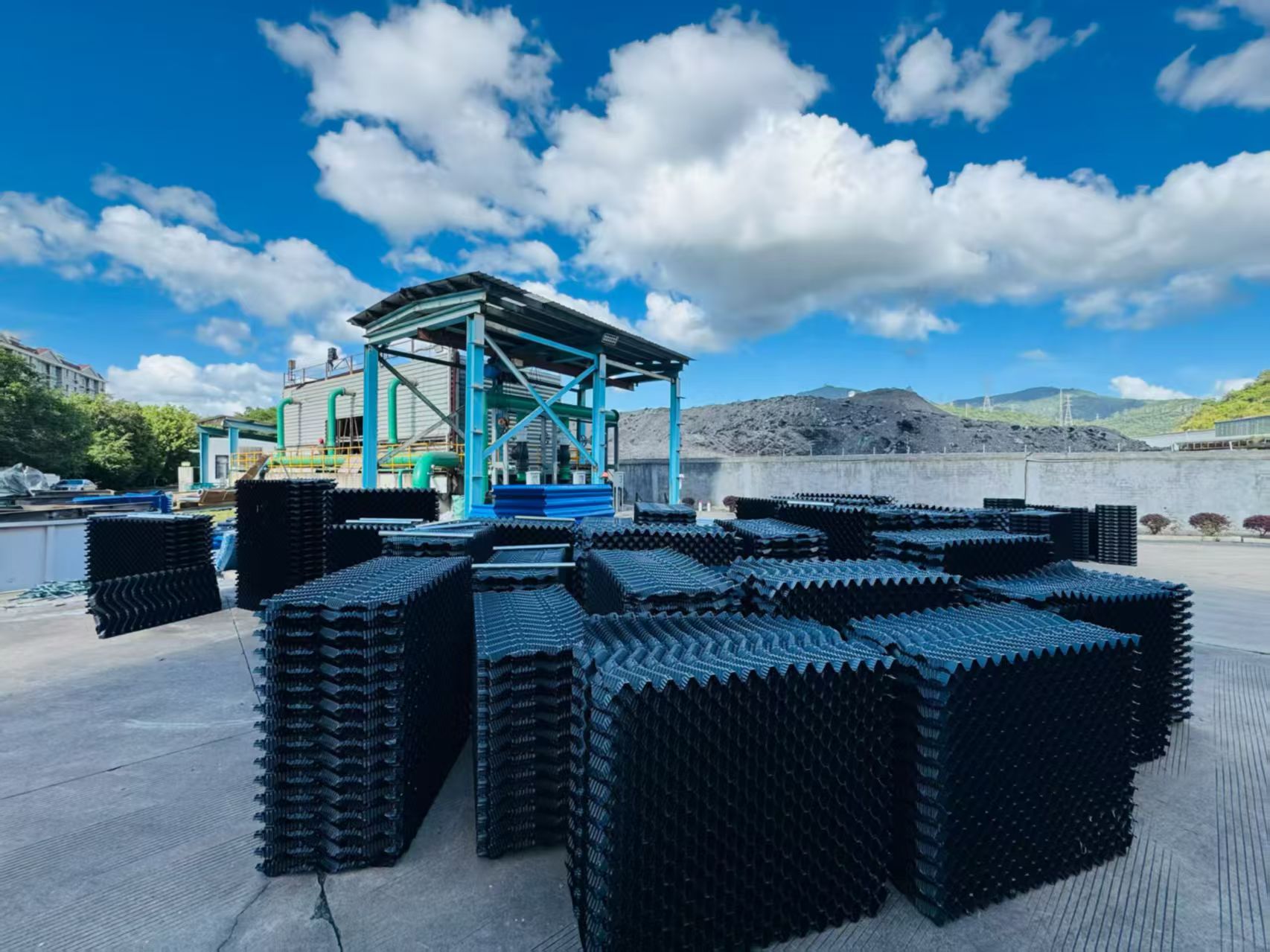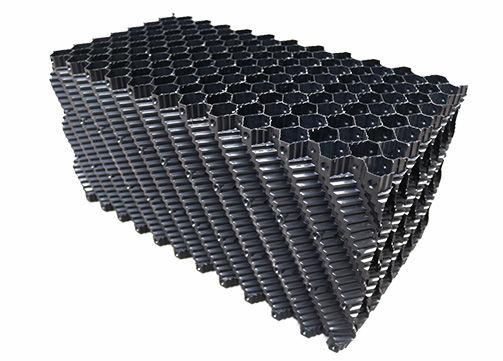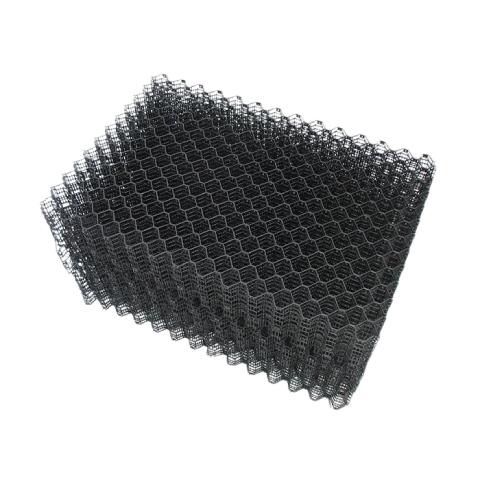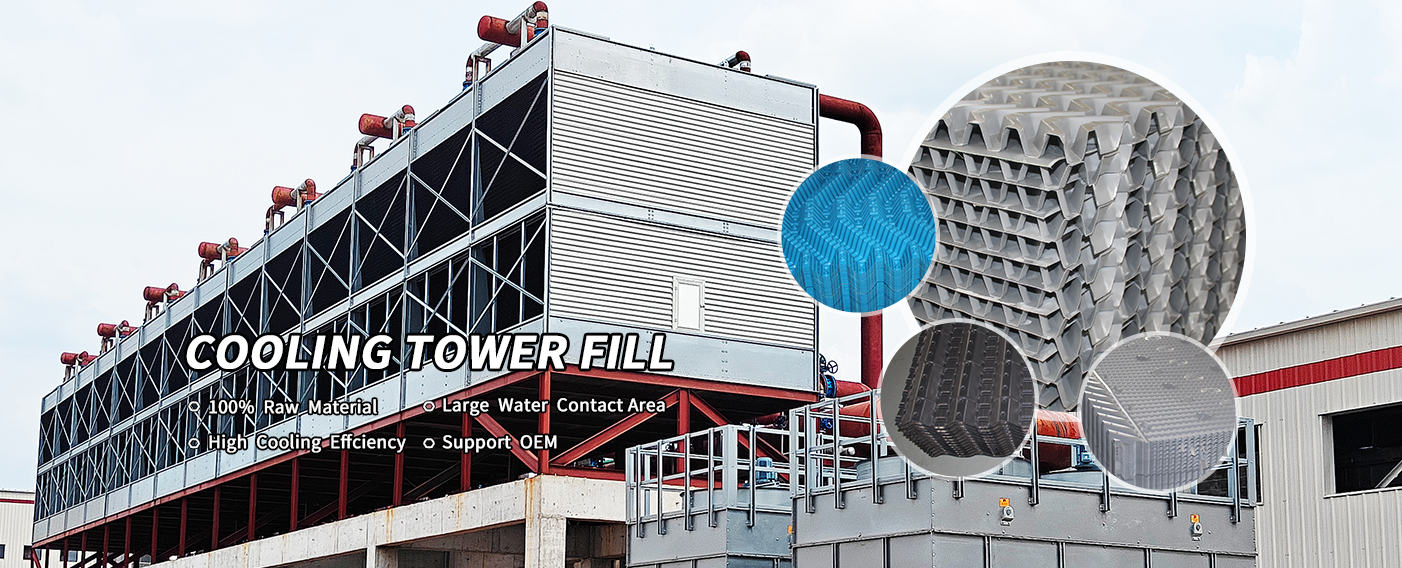
Cooling tower fills are one of the most important components inside an industrial cooling tower. They increase the contact area between hot process water and airflow, helping transfer heat more efficiently and reduce the temperature of circulating water.
For industrial cooling tower applications, PP cooling tower fills and PVC cooling tower fills are two of the most widely used options. Both materials offer good corrosion resistance, low weight, and reliable performance, but their properties make them suitable for different operating conditions.
Choosing the right cooling tower fill media can improve thermal performance, extend maintenance intervals, and support stable tower operation. This guide explains the differences between PP and PVC fills and how to select the right solution for an industrial cooling tower.
What Is Cooling Tower Fill?
Cooling tower fill is the heat-transfer media installed inside a cooling tower. Its primary purpose is to increase the surface area available for water-to-air contact.
When hot water enters the tower, it is distributed over the fill. The fill breaks the water into thin films or droplets while air moves through the tower. Heat is transferred from the water to the air, and a portion of the water evaporates.
A properly selected cooling tower fill can:
Increase heat-transfer efficiency
Improve water distribution
Increase air-water contact time
Reduce required tower size
Support lower cold-water temperatures
Improve cooling tower capacity
For this reason, fill media should be considered carefully during new tower design, retrofit projects, and cooling tower fill replacement.
PP vs. PVC Cooling Tower Fills
PP and PVC are both thermoplastic materials commonly used for industrial cooling tower fill.
| Feature | PP Cooling Tower Fill | PVC Cooling Tower Fill |
| Material | Polypropylene | Polyvinyl chloride |
| Temperature resistance | Generally higher | Good for standard applications |
| Chemical resistance | Excellent | Excellent |
| Weight | Lightweight | Lightweight |
| Typical use | Higher-temperature or demanding applications | General industrial cooling |
| Common designs | Splash and film fill | Film and splash fill |
| Maintenance | Easy to handle | Easy to handle |
| Replacement use | New towers and retrofits | New towers and retrofits |
The best material depends on water temperature, chemical conditions, fouling risk, tower design, and required thermal performance.
PP Cooling Tower Fills
PP cooling tower fills are manufactured from polypropylene, a material known for good chemical resistance and higher temperature capability than many standard plastics.
PP fill can be a practical choice for industrial cooling towers where operating conditions are more demanding. It is also widely used for splash-type fill and selected film-fill designs.
Advantages of PP Fill
PP cooling tower fill offers several benefits:
Good resistance to many chemicals
Higher temperature capability
Low material weight
Good mechanical durability
Resistance to corrosion
Suitable for industrial environments
Easy installation and replacement
PP is particularly attractive where hot water temperatures or chemical exposure make material selection more challenging.
PVC Cooling Tower Fills
PVC cooling tower fills are widely used because PVC combines good thermal performance, chemical resistance, availability, and cost effectiveness.
PVC film fill is especially common in mechanical-draft cooling towers. The formed sheets create channels that distribute water across a large surface area while allowing air to pass through the fill pack.
Advantages of PVC Fill
Key benefits include:
Excellent water distribution
Large effective heat-transfer area
Good chemical resistance
Lightweight construction
Cost-effective replacement
Easy cutting and installation
Wide availability in different configurations
For many standard industrial cooling tower applications, PVC film fill provides an effective balance between performance and purchase cost.
Film Fill vs. Splash Fill
Material is only one part of the fill-selection process. The fill type is equally important.
Film Fill
Film fill spreads water into a thin continuous film over the surface of corrugated or formed sheets. This creates a large contact area between water and air.
Advantages include:
High heat-transfer efficiency
Compact fill volume
Suitable for applications with relatively clean water
Efficient use of tower space
PVC film fill is commonly selected when high thermal performance is required.
Splash Fill
Splash fill breaks falling water into droplets as it passes through bars, grids, or other splash elements. It is often selected for water containing suspended solids or applications where resistance to fouling is important.
Advantages include:
Better tolerance of dirty water
Reduced sensitivity to suspended solids
Suitable for wastewater and industrial processes
Robust construction
Easier cleaning in many applications
PP is commonly used for splash fill because of its durability and material properties.
Applications of PP and PVC Cooling Tower Fills
PP and PVC fills can be used across many industrial cooling applications.
Typical applications include:
Power plants
Chemical processing plants
Petrochemical facilities
Steel and metal processing
HVAC and district cooling
Food and beverage plants
Manufacturing facilities
Wastewater treatment
Data center cooling systems
Process cooling systems
The correct fill should be selected according to the specific process rather than simply replacing the existing material with the same type.
How to Choose Industrial Cooling Tower Fill
Before purchasing industrial cooling tower fills, consider the following factors.
1. Operating Water Temperature
Check both normal and maximum water temperature. PP may be preferable for higher-temperature applications, while PVC is widely used for conventional cooling conditions.
2. Water Quality
Water containing algae, suspended solids, oil, biological growth, or heavy mineral deposits can affect fill performance.
If fouling is a major concern, splash fill or a more open fill design may be preferable to closely spaced film fill.
3. Chemical Compatibility
Analyze the cooling-water chemistry, including pH, biocides, acids, and other treatment chemicals. The fill material must be compatible with the water-treatment program.
4. Thermal Performance
Consider required heat rejection, entering and leaving water temperatures, airflow, water loading, and available fill volume.
A higher-performance fill is not automatically better if the tower's airflow and water-distribution system cannot support it.
5. Existing Tower Dimensions
For a replacement project, measure the existing fill area, height, width, support structure, and water-distribution arrangement.
Correct dimensions are essential for a successful cooling tower fill replacement.
6. Fouling and Maintenance
If the cooling water is dirty, selecting a fill with suitable channel spacing and an easy-clean design can reduce maintenance problems.
Cooling Tower Fill Replacement
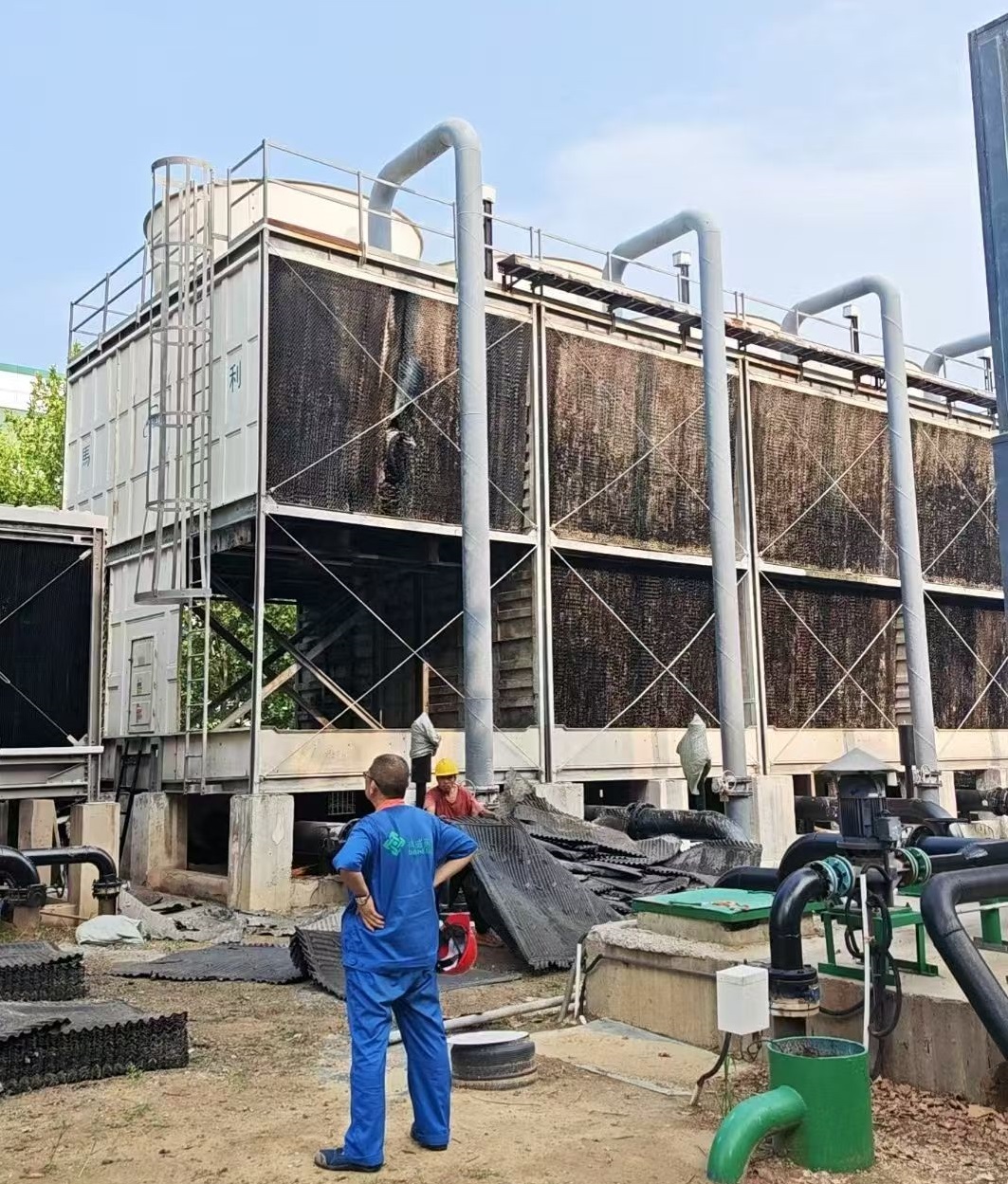
Over time, cooling tower fill can become damaged, brittle, blocked, deformed, or heavily fouled. These conditions reduce effective heat-transfer area and may increase the tower's approach temperature.
Common signs that fill replacement may be necessary include:
Increasing cold-water temperature
Reduced cooling capacity
Higher approach temperature
Visible fill deformation
Cracked or brittle sheets
Heavy scaling or biological fouling
Restricted airflow
Uneven water distribution
Replacing old fill with modern PP or PVC cooling tower fill can restore tower performance without necessarily replacing the entire cooling tower.
Why Fill Quality Matters
Not all cooling tower fills provide the same performance. Sheet thickness, geometry, flute pattern, welding or bonding quality, block dimensions, material formulation, and manufacturing consistency can affect service life and thermal performance.
For B2B buyers, it is important to request technical information such as:
Fill material: PP or PVC
Fill type: film or splash
Sheet thickness
Fill block dimensions
Operating temperature range
Chemical compatibility
Water loading range
Airflow requirements
Installation method
Replacement compatibility
A qualified supplier should be able to recommend a fill based on the tower's actual operating conditions.
PP or PVC: Which Cooling Tower Fill Is Better?
There is no universal winner.
PVC cooling tower fill is often a strong choice for standard industrial applications where high thermal efficiency and cost-effective film fill are priorities.
PP cooling tower fill can be a better option when higher temperature resistance, chemical resistance, or robust splash-fill construction is required.
The right choice depends on the cooling tower design and operating environment.
Cooling Tower Fills for Industrial Replacement Projects
For a cooling tower retrofit or replacement project, compatibility is critical. A replacement fill should match the tower's dimensions and provide appropriate water and airflow characteristics.
CoolingTowerPart.com supplies PP and PVC cooling tower fills for industrial cooling tower applications, including film-fill and splash-fill solutions. Replacement configurations can be selected according to tower dimensions, operating conditions, water quality, and required cooling performance.
Whether you need PVC film fill, PP splash fill, cooling tower fill media, or replacement fill blocks, selecting the correct specification can help improve tower efficiency and extend operating life.
Frequently Asked Questions
What is the main purpose of cooling tower fill?
Cooling tower fill increases the contact area and contact time between water and air, improving evaporative heat transfer inside the tower.
Is PP or PVC better for cooling tower fill?
PVC is widely used for standard film-fill applications, while PP offers advantages in higher-temperature or demanding industrial conditions. The best choice depends on water temperature, chemistry, fouling, and tower design.
Can PVC cooling tower fill be replaced with PP?
In some applications, yes, but the replacement should be evaluated for temperature, chemical compatibility, dimensions, water loading, and thermal performance before installation.
How often should cooling tower fill be replaced?
There is no universal replacement interval. Fill should be inspected regularly and replaced when it becomes damaged, heavily fouled, brittle, deformed, or unable to provide the required cooling performance.
What is the difference between film fill and splash fill?
Film fill spreads water into thin films over formed sheets for high heat-transfer efficiency. Splash fill breaks water into droplets and is generally more tolerant of suspended solids and fouling.
Conclusion
PP and PVC cooling tower fills are proven solutions for industrial cooling tower applications. PVC film fill provides efficient heat transfer and cost-effective performance for many conventional systems, while PP fill offers excellent chemical resistance, durability, and higher-temperature capability.
The best cooling tower fill media should be selected based on operating temperature, water quality, chemical conditions, thermal requirements, tower dimensions, and maintenance needs.
For new installations and cooling tower fill replacement projects, choosing the correct PP or PVC fill can make a significant difference in cooling efficiency, reliability, and long-term operating costs.
Internal Links for Other CoolingTowerParts
Cooling Tower Fill
Cooling Tower Nozzles
Cooling Tower Drift Eliminators
Cooling Tower Louvers
Cooling Tower Fan Blades
Cooling Tower Motors