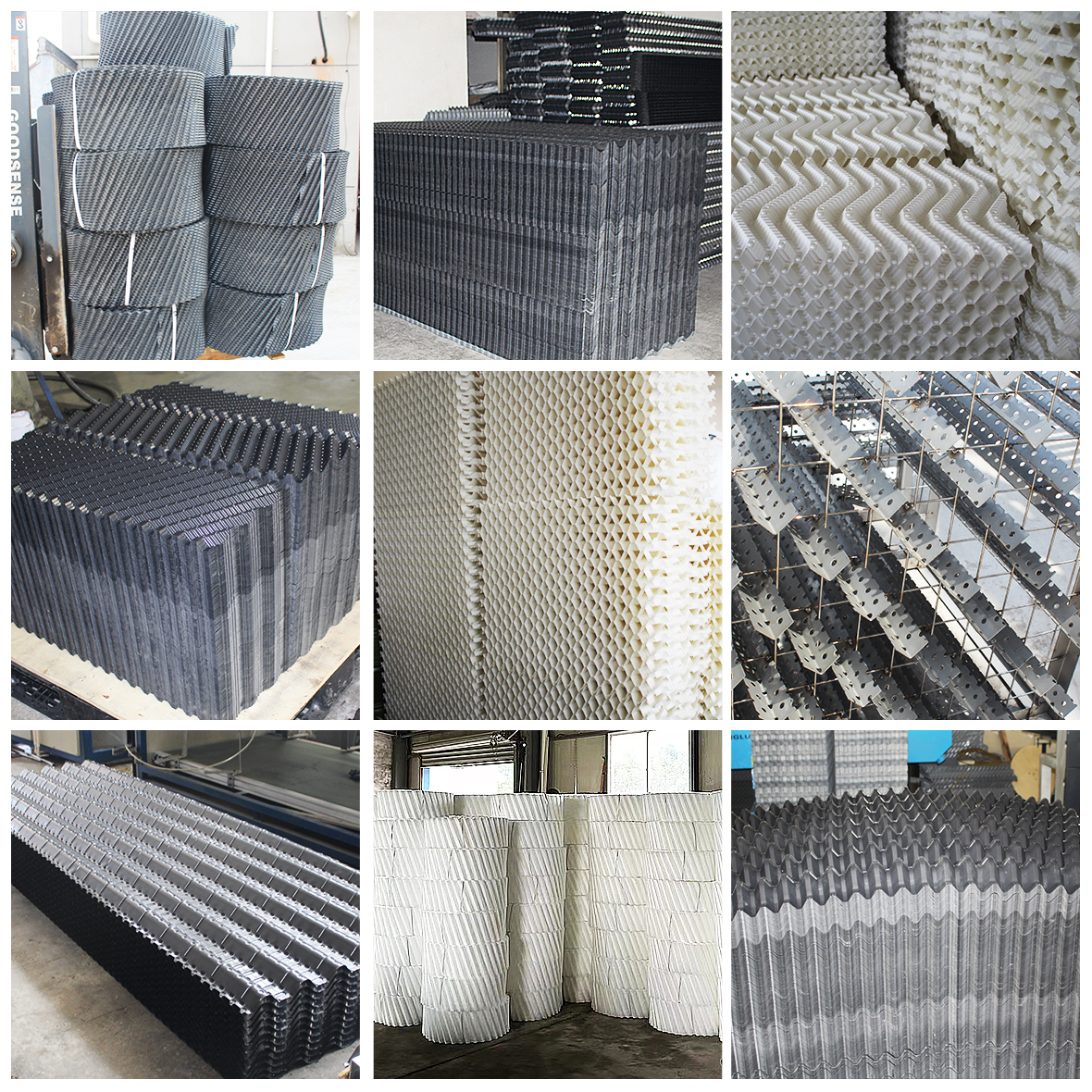
Selecting the right cooling tower fill media for replacement is essential for maintaining heat-transfer efficiency, reliable operation, and long-term maintenance performance. Whether you manage an industrial cooling tower, commercial HVAC system, power plant, or manufacturing facility, the correct fill media can help restore cooling capacity and reduce recurring maintenance problems.
However, not all cooling tower fill media is the same. PVC film fill, PP film fill, and splash fill have different characteristics, and the best option depends on water quality, operating temperature, cooling tower design, and the risk of fouling.
This guide explains how to choose replacement cooling tower fill media, compare materials, verify compatibility, and select a reliable supplier for your project.
1. Understand the Main Types of Cooling Tower Fill Media
Before purchasing replacement fill, identify the type of media your cooling tower requires.
PVC Film Fill
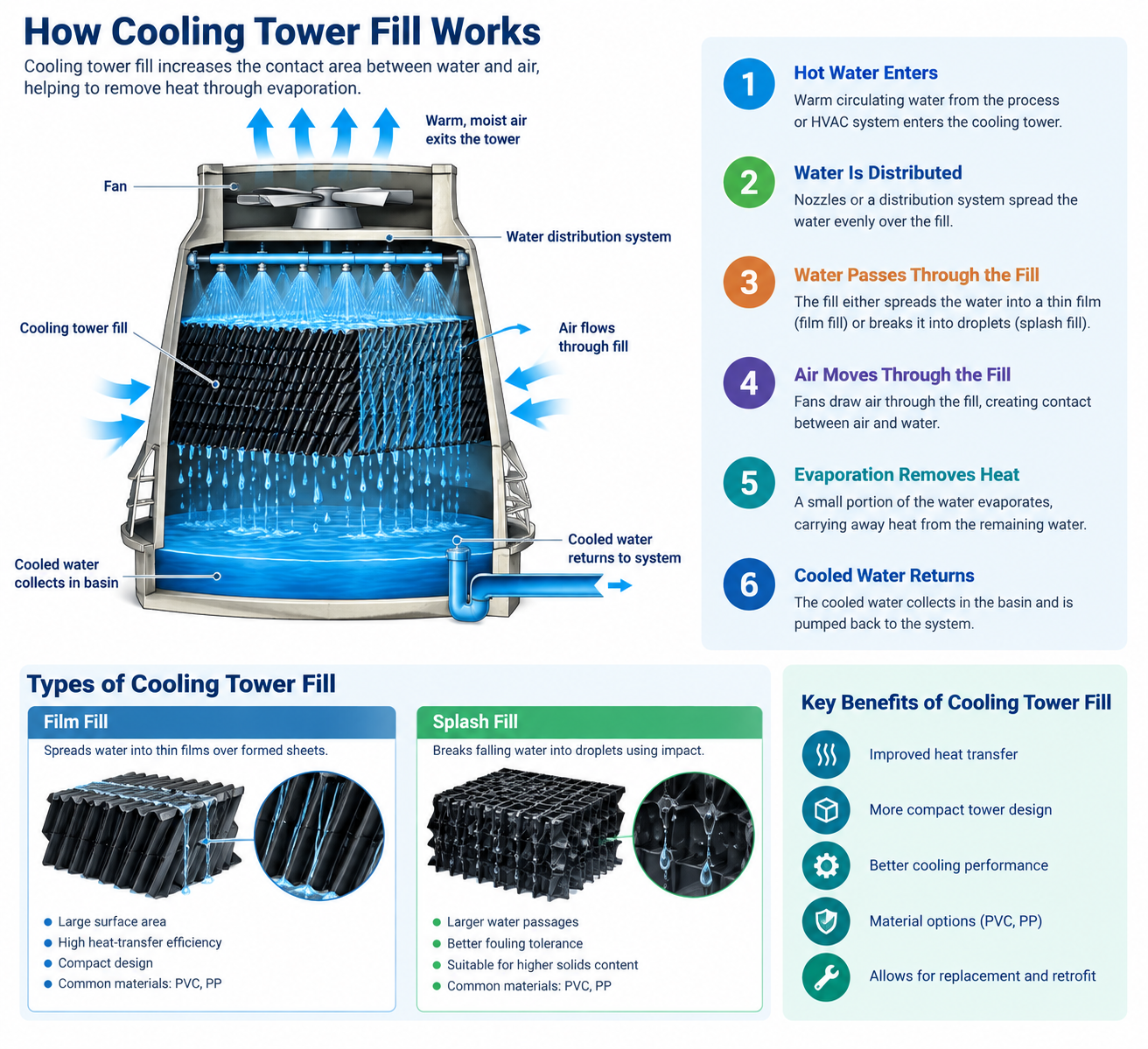
PVC film fill consists of closely spaced plastic sheets that spread water into thin films, increasing contact between water and air.
Advantages:
High heat-transfer efficiency in suitable operating conditions
Large effective surface area
Compact design for efficient use of tower space
Widely available for industrial and commercial replacement projects
PVC film fill is a common choice when circulating water has been properly treated and suspended solids are controlled.
PP Film Fill
Polypropylene (PP) film fill uses a similar heat-transfer principle but is manufactured from polypropylene.
Advantages:
Can provide higher temperature resistance than conventional PVC, depending on the material grade
Suitable for certain demanding operating environments
Available in different sheet configurations and pack dimensions
PP fill may be suitable when operating temperature or chemical compatibility makes it preferable to PVC. Always confirm the manufacturer's temperature limits and chemical-resistance data.
Splash Fill
Splash fill uses bars, grids, or other structures to break falling water into droplets, increasing contact with air.
Advantages:
Often suitable for water with higher suspended-solids levels
Open structures can help reduce the risk of narrow passages becoming blocked
Available in different configurations for industrial applications
Splash fill is worth considering when fouling is a major concern, although its suitability depends on the tower design and required thermal performance.
2. Evaluate Water Quality and Fouling Risk
Water quality is one of the most important factors when selecting cooling tower replacement fill media.
Cooling water may contain suspended solids, minerals, biological growth, and treatment chemicals. These contaminants can accumulate on fill surfaces, restrict airflow, and reduce heat-transfer performance.
Consider the following conditions before choosing a fill type:
High suspended solids: An open splash-fill configuration may be preferable where the existing system experiences frequent blockage.
Hard water: Scale control and water treatment are essential, especially for film fill with narrow passages.
Biological growth: Effective water treatment and regular cleaning help prevent biofilm accumulation.
Chemical exposure: Confirm that the fill material is compatible with the treatment chemicals and operating environment.
High operating temperatures: Evaluate PP or other suitable materials against the actual maximum water temperature.
Do not select replacement fill based on water quality alone. Airflow, water loading, tower geometry, and thermal requirements must also be considered.
3. Compare PVC and PP Cooling Tower Fill
PVC and PP film fill are both widely used, but their suitability varies by application.
| Selection Factor | PVC Film Fill | PP Film Fill |
| Typical applications | Standard industrial and commercial cooling | Applications requiring suitable higher-temperature performance |
| Heat-transfer design | Closely spaced film surfaces | Closely spaced film surfaces |
| Temperature resistance | Depends on formulation and design | Often higher than conventional PVC, depending on grade |
| Chemical compatibility | Must be verified | Must be verified |
| Purchase cost | Often economical | May cost more depending on specifications |
| Fouling resistance | Depends on sheet spacing and water quality | Depends on sheet spacing and water quality |
There is no universally superior material. Compare the actual material grade, operating limits, sheet configuration, and total project cost before ordering.
4. Confirm Cooling Tower Fill Dimensions and Compatibility
Even high-quality fill media may perform poorly if it does not fit the existing cooling tower correctly.
Before requesting a quotation, confirm:
Cooling tower manufacturer and model
Fill block length, width, and height
Sheet spacing and flute geometry
Fill pack orientation
Required quantity or total fill volume
Support structure and installation clearances
Water distribution and airflow arrangements
If the original drawings are unavailable, provide clear photographs and measured dimensions to the supplier.
For Marley, BAC, EVAPCO, SPX, or other cooling tower installations, verify the actual equipment model and fill configuration. A replacement described as compatible with a particular brand should still be checked against the original specifications.
5. Match the Fill to Cooling Performance Requirements
Replacement cooling tower fill should meet the tower's required thermal performance rather than simply match the original material.
Important factors include:
Heat-transfer capacity: The fill must provide sufficient contact area for the required cooling duty.
Airflow resistance: Fill geometry affects pressure drop and fan operating requirements. A design that restricts airflow excessively may increase operating costs.
Water distribution: The fill must work with the tower's spray nozzles or distribution system to achieve uniform wetting.
Water loading: Confirm that the fill configuration suits the actual water flow and distribution pattern.
Tower configuration: Crossflow and counterflow cooling towers have different arrangements, so replacement media must match the intended installation.
For major retrofit projects, request technical data or an engineering review from the manufacturer. Changing fill geometry without evaluating the tower can affect airflow, water distribution, and thermal performance.
6. Consider Cleaning Requirements and Service Life
The cheapest fill media is not necessarily the most economical choice over its service life.
When comparing replacement products, consider how easily the fill can be inspected and cleaned, how susceptible its geometry is to blockage, and whether the material suits the facility's water-treatment program.
For systems with recurring fouling, investigate the underlying causes before installing new fill. Poor water treatment, excessive suspended solids, blocked nozzles, and inadequate maintenance can cause replacement media to deteriorate prematurely.
A suitable fill design, combined with effective water treatment and regular inspections, can help reduce avoidable maintenance expenses.
7. Calculate the Total Cooling Tower Fill Replacement Cost
The total cost of a replacement project includes more than the purchase price of the fill media.
| Cost Component | What to Consider |
| Fill media | Material, dimensions, configuration, and quantity |
| Packaging | Cartons, pallets, and protection during transportation |
| Shipping | Freight, insurance, import duties, and local delivery |
| Removal | Labor and disposal of old fill |
| Installation | Labor, lifting equipment, and fitting |
| Additional repairs | Supports, fasteners, nozzles, or related components |
| Downtime | Planned shutdowns or temporary cooling arrangements |
For international buyers, compare the delivered cost rather than the factory price alone. Bulk orders may reduce the unit cost or freight per unit when the quantity matches actual project requirements.
8. How to Choose a Reliable Cooling Tower Fill Supplier
A qualified manufacturer or supplier should be able to support both technical selection and purchasing requirements.
Look for a supplier that can provide:
PVC, PP, or splash fill options appropriate to your application
Technical specifications and dimensional confirmation
Material information and operating limits
Custom sizes for replacement and retrofit projects
Clear quotations covering quantity and packaging
Export experience and delivery estimates
Installation guidance or technical support where available
Ask for product samples, drawings, or photographs when necessary. Confirm the material, dimensions, and configuration before approving a bulk order.
For industrial distributors, contractors, and maintenance teams, a supplier that understands replacement requirements can help reduce ordering errors and project delays.
Frequently Asked Questions
Which cooling tower fill media is best for replacement?
PVC film fill is common for standard applications, PP film fill may suit certain higher-temperature conditions, and splash fill can be advantageous in applications with greater fouling risk. The best choice depends on water quality, temperature, tower design, and thermal requirements.
Can I replace PVC fill with PP fill?
Potentially, but the change should be evaluated for dimensional fit, material compatibility, thermal performance, airflow resistance, and water distribution. Confirm suitability with the cooling tower manufacturer or a qualified fill supplier.
How do I measure cooling tower fill for replacement?
Record the length, width, and height of the fill sections, along with sheet spacing, flute geometry, orientation, and quantity. Photographs and original equipment information can help the supplier confirm the correct configuration.
Does new cooling tower fill improve efficiency?
It can restore performance when the original fill is fouled, damaged, or deteriorated. Results also depend on fan condition, water distribution, airflow, water treatment, and operating conditions.
How often should cooling tower fill be replaced?
There is no universal replacement interval. Service life depends on water quality, operating temperature, material selection, chemical exposure, and maintenance. Inspect the fill regularly and replace it when cleaning or repair can no longer restore acceptable performance economically.
Conclusion
Selecting the right cooling tower fill media for replacement requires careful evaluation of material, water quality, operating temperature, fill dimensions, and cooling performance requirements.
PVC film fill, PP film fill, and splash fill each offer different advantages. The most suitable option is the one that matches your cooling tower design and operating conditions while balancing purchase price, maintenance requirements, and expected service life.
Before placing an order, confirm the original fill configuration, compare technical specifications, and evaluate the total replacement cost. Working with an experienced cooling tower fill manufacturer can help ensure the replacement media fits correctly and supports reliable long-term operation.
Recommended internal links for CoolingTowerPart.com:


