1. Introduction to Cooling Tower Fan Parts
A cooling tower fan may look like a simple rotating machine, but it plays a critical role in the performance of an industrial cooling system. It moves large volumes of air through the tower, helping transfer heat from circulating water into the atmosphere. Without reliable airflow, even a well-designed cooling tower may struggle to maintain the required water temperature.
So, what keeps a cooling tower fan operating efficiently? The answer is a group of components that work together, including fan blades, hubs, motors, gearboxes, shafts, couplings, and supporting structures.
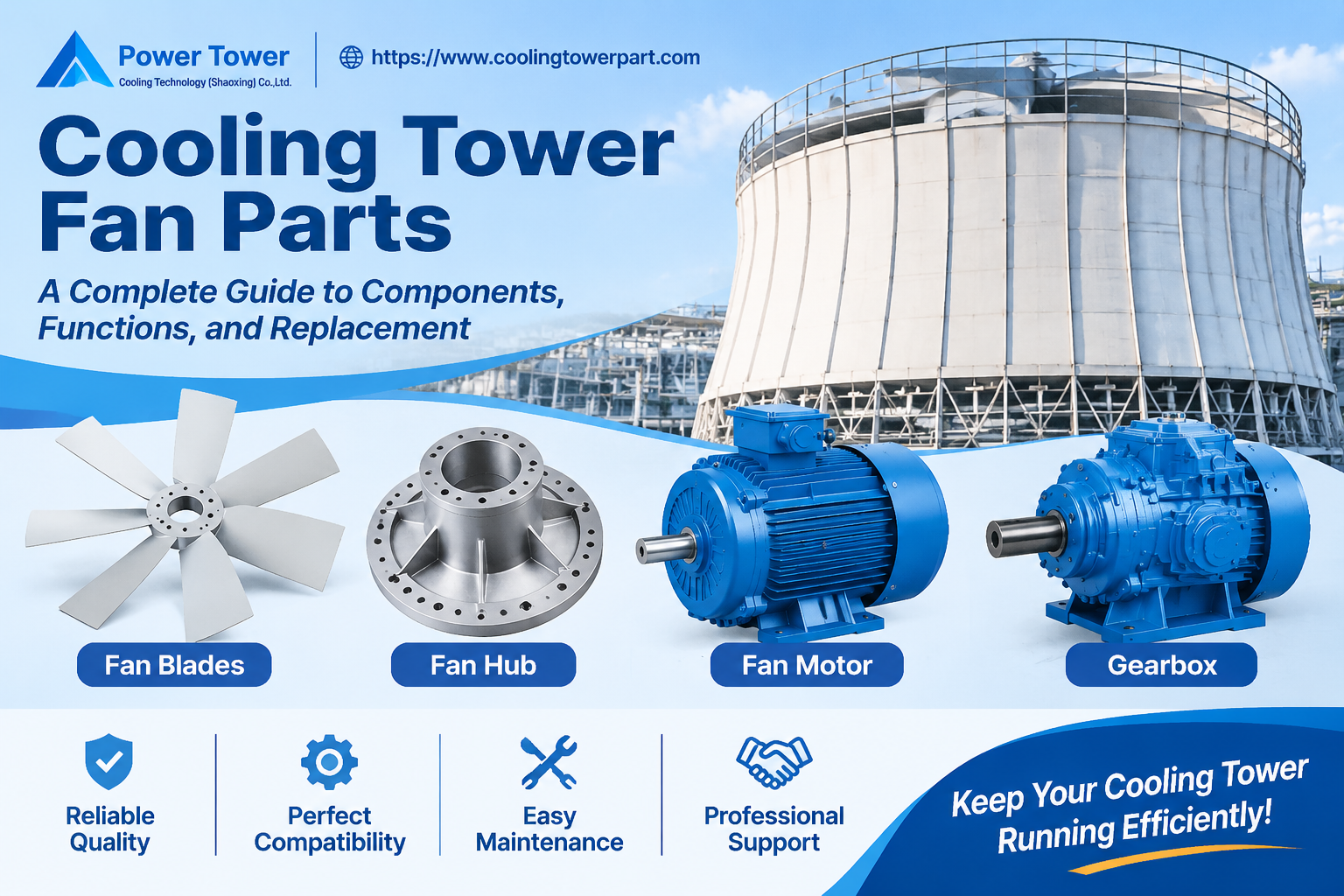
Each part has a specific job. Fan blades generate airflow. The hub connects and supports the blades. The motor provides power, while the gearbox adjusts rotational speed and transmits torque in gearbox-driven systems. If one component becomes damaged, loose, worn, or incorrectly selected, the entire fan assembly can be affected.
For cooling tower owners, maintenance teams, and purchasing managers, understanding these components makes it easier to identify problems and choose suitable replacement parts.
In this guide, Power Tower Cooling Technology (Shaoxing) Co.,Ltd. explains the main cooling tower fan parts, their functions, common problems, and practical replacement considerations. Whether you are maintaining an existing cooling tower or sourcing replacement components, this guide will help you make a more informed decision.
2. How Does a Cooling Tower Fan System Work?
A cooling tower fan creates airflow through the tower. As warm circulating water comes into contact with moving air, a portion of the water evaporates. This evaporation removes heat from the remaining water, reducing its temperature before the water returns to the cooling process.
The fan does not cool the water directly like a refrigeration compressor. Instead, it supports the air movement needed for heat and mass transfer.
2.1 The Role of the Fan in Heat Rejection
In a mechanical-draft cooling tower, the fan helps control airflow through the fill and other internal components.
Depending on the tower design, the fan may be installed above the tower or near the air inlet. Its position influences how air moves through the system.
An induced-draft cooling tower generally has the fan near the top. It pulls air through the tower and discharges it upward. A forced-draft design places the fan near the air inlet, where it pushes air into the tower.
Both arrangements use fans to support heat rejection, but their operating conditions and maintenance requirements can differ.
2.2 Axial Fans and Centrifugal Fans
Axial fans are widely used in many industrial cooling towers because they can move large volumes of air with relatively low pressure requirements. Air generally travels parallel to the fan shaft.
Centrifugal fans operate differently. They draw air into an impeller and discharge it in a direction that is generally perpendicular to the inlet flow. They are often considered when a system requires higher static pressure or has a different ducting arrangement.
Neither type is automatically better for every application. The correct choice depends on the required airflow, system resistance, fan curve, installation space, noise limits, and energy requirements.
3. Main Cooling Tower Fan Components
A cooling tower fan assembly can contain several mechanical and electrical components. The exact arrangement depends on the cooling tower manufacturer, fan design, drive system, and operating capacity.
The following are the main parts that maintenance teams and buyers should understand.
3.1 Cooling Tower Fan Blades
Fan blades are among the most visible and important cooling tower fan parts. They rotate to move air through the tower. Their shape, diameter, pitch, material, and operating speed all influence fan performance.
A blade is not simply a flat piece of material. Its aerodynamic profile is designed to generate airflow while controlling power consumption and mechanical loading.
Blade Materials and Design
Common cooling tower fan blade materials include:
FRP (fiberglass reinforced plastic): FRP blades offer a combination of strength, corrosion resistance, and relatively low weight. They are used in many industrial cooling tower applications.
Aluminum alloy: Aluminum blades are lightweight and can provide good mechanical performance when properly designed and protected for the operating environment.
Other engineered materials: Some fan designs use specially formulated composite materials to meet particular strength, weight, or environmental requirements.
Blade selection should consider more than material alone. Diameter, number of blades, airfoil profile, pitch, rotational speed, and fan-system resistance must all be compatible.
Common Blade Problems
Cooling tower fan blades may experience:
Damaged or mismatched blades can cause vibration, reduce airflow, and increase motor or gearbox loading.
Never assume that increasing the blade pitch will automatically improve cooling performance. A larger pitch may increase the aerodynamic load and cause the motor to draw excessive current. Any pitch adjustment should follow the fan manufacturer's instructions and be checked against the motor and drive-system limits.
3.2 Cooling Tower Fan Hub
The fan hub connects the blades to the rotating shaft or drive assembly. It supports the blades and transfers rotational force from the drive system to the fan.
Depending on the design, the hub may include a central body, blade mounting points, clamping arrangements, bolts, and other connection hardware.
A reliable hub helps maintain the correct blade position and distributes operating loads across the fan assembly.
Common hub problems include corrosion, cracks, loose fasteners, damaged threads, and wear around connection surfaces. A damaged hub can affect blade security and fan balance.
When replacing a hub, check the shaft connection, hub diameter, bolt pattern, blade mounting arrangement, material, and overall compatibility. A hub that looks similar to the original may still have different dimensions or load characteristics.
3.3 Cooling Tower Fan Motor
The motor supplies the mechanical power needed to rotate the fan. It is a critical component because its output must match the fan's operating requirements.
Cooling tower fan motors are often exposed to humid air, water droplets, temperature changes, and outdoor conditions. For this reason, motor protection and installation details deserve careful attention.
Important motor specifications include:
Rated power
Rated voltage and frequency
Full-load current
Rotational speed
Mounting arrangement
Shaft dimensions
Insulation class
Enclosure and ingress protection
Duty rating
Suitability for variable-frequency-drive operation, when applicable
A motor with insufficient power may struggle under the required load. An oversized motor is not automatically a better choice either. It may increase initial cost and could be poorly matched to the actual fan operating point.
Common motor problems include overheating, bearing failure, insulation deterioration, electrical imbalance, moisture ingress, and frequent protective trips.
Before ordering a replacement motor, confirm the nameplate data and mechanical interface. For gearbox-driven fans, also verify that the motor is compatible with the gearbox input arrangement.
3.4 Cooling Tower Fan Gearbox
A gearbox is used in many cooling tower fan systems to transmit power and reduce motor speed to the required fan speed. It provides the torque needed to drive the fan under the intended operating conditions.
Not every cooling tower uses a gearbox. Some systems use direct-drive arrangements, so buyers should first identify the existing drive configuration.
Common gearbox components may include gears, shafts, bearings, seals, lubrication passages, and a housing.
Typical gearbox problems include:
When replacing a gearbox, check the rated power, input speed, output speed, ratio, torque capacity, shaft arrangement, mounting dimensions, rotation direction, and lubrication requirements.
A gearbox that physically fits may still have an unsuitable ratio or load rating. Always verify the operating specifications before purchase.
3.5 Fan Shaft, Coupling, and Supporting Components
The shaft transfers torque between the drive system and the fan. Couplings connect rotating components and may accommodate limited alignment differences, depending on their design.
Supporting components can include bearing assemblies, mounting brackets, base frames, and fasteners.
These parts may receive less attention than blades or motors, but they are essential to stable operation.
A worn bearing can cause shaft movement and vibration. A damaged coupling can interrupt power transmission. Loose mounting hardware can create noise and increase mechanical stress.
During inspection, check for unusual movement, corrosion, cracks, damaged threads, lubricant leakage, and signs of misalignment.
3.6 Fan Stack and Protective Components
The fan stack, sometimes called the fan cylinder, surrounds or guides airflow around the fan. It helps direct air through the intended discharge path.
Depending on the cooling tower design, additional protective components may include guards, access covers, screens, and other safety-related structures.
Damage to the fan stack can affect airflow and create mechanical or safety concerns. Loose or missing guards can expose personnel to rotating equipment.
These components should be inspected as part of the complete fan-system maintenance program, not treated as unrelated accessories.
4. How Cooling Tower Fan Parts Work Together
A cooling tower fan is a coordinated mechanical system. The motor supplies power, and the gearbox or direct-drive arrangement transmits that power to the rotating assembly.
The shaft and hub transfer torque to the blades. The blades generate airflow, while the fan stack helps guide the air through the tower.
Think of the system as a chain: every link matters. A high-quality motor cannot compensate for damaged blades. A well-balanced fan cannot perform correctly if the gearbox has the wrong speed ratio. Likewise, a suitable blade set may still cause problems if the hub or mounting arrangement is incompatible.
For this reason, replacement decisions should consider the entire fan assembly rather than focusing on one component in isolation.
5. Common Cooling Tower Fan Parts Problems
Cooling tower fan parts operate under continuous mechanical loads and changing environmental conditions. Over time, wear and damage may affect performance.
Recognizing early warning signs can help maintenance teams prevent more serious failures.
5.1 Blade Damage and Imbalance
Cracked, deformed, or mismatched blades can create uneven rotating forces. This may lead to vibration, noise, and additional stress on bearings, shafts, and the drive system.
Deposits on blades can also affect balance. Even if the blades appear undamaged, uneven dirt or buildup may change their weight distribution.
Inspect blade surfaces, mounting points, fasteners, and pitch settings. If a blade needs replacement, confirm whether the fan manufacturer permits individual blade replacement and whether a complete matching set or rebalancing procedure is required.
5.2 Hub Loosening and Corrosion
The hub experiences repeated mechanical loading. Loose bolts, damaged threads, corrosion, and cracks can weaken the connection between the blades and the shaft.
Warning signs may include unusual noise, visible movement, rust around joints, or changes in vibration.
Do not attempt improvised welding, drilling, or other modifications to a damaged hub. Use a compatible replacement and follow the manufacturer's installation requirements.
5.3 Motor Overheating and Electrical Failure
A motor may overheat because of overload, voltage imbalance, poor ventilation, bearing problems, frequent starting, or incorrect drive settings.
Electrical problems can also cause repeated tripping or prevent the motor from starting.
Maintenance personnel should check the power supply, phase condition, current, protection settings, ventilation, and mechanical load. Electrical testing should be performed by qualified personnel.
Do not simply increase the overload protection setting to stop nuisance trips. The underlying cause must be identified first.
5.4 Gearbox Noise, Leakage, and Wear
A gearbox may produce abnormal noise or vibration when gears, bearings, or other internal components become worn or damaged. Oil leakage may indicate a seal problem, excessive pressure, incorrect oil level, or another mechanical issue.
Check the lubricant condition and level according to the gearbox manufacturer's instructions. Also inspect seals, mounting bolts, temperature, and vibration.
Using the wrong lubricant or operating with insufficient oil can accelerate wear and lead to serious gearbox damage.
6. When Should You Replace Cooling Tower Fan Parts?
There is no single replacement interval that applies to every cooling tower fan. Service life depends on operating hours, load, environment, material, maintenance quality, and the original component design.
Replacement may be necessary when:
A blade has a crack, serious deformation, or unacceptable damage.
The hub has structural cracks or damaged mounting points.
A motor has an electrical or mechanical fault that cannot be repaired economically.
A gearbox has severe internal wear or cannot maintain reliable operation.
A shaft, coupling, or bearing has excessive wear or damage.
A component no longer meets the required operating specifications.
Repeated repairs are becoming more expensive than a suitable replacement.
The decision should be based on inspection results, manufacturer guidance, operating risk, and repair economics—not simply the age of the component.
7. How to Choose the Right Cooling Tower Fan Replacement Parts
Choosing replacement parts requires more than matching a product photograph. A component must fit the existing equipment and perform safely under the actual operating conditions.
7.1 Check the Original Equipment Specifications
Start by collecting the original equipment information. Useful records include equipment nameplates, drawings, manuals, purchase records, and previous maintenance reports.
For a fan blade, record the diameter, number of blades, material, profile, pitch, and mounting arrangement where available.
For a motor, record power, voltage, frequency, speed, current, mounting, and shaft details.
For a gearbox, record the ratio, input and output speeds, power rating, torque requirements, and mounting dimensions.
If the original specifications are unavailable, take accurate measurements and consult a qualified supplier or equipment specialist before ordering.
7.2 Match Fan Performance Requirements
A replacement fan or blade set must meet the required airflow and operate within the drive system's limits.
Important factors include:
Required airflow
Fan diameter
Rotational speed
Static pressure
Fan performance curve
Blade design and pitch
Motor power and current
Gearbox ratio, if fitted
System resistance
Changing a fan's diameter, pitch, or speed can affect motor loading. A replacement should be evaluated as part of the complete system.
7.3 Consider Materials and Operating Conditions
Cooling towers often operate in humid environments where corrosion, water quality, temperature, and chemical exposure can affect component life.
FRP, aluminum alloy, coated metals, and other engineered materials have different properties. The correct material depends on the application and manufacturer's design.
For motors and electrical components, verify the required enclosure, ingress protection, insulation, and environmental suitability.
For mechanical parts, consider corrosion resistance, structural strength, fatigue performance, and compatibility with existing materials.
7.4 Verify Compatibility and Installation Dimensions
Before placing an order, confirm all critical dimensions and interfaces.
For example, two fan hubs may have similar external shapes but different shaft bores or bolt patterns. Two motors may have the same rated power but different shaft sizes or mounting arrangements.
A practical compatibility check should include drawings, dimensional measurements, connection details, and the original equipment model where available.
When uncertainty remains, share photographs, nameplate information, and technical drawings with the supplier.
8. Individual Part Replacement vs. Complete Fan Replacement
Should you replace one damaged component or the entire fan assembly? The answer depends on the condition and compatibility of the existing equipment.
Individual part replacement may be suitable when the damage is limited to one component and the remaining parts are in good condition. For example, replacing a compatible motor or a damaged hub may be more economical than replacing the complete assembly.
However, individual replacement requires careful compatibility checks. A new blade must match the fan design. A new gearbox must meet the required ratio and torque. A replacement motor must suit the drive arrangement and electrical supply.
Complete fan replacement may be worth considering when multiple components are worn, the existing design is obsolete, or the system no longer meets performance requirements.
A complete replacement can also provide an opportunity to review fan efficiency, operating speed, and maintenance needs.
Compare the total cost of parts, installation, downtime, balancing, and future maintenance before making the decision.
9. Cooling Tower Fan Parts Replacement Process
Replacing cooling tower fan components involves rotating machinery and electrical equipment. Safety must come before speed or convenience.
A general replacement workflow includes:
Review the equipment information. Confirm the fan arrangement, component specifications, and manufacturer's instructions.
Shut down and isolate the equipment. Apply the site's lockout/tagout procedure and isolate all relevant energy sources.
Verify zero energy and zero speed. Never work on a fan that may start unexpectedly or is still rotating.
Inspect the surrounding assembly. Check blades, hub, shaft, bearings, gearbox, motor, mounting, and fan stack.
Remove the damaged component. Use suitable tools and lifting equipment. Follow the correct sequence for the component.
Check the replacement part. Confirm dimensions, materials, ratings, and connection details before installation.
Install according to the manufacturer's instructions. Use the specified fasteners, tightening procedures, alignment requirements, and lubrication.
Inspect balance and alignment. Verify that the fan assembly meets the applicable requirements.
Reinstall protective devices. Confirm that guards and covers are correctly secured.
Perform controlled commissioning. Qualified personnel should check rotation direction, vibration, current, noise, and operating conditions.
The exact procedure varies by equipment design. Work at height, lifting, electrical isolation, and rotating machinery hazards must be managed under the site's safety procedures.
10. Maintenance Tips to Extend Component Service Life
Regular maintenance helps identify problems before they develop into expensive failures. A good maintenance program should cover the complete fan system.
10.1 Inspect Blades and Hubs
Look for cracks, deformation, corrosion, loose fasteners, and unusual deposits. Check that blades are secure and that the hub shows no signs of structural damage.
10.2 Monitor Vibration and Noise
Record vibration and noise trends where suitable monitoring equipment is available. A sudden change may indicate imbalance, looseness, bearing wear, misalignment, or another developing issue.
Do not assume that every vibration problem comes from the fan blades. The motor, gearbox, shaft, bearings, mounting structure, and surrounding equipment may also contribute.
10.3 Maintain Motors and Gearboxes
Follow the motor and gearbox manufacturers' instructions for lubrication, inspection, cleaning, and operating limits.
Check motor current, temperature, ventilation, electrical connections, and signs of moisture. For gearboxes, inspect oil level, lubricant condition, seals, temperature, and abnormal noise.
Avoid over-lubricating bearings. Some bearings are sealed for life, while others require lubrication at specified intervals and quantities.
10.4 Keep Maintenance Records
Record inspection dates, vibration readings, current measurements, repairs, component replacements, and operating observations.
These records help identify recurring problems and make future replacement decisions more accurate.
11. Factors Affecting Cooling Tower Fan Parts Costs
Cooling tower fan parts prices vary depending on the component and its technical requirements. A standard blade and a specially engineered fan hub do not have the same manufacturing or material costs.
Key price factors include:
Material: FRP, aluminum alloy, stainless steel, and other materials have different costs.
Dimensions: Larger or specially designed components may require more material and processing.
Technical specifications: Special profiles, tolerances, ratings, and connection designs can affect manufacturing costs.
Compatibility requirements: Custom dimensions or non-standard interfaces may require additional engineering.
Order quantity: Bulk orders may offer different unit pricing from individual replacement purchases.
Shipping and packaging: Large or fragile fan components may require special packaging and transportation arrangements.
Testing and documentation: Inspection, balancing, and requested technical documents may influence the final quotation.
When comparing suppliers, do not focus on the unit price alone. Consider product compatibility, quality consistency, delivery time, technical support, and expected service life.
12. How to Select a Reliable Cooling Tower Fan Parts Supplier
A reliable supplier should help you identify the correct component, not simply offer a product that looks similar.
Before choosing a cooling tower fan parts supplier, consider the following:
Product range: Can the supplier provide the components you need, such as blades, hubs, motors, gearboxes, and related accessories?
Technical understanding: Can the supplier review drawings, dimensions, equipment models, and operating specifications?
Material and quality control: Can the supplier explain the materials used and the inspection process?
Customization capability: Can the supplier evaluate non-standard dimensions or replacement requirements?
Communication: Does the supplier respond clearly to technical questions and provide useful product information?
Delivery and packaging: Can the supplier explain production lead times, packing methods, and shipping arrangements?
Ask for relevant drawings, specifications, photographs, and inspection information before confirming an order. For critical rotating components, make sure the replacement has been properly evaluated for its intended operating conditions.
13. Cooling Tower Fan Parts from Power Tower
Power Tower Cooling Technology (Shaoxing) Co.,Ltd. focuses on cooling tower components and replacement parts for industrial applications.
Website: https://www.coolingtowerpart.com
When maintaining a cooling tower, buyers may need more than one replacement component. A fan problem can involve blades, hubs, drive components, or supporting parts. Identifying the correct requirement before purchasing helps reduce compatibility risks and unnecessary downtime.
Power Tower provides a platform for customers looking for cooling tower components and replacement solutions. Buyers can visit the website to review relevant product information and contact the company with their equipment requirements.
To help evaluate a replacement request, it is useful to provide:
Cooling tower brand and model
Original component name or part number
Fan diameter and blade quantity, if applicable
Motor or gearbox nameplate information, where relevant
Drawings and installation dimensions
Photos of the existing component
Operating conditions and the reason for replacement
With this information, the replacement requirement can be assessed more accurately.
14. Frequently Asked Questions
14.1 What Are the Main Parts of a Cooling Tower Fan?
The main parts typically include fan blades, a hub, a motor, and, in gearbox-driven systems, a gearbox. Other components may include shafts, couplings, bearings, mounting hardware, a fan stack, and protective guards. The exact arrangement depends on the cooling tower design.
14.2 How Long Do Cooling Tower Fan Parts Last?
There is no universal service life for all cooling tower fan parts. Operating hours, loading, material, water and air conditions, maintenance, and installation quality all affect service life. Regular inspection is more reliable than using a fixed replacement interval for every component.
14.3 Can I Replace Only One Fan Blade?
Sometimes, but only when the fan design and manufacturer allow individual blade replacement. The replacement blade must match the required specifications, and the complete fan assembly must meet the applicable balance and operating requirements. In some cases, replacing a matched set is more appropriate.
14.4 How Do I Know Whether the Fan or Motor Is Faulty?
Start with a complete inspection. Reduced airflow may be caused by incorrect rotation, damaged blades, blocked air passages, poor water distribution, or other system problems—not necessarily a motor fault.
Check motor current, voltage, temperature, vibration, and mechanical condition. Electrical diagnosis should be performed by qualified personnel.
14.5 What Information Is Needed When Ordering Replacement Parts?
Provide the cooling tower model, original component details, part number if available, measurements, photographs, and relevant nameplate information. For blades, include diameter, blade quantity, material, and mounting details where known. For motors and gearboxes, provide their technical ratings and connection specifications.
The more accurate the information, the easier it is to identify a compatible replacement.
15. Conclusion
Cooling tower fan parts work together to maintain airflow and support reliable heat rejection. Blades generate airflow, hubs connect the blades to the rotating assembly, motors provide power, and gearboxes transmit and adjust speed in systems that use them. Shafts, bearings, couplings, and supporting structures complete the mechanical system.
When a component becomes damaged or worn, replacing it with a compatible part is essential. Buyers should check the original specifications, operating requirements, dimensions, materials, and installation interfaces before placing an order.
Regular inspection and proper maintenance can also help extend component service life and reduce unexpected downtime.
For industrial cooling tower component and replacement-part requirements, contact Power Tower Cooling Technology (Shaoxing) Co.,Ltd. through https://www.coolingtowerpart.com to discuss your application and equipment details.


