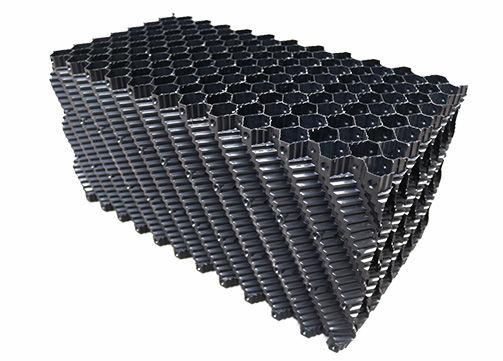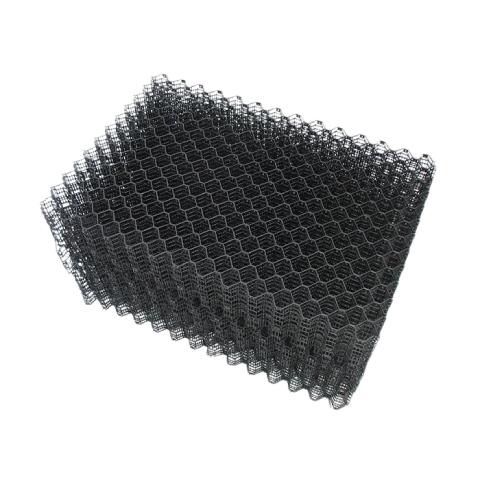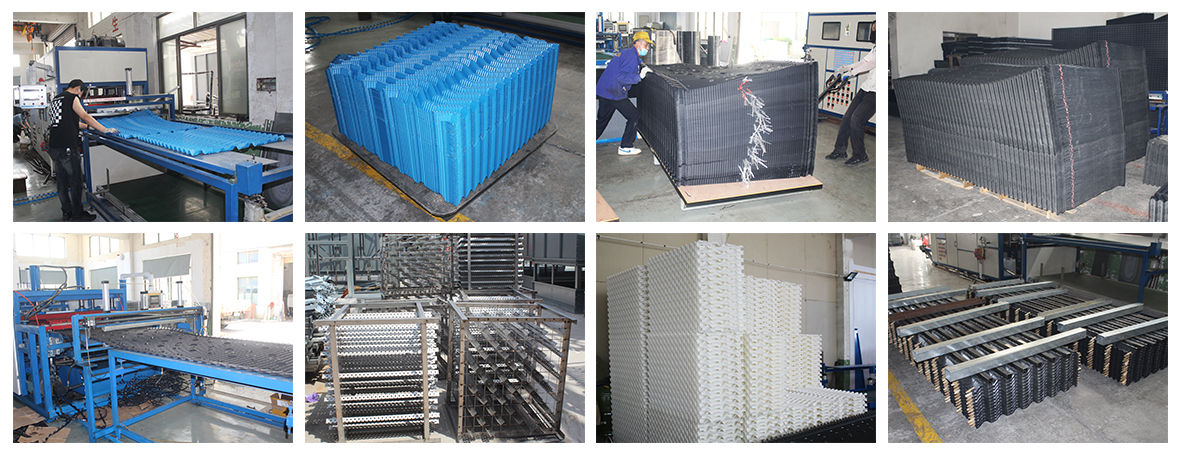
Cooling tower fill is one of the most important components inside a cooling tower. It increases the contact area between hot process water and moving air, allowing heat to transfer more efficiently and helping the tower achieve the required cooling performance.
But what is the fill material in a cooling tower?
The most common cooling tower fill materials are PVC (polyvinyl chloride) and PP (polypropylene). Depending on the tower design, water quality, temperature, and operating conditions, other materials may also be used. Cooling tower fill is generally manufactured as film fill or splash fill, with each type designed for different applications.
This guide explains cooling tower fill materials, their advantages, common types, and how to choose the right fill for a replacement or retrofit project.
What Is Cooling Tower Fill?
Cooling tower fill is the internal media installed in the water distribution area of a cooling tower. Its main purpose is to increase the surface area available for contact between water and air.
Instead of allowing water to fall directly through the tower, fill breaks the water into thin films or droplets. This creates more contact time and surface area, improving evaporative cooling.
A properly selected cooling tower fill can help:
Increase heat transfer efficiency
Improve cooling tower capacity
Reduce required tower size
Maintain stable outlet water temperature
Improve water distribution
Support energy-efficient operation
Because fill operates continuously in a wet and chemically active environment, its material must provide suitable mechanical strength, temperature resistance, and chemical resistance.
What Material Is Cooling Tower Fill Made Of?
PVC Cooling Tower Fill
PVC cooling tower fill is one of the most widely used materials for film-fill applications.
PVC sheets can be formed into corrugated or other structured profiles that promote water spreading and air-water contact. PVC is relatively economical, easy to process, and suitable for many industrial and commercial cooling towers.
Common characteristics include:
PVC film fill is commonly used in crossflow and counterflow cooling towers.
However, the allowable operating temperature must be checked carefully. High-temperature applications may require a different material or specially formulated fill.
PP Cooling Tower Fill
PP, or polypropylene, cooling tower fill is another widely used option, particularly where higher temperature or chemical resistance is important.
PP has a higher temperature capability than standard PVC in many applications and offers good resistance to a wide range of chemicals.
Typical advantages include:
Higher temperature resistance
Good chemical resistance
Low water absorption
Good mechanical properties
Suitable for demanding industrial applications
PP is available in both film-fill and splash-fill configurations.
When selecting PP fill, buyers should still verify the actual water temperature, chemical concentration, flame-retardancy requirements, and manufacturer specifications.
Film Fill vs. Splash Fill
Cooling tower fill is generally divided into two major categories: film fill and splash fill.
Film Fill
Film fill uses closely spaced sheets with formed surfaces. Water spreads over the sheets as a thin film while air moves through the fill.
The large effective surface area allows efficient heat and mass transfer.
Film fill is commonly selected when:
High thermal efficiency is required
Relatively clean circulating water is available
The tower needs compact, high-performance fill
The application uses crossflow or counterflow tower designs
PVC and PP are common materials for film fill.
Splash Fill
Splash fill works differently. Water repeatedly hits bars, grids, or other splash surfaces and breaks into droplets.
The repeated splashing increases water-air contact and promotes evaporation.
Splash fill is often preferred for applications where circulating water contains suspended solids or where fouling resistance is more important than maximum compactness.
Common splash-fill materials include PP and PVC, although specific designs and materials vary by manufacturer.
Why Is PVC So Common for Cooling Tower Fill?
PVC has become a popular material because it provides a practical balance between performance, cost, processability, and chemical resistance.
A PVC cooling tower fill sheet can be thermoformed into a structured surface that improves water distribution and air contact.
For many standard cooling tower applications, PVC offers sufficient durability without the higher material cost associated with some alternatives.
However, "PVC" alone does not determine whether a fill is suitable. Buyers should consider the complete operating environment.
Why Use PP Cooling Tower Fill?
PP cooling tower fill is frequently considered when operating conditions are more demanding.
For example, an industrial cooling tower may operate with higher water temperatures or specific chemical-treatment requirements. In such cases, PP can provide a useful alternative to conventional PVC.
PP fill can also be selected for splash-fill applications where durability and fouling resistance are important.
The correct choice should always be based on the manufacturer's temperature and chemical compatibility data.
How Does Cooling Tower Fill Work?
The basic cooling process is simple.
Hot water enters the cooling tower and is distributed over the fill. As the water moves downward, air passes through the fill.
A portion of the water evaporates. The energy required for evaporation comes from the circulating water, reducing its temperature.
The fill improves this process by:
Increasing water surface area
Increasing air-water contact
Extending water contact time
Improving water distribution
Promoting evaporation
The fill therefore has a direct influence on the tower's heat-transfer performance.
What Are the Most Common Cooling Tower Fill Types?
Besides the basic film and splash classifications, fill products can have different physical designs.
Common examples include:
PVC film fill
PP film fill
PVC crossflow fill
PP counterflow fill
High-temperature PP fill
Splash bars
Grid splash fill
Ladder-type splash fill
Hybrid fill systems
The correct configuration depends on the cooling tower design and operating conditions.
How to Choose Cooling Tower Fill Material
Choosing fill material should not be based on price alone. Before purchasing cooling tower fill, evaluate the following factors.
1. Operating Temperature
Check the normal and maximum circulating-water temperature.
High-temperature applications may require PP or a specialized fill design.
2. Water Quality
Water containing suspended solids, biological growth, scale, or debris can cause fill blockage.
For poor-quality water, splash fill may be worth considering because its larger openings can provide better fouling resistance.
3. Chemical Compatibility
Cooling tower water may contain biocides, corrosion inhibitors, acids, alkalis, and other treatment chemicals.
Confirm that the selected PVC or PP material is compatible with the treatment program.
4. Tower Type
Identify whether the tower is:
Crossflow
Counterflow
Induced draft
Forced draft
Mechanical draft
The fill geometry must match the tower's internal arrangement and airflow pattern.
5. Existing Fill Dimensions
For replacement projects, measure the existing fill blocks carefully.
Important dimensions include:
A replacement fill should fit the existing tower without creating airflow or structural problems.
What Causes Cooling Tower Fill to Fail?
Even durable PVC and PP fill can eventually require replacement.
Common causes include:
Scale and Mineral Deposits
Hard-water minerals can build up on fill surfaces and reduce effective heat-transfer area.
Biological Growth
Algae, bacteria, and other biological deposits can block airflow and water passages.
Dirt and Suspended Solids
Dust, sand, rust, and process contaminants may accumulate inside the fill.
High Temperature
Operating above the recommended material temperature can cause deformation or premature failure.
Chemical Attack
Incorrect water treatment or excessive chemical concentrations may damage the fill material over time.
Mechanical Damage
Improper cleaning, installation, or support can break or deform fill sheets.
When Should Cooling Tower Fill Be Replaced?
Cooling tower fill should be inspected regularly. Replacement may be necessary when the fill becomes severely blocked, brittle, deformed, cracked, or structurally damaged.
Typical warning signs include:
Higher approach temperature
Reduced cooling capacity
Increased pressure drop
Uneven water distribution
Visible fill deformation
Heavy scaling or fouling
Broken fill sheets or blocks
Replacing damaged fill can restore water-air contact and help the cooling tower operate closer to its intended performance.
Cooling Tower Fill Replacement: What Buyers Should Check
For an industrial cooling tower fill replacement, provide the supplier with as much information as possible.
Useful information includes:
Cooling tower manufacturer
Tower model
Crossflow or counterflow configuration
Existing fill type
Fill dimensions
Operating water temperature
Water quality
Required cooling capacity
Existing photographs or drawings
A supplier can then recommend a suitable PVC or PP cooling tower fill replacement.
For branded towers such as Marley, BAC, EVAPCO, SPX, Hamon, or Liang Chi, the replacement fill should be matched to the tower's actual dimensions and operating requirements rather than selected by brand name alone.
PVC vs. PP Cooling Tower Fill
| Feature | PVC Fill | PP Fill |
| Material cost | Generally economical | Generally higher |
| Temperature resistance | Good for standard applications | Generally higher |
| Chemical resistance | Good | Very good |
| Common application | Film fill | Film and splash fill |
| Water quality suitability | Best with relatively clean water | Depends on design |
| Replacement availability | Widely available | Widely available |
Actual performance depends on the specific formulation, geometry, thickness, and manufacturer.
Frequently Asked Questions
What is the most common cooling tower fill material?
PVC is one of the most common materials for cooling tower film fill. PP is also widely used, especially for applications requiring higher temperature or chemical resistance.
Is PVC or PP better for cooling tower fill?
Neither material is universally better. PVC can be suitable for many standard applications, while PP may be preferred for higher-temperature or more demanding conditions. Water quality and fill design are equally important.
How long does cooling tower fill last?
Service life varies considerably. Water quality, temperature, chemical treatment, UV exposure, cleaning practices, and mechanical conditions all affect fill life.
Can cooling tower fill be cleaned?
Yes. Depending on the fill design and condition, cleaning may remove scale, biological deposits, and debris. Cleaning methods should follow the fill manufacturer's recommendations to avoid damaging the sheets.
Can PVC film fill be replaced with PP fill?
Potentially, but the replacement should be checked for dimensions, temperature rating, chemical compatibility, airflow resistance, water distribution, and thermal performance before installation.
Conclusion
So, what is the fill material in a cooling tower?
The most common answers are PVC and polypropylene (PP). PVC is widely used for economical and efficient film-fill applications, while PP offers advantages where higher temperature resistance or specific chemical compatibility is required.
The material is only one part of the selection process. Fill type, geometry, water quality, operating temperature, tower configuration, and replacement dimensions all affect cooling tower performance.
For a cooling tower fill replacement project, choosing the correct PVC cooling tower fill, PP cooling tower fill, film fill, or splash fill can help maintain heat-transfer efficiency and extend the useful life of the tower.
Internal Links for Other CoolingTowerParts
Cooling Tower Fill
Cooling Tower Nozzles
Cooling Tower Drift Eliminators
Cooling Tower Louvers
Cooling Tower Fan Blades
Cooling Tower Motors