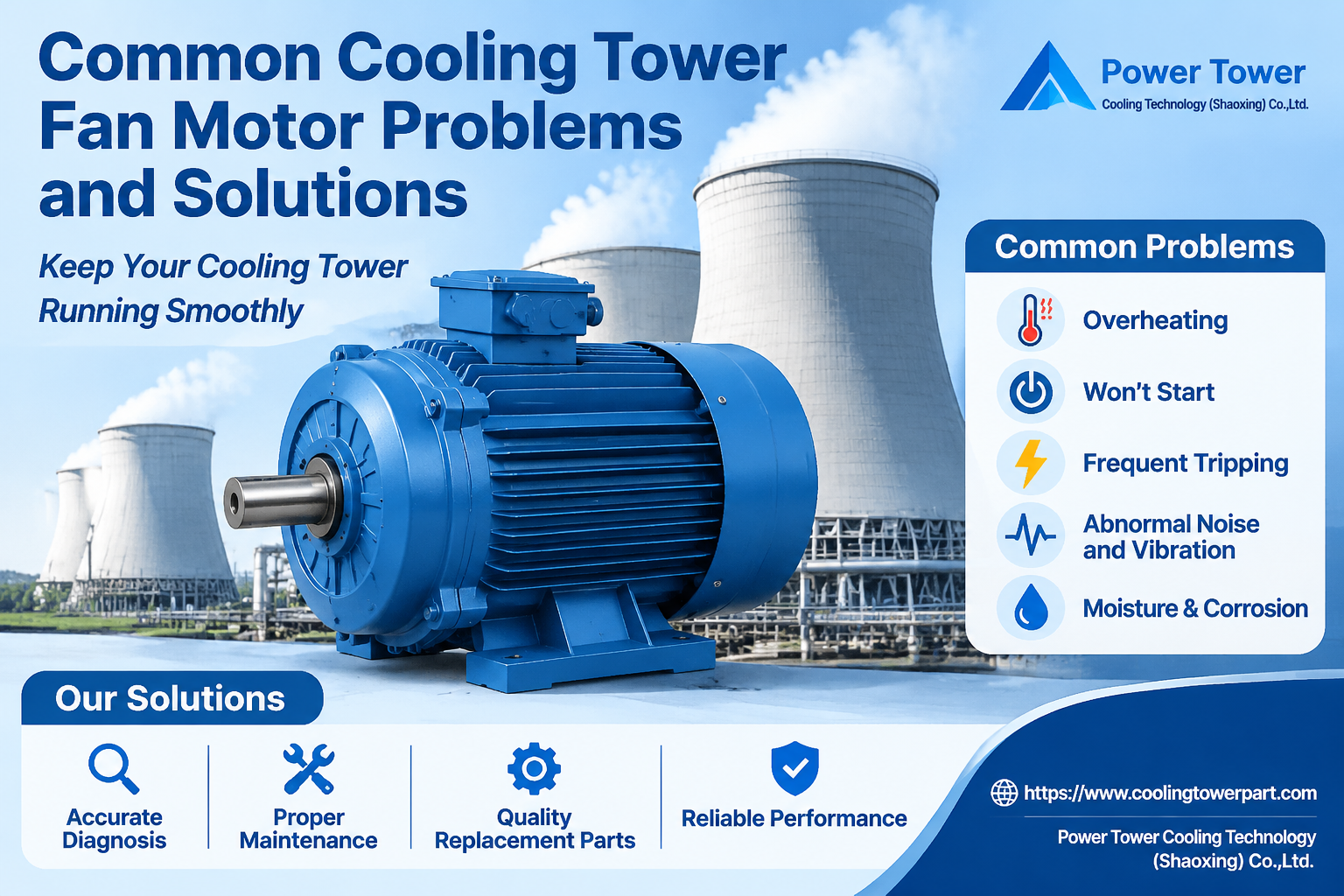
1. Introduction: Why Cooling Tower Fan Motor Reliability Matters
A cooling tower fan motor may look like an ordinary industrial motor, but its role in a cooling system is extremely important. It provides the power needed to drive the fan, move air through the tower, and support the heat rejection process.
When the motor works properly, the cooling tower can maintain the airflow required by its design. When something goes wrong, however, the consequences can spread quickly. You may notice unusual noise, excessive vibration, higher electricity consumption, frequent electrical trips, or reduced cooling performance.
Even worse, an unexpected motor failure can force an industrial cooling system to shut down.
So, what are the most common cooling tower fan motor problems? Why does a motor overheat? What causes repeated tripping? And how can you decide whether to repair the motor or replace it?
This guide explains the most common cooling tower fan motor problems, their possible causes, and practical solutions. It also covers preventive maintenance and replacement motor selection to help you keep your cooling tower operating reliably.
2. How Does a Cooling Tower Fan Motor Work?
Before troubleshooting a motor, it helps to understand its job within the cooling tower.
A mechanical cooling tower uses a fan to move air through the tower. Warm circulating water flows over or through the fill, while air passes through the tower and supports evaporative heat transfer. The fan motor provides the mechanical power required to move that air.
2.1 The Motor's Role in Airflow and Heat Rejection
Think of the motor as the power source behind the cooling tower's airflow system.
It converts electrical energy into mechanical rotation. This rotation drives the fan, which moves air through the cooling tower at the rate required by the system design.
If the motor cannot deliver the required power or speed, airflow may decrease. Depending on the operating conditions, this can affect the tower's ability to achieve its required cold-water temperature.
However, poor cooling performance does not automatically mean the motor is defective. Blocked fill, poor water distribution, damaged fan blades, incorrect fan rotation, or excessive system resistance can also reduce cooling performance.
A proper diagnosis should consider the entire cooling tower system.
2.2 Direct-Drive vs. Gearbox-Driven Motors
Cooling tower fan motors generally operate in two common arrangements.
Direct-drive systems
In a direct-drive arrangement, the motor connects directly to the fan or through a suitable coupling. The motor speed is closely related to the fan speed.
This arrangement has fewer drive components, but the motor must be selected to match the fan's operating requirements.
Gearbox-driven systems
In a gearbox-driven arrangement, the motor connects to a reduction gearbox. The gearbox reduces motor speed and transfers torque to the fan.
This arrangement is common in many larger industrial cooling towers.
It introduces additional components that require inspection, including gears, bearings, lubrication systems, couplings, and drive shafts.
Understanding which arrangement your cooling tower uses is essential when diagnosing problems or ordering replacement parts.
3. Common Cooling Tower Fan Motor Problems
Cooling tower fan motors operate in demanding environments. Humidity, water exposure, vibration, electrical fluctuations, and continuous operating hours can all affect their service life.
The following table summarizes common motor problems and their possible causes.
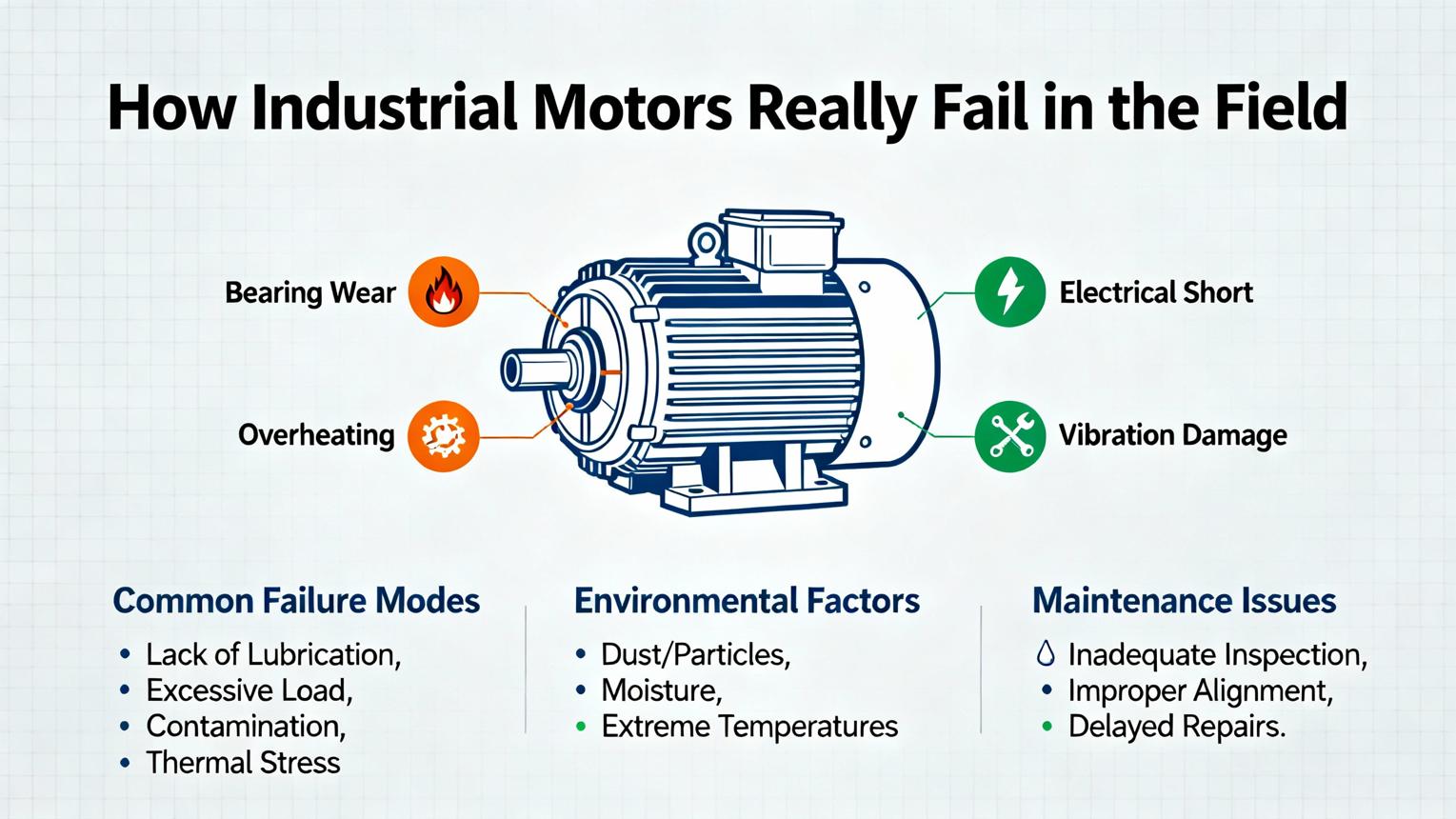
| Motor Problem | Possible Causes | Recommended Action |
| Motor overheating | Overload, poor ventilation, voltage imbalance, bearing problems | Check load, electrical supply, cooling passages, and bearings |
| Motor will not start | Power failure, control fault, overload trip, winding damage | Inspect supply, protection devices, and motor condition |
| Frequent tripping | Excessive load, electrical faults, incorrect protection settings | Measure current and investigate the cause |
| Abnormal noise | Bearing wear, loose components, mechanical contact | Inspect bearings, mounting, and connected equipment |
| Excessive vibration | Imbalance, misalignment, looseness, damaged bearings | Check the complete rotating assembly |
| Insulation failure | Moisture, contamination, overheating, aging | Test insulation and evaluate repair or replacement |
| Incorrect operating speed | VFD settings, supply frequency, drive issues | Verify motor speed and control settings |
Let's look at each problem in more detail.
4. Cooling Tower Fan Motor Overheating
Motor overheating is one of the most common warning signs in industrial cooling tower operation.
An electric motor naturally produces some heat during operation. However, excessive temperature can damage insulation, shorten bearing life, and eventually cause motor failure.
4.1 Common Causes of Motor Overheating
1. Excessive mechanical load
If the fan requires more power than the motor can safely deliver, the motor may draw excessive current and overheat.
Possible reasons include incorrect fan blade pitch, a damaged fan assembly, mechanical interference, or an unsuitable replacement fan.
2. Poor ventilation
Cooling tower environments can contain moisture, dust, and airborne contaminants. Dirt or debris around the motor's cooling passages can restrict airflow and reduce heat dissipation.
3. Voltage imbalance
An imbalance between the phases of a three-phase electrical supply can cause unequal current and additional motor heating.
Even when the motor continues running, prolonged voltage imbalance can shorten its service life.
4. Bearing problems
Worn or damaged bearings can increase friction and mechanical resistance. This may increase motor load and contribute to overheating.
5. Frequent starting and stopping
Repeated starts can create additional electrical and thermal stress. The actual effect depends on motor design, starting method, load, and operating cycle.
4.2 Practical Solutions
If the motor becomes unusually hot, do not immediately assume that it needs replacement.
Start by checking the following:
Measure voltage and current on all phases.
Compare operating current with the motor nameplate rating.
Inspect motor cooling passages and ventilation.
Check bearing condition and lubrication requirements.
Inspect fan blades, hub, and connected drive components.
Verify that the fan operates within its approved performance range.
If overheating continues after the underlying problem has been corrected, a qualified technician should evaluate the motor's insulation and internal condition.
Never ignore repeated overheating. It is often an early warning of a more serious problem.
5. Cooling Tower Fan Motor Won't Start
A cooling tower fan motor that refuses to start can interrupt the entire cooling process. Fortunately, the cause is not always a failed motor.
5.1 Electrical Supply and Control Problems
Start with the electrical supply and control system.
Common causes include:
No incoming power
Blown fuses
Tripped circuit breakers
Overload protection activation
Faulty contactors
Loose electrical connections
Incorrect control signals
Problems with a variable frequency drive
A motor may also fail to start if an interlock or safety device prevents operation.
Qualified electrical personnel should check the supply voltage, control circuit, protection devices, and relevant drive equipment.
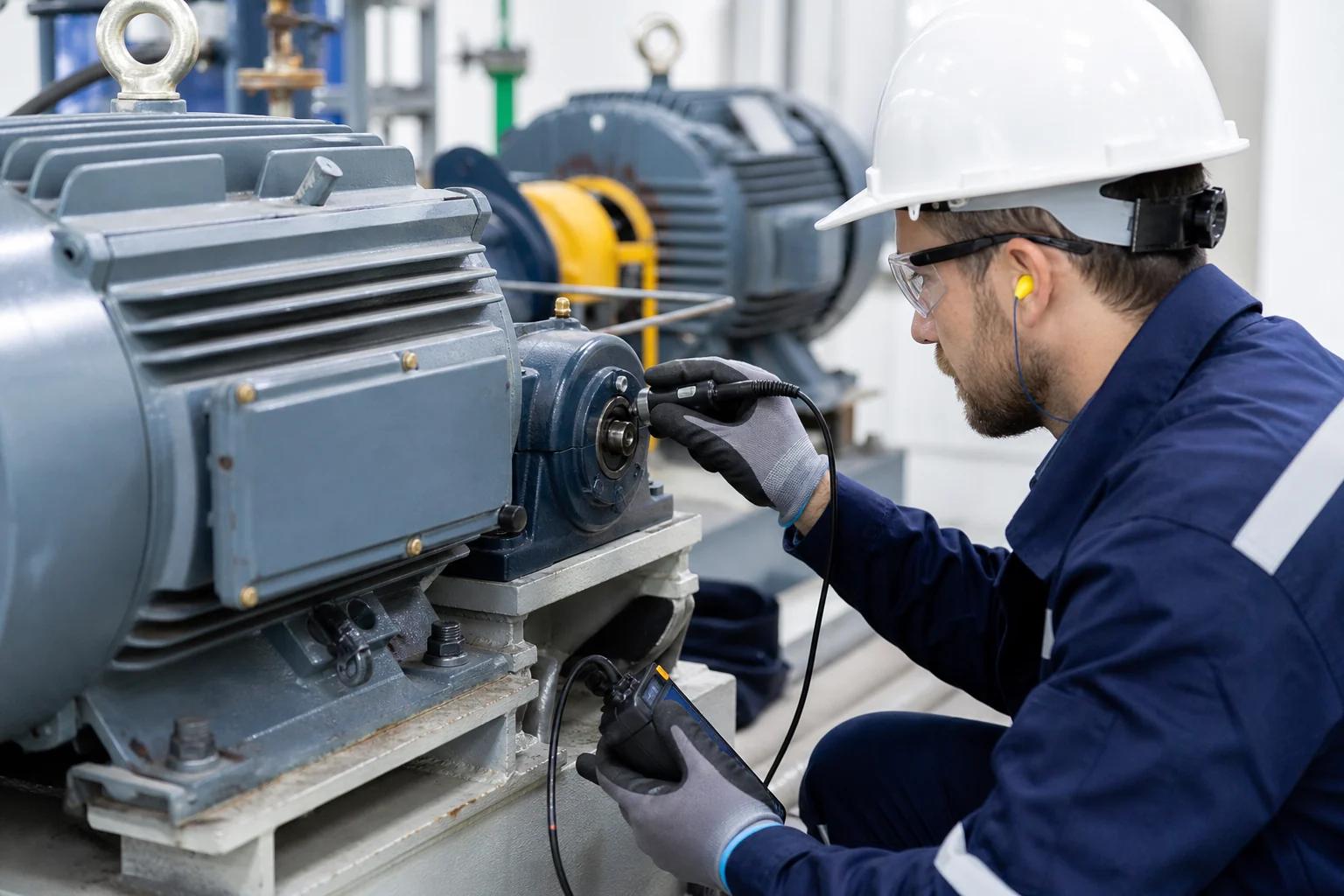
5.2 Motor and Mechanical Problems
If the electrical supply is normal, the motor itself or the connected mechanical system may be responsible.
Possible problems include winding damage, bearing seizure, shaft obstruction, or mechanical interference within the fan drive system.
A motor that hums but cannot rotate requires prompt investigation. Repeatedly attempting to start it can cause additional electrical and thermal damage.
Solution: Isolate the equipment, verify that it is safe to inspect, and check the motor and connected rotating components. Repair or replace defective parts according to the manufacturer's requirements.
6. Motor Trips Frequently or Draws Excessive Current
Does your cooling tower fan motor keep tripping even after you reset the protection device?
This is a problem that deserves attention. Repeatedly resetting the motor without finding the cause can create further damage.
6.1 Possible Causes
Frequent motor tripping may result from:
Mechanical overload
Low or unbalanced supply voltage
Phase loss
Short circuits or insulation deterioration
Bearing problems
Incorrect motor protection settings
Excessive fan load
Faulty electrical connections
A cooling tower fan motor may also experience increased load after changes to fan blades, pitch, or drive components.
6.2 Troubleshooting and Solutions
Start by recording the conditions under which the motor trips.
Does it trip immediately during startup? Does it operate for several minutes before tripping? Does the problem appear only under certain operating conditions?
These details help narrow down the possible causes.
A qualified technician should measure the phase currents, check supply voltage, inspect electrical connections, and compare actual operating conditions with the motor's rated specifications.
Also inspect the fan and drive system for abnormal resistance or mechanical damage.
Do not simply increase the overload setting to stop nuisance trips. Protection settings must be coordinated with the motor nameplate and applicable electrical requirements.
7. Abnormal Motor Noise and Vibration
A healthy cooling tower fan motor should operate without unusual mechanical noise or excessive vibration.
If you hear grinding, rattling, humming, or knocking, investigate the cause rather than assuming the motor has failed.
7.1 Bearing Wear and Mechanical Looseness
Bearings support the motor shaft and allow it to rotate smoothly. Over time, contamination, improper lubrication, misalignment, or normal wear can damage them.
Common warning signs include:
Grinding or squealing sounds
Increased vibration
Abnormal bearing temperature
Rough shaft rotation
Excessive bearing clearance
Loose mounting bolts or damaged brackets can also create vibration and noise.
The solution may involve bearing replacement, mounting correction, or other approved repairs. Follow the motor manufacturer's bearing and lubrication specifications.
7.2 Misalignment and Fan Imbalance
Sometimes, the motor is not the source of the vibration.
A damaged or unbalanced fan, loose hub connections, bent shaft, worn coupling, or gearbox problem can transmit vibration back through the drive system.
For gearbox-driven towers, alignment between the motor, gearbox, and drive shaft is particularly important.
Inspect the complete rotating assembly before deciding which component needs replacement.
8. Cooling Tower Fan Motor Bearing Failure
Bearing failure deserves special attention because it can affect both motor reliability and mechanical safety.
Common contributing factors include:
Insufficient or incorrect lubrication
Excessive lubrication
Contamination from moisture or dirt
Misalignment
Excessive radial or axial loading
Incorrect bearing installation
Normal fatigue and wear
Not every motor bearing requires the same lubrication interval or method. Some bearings are sealed for life, while others require periodic lubrication.
Always follow the motor manufacturer's maintenance instructions. Adding more grease is not automatically a good solution. Over-greasing can also increase bearing temperature and damage seals.
If bearing noise, vibration, or temperature increases, arrange an inspection before the problem causes further damage to the motor shaft or housing.
9. Moisture, Corrosion, and Insulation Problems
Cooling towers naturally create humid operating environments. Motors installed nearby may be exposed to moisture, water droplets, chemicals, and airborne contaminants.
Over time, these conditions can affect electrical insulation and metal components.
Common warning signs include:
Corrosion on the motor housing
Deteriorated cable connections
Moisture inside electrical enclosures
Insulation resistance deterioration
Rust around mounting surfaces
Damaged protective coatings
Moisture can reduce insulation performance and increase the risk of electrical faults.
Practical solutions:
Select a motor with suitable environmental protection for the installation.
Inspect cable glands, terminal boxes, and seals.
Keep ventilation passages clean.
Check for water leakage or direct spray exposure.
Arrange insulation testing when required.
Repair damaged protective coatings using suitable methods.
The motor's enclosure rating and installation arrangement should match the actual site conditions. A motor described as industrial-duty is not automatically suitable for every cooling tower environment.
10. Cooling Tower Fan Motor Runs at the Wrong Speed
Incorrect motor speed can affect fan airflow, energy consumption, and cooling tower performance.
In a fixed-speed system, the operating speed is mainly determined by the motor design and supply frequency, with a small difference between synchronous and actual induction motor speed under load.
In variable-speed systems, a variable frequency drive (VFD) controls motor speed by adjusting the electrical supply frequency and voltage according to the drive's control strategy.
Possible causes of incorrect speed include:
Incorrect VFD frequency settings
Control signal problems
Incorrect motor configuration
Supply frequency differences
Drive faults
Incorrect replacement motor specifications
If the fan runs too slowly, airflow may be insufficient. If it runs faster than the approved design speed, motor loading and mechanical stress may increase.
Never increase the operating frequency simply to obtain more airflow. Verify the fan's maximum permitted speed, motor ratings, gearbox limitations, and system design before making adjustments.
11. Cooling Tower Fan Motor Troubleshooting Checklist
A structured troubleshooting process makes it easier to identify the real problem.
| Inspection Item | What to Check | Why It Matters |
| Power supply | Voltage, phase condition, frequency | Identifies electrical supply problems |
| Motor current | Current on each phase | Helps identify overload or imbalance |
| Motor temperature | Operating temperature and trends | Reveals possible thermal problems |
| Bearings | Noise, vibration, lubrication condition | Identifies mechanical wear |
| Motor insulation | Insulation condition and test results | Helps identify electrical deterioration |
| Fan assembly | Blade damage, pitch, imbalance | Checks whether fan load is abnormal |
| Gearbox and coupling | Noise, alignment, lubrication | Identifies drive-related problems |
| VFD and controls | Parameters, alarms, control signals | Checks speed-control problems |
For a reliable diagnosis, compare inspection results with the motor nameplate, equipment drawings, and manufacturer recommendations.
Do not rely on one symptom alone. For example, high motor temperature could result from electrical imbalance, mechanical overload, poor ventilation, or bearing problems.
12. How to Prevent Cooling Tower Fan Motor Problems
Preventive maintenance is usually more economical than dealing with an unexpected motor failure.
You do not need to wait for unusual noise or an electrical trip before inspecting the equipment.
12.1 Regular Inspection
Create an inspection routine based on operating hours, site conditions, and manufacturer recommendations.
Check motor temperature, vibration, noise, mounting bolts, cable connections, and visible corrosion.
Record the results so you can identify changes over time.
12.2 Electrical Maintenance
Electrical inspections should include:
Supply voltage and phase balance
Operating current
Electrical connections
Overload and short-circuit protection
Insulation condition
VFD alarms and settings, where applicable
Electrical testing and repairs should be performed by qualified personnel using appropriate procedures.
12.3 Mechanical Maintenance
The motor does not work alone. Its condition depends partly on the fan and drive system.
Inspect fan blades, hub connections, shaft alignment, couplings, gearbox condition, and bearing performance.
Remove dirt buildup that could affect fan balance, and correct mechanical problems before they create additional motor loading.
12.4 Environmental Protection
Protect the motor from unnecessary water exposure, contamination, and corrosion.
Check the installation's drainage, ventilation, cable sealing, and protective covers where applicable.
A suitable motor installation can significantly reduce the risk of moisture-related electrical problems.
13. When Should You Repair or Replace a Cooling Tower Fan Motor?
Not every motor problem requires a new motor. Some issues can be corrected through maintenance or component replacement.
For example, a motor may only need a bearing replacement, connection repair, or correction of an external mechanical problem.
However, replacement may be more appropriate when:
The motor winding has severe damage.
The motor housing or shaft is structurally damaged.
Repeated failures continue after proper repairs.
Repair costs approach the cost of a suitable replacement.
The motor cannot meet the required operating conditions.
Replacement parts are unavailable or the motor is obsolete.
Before making a decision, compare repair costs, replacement costs, expected service life, energy efficiency, downtime, and compatibility.
A replacement motor should not be selected only because it has the same physical size. Its electrical and mechanical specifications must also match the cooling tower fan system.
14. How to Choose a Replacement Cooling Tower Fan Motor
Choosing the correct replacement motor is essential for safe and reliable operation.
14.1 Power, Voltage, and Frequency
Check the original motor nameplate for:
Rated power (kW or HP)
Rated voltage
Frequency (Hz)
Rated current
Phase
Power factor
Efficiency rating
The replacement must be suitable for the electrical supply and required mechanical load.
Do not automatically select a higher-power motor. A larger motor does not solve an incorrectly designed fan system or an underlying mechanical problem.
14.2 Speed, Mounting, and Shaft Dimensions
Motor speed and mounting arrangement must match the drive system.
Confirm:
Rated speed
Mounting type
Frame size
Shaft diameter and length
Keyway dimensions, where applicable
Coupling or gearbox connection
Installation orientation
For gearbox-driven cooling towers, verify that the replacement motor is compatible with the gearbox input requirements.
14.3 Protection and Efficiency
Cooling tower motors operate in humid environments, so environmental protection matters.
Check the required ingress protection rating, insulation class, cooling method, duty rating, and ambient temperature limits.
You should also compare energy efficiency ratings. Higher-efficiency motors may reduce electricity consumption, but actual savings depend on operating hours, loading, system design, and energy prices.
If the motor uses a VFD, confirm that it is suitable for the intended variable-speed operation.
15. Cooling Tower Fan Motor Replacement Cost Factors
The price of a replacement cooling tower fan motor depends on several factors.
Motor power: Larger motors generally require more materials and may cost more.
Efficiency rating: Higher-efficiency designs can have a different purchase price and operating-cost profile.
Protection requirements: Motors designed for demanding environments may require additional protection.
Speed and mounting configuration: Special shaft dimensions, frame sizes, and mounting arrangements can affect availability and cost.
Brand and manufacturing quality: Different manufacturers offer different specifications, designs, and support arrangements.
Installation work: Electrical disconnection, lifting, alignment, commissioning, and related repairs add to the project cost.
Related component condition: A motor replacement may also require attention to the gearbox, coupling, shaft, or fan assembly.
When comparing quotations, make sure the specifications are equivalent. A lower-priced motor is not necessarily a suitable replacement.
16. Choosing a Reliable Cooling Tower Motor Parts Supplier
A reliable supplier should understand cooling tower applications and the importance of component compatibility.
Before ordering, consider the following:
Technical understanding: Can the supplier review motor nameplates, equipment drawings, and operating information?
Product information: Are specifications, dimensions, and material details clearly provided?
Compatibility support: Can the supplier help check the motor's relationship with the fan, gearbox, and drive system?
Quality control: Are product inspections and relevant quality documents available?
Communication: Does the supplier respond clearly to technical questions and delivery requirements?
Prepare the original motor nameplate, cooling tower model, fan specifications, and installation photographs before requesting a quotation. This information helps reduce selection mistakes.
17. Cooling Tower Components from Power Tower
Power Tower Cooling Technology (Shaoxing) Co.,Ltd. supplies cooling tower components and replacement products for industrial cooling tower applications.
Website: https://www.coolingtowerpart.com
When dealing with cooling tower fan motor problems, it is important to inspect the complete fan assembly rather than focusing only on the motor. Damaged blades, worn hubs, mechanical imbalance, and drive-system problems can all contribute to abnormal motor loading.
Power Tower's cooling tower component business provides a relevant sourcing option for buyers looking for cooling tower replacement parts.
For a replacement inquiry, prepare the following information:
Cooling tower brand and model
Original motor manufacturer and model
Motor nameplate photograph
Rated power, voltage, frequency, and speed
Mounting and shaft dimensions
Fan diameter and blade configuration
Gearbox details, if applicable
Photos of the existing installation
These details help establish the technical requirements before a replacement component is selected.
For industrial customers, the goal is not simply to install another motor. It is to restore a compatible fan system that can deliver the required airflow and operate reliably.
Visit https://www.coolingtowerpart.com to learn more about Power Tower's cooling tower components and replacement product options.
18. Frequently Asked Questions
18.1 Why Does a Cooling Tower Fan Motor Overheat?
Common causes include excessive mechanical load, voltage imbalance, poor ventilation, bearing problems, and frequent starting. Check electrical and mechanical conditions before deciding whether the motor needs replacement.
18.2 Can a Cooling Tower Fan Motor Run Continuously?
Many industrial cooling tower motors are designed for continuous-duty operation when correctly selected and installed. However, actual operating limits depend on the motor's duty rating, ambient conditions, cooling method, load, and manufacturer's instructions.
18.3 What Causes a Cooling Tower Fan Motor to Trip?
Possible causes include overload, phase loss, voltage imbalance, insulation faults, bearing problems, and excessive fan load. Identify the cause before resetting the protection device.
18.4 How Often Should a Cooling Tower Fan Motor Be Maintained?
Maintenance frequency depends on operating hours, environmental conditions, motor design, and manufacturer recommendations. Regular inspections and trend monitoring are more useful than relying on one universal maintenance interval.
18.5 Should I Repair or Replace a Failed Motor?
Repair may be suitable for localized problems such as certain bearing or connection failures. Replacement may be more economical when winding damage is severe, the motor is obsolete, or repeated repairs are required.
Compare the total repair cost, replacement cost, expected service life, and downtime before deciding.
18.6 Can I Replace a Motor with a Higher-Power Model?
Not without checking the complete system. A higher-power motor may not solve the original problem and could be incompatible with the gearbox, electrical supply, mounting arrangement, or fan design.
Confirm the required operating point and equipment specifications before selecting a replacement.
19. Conclusion
Cooling tower fan motor problems can affect airflow, cooling performance, energy consumption, and overall system reliability. Overheating, frequent tripping, bearing failure, unusual noise, moisture damage, and incorrect operating speed are among the most common issues.
The key to solving these problems is accurate diagnosis. Do not replace a motor simply because it becomes hot or starts vibrating. Check the electrical supply, fan load, bearings, gearbox, alignment, and operating conditions to identify the real cause.
Regular inspections and preventive maintenance can also help extend motor service life and reduce unexpected downtime.
When replacement is necessary, select a motor that matches the original electrical, mechanical, and operating requirements. Also inspect the connected fan and drive components to make sure the entire system works together correctly.
For cooling tower component sourcing and replacement requirements, contact Power Tower Cooling Technology (Shaoxing) Co.,Ltd. through https://www.coolingtowerpart.com.


