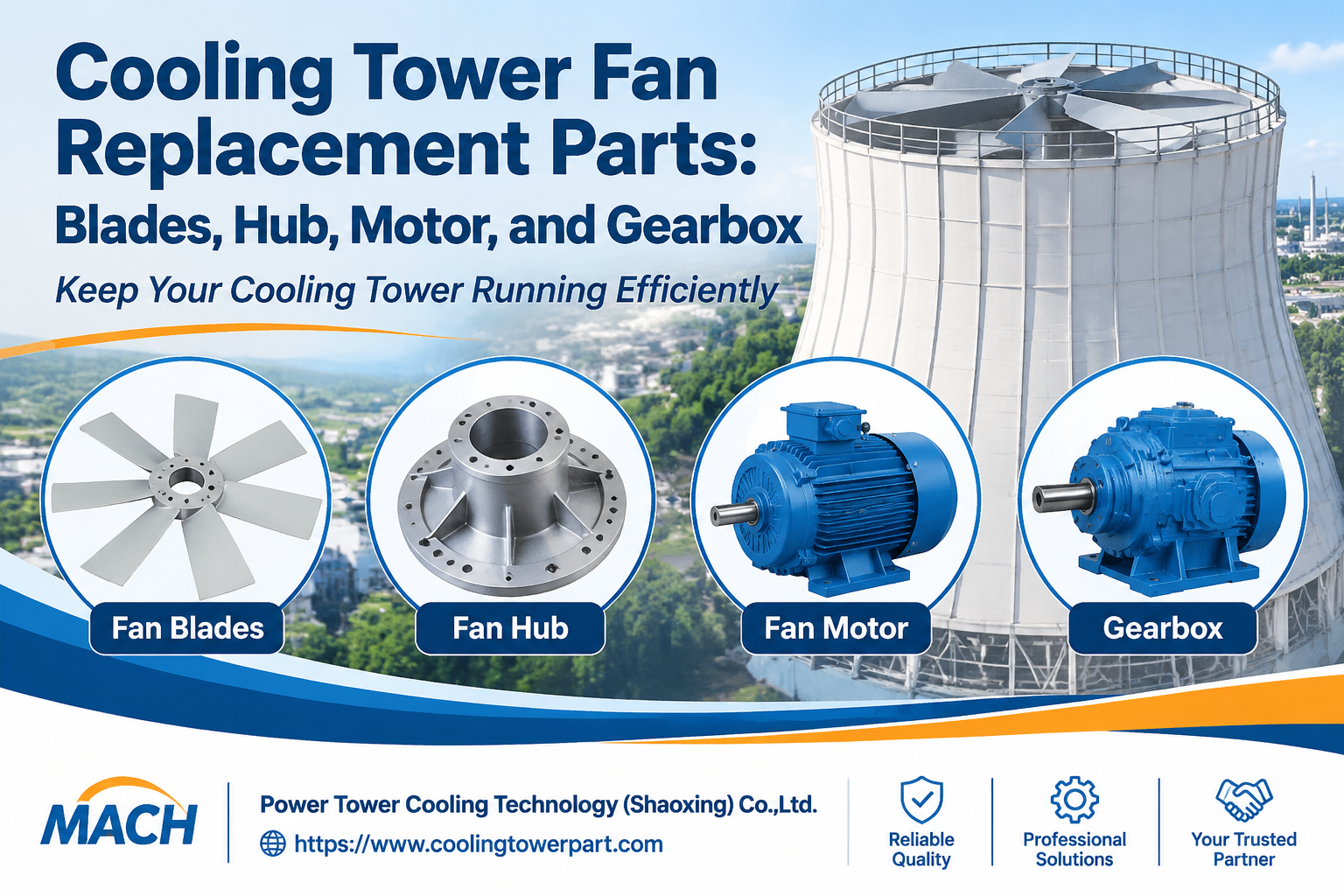
1. Introduction: Why Cooling Tower Fan Parts Matter
A cooling tower fan may look like a simple rotating component, but it plays a critical role in the entire cooling process. It moves air through the tower, supports heat rejection, and helps maintain the required operating temperature of industrial equipment and HVAC systems.
However, a fan is not a single component. It is an assembly made up of several important parts, including fan blades, a hub, a motor, and, in many designs, a gearbox. Each component has a different job. If one part becomes damaged, worn, or incorrectly adjusted, the performance of the entire fan system can suffer.
What happens when a fan blade develops a crack? What if the gearbox starts making unusual noise? Can you replace the motor without changing the complete fan assembly?
Understanding cooling tower fan replacement parts helps you identify problems earlier, select compatible components, and avoid unnecessary equipment replacement.
In this guide, we will explain the functions of cooling tower fan blades, hubs, motors, and gearboxes, discuss common failure symptoms, and share practical tips for selecting replacement parts. We will also introduce Power Tower Cooling Technology (Shaoxing) Co.,Ltd. as a supplier of cooling tower components and replacement parts.
2. How Does a Cooling Tower Fan System Work?
A cooling tower fan system creates or supports airflow through the cooling tower. As warm process water flows through the fill, air passes through the tower and comes into contact with the water. A portion of the water evaporates, removing heat and lowering the temperature of the remaining water.
Mechanical cooling towers use fans to move air through this process. The fan system must deliver the airflow required by the tower's thermal design.
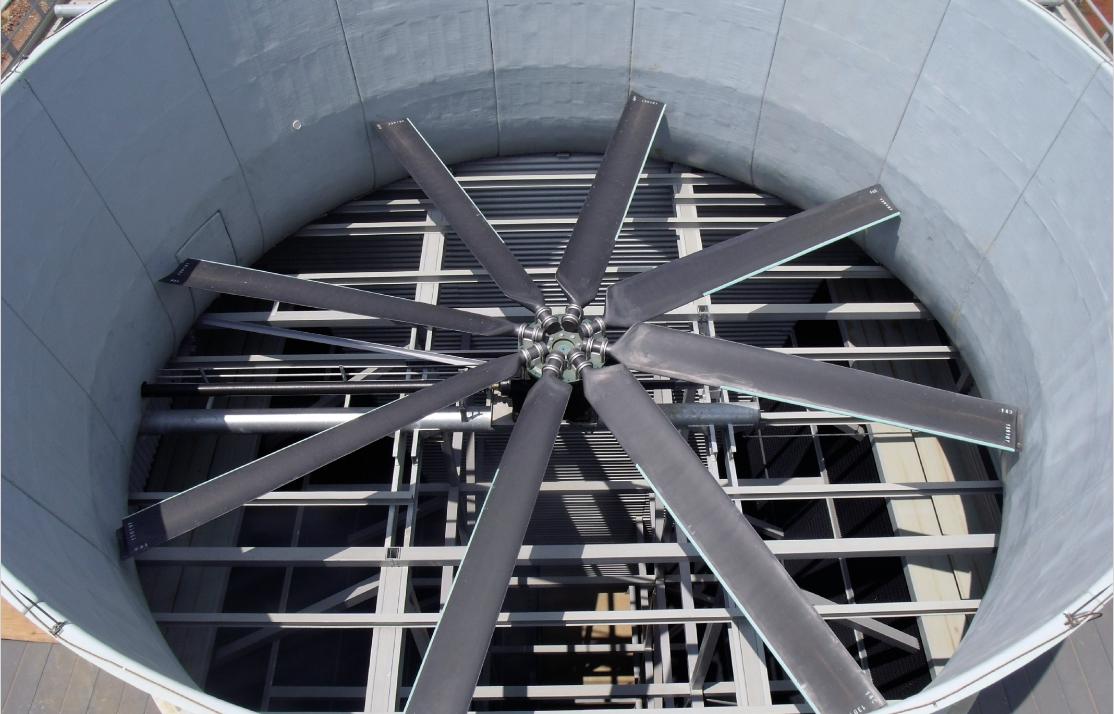
2.1 The Role of the Fan in Heat Rejection
Think of the cooling tower fan as the engine of an airflow system. Its job is not to pump water or directly cool the process equipment. Instead, it moves air so that heat can transfer from the circulating water to the surrounding atmosphere.
If airflow becomes insufficient, the tower may struggle to achieve its target cold-water temperature, particularly under high heat loads or demanding weather conditions.
But more airflow is not always better. The fan must operate at an appropriate point on its performance curve. Excessive airflow can increase motor power consumption, while insufficient airflow can reduce cooling performance.
2.2 How Fan Components Work Together
A typical mechanical cooling tower fan system may include:
Fan blades: Move air through the tower.
Fan hub: Holds the blades and connects the fan assembly to the drive shaft.
Motor: Supplies mechanical power.
Gearbox: Reduces motor speed and transfers torque where a geared drive is used.
Drive shaft and coupling: Connect the gearbox or motor to the fan assembly, depending on the configuration.
Bearings and mounting components: Support rotating equipment and maintain alignment.
Not every cooling tower uses the same arrangement. Some smaller towers use direct-drive motors, while many larger industrial towers use geared drives. Always identify the actual drive configuration before ordering replacement components.
3. Overview of Cooling Tower Fan Replacement Parts
When a cooling tower fan develops a problem, the first step is to identify which component is responsible.
| Replacement Part | Main Function | Common Replacement Reasons |
| Fan blades | Generate airflow | Cracks, deformation, erosion, corrosion, or damage |
| Fan hub | Connects and supports blades | Cracks, corrosion, worn mounting points, or deformation |
| Motor | Supplies rotating power | Electrical failure, bearing damage, overheating |
| Gearbox | Reduces speed and transfers torque | Gear wear, bearing failure, leakage, overheating |
| Drive shaft and coupling | Transmit mechanical power | Wear, misalignment, corrosion, or damage |
| Bearings and fasteners | Support and secure components | Wear, looseness, fatigue, or corrosion |
Replacing the correct component can restore reliable operation without requiring a complete fan system replacement. However, it is important to investigate the root cause of the failure before installing new parts.
For example, repeated blade damage may be related to vibration, incorrect pitch, fan imbalance, or mechanical interference. Replacing the blades without addressing the underlying problem may simply repeat the same repair.
4. Cooling Tower Fan Blades
Fan blades are among the most visible and important cooling tower fan components. Their shape, material, pitch, and diameter influence airflow, efficiency, noise, and motor load.
4.1 Common Fan Blade Materials
Cooling tower fan blades are manufactured from different materials to suit operating environments and performance requirements.
FRP fan blades
FRP stands for fiber-reinforced plastic. These blades combine reinforcing fibers with a resin matrix. They are widely used in industrial cooling tower applications because they can offer a favorable balance of weight, corrosion resistance, and design flexibility.
Their performance depends on fiber content, resin selection, manufacturing quality, blade geometry, and environmental conditions.
Aluminum alloy fan blades
Aluminum alloy blades are relatively lightweight and can provide good mechanical performance when correctly designed and manufactured. Surface treatment and material specifications are important when the blades operate in humid or chemically aggressive environments.
Other engineered materials
Some applications use specialized composite or metallic materials according to temperature, chemical exposure, structural loading, and manufacturer design requirements.
There is no single best material for every cooling tower. The correct choice depends on the fan design and actual operating conditions.
4.2 Signs That Fan Blades Need Replacement
How can you tell when a cooling tower fan blade needs attention?
Look for these warning signs:
Visible cracks or fractures
Blade deformation or permanent bending
Severe erosion or surface deterioration
Corrosion or damage around mounting points
Unusual fan vibration
Increased operating noise
Loose or damaged blade fasteners
Reduced airflow or abnormal motor loading
Not every vibration problem comes from a damaged blade. Dirt accumulation, loose bolts, hub damage, shaft misalignment, worn bearings, gearbox problems, and structural resonance can produce similar symptoms.
A proper inspection should identify the actual cause before replacement.
4.3 How to Select Replacement Fan Blades
Choosing replacement blades requires more than matching the original blade length.
Check the following specifications:
Fan diameter and blade quantity
Blade profile and geometry
Blade material and construction
Blade pitch and measurement reference
Operating speed and rotation direction
Hub mounting arrangement
Required airflow and static pressure
Motor power and gearbox operating conditions
Tower model and installation clearances
Blade pitch deserves particular attention. Increasing the pitch can increase airflow, but it can also increase motor load. Never assume that a larger pitch angle automatically improves cooling efficiency.
The replacement blade configuration should be approved for the specific fan assembly and operating point.
5. Cooling Tower Fan Hub
The fan hub is the central component that connects the blades to the drive system. Although it is often less noticeable than the blades, it plays an essential role in mechanical safety and performance.
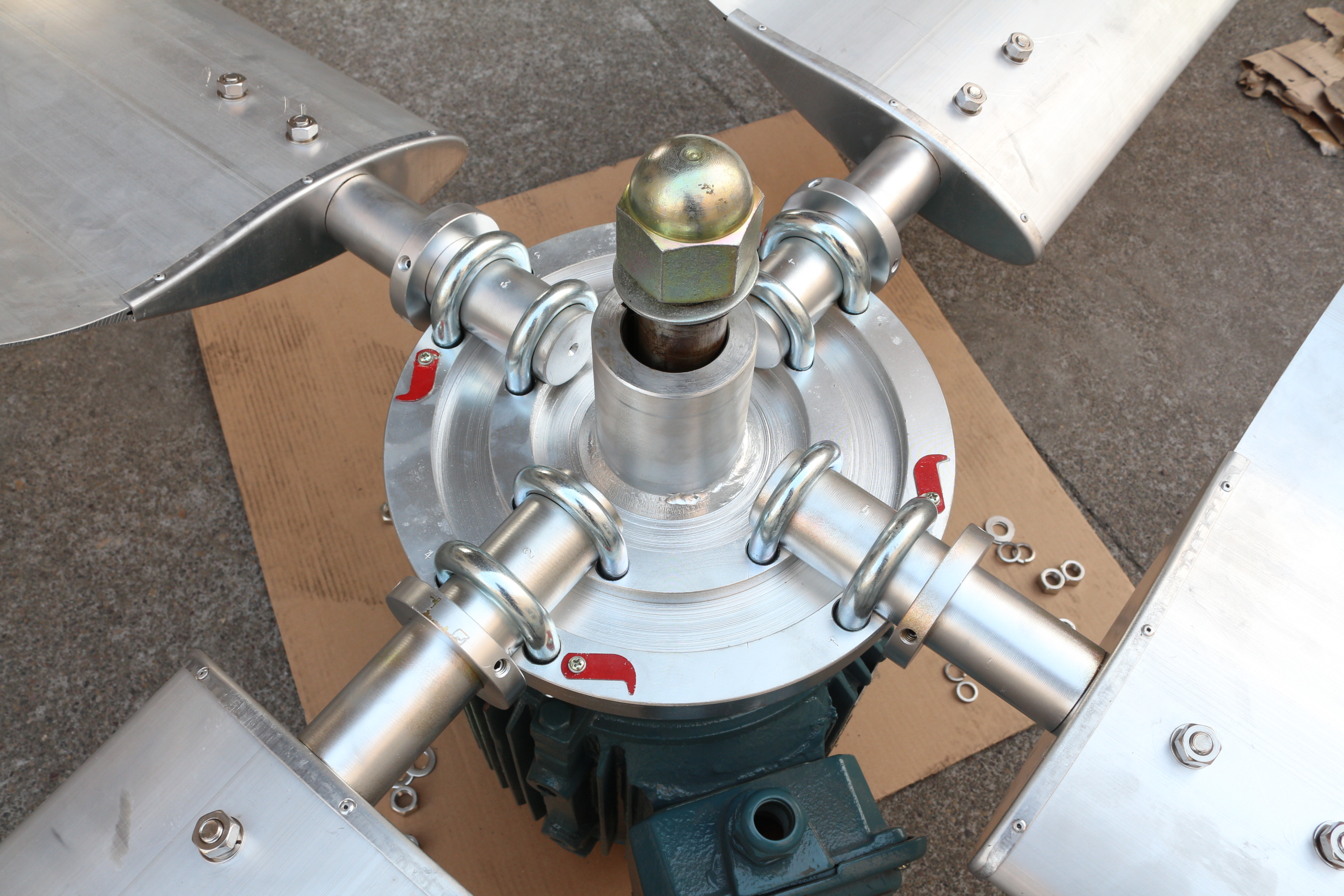
5.1 Fan Hub Structure and Function
A cooling tower fan hub supports the blades and transfers torque from the drive shaft to the fan assembly.
Depending on the design, a hub may include:
Central shaft connection or mounting flange
Blade mounting positions
Bolts and fastening hardware
Pitch adjustment mechanisms
Structural support features
Some hubs allow blade pitch adjustment, while others use fixed mounting positions. Materials and construction vary according to fan size, design, speed, and operating loads.
A properly matched hub helps maintain blade alignment and distribute mechanical loads across the assembly.
5.2 Common Hub Problems
Hub problems can affect the complete fan assembly. Common warning signs include:
Cracks around blade mounting positions
Corrosion or material deterioration
Loose or damaged fasteners
Worn shaft connections
Deformation around mounting holes
Unusual vibration during operation
If a hub is damaged, replacing only the affected blade may not solve the problem. The hub and its connections must also be inspected.
Never assume that a hub can be repaired safely by drilling new holes, welding, or modifying its mounting structure. Follow the original manufacturer's repair and replacement requirements.
5.3 Choosing a Compatible Replacement Hub
Before purchasing a replacement cooling tower fan hub, confirm:
Fan model and manufacturer
Hub outside diameter and overall dimensions
Shaft diameter and connection type
Bore, keyway, or flange specifications
Blade quantity and mounting arrangement
Blade pitch adjustment method
Operating speed and torque requirements
Material and corrosion protection
A hub that looks similar may have a different shaft connection or blade mounting pattern. Even small dimensional differences can create installation and balance problems.
6. Cooling Tower Fan Motor
The motor supplies the mechanical energy that drives the fan. Its selection affects airflow capability, energy consumption, reliability, and maintenance requirements.
6.1 Motor Types and Operating Requirements
Many mechanical cooling towers use electric motors designed for industrial environments.
Important motor characteristics include:
Rated power
Rated voltage and frequency
Operating speed
Full-load current
Efficiency rating
Enclosure and ingress protection
Insulation class
Duty rating
Starting method and control requirements
Cooling tower environments are often humid and exposed to water droplets, chemicals, and changing temperatures. Motor enclosure and protection should therefore match the installation conditions.
Direct-drive cooling towers connect the motor to the fan without a conventional speed-reduction gearbox. Geared systems use a gearbox to reduce motor speed and provide the torque required by the fan.
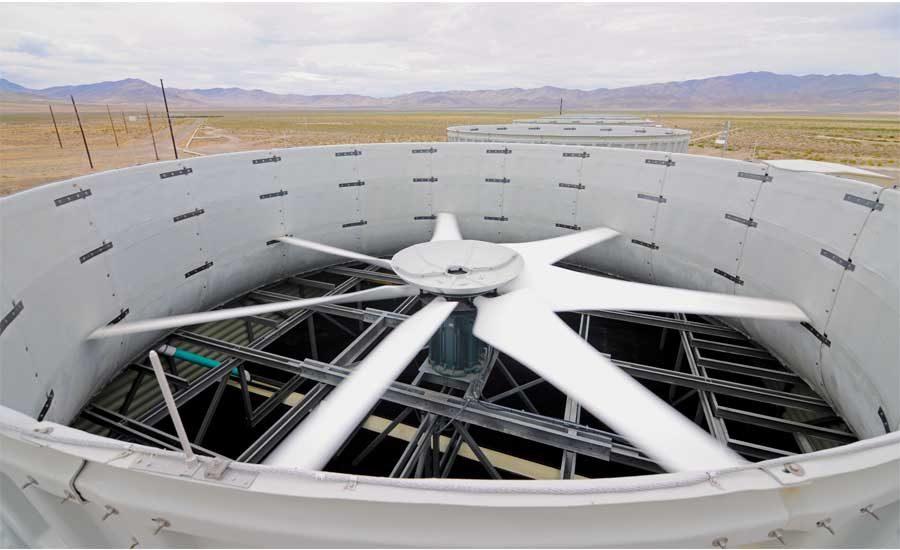
6.2 Signs of Motor Failure
A cooling tower motor may need inspection or replacement when you notice:
These symptoms do not always mean the motor itself has failed.
For example, a damaged gearbox, excessive fan load, incorrect blade pitch, poor ventilation, or electrical supply problems can also cause motor overheating.
A qualified technician should check the electrical and mechanical systems before deciding whether to replace the motor.
6.3 Motor Replacement Considerations
When selecting a replacement motor, do not focus on rated horsepower alone.
Confirm the motor's electrical specifications, speed, mounting dimensions, shaft arrangement, operating environment, and compatibility with the existing drive system.
For geared systems, the replacement motor must also be suitable for the gearbox input requirements.
If a variable frequency drive is used, verify motor and drive compatibility, including the intended speed range and cooling arrangements.
7. Cooling Tower Gearbox
A gearbox is commonly used in larger mechanical cooling towers to reduce motor speed and transmit torque to the fan.
It is a critical part of the drive system. Gearbox condition affects fan speed, vibration, operating noise, and overall equipment reliability.
7.1 Gearbox Function and Operating Principle
Electric motors often operate at speeds higher than those required by large cooling tower fans. A reduction gearbox converts the motor's input speed into a lower output speed while increasing available output torque, subject to transmission losses.
Cooling tower gearboxes may use different gear arrangements depending on the manufacturer and design.
The correct gearbox must match the required input speed, output speed, power, torque, mounting configuration, and operating conditions.
7.2 Common Gearbox Failure Symptoms
Watch for these warning signs:
Unusual grinding or knocking noises
Excessive vibration
Oil leakage
Abnormally high operating temperature
Metal particles in lubricating oil
Damaged seals
Bearing or gear deterioration
Unstable fan speed
Gearbox failures may result from insufficient lubrication, contaminated oil, excessive loading, incorrect alignment, bearing damage, or inadequate maintenance.
If a gearbox becomes unusually hot or noisy, investigate the cause promptly. Continuing to operate damaged equipment can lead to more extensive failures.
7.3 Gearbox Replacement and Compatibility
Before ordering a replacement gearbox, collect the following information:
Original gearbox manufacturer and model
Input and output speed
Rated power and torque
Gear ratio
Shaft dimensions and connection details
Mounting arrangement
Lubrication requirements
Rotation direction
Service and operating conditions
A gearbox with a similar external appearance may not have the correct ratio or load capacity.
Also inspect the drive shaft, coupling, motor base, and fan hub during replacement. Problems in these connected components can damage a new gearbox if left unresolved.
8. When Should You Replace Cooling Tower Fan Parts?
There is no universal replacement interval for every cooling tower fan component. Service life depends on material quality, operating hours, vibration, maintenance, water chemistry, environmental exposure, and mechanical loading.
In general, replacement should be considered when inspection identifies structural damage, unacceptable wear, or a condition that cannot be corrected through approved maintenance.
For example:
Replace blades when cracks, deformation, or damage make continued operation unsafe.
Replace a hub when its structural integrity or mounting connections are compromised.
Replace a motor when electrical or mechanical failure cannot be economically and safely repaired.
Replace a gearbox when gears, bearings, or the housing are damaged beyond acceptable repair limits.
Preventive inspection is usually less expensive than waiting for a serious failure during peak production.
9. How to Choose the Right Cooling Tower Fan Replacement Parts
Selecting compatible parts is one of the most important steps in a successful replacement project.
9.1 Check the Original Equipment Specifications
Start by collecting the original equipment documentation.
Useful information includes the cooling tower manufacturer, tower model, fan model, component drawings, equipment nameplates, and previous maintenance records.
If the original model information is unavailable, take accurate measurements and photographs. A supplier may need additional technical details before confirming compatibility.
9.2 Match Fan Diameter, Speed, and Airflow
Fan diameter alone is not enough to identify a replacement.
The new fan configuration must match the required airflow, static pressure, operating speed, rotation direction, and system resistance.
A fan with the wrong performance characteristics may fail to provide the required cooling or may overload the motor.
Always compare the manufacturer's fan performance data and confirm the intended operating point.
9.3 Evaluate Materials and Corrosion Resistance
Cooling towers operate in demanding environments. Moisture, water treatment chemicals, suspended solids, and airborne contaminants can affect component life.
Select blade, hub, and hardware materials according to the operating environment. Check protective coatings, resin systems, fastener materials, and compatibility with the surrounding equipment.
9.4 Confirm Mechanical and Electrical Compatibility
Mechanical compatibility includes shaft connections, mounting dimensions, bolt patterns, clearances, and alignment.
Electrical compatibility includes voltage, frequency, rated current, motor power, control requirements, and protection.
For a gearbox, check the ratio, torque rating, and input/output arrangement.
Do not assume that a replacement part is compatible simply because it fits physically.
10. Individual Part Replacement vs. Complete Fan System Replacement
Should you replace one component or the complete fan assembly? The answer depends on the condition of the existing equipment.
| Replacement Option | Advantages | When It May Be Suitable |
| Blade replacement | Can restore a damaged blade assembly without replacing every component | Hub and other blades remain suitable, and the manufacturer permits the replacement method |
| Hub replacement | Addresses damaged blade mounting or shaft connection | Hub is defective but blades and drive components remain compatible |
| Motor replacement | Restores the power source | Motor has failed but the rest of the drive system is serviceable |
| Gearbox replacement | Addresses speed reduction or torque transmission problems | Gearbox damage is confirmed and other components remain suitable |
| Complete fan system replacement | Allows a coordinated upgrade of major components | Multiple parts are worn, incompatible, or no longer economical to repair |
Replacing one component can reduce initial costs, but it is not always the best long-term decision. If several parts are close to the end of their service life, a coordinated replacement may reduce repeated shutdowns and maintenance work.
The decision should be based on inspection findings, compatibility, total cost, and operational risk.
11. Cooling Tower Fan Replacement Cost Factors
Cooling tower fan replacement costs vary significantly from one project to another. There is no reliable universal price because the required parts and installation conditions differ.
The main cost factors include:
1. Component type: Fan blades, hubs, motors, and gearboxes have different manufacturing and material costs.
2. Fan size and specifications: Larger or specially engineered components may require more material and manufacturing work.
3. Material selection: FRP, aluminum alloy, stainless steel, and other materials have different costs and performance characteristics.
4. Customization: Non-standard dimensions, shaft connections, or mounting arrangements may increase production costs.
5. Installation requirements: Labor, lifting equipment, access platforms, electrical work, and alignment can affect the total project budget.
6. Downtime: Production interruptions may create costs beyond the replacement parts themselves.
When comparing quotations, check that suppliers are offering equivalent specifications. A low-priced blade or gearbox may not be a suitable substitute for the required equipment.
12. Installation and Safety Considerations
Cooling tower fan replacement involves rotating machinery, electrical equipment, and often work at height. Safety must come before speed.
12.1 Inspection Before Installation
Before installing replacement parts, inspect the existing fan assembly and drive system.
Check the shaft, hub, fasteners, motor base, gearbox mounting, coupling, and surrounding structure. Look for corrosion, cracks, wear, misalignment, and signs of previous damage.
Confirm that the replacement components match the approved drawings and equipment specifications.
12.2 Safe Replacement Procedures
A safe replacement process should include:
Shut down the cooling tower according to site procedures.
Isolate electrical power and apply lockout/tagout.
Verify zero energy and confirm that all rotating parts have stopped.
Establish safe access and fall protection where required.
Use suitable lifting equipment for heavy components.
Remove damaged parts according to manufacturer instructions.
Inspect mounting surfaces and connected components.
Install the replacement parts using approved hardware and torque requirements.
Verify alignment, clearances, and mechanical connections.
Complete all required checks before restarting.
Never attempt to adjust blades or repair rotating equipment while it is running.
12.3 Testing After Installation
After installation, qualified personnel should check the fan assembly and drive system before returning the tower to normal service.
Verify blade orientation, pitch settings, rotation direction, clearances, fastener security, lubrication, and alignment.
During controlled commissioning, monitor vibration, noise, motor current, gearbox temperature, and operating speed.
If abnormal vibration or noise occurs, stop and investigate. Do not attempt to solve a mechanical problem by adding improvised weights or making unapproved adjustments.
13. Maintenance Tips to Extend Fan Component Service Life
Good maintenance helps reduce unexpected failures and protects your investment.
Here are practical recommendations:
Inspect fan blades regularly for cracks, erosion, and deformation.
Check hub connections and fasteners for signs of looseness or damage.
Monitor motor temperature, current, insulation condition, and bearing noise.
Follow gearbox lubrication recommendations and inspect oil condition.
Check shaft alignment and coupling condition.
Monitor vibration trends instead of relying only on occasional visual checks.
Remove deposits that may create fan imbalance, following approved cleaning procedures.
Keep maintenance records, including replacement dates and inspection results.
A consistent maintenance program helps identify developing problems before they cause major equipment damage.
14. How to Choose a Reliable Cooling Tower Fan Parts Supplier
The right supplier should do more than offer a low quotation. Replacement parts must match your actual cooling tower and operating requirements.
Consider these factors when evaluating suppliers:
Product range: Can the supplier provide fan blades, hubs, motors, gearboxes, and related cooling tower components?
Technical support: Can the supplier review drawings, dimensions, and operating specifications to help identify compatible parts?
Material information: Are material specifications and relevant product details available?
Manufacturing quality: Does the supplier have appropriate inspection and quality-control procedures?
Customization capability: Can the supplier discuss non-standard dimensions or replacement requirements?
Communication and delivery: Are technical questions answered clearly, and are production and delivery arrangements explained?
Before placing an order, provide the supplier with as much original equipment information as possible. This reduces the risk of receiving parts that look correct but do not fit or perform as required.
15. Cooling Tower Fan Replacement Parts from Power Tower
Power Tower Cooling Technology (Shaoxing) Co.,Ltd. focuses on cooling tower components and replacement parts. Its website, https://www.coolingtowerpart.com, provides information for customers looking for cooling tower fill and related replacement components.
For cooling tower fan replacement projects, buyers should identify the exact parts they need and confirm the relevant technical specifications before ordering.
Whether you are sourcing fan blades, a hub, or other cooling tower components, accurate measurements and equipment details help suppliers evaluate the replacement requirements.
When contacting Power Tower, it is useful to prepare:
Cooling tower brand and model
Original fan manufacturer and model
Fan diameter and number of blades
Blade material and mounting dimensions
Hub dimensions and shaft connection
Motor nameplate information
Gearbox model and gear ratio, if applicable
Photos, drawings, and equipment nameplates
These details help establish whether a proposed component is suitable for your application.
For industrial buyers, choosing compatible replacement parts is about more than restoring rotation. It is about maintaining the intended airflow, mechanical reliability, and long-term operation of the cooling tower.
Visit https://www.coolingtowerpart.com to learn more about Power Tower's cooling tower products and component supply options.
16. Frequently Asked Questions
16.1 How Long Do Cooling Tower Fan Blades Last?
There is no fixed service life for all cooling tower fan blades. Their lifespan depends on material, manufacturing quality, operating speed, vibration, environmental exposure, and maintenance.
Regular inspection helps identify cracks, erosion, deformation, and other signs of deterioration.
16.2 Can I Replace Only One Cooling Tower Fan Blade?
Sometimes, but only when the fan manufacturer permits individual blade replacement and the replacement meets the required specifications.
The replacement blade must match the approved profile, material, mounting arrangement, and pitch requirements. The complete fan assembly must also meet the manufacturer's balance requirements.
Replacing only one blade without checking compatibility and balance can create dangerous vibration.
16.3 When Should a Cooling Tower Fan Hub Be Replaced?
A hub should be replaced when cracks, structural deformation, severe corrosion, damaged mounting points, or unacceptable shaft connection wear compromise its integrity.
Always inspect the blades, shaft, fasteners, and related components at the same time.
16.4 Can a Different Motor Be Used as a Replacement?
A different motor may be suitable if its electrical ratings, speed, power, mounting dimensions, shaft configuration, and environmental protection match the system requirements.
For geared drives, motor compatibility with the gearbox must also be confirmed. Do not select a motor based only on horsepower.
16.5 What Causes Cooling Tower Gearbox Failure?
Common causes include poor lubrication, contaminated oil, excessive loading, bearing wear, incorrect alignment, overheating, and inadequate maintenance.
Regular oil checks, vibration monitoring, and inspection can help identify problems before serious failure occurs.
16.6 How Do I Find the Correct Replacement Fan Parts?
Start with the cooling tower and fan model numbers. Collect component drawings, nameplate details, measurements, and photographs.
If original documentation is unavailable, provide accurate dimensions and operating information to a qualified supplier for compatibility review.
17. Conclusion
Cooling tower fan blades, hubs, motors, and gearboxes each play a specific role in keeping an industrial cooling system operating reliably. A problem in one component can affect the performance and safety of the entire fan assembly.
The best replacement strategy starts with accurate diagnosis. Identify the damaged part, investigate the root cause, confirm the original specifications, and select components that match the actual operating conditions.
Whether you need FRP fan blades, a compatible hub, a replacement motor, or a cooling tower gearbox, do not rely on appearance or dimensions alone. Airflow, speed, torque, materials, mounting details, and mechanical balance all matter.
For cooling tower component sourcing and replacement requirements, Power Tower Cooling Technology (Shaoxing) Co.,Ltd. is a supplier worth contacting. Visit https://www.coolingtowerpart.com to explore its cooling tower products and discuss your replacement needs.


