You are here: Home » Blog » Technical Articles » Industrial Cooling Tower Fan Blade: How Blade Shape Affects Efficiency
Industrial Cooling Tower Fan Blade: How Blade Shape Affects Efficiency
Views: 0 Author: Lisa Publish Time: 2026-11-25 Origin: Site
Industrial Cooling Tower Fan Blade Aerodynamics: How Blade Shape Affects Efficiency
Many maintenance teams focus only on fan RPM, pitch angle and motor amps, but the underlying aerodynamic shape of the blade sets the maximum possible efficiency for an industrial cooling tower axial fan. Blade geometry — airfoil cross-section, twist distribution, chord width, tip contour and trailing edge design — determines lift, drag, turbulence and stall behavior. Poor blade shape wastes electricity, creates noise, limits airflow and makes the fan prone to stall, even with correct pitch and balanced blades. This guide breaks down how each shape feature changes performance for FRP and aluminum cooling tower fan blades used in power plants, chemical facilities, data centers and manufacturing plants.
Core Aerodynamic Principle
Cooling tower axial fan blades generate lift like airplane wings. As the blade rotates, a pressure difference forms across the airfoil surface, pulling air through the tower fill and drift eliminators. The goal of optimized blade shape is to maximize lift-to-drag ratio: move more air with less shaft power while delaying airflow separation and stall. Flat, simple curved blades create high drag and early separation; modern molded airfoil profiles deliver far better energy efficiency.
Key Blade Shape Features and Their Impact on Efficiency
1. Airfoil Profile (Cross-Section Shape)
The airfoil is the cross-sectional curve of the blade.
Thin, high-lift airfoil: Optimized for low-to-medium static pressure, high airflow, lower energy draw. Most common for standard cooling towers with clean fill.
Thicker, robust airfoil: Better for high static pressure, clogged fill or towers with heavy internal resistance. Resists stall but consumes slightly more power at the same airflow.
Old flat-plate blades: Very low lift-to-drag ratio. Turbulence forms early, efficiency drops, noise rises. These are the best candidates for upgrade.
A well-designed airfoil keeps airflow attached to the blade surface across a wider range of pitch and RPM settings, expanding the fan’s stable operating window.
2. Blade Twist (Geometric Tapered Angle)
Blade tip travels much faster than the blade root. If the whole blade had the same pitch angle, the root would stall while the tip operated at too low an angle.
Twisted blades: The root has a higher angle, and the angle gradually reduces toward the tip. This matches the local airflow angle at every span position.
Result: Uniform lift distribution across the blade, less turbulence, higher efficiency and wider stall margin.
Untwisted blades: Only efficient at one narrow operating point. Small changes in pitch or wet bulb temperature trigger local stall and vibration.
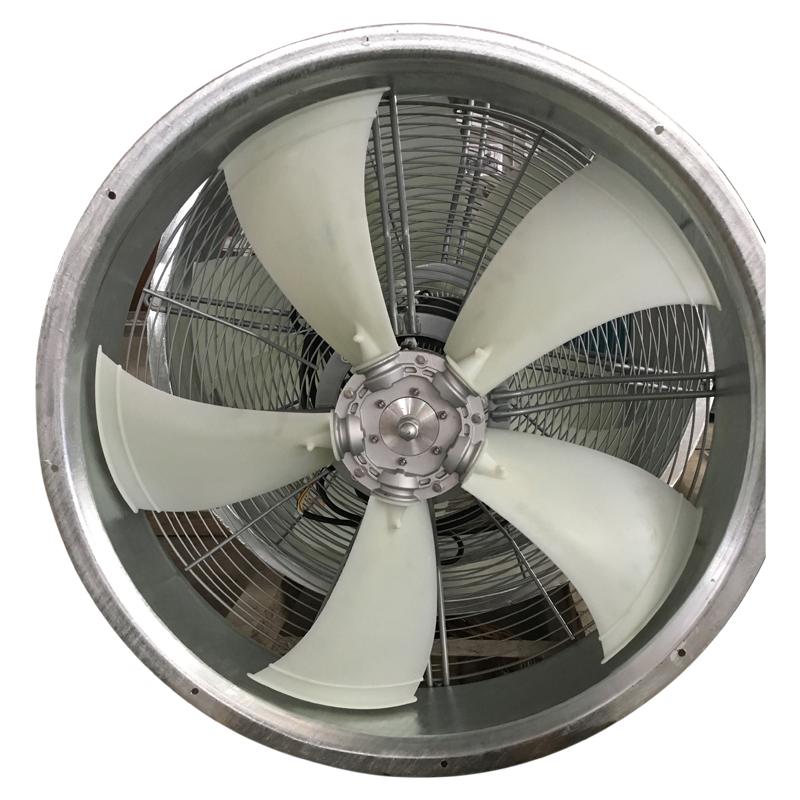
Twist is one of the biggest advantages of molded FRP blades, which can easily form continuous twist; simple cast aluminum blades often have limited or no twist.
3. Chord Width (Blade Width)
Chord is the width of the airfoil from leading edge to trailing edge.
Wider chord near the root: Adds strength and generates lift at the slow-moving root section.
Narrower chord toward the tip: Reduces drag at the high-speed tip, where wide surfaces create excess drag and tip vortex losses.
Overly wide tips waste power; overly narrow roots reduce lift and structural strength. Good designs use a tapered chord along the blade span.
4. Blade Tip Shape: Blended Tips vs Sharp Tips
Blade tips create tip vortices — swirling air that leaks from the high-pressure side to the low-pressure side of the blade. Tip vortices are a major source of energy loss and noise.
Blended / rounded swept tips: Smooth, tapered tip geometry weakens tip vortices, cutting turbulence losses and improving efficiency.
Serrated (sawtooth) trailing edges are a popular upgrade feature, usually molded into FRP blades.
Serrations break large turbulent eddies into smaller, quieter flow structures.
Primary benefit: noise reduction. Well-designed serrated blades maintain nearly the same aerodynamic efficiency while lowering tonal noise.
They do not fix poor airfoil or twist design; they are a refinement, not a replacement for good base aerodynamics.
How Blade Shape Interacts With Pitch and System Resistance
Pitch and blade shape work together.
Even a perfectly tuned pitch angle cannot compensate for a low-efficiency flat blade profile.
A high-performance twisted airfoil blade has a larger safe operating range: you can adjust pitch seasonally without hitting stall quickly.
When fill scales up and static pressure rises, blades with a stall-resistant airfoil shape keep running efficiently, while simple blades fall into surge and unstable airflow.
This is why a direct replacement blade that matches the original shape is critical. A different airfoil profile with the same nominal diameter and pitch will deliver different airflow, amps and stall risk.
FRP vs Aluminum: Shape Flexibility
FRP blades: Molded composite supports complex twist, custom chord tapers, blended tips and serrated trailing edges in one piece. Aerodynamic optimization is easier and more cost-effective.
Aluminum blades: Usually cast or extruded. Complex twisted profiles and fine serrations are harder and more expensive to manufacture; many standard aluminum blades use simpler airfoil shapes.
Common Shape-Related Aerodynamic Problems
Symptom
Root Shape Issue
Impact
Fan stalls easily when pitch increases
Poor airfoil, insufficient twist, square tip
Limited airflow range, high noise, motor overload risk
High power draw for moderate airflow
Flat plate or low lift-to-drag profile
Wasted energy, high operating cost
Loud tonal noise
Sharp tip, strong tip vortex, non-optimized trailing edge
Noise complaints, no efficiency gain
Vibration after pitch adjustment
Uneven lift distribution from poor twist
Aerodynamic imbalance, bearing and gearbox wear
Best Practices for Blade Shape Selection and Replacement
✅ Match airfoil profile, twist pattern and chord taper when ordering direct replacement blades. Do not rely only on diameter and pitch.
✅ For energy upgrade projects, select CFD-optimized twisted airfoil blades, preferably with blended tips.
✅ Serrated trailing edges are ideal for sites with noise limits, such as near offices or residential areas.
✅ Never mix blade designs on one hub. Different airfoils generate different lift and drag, creating aerodynamic imbalance.
✅ After upgrading to a new blade shape, reset pitch and run a full performance test to log amps, water temperature and vibration.
✅ Inspect blade surface erosion: worn, gouged or deformed airfoil sections destroy the original aerodynamic shape and reduce efficiency over time.
Frequently Asked Questions
Q: Can a better blade shape reduce energy use even at the same RPM and pitch?
A: Yes. An optimized twisted airfoil blade converts more motor power into airflow, lowering power draw for the same CFM or delivering more airflow at the same power.
Q: Is serrated edge always better?
A: Serrations mainly reduce noise. Efficiency gains are modest. If noise is not a concern, a smooth blended tip may be the best choice.
Q: Why does the same pitch setting cause stall on old blades but not new blades?
A: The new blades have a different airfoil and twist distribution with a wider stall margin. The blade shape defines the stable operating envelope.
Q: Can I reshape damaged blades to restore aerodynamics?
A: Minor surface repairs can be done, but twist, chord and tip contour are hard to restore accurately. Severe deformation means the blade aerodynamics are permanently compromised.
Conclusion
Blade aerodynamic shape is the foundation of cooling tower fan efficiency. The airfoil profile, span-wise twist, tapered chord, tip contour and trailing edge design control lift, drag, turbulence and stall resistance. A well-designed twisted airfoil blade runs quieter, uses less power and tolerates seasonal pitch changes and fouling better than simple flat or untwisted blades. When replacing or upgrading fans, look beyond diameter and pitch; verify the aerodynamic geometry. For Marley, BAC, Evapco and custom cooling tower retrofits, selecting the right blade shape delivers long-term energy savings and stable cooling performance.
Recommended internal links for CoolingTowerPart.com: