You are here: Home » Blog » Technical Articles » Industrial Cooling Tower Fan Blade Efficiency: Factors That Affect Performance
Industrial Cooling Tower Fan Blade Efficiency: Factors That Affect Performance
Views: 0 Author: Lisa Publish Time: 2026-11-26 Origin: Site
Industrial Cooling Tower Fan Blade Efficiency: Factors That Affect Performance
Cooling tower fan blade efficiency defines how much useful airflow a fan can deliver per kilowatt of power consumed. Even well-built blades lose efficiency when design, installation, maintenance or site conditions are not properly controlled. For power plants, chemical facilities, data centers and manufacturing cooling towers, understanding these influencing factors helps reduce electricity bills, avoid motor overload and maintain stable heat rejection. This guide breaks down the core variables that govern axial fan blade efficiency for FRP and aluminum cooling tower fans.
1. Aerodynamic Blade Geometry
The airfoil profile, span-wise twist, chord taper, tip shape and trailing edge design form the foundation of blade efficiency.
Airfoil profile: High-lift, low-drag curved airfoils outperform old flat-plate blades. A good airfoil keeps airflow attached across a wider operating range and delays stall.
Blade twist: Twisted blades match the local airflow angle from root to tip, distributing lift evenly and minimizing turbulence. Untwisted blades only run efficiently at one narrow pitch and RPM setting.
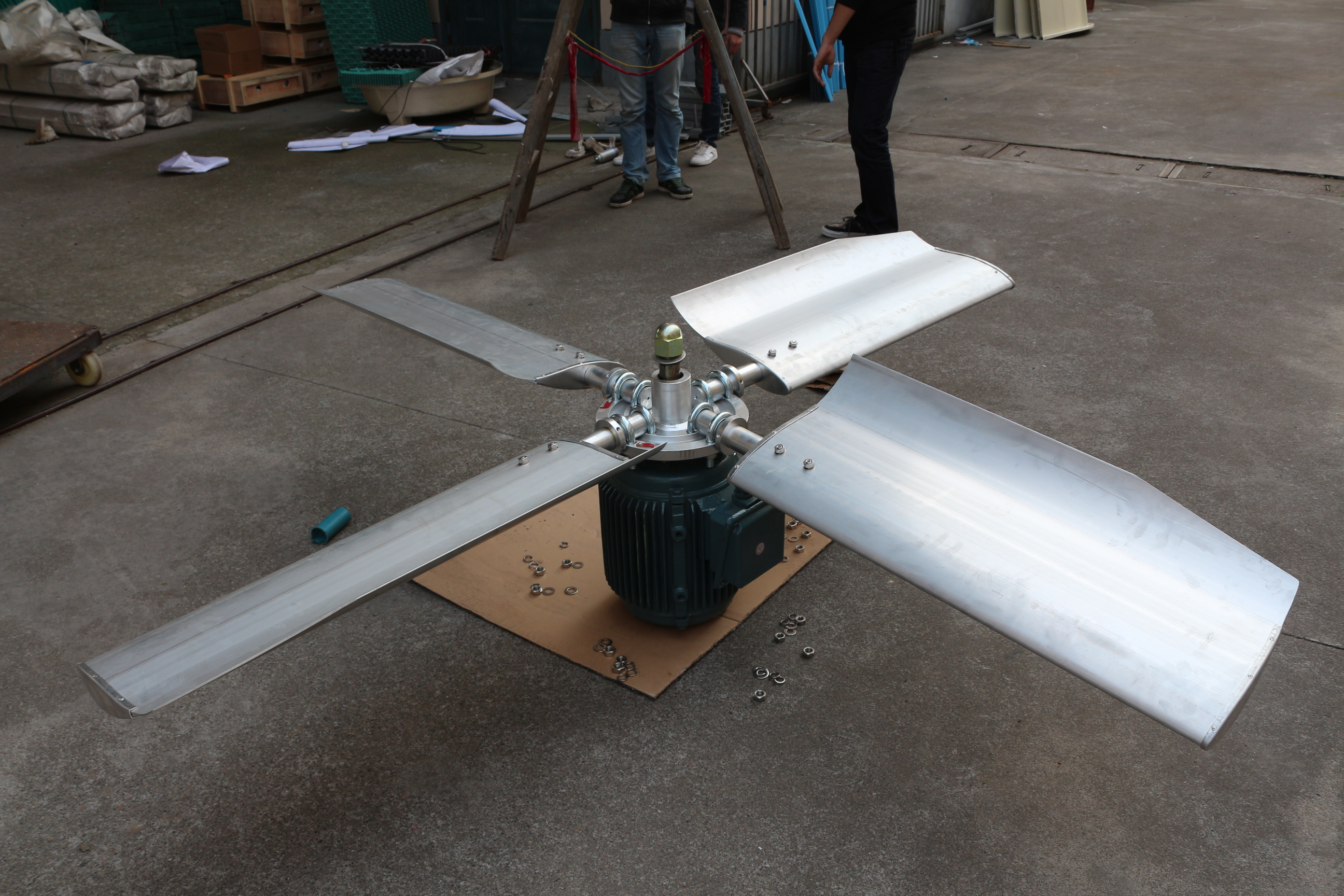
Tip contour: Sharp, square blade tips create powerful tip vortices and air leakage. Blended, swept tips reduce vortex loss and preserve efficiency. Serrated trailing edges cut noise with only minor efficiency tradeoffs. Blade geometry is fixed once molded or cast. Upgrading to CFD-optimized twisted airfoil blades is one of the most impactful retrofits for low-efficiency legacy fans.
2. Blade Pitch Angle and Uniformity
Pitch is the angle between the blade chord and the rotation plane. It directly controls airflow and power draw.
Too high pitch pushes the fan near stall: power spikes while airflow gains are minimal, dropping efficiency sharply.
Too low pitch reduces airflow; the tower may fail to meet cooling setpoints, forcing longer runtime and higher total energy consumption.
Uneven pitch between blades (more than ±0.5° difference) creates aerodynamic imbalance. This imbalance cannot be fixed by adding balance weights and wastes energy through vibration. All blades must be calibrated to the same target angle after hub bolting, and rechecked after every blade repair or replacement.
3. Blade Tip Clearance
Tip clearance is the gap between blade tip and the inner wall of the fan stack. It is often overlooked but critical for efficiency.
Excessive clearance allows high-pressure air to leak back across the blade tip, forming tip vortices and reducing net airflow.
Too little clearance risks rubbing, scraping, blade damage and noise.
Each fan has a manufacturer-approved clearance range. Trimming blade tips to fix clearance ruins the original airfoil shape and permanently hurts efficiency. If the fan stack is deformed or out-of-round, repair the stack instead of trimming blades.
4. Surface Condition, Fouling and Damage
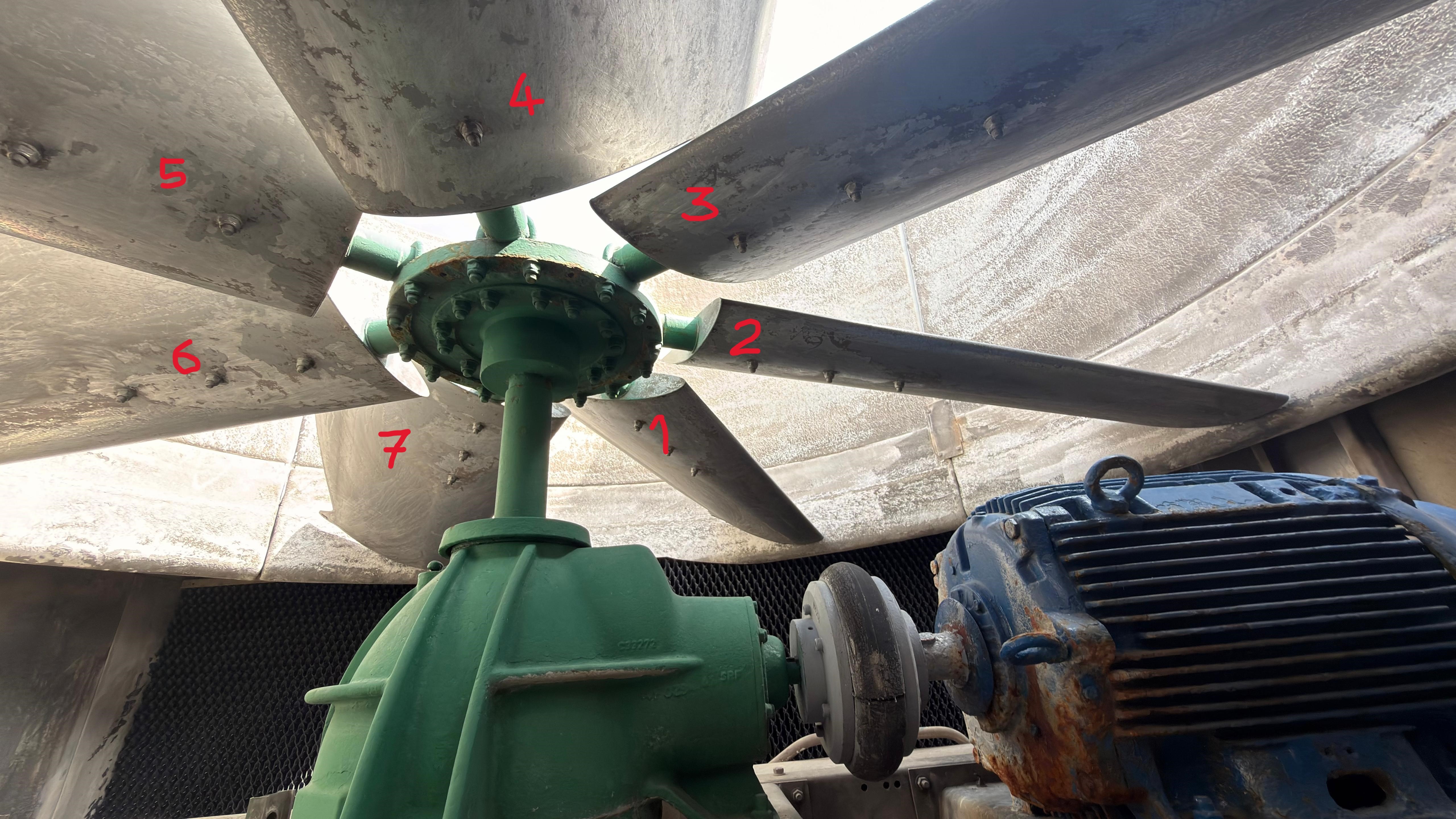
Scale, biological slime, dust, corrosion, erosion, nicks and delamination alter the aerodynamic surface of the blade.
Mineral scale and biofilm buildup change the airfoil contour, increasing drag and reducing lift-to-drag ratio.
Hollow FRP blades with cracked shells can trap condensate. Trapped water creates recurring imbalance and vibration, which dissipates energy as heat and noise.
Fatigue cracks, bent blades and gouged leading edges disrupt smooth airflow and create turbulence. Routine cleaning and visual inspection preserve the original aerodynamic shape and keep efficiency steady.
5. Mechanical Balance and Structural Vibration
Unbalanced blades force the fan assembly to vibrate continuously, draining energy and accelerating wear on bearings, gearboxes and hubs.
Static balancing alone is insufficient for large cooling tower fans. Dynamic balancing under operating conditions is required.
Imbalance can stem from uneven scale deposits, trapped water, mismatched blade weight, or damaged blades.
Vibration wastes shaft power and can trigger resonance in the fan stack, further reducing overall system performance. Always rebalance after pitch adjustment, blade replacement, cleaning or structural repair.
6. Material and Construction Type
Hollow or solid construction, FRP versus aluminum, changes operating behavior and long-term efficiency retention.
Hollow FRP blades support complex twisted airfoils with low weight, reducing centrifugal load on the drive train and damping vibration.
Solid aluminum blades are heavier, transfer more vibration, and are usually limited to simpler airfoil shapes.
FRP gel coat degradation, UV aging and delamination will degrade aerodynamics over time; aluminum suffers pitting corrosion that damages the blade surface. Material selection does not automatically make a blade more efficient, but it determines how long the blade maintains its designed aerodynamic shape in your site environment.
7. Fan Speed, System Static Pressure and Operating Point
Blade efficiency is not constant; it changes depending on the fan’s operating point on its performance curve.
Fan static pressure must overcome resistance from fill, drift eliminators, louvers and internal baffles. Fouled fill increases static pressure and shifts the fan toward stall.
Higher tip speed boosts airflow but also raises aerodynamic losses and noise. VFD speed control lets operators match fan output to cooling load and stay within the high-efficiency zone.
Wet-bulb temperature and seasonal heat load also change the required airflow. Fixed-pitch fans often run off-peak efficiency in transitional seasons.
8. Blade Set Matching
Mismatched blades break uniform airflow distribution and create aerodynamic losses.
Never mix blade brands, airfoil profiles, hollow/solid construction, or materials on one hub.
A single new blade installed among worn old blades will have different weight, lift and drag properties, creating permanent imbalance and efficiency loss. Blade replacement should always use a matched set from the same design family.
Quick Reference Table: Factors and Efficiency Impact
Factor
Efficiency Impact
Poor airfoil / untwisted blade
Large permanent efficiency loss
Uneven pitch or over-pitching
High power waste, stall risk
Excessive tip clearance
Tip vortex leakage, reduced airflow
Scale, slime or surface damage
Increased drag, distorted airflow
Unbalanced blades
Energy lost to vibration
Mismatched blade set
Aerodynamic imbalance
High static pressure from fouled fill
Fan moves into low-efficiency curve region
Best Practices to Preserve Blade Efficiency
✅ Calibrate blade pitch to uniform angles within ±0.5° tolerance and avoid stall conditions.
✅ Maintain tip clearance per OEM specification; do not trim blade tips.
✅ Clean blades, fill and drift eliminators regularly to reduce static pressure and fouling.
✅ Perform dynamic balancing after any blade work, pitch change or major cleaning.
✅ Inspect hollow FRP blades for cracks and clogged drain holes to prevent trapped water.
✅ Select matched blade sets with the same airfoil design when replacing. ✅ Use VFD speed modulation to keep the fan operating in its optimal efficiency window across seasons.
Frequently Asked Questions
Q: Can a good blade design offset high static pressure from clogged fill?
A: No. Even premium blades lose efficiency when system resistance rises. Cleaning fill is required before tuning blades.
Q: Does a larger fan diameter always mean higher efficiency?
A: Not necessarily. The fan must be sized correctly for the tower cell, motor power and static pressure. Oversized fans may operate in unstable, low-efficiency zones.
Q: How much efficiency loss can fouled blades cause?
A: Heavy scaling or biofouling can reduce fan efficiency by 10–20% while drawing the same or higher motor power.
Q: Is FRP always more efficient than aluminum?
A: FRP enables more efficient aerodynamic shaping, but efficiency depends primarily on airfoil design, not material alone.
Conclusion
Cooling tower fan blade efficiency is driven by aerodynamic geometry, pitch uniformity, tip clearance, surface condition, mechanical balance, system resistance and blade set matching. A perfectly designed blade will underperform if pitch is uneven, clearance is too large, or fouling distorts its airfoil. For Marley, BAC, Evapco and custom retrofit cooling towers, regular calibration, inspection and matching blade upgrades keep airflow high and energy consumption low year-round.
Recommended internal links for CoolingTowerPart.com: