You are here: Home » Blog » Technical Articles » How To Reduce Noise And Vibration in Industrial Cooling Tower Fan Blades
How To Reduce Noise And Vibration in Industrial Cooling Tower Fan Blades
Views: 0 Author: Lisa Publish Time: 2026-11-26 Origin: Site
How to Reduce Noise and Vibration in Industrial Cooling Tower Fan Blades
Excessive noise and vibration from cooling tower fan blades are common headaches for industrial facilities, data centers, chemical plants and manufacturing sites. High vibration wears bearings, gearboxes and fan stacks, while loud fan noise triggers environmental complaints and regulatory issues. Many maintenance teams only add balancing weights, but vibration and noise often come from aerodynamic defects, uneven pitch, blade damage or trapped water. This guide walks through proven, actionable methods to stabilize fan operation and lower sound levels for FRP and aluminum axial fan blades.
Understand the Root Sources of Noise and Vibration
Cooling tower fan noise falls into two main categories: mechanical noise and aerodynamic noise.
Mechanical vibration: Caused by weight imbalance, loose hub bolts, shaft misalignment, worn bearings, mineral scale buildup, trapped water inside hollow FRP blades, or cracked/deformed blades.
Aerodynamic noise: Generated by blade tip vortices, turbulent airflow, stall, uneven pitch, sharp blade edges, and improper tip clearance between blade and fan stack.
Important note: Aerodynamic imbalance from mismatched blade pitch cannot be fixed by balancing weights alone.
Uneven pitch between blades is one of the most overlooked causes of persistent vibration and tonal noise. Even a difference over ±0.5° creates uneven lift across the rotating set.
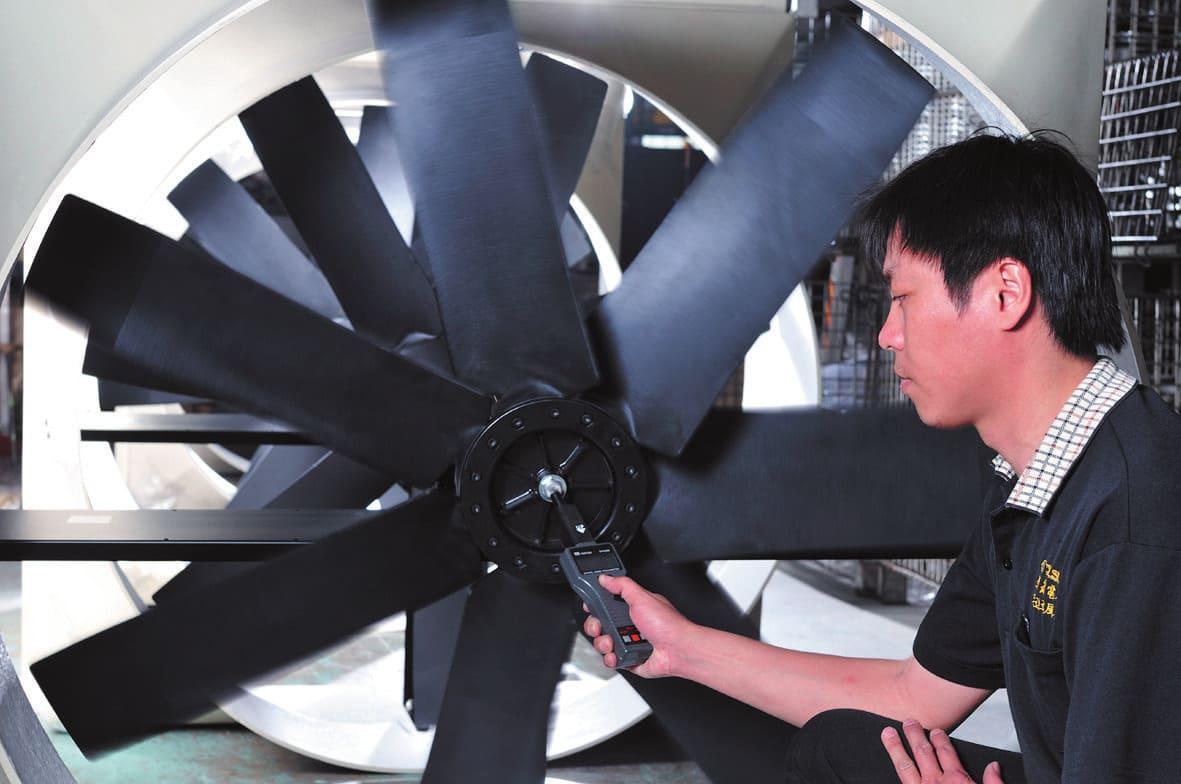
Use a calibrated pitch gauge or digital inclinometer and measure every blade at the OEM reference point.
Adjust all blades to the identical target angle, then recheck pitch after torquing hub bolts.
Avoid over-pitching, which pushes the fan into stall and produces loud surging noise plus motor overload.
Tune pitch seasonally; excessive pitch for low wet-bulb conditions increases turbulence and noise unnecessarily.
2. Perform Professional Dynamic Balancing
Static balancing is not enough for large cooling tower fans. Dynamic balancing corrects imbalance while the fan rotates under operating conditions.
Clean off mineral scale, slime and debris on blade surfaces first, since uneven deposits shift weight distribution.
For hollow FRP blades, check drain holes for clogging. Trapped condensate creates recurring imbalance that returns quickly after balancing.
Follow ISO balancing grades; G2.5 is recommended for critical industrial cooling tower fans.
After blade repair, replacement or pitch adjustment, always rebalance the full rotating assembly.
3. Upgrade to Aerodynamically Optimized Low-Noise Blades
If your existing blades are old flat-plate, simple untwisted aluminum blades, upgrading delivers lasting noise reduction.
Serrated trailing edges: Breaks large turbulent eddies into smaller flow structures, cutting tonal blade-pass noise.
Swept or blended rounded tips: Weakens tip vortex leakage, the biggest source of aerodynamic noise.
Twisted airfoil profiles: Distributes lift evenly along the blade span and delays stall, running smoother and quieter.
FRP composite blades: Natural vibration damping reduces structure-borne noise compared with rigid solid aluminum blades. Never mix blade styles, airfoils or materials on one hub. Mismatched blades create permanent aerodynamic imbalance.
4. Maintain Proper Blade Tip Clearance
Too-small tip clearance causes scraping, rubbing noise and vortex amplification; too large clearance wastes airflow and increases tip noise.
Measure the gap between each blade tip and the inner wall of the FRP fan stack.
Match the clearance range recommended by the blade manufacturer.
If the fan stack is out-of-round or deformed, repair the stack instead of only trimming blade tips. Trimming ruins the original airfoil shape and hurts efficiency.
5. Inspect, Repair or Replace Damaged Blades
Blade damage changes weight and aerodynamic shape, leading to vibration and noise.
Check for gel coat cracks, delamination, erosion, bending, nicks and leading-edge gouges.
Small surface damage can be professionally repaired, but structural cracks, large delamination or twisted deformation usually require full-set replacement.
Replace the entire matched blade set instead of swapping one single damaged blade. A single new blade will not match the weight and aerodynamic performance of aged blades.
✅ Build a quarterly inspection schedule: check pitch, blade surface, drain holes, vibration levels and bolt torque.
✅ Keep fill and drift eliminators clean; fouling raises static pressure and pushes fans toward stall.
✅ Use vibration analysis tools to track trending vibration, so you catch degradation before it becomes severe.
✅ Document all balancing, pitch changes and blade replacements for repeatable maintenance.
✅ If noise limits are strict, combine blade upgrades with acoustic barriers or silencers around the fan stack outlet.
Frequently Asked Questions
Q: Can balancing alone fix fan noise?
A: Balancing only resolves imbalance-related vibration. It cannot fix aerodynamic noise from poor blade shape, stall, uneven pitch or tip vortices.
Q: Are serrated blades much quieter?
A: Serrated trailing edges typically reduce tonal noise by 4–8 dB(A) without major efficiency loss, ideal for sites near offices or residential areas.
Q: Why do hollow FRP blades keep vibrating after balancing?
A: The most common reason is clogged drain holes and trapped water inside the blade cavity. Drain and seal shell cracks first.
Q: Can I trim blade tips to reduce noise?
A: Not recommended. Trimming changes the airfoil and lift distribution, often creating worse vibration and airflow loss.
Conclusion
Reducing noise and vibration for cooling tower fan blades needs a combined approach: uniform pitch calibration, accurate dynamic balancing, regular blade inspection, proper tip clearance and aerodynamic upgrades when needed. FRP blades with twisted airfoils, blended tips and serrated trailing edges deliver the best acoustic performance, while VFD speed control helps match fan output to cooling load. For Marley, BAC, Evapco and custom retrofit cooling tower fans, addressing aerodynamic root causes — not just adding weights — will deliver stable, quiet fan operation and protect your gearbox, bearings and fan stack from premature failure.
Recommended internal links for CoolingTowerPart.com: