Choosing the right cooling tower fill is essential for maintaining efficient heat transfer, stable cooling performance, and reliable operation. The wrong fill can lead to poor water distribution, excessive fouling, higher maintenance costs, and reduced cooling capacity.
With different types, materials, shapes, and designs available, how do you select the right cooling tower fill media for your application?
The answer depends on several factors, including cooling tower design, water quality, operating temperature, thermal requirements, and maintenance conditions.
This guide explains the key factors to consider when selecting cooling tower fill for new installations, retrofit projects, and replacement applications.
What Is Cooling Tower Fill?
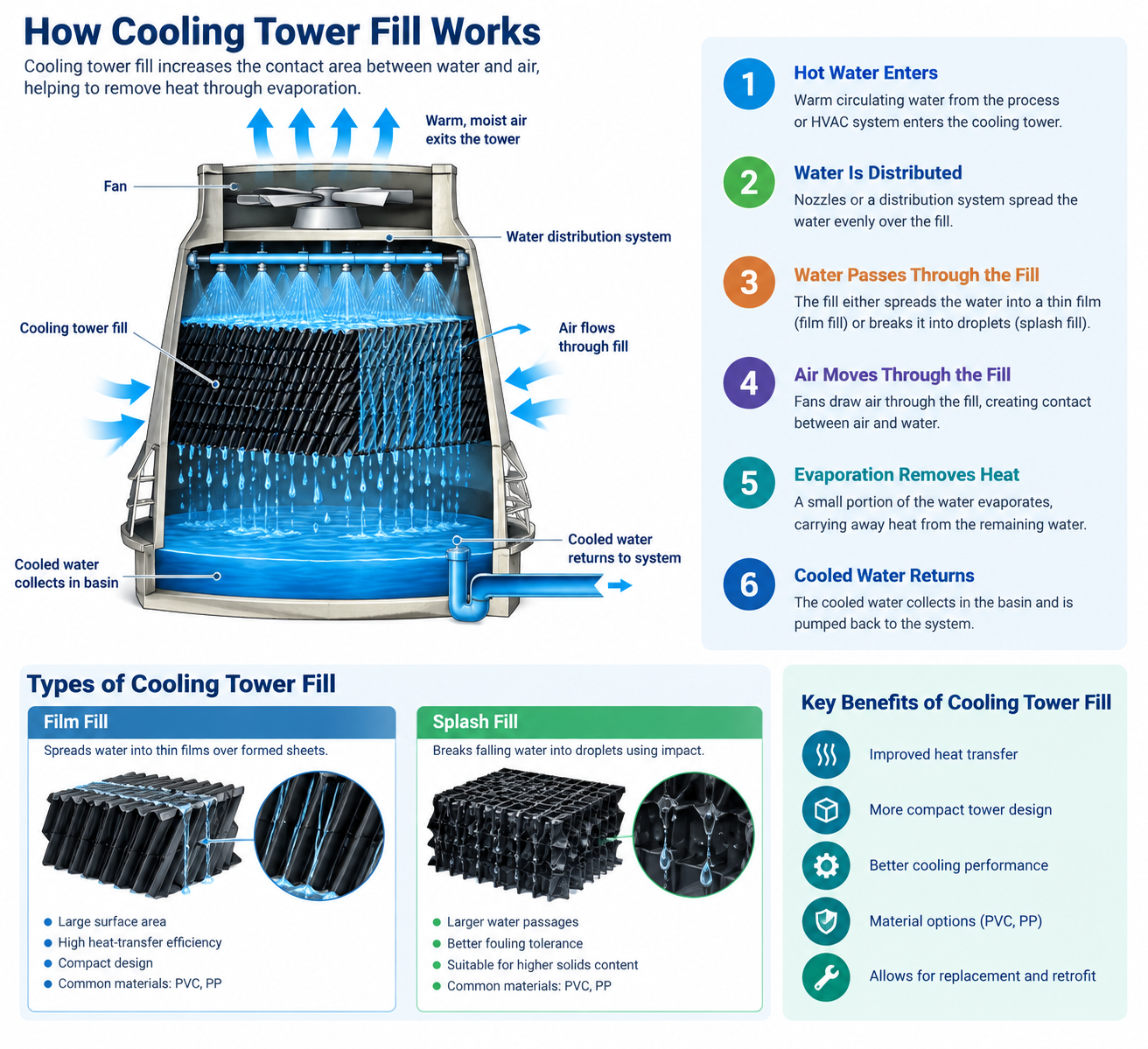
Cooling tower fill, also called fill media, is the internal component that increases the contact area between circulating water and air.
Warm water enters the cooling tower and flows through the fill while air moves through it. The fill spreads the water into a thin film or repeatedly breaks it into droplets. This increases water-air contact and improves heat and mass transfer.
The main types of cooling tower fill are:
Film fill
Splash fill
Hybrid fill
The best option depends on the operating conditions of the cooling tower.
1. Identify Your Cooling Tower Type
The first step is to determine the type and configuration of your cooling tower.
Common designs include:
Crossflow cooling towers
Counterflow cooling towers
Induced-draft cooling towers
Forced-draft cooling towers
Natural-draft cooling towers
Fill geometry and dimensions must be compatible with the tower's internal structure.
For replacement projects, measure the existing fill height, width, length, block configuration, support arrangement, and available fill volume before ordering.
A fill that performs well thermally may still be unsuitable if it cannot be properly installed in the existing tower.
2. Choose Between Film Fill and Splash Fill
One of the most important decisions is selecting the correct cooling tower fill type.
Film Fill
Film fill consists of formed sheets that create a large wetted surface. Water flows over the sheets as a thin film while air passes through the fill.
Film fill advantages include:
PVC film fill is widely used in industrial and HVAC cooling towers.
However, tightly spaced film fill can be more vulnerable to blockage when water contains high concentrations of suspended solids or biological contamination.
Splash Fill
Splash fill uses bars, grids, or modules to repeatedly break falling water into smaller droplets.
Splash fill advantages include:
More open passages
Good resistance to plugging
Suitable for poorer water quality
Easier access for some cleaning applications
Available in PVC and PP configurations
Splash fill is often considered for industrial cooling towers where suspended solids, fouling, or contamination make conventional film fill less suitable.
Hybrid Fill
Hybrid fill combines design features of film and splash media. It can provide a balance between heat-transfer performance and resistance to fouling.
It may be suitable when the application requires both good thermal efficiency and greater tolerance to challenging water conditions.
3. Evaluate Cooling Water Quality
Water quality is one of the most important factors when selecting cooling tower fill.
Before choosing fill media, evaluate:
Suspended solids
Total dissolved solids
Hardness
Scaling tendency
Biological growth
Oil contamination
Corrosive chemicals
Water treatment program
Clean or Well-Treated Water
Film fill can be a practical choice when the circulating water is properly treated and relatively clean.
Its high surface area supports efficient heat transfer.
Dirty or Solids-Laden Water
If the water contains significant suspended solids, splash fill may provide greater resistance to blockage because of its more open structure.
However, fill selection should be based on actual water conditions and the manufacturer's thermal and hydraulic recommendations.
4. Select the Right Fill Material
The material of the fill affects its chemical resistance, temperature capability, durability, and service life.
PVC Cooling Tower Fill
PVC cooling tower fill is widely used because it offers a useful combination of:
PVC is commonly used for film fill and many other cooling tower components.
PP Cooling Tower Fill
PP cooling tower fill uses polypropylene and is available in film and splash designs.
PP can be advantageous in applications requiring greater temperature capability or specific chemical resistance.
PP splash fill is particularly common in industrial applications where water quality can be challenging.
Other Materials
Specialized cooling towers may use other plastics or materials depending on temperature, chemicals, fire requirements, and mechanical conditions.
Always verify material compatibility with the actual operating environment.
5. Check Operating Temperature
Temperature is another critical selection factor.
Determine:
The selected fill material must remain stable under the expected temperature conditions.
Higher-temperature applications may require a different material or fill configuration than standard HVAC cooling towers.
6. Consider Thermal Performance Requirements
The right fill must be capable of handling the required thermal load.
Important design parameters include:
Water flow rate
Airflow rate
Hot-water temperature
Cold-water temperature
Wet-bulb temperature
Cooling range
Approach temperature
Fill height
Water loading
A fill with a large surface area does not automatically guarantee better performance. The fill must work correctly with the tower's airflow and water distribution system.
For replacement projects, thermal performance should be evaluated rather than simply copying the dimensions of an old fill pack.
7. Check Water Distribution
Even high-performance fill cannot operate effectively if water is poorly distributed.
Before selecting fill, inspect the cooling tower's:
Spray nozzles
Distribution pipes
Headers
Water pressure
Flow rate
Nozzle spacing
Uneven water distribution can create dry areas and overloaded sections inside the fill.
For a replacement project, make sure the new fill works with the existing distribution system.
8. Consider Fouling and Maintenance
Cooling tower fill is continuously exposed to circulating water and air. Over time, deposits, biological growth, and debris can accumulate.
Consider the expected maintenance environment when selecting fill.
For example:
Film fill: High thermal efficiency but generally requires good water treatment to minimize blockage.
Splash fill: More open structure and often more tolerant of solids and fouling.
A suitable water-treatment program remains important regardless of fill type.
9. Measure the Existing Fill for Replacement
If you are purchasing cooling tower fill replacement, accurate measurements are essential.
Record:
Fill block length
Fill block width
Fill height
Sheet or bar spacing
Module configuration
Support beam dimensions
Airflow direction
Water flow direction
Also determine whether the existing tower uses crossflow or counterflow fill.
Photos of the existing installation can help a supplier identify the appropriate replacement configuration.
10. Consider Installation and Handling
Cooling tower fill is available as individual sheets, assembled blocks, modules, or splash components.
Consider how the fill will be transported and installed.
Lightweight PVC and PP fill can simplify handling, but large fill blocks may still require careful planning inside an operating plant.
For retrofit projects, confirm that the replacement fill can pass through available access openings and fit the existing support structure.
11. Compare Total Cost, Not Just Purchase Price
The cheapest cooling tower fill is not necessarily the most economical option.
Evaluate the total cost, including:
A higher-performance fill may reduce operating costs if it improves cooling efficiency or extends maintenance intervals.
Cooling Tower Fill Selection Checklist
Before placing an order, confirm the following:
| Selection Factor | What to Check |
| Tower type | Crossflow or counterflow |
| Fill type | Film, splash, or hybrid |
| Material | PVC, PP, or other suitable material |
| Water quality | Solids, scale, biological growth |
| Temperature | Normal and maximum operating temperature |
| Water flow | Required circulation rate |
| Airflow | Tower airflow and fan performance |
| Thermal duty | Range and approach requirements |
| Dimensions | Fill height, width, length |
| Distribution | Nozzles, headers, and water coverage |
| Maintenance | Cleaning and inspection requirements |
| Installation | Access and support structure |
Common Cooling Tower Fill Selection Mistakes
Choosing Fill Based Only on Price
A low purchase price may result in higher maintenance or reduced thermal performance.
Ignoring Water Quality
Selecting high-density film fill for heavily contaminated water can increase the risk of blockage and fouling.
Matching Dimensions Without Checking Performance
A replacement fill may physically fit but still fail to meet the required thermal duty.
Ignoring the Distribution System
Poor water distribution can prevent the fill from reaching its designed performance.
Failing to Check Temperature Compatibility
The fill material must be suitable for both normal and maximum operating temperatures.
Cooling Tower Fill for New and Replacement Applications
For a new cooling tower, fill selection should be part of the overall thermal and hydraulic design.
For an existing tower, the process is slightly different. Start with the current tower configuration, operating data, water quality, and performance problems.
If the existing fill is cracked, brittle, heavily scaled, damaged, or permanently blocked, cooling tower fill replacement may be necessary.
A replacement supplier should be able to evaluate the existing fill dimensions and operating conditions and recommend a compatible solution.
Frequently Asked Questions
What is the best cooling tower fill?
There is no single best fill for every application. Film fill, splash fill, and hybrid fill have different performance characteristics and should be selected according to water quality, thermal requirements, temperature, and tower design.
Is PVC or PP better for cooling tower fill?
Both PVC and PP are widely used. The appropriate material depends on operating temperature, chemical exposure, water conditions, and the specific fill design.
Is film fill suitable for dirty water?
Film fill can be more susceptible to blockage when water contains high levels of suspended solids or biological contamination. Splash fill may be more appropriate for some dirty-water applications.
How do I choose replacement cooling tower fill?
Start by identifying the tower type, fill dimensions, water flow, operating temperatures, water quality, thermal requirements, and existing support structure. These details help ensure the replacement fill is both physically and thermally compatible.
Can cooling tower fill improve tower performance?
Replacing severely damaged or fouled fill can restore cooling performance. However, actual performance depends on the complete system, including fill, water distribution, airflow, fan performance, and water treatment.
Conclusion
Selecting the right cooling tower fill requires more than choosing between PVC and PP or film and splash designs. The correct solution must match the cooling tower configuration, water quality, operating temperature, thermal duty, water distribution, and maintenance requirements.
For clean and well-treated water, film fill can provide high heat-transfer efficiency. For applications with higher fouling potential, splash fill may offer a more open and maintenance-friendly structure. PP and PVC remain common choices for different operating conditions.
For new installations and cooling tower fill replacement, evaluating the complete operating environment before purchasing can help ensure reliable cooling performance and long-term value.
Internal Links for Other CoolingTowerParts
Cooling Tower Nozzles
Cooling Tower Drift Eliminators
Cooling Tower Louvers
Cooling Tower Fan Blades
Cooling Tower Motors


