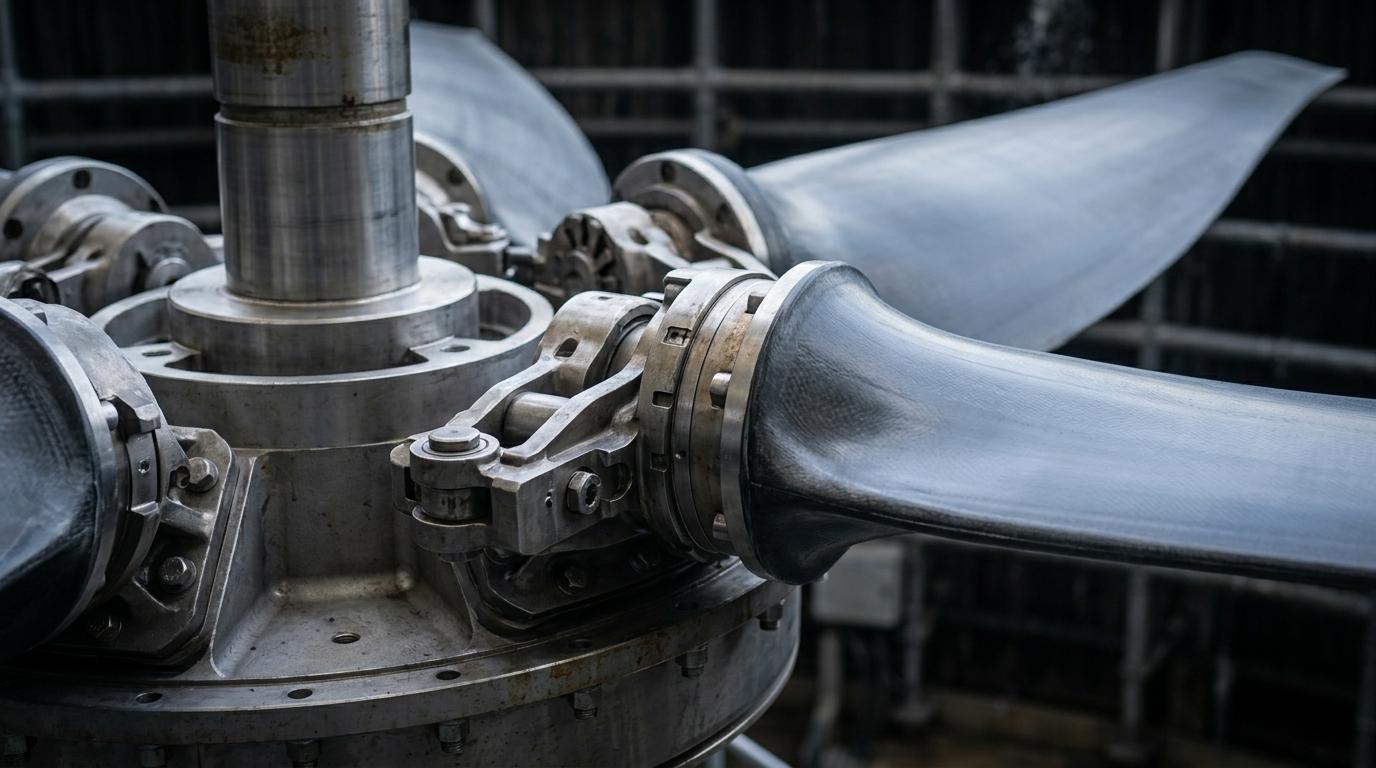
Cooling tower fan blade pitch adjustment is an important maintenance task that can improve airflow, heat rejection, and energy efficiency. When the fan pitch is too low, the cooling tower may not deliver enough air to meet the required cooling load. When the pitch is too high, the fan motor may consume excessive power, experience overload, or operate outside its recommended limits.
Learning how to adjust cooling tower fan blade pitch helps maintenance teams optimize fan performance, reduce operating costs, and extend equipment service life. This guide explains the adjustment process, pitch measurement, common problems, and best practices for industrial cooling towers.
1. What Is Cooling Tower Fan Blade Pitch?
Cooling tower fan blade pitch is the angle of a fan blade relative to a defined reference plane, usually the plane of rotation. The exact measurement convention depends on the fan manufacturer and measurement method.
Blade pitch affects the amount of air a fan moves through the cooling tower. A correctly adjusted fan helps maintain the airflow required for heat transfer between the circulating water and the surrounding air.
Fan pitch adjustment is commonly performed during:
Cooling tower commissioning
Fan or blade replacement
Motor or gearbox maintenance
Cooling capacity optimization
Troubleshooting low airflow or excessive power consumption
Important: Blade pitch is not the same as blade tip clearance, blade tracking, or blade mounting angle. These measurements serve different purposes and should be checked separately.
2. Why Adjust Cooling Tower Fan Blade Pitch?
Correct cooling tower fan blade pitch can improve operating performance in several ways.
Improve Cooling Efficiency
Insufficient fan airflow can reduce heat rejection and cause higher cooling water outlet temperatures. Adjusting the pitch to the manufacturer's specified setting can help restore the required airflow.
Reduce Energy Consumption
A fan operating at an unnecessarily high pitch may draw more power than required. Proper adjustment helps balance airflow demand and motor energy consumption.
Prevent Motor Overload
Excessive pitch can increase the aerodynamic load on the fan. Depending on fan design and operating conditions, this can cause motor current to exceed allowable limits.
Reduce Mechanical Stress
Correct pitch settings, combined with proper blade alignment and balance, help reduce unnecessary operating stress on fan blades, bearings, shafts, gearboxes, and supporting structures.
3. Tools Required for Fan Blade Pitch Adjustment
Prepare the following tools and equipment before starting work:
Manufacturer-approved blade pitch gauge or angle-measuring instrument
Tape measure or ruler
Torque wrench
Appropriate hand tools
Clamp meter or power-monitoring equipment
Personal protective equipment
Manufacturer's fan installation and maintenance manual
The required tools depend on the fan design. Some adjustable-pitch fans have marked pitch scales, while others require direct angle measurement.
4. How to Adjust Cooling Tower Fan Blade Pitch Step by Step
Step 1: Shut Down and Isolate the Equipment
Stop the cooling tower fan and isolate its electrical supply. Apply lockout/tagout procedures and verify that the fan cannot restart automatically.
Allow all rotating components to stop completely. Never adjust fan blades while the fan is running.
Step 2: Inspect the Fan Assembly
Before changing the pitch, inspect the fan blades, hub, fasteners, drive system, and supporting structure.
Look for:
Cracked, bent, or damaged blades
Loose hub bolts or blade clamps
Corrosion or material deterioration
Uneven blade positions
Excessive vibration or abnormal wear
Repair or replace defective components before making adjustments.
Step 3: Identify the Required Blade Pitch
Consult the fan manufacturer's documentation to determine the correct pitch setting for the specific model and operating conditions.
Do not assume that every blade should use the same angle as another cooling tower fan. Pitch requirements vary with blade geometry, diameter, rotational speed, motor power, and fan design.
If the original setting is known and the equipment was operating correctly, record it as a reference before making changes.
Step 4: Measure the Existing Blade Pitch
Position the pitch gauge at the measurement location specified by the manufacturer. Use the same radial position and reference plane for each blade.
Record the measured angle for every blade.
For consistent results:
Measure all blades at the same radius.
Use the same measurement reference and instrument orientation.
Keep the instrument firmly positioned.
Repeat measurements if readings are inconsistent.
Blade pitch can vary along the blade because of its aerodynamic twist. Therefore, measurements taken at different radial positions should not be compared directly.
Step 5: Adjust Each Blade to the Specified Angle
Loosen the blade mounting or clamping hardware according to the manufacturer's instructions.
Rotate each blade to the required pitch setting. Adjust the blades uniformly and confirm that each blade uses the correct reference location.
Do not increase the pitch simply because cooling performance is poor. Low airflow may also result from dirty fill, blocked air inlets, incorrect fan rotation, damaged blades, or drive-system problems.
Step 6: Tighten the Fasteners
Tighten all mounting bolts to the specified torque using a calibrated torque wrench.
Follow the manufacturer's tightening sequence and any requirements for locking devices or fastener replacement. Incorrect tightening can allow blades to move during operation or damage the hub.
Step 7: Check Blade Tracking and Clearances
After adjustment, verify that the blade tips follow the specified tracking pattern and maintain the required clearance from the fan cylinder.
Check that all blades are securely installed and that the fan can rotate freely without interference.
Blade pitch, blade tracking, and tip clearance must all meet the fan manufacturer's requirements.
Step 8: Restart and Verify Performance
Remove tools and personnel from the danger area, restore the equipment according to site procedures, and restart the fan.
Monitor:
Motor current and power consumption
Fan rotational speed
Vibration and abnormal noise
Cooling water inlet and outlet temperatures
Fan rotation direction
Overall cooling tower performance
Compare operating results with the manufacturer's limits and the original baseline. If current, vibration, or temperature readings are abnormal, stop the equipment and investigate before continuing operation.
5. How to Measure Cooling Tower Fan Blade Pitch Correctly
Accurate pitch measurement is essential for reliable fan performance.
The blade angle should be measured at the radial station and relative to the reference plane specified by the manufacturer. A reading taken near the hub may differ from one taken near the blade tip because many fan blades have a twisted profile.
Avoid comparing pitch values from different manufacturers unless their measurement conventions are confirmed to be equivalent.
For maintenance records, document:
| Measurement item | What to record |
| Fan model | Manufacturer and model number |
| Blade configuration | Number and type of blades |
| Pitch measurement | Angle and measurement location |
| Motor data | Rated power, voltage, and current |
| Operating conditions | Fan speed and cooling load |
| Performance results | Current, vibration, and water temperatures |
These records make future inspections and troubleshooting more consistent.
6. Common Cooling Tower Fan Pitch Adjustment Problems
Uneven Blade Pitch
Possible cause: Inconsistent measurements or incorrect blade positioning.
Solution: Recheck every blade using the same measurement method and specified radial location.
High Motor Current After Adjustment
Possible cause: Excessive pitch, incorrect rotational speed, or another mechanical or electrical problem.
Solution: Stop the fan if operating limits are exceeded. Verify the pitch setting and investigate the drive system before restarting.
Low Airflow Despite Correct Pitch
Possible cause: Incorrect fan rotation, damaged blades, blocked air inlets, fouled fill, or inadequate fan speed.
Solution: Inspect the complete airflow path and drive system rather than continuing to increase pitch.
Excessive Vibration
Possible cause: Uneven blade settings, blade damage, loose fasteners, imbalance, or shaft and gearbox problems.
Solution: Shut down the fan and inspect the assembly. Pitch adjustment alone will not correct every vibration problem.
7. Best Practices for Cooling Tower Fan Blade Pitch Adjustment
To maintain reliable operation, follow these recommendations:
Follow the manufacturer's specifications. Never use a universal pitch angle for all cooling tower fans.
Adjust all blades consistently. Uneven settings can create airflow differences and mechanical imbalance.
Monitor motor load. Confirm that current and power remain within allowable limits after adjustment.
Inspect the entire cooling tower. Poor thermal performance may originate from water distribution, fill fouling, or other system problems.
Record every adjustment. Document the original pitch, final setting, and operating results.
Use qualified maintenance personnel. Fan hubs, large blades, and elevated cooling tower equipment present serious mechanical hazards.
8. When Should You Replace Cooling Tower Fan Blades?
Pitch adjustment is appropriate when the blades remain structurally sound and are designed for adjustment. It is not a substitute for replacing damaged or unsuitable components.
Consider replacement when blades have cracks, permanent deformation, severe corrosion, damaged mounting areas, or deterioration that prevents reliable operation.
When sourcing replacement cooling tower fan blades, confirm the fan diameter, blade profile, material, hub compatibility, rotational speed, rotation direction, and required airflow. Replacement blades should meet the original equipment's mechanical and aerodynamic requirements.
For industrial cooling tower retrofit projects, a qualified supplier can help evaluate replacement fan blades and compatible components based on the existing fan assembly and operating conditions.
9. Frequently Asked Questions
What Is the Correct Cooling Tower Fan Blade Pitch Angle?
There is no single correct angle for every cooling tower fan. The required setting depends on the fan design, rotational speed, blade geometry, and operating requirements. Always follow the manufacturer's specifications.
Does Increasing Fan Blade Pitch Improve Cooling Performance?
Increasing pitch may increase airflow under some operating conditions, but it can also increase motor load and power consumption. Excessive pitch may overload the motor or exceed fan operating limits.
How Often Should Cooling Tower Fan Pitch Be Checked?
Check blade pitch during commissioning, fan maintenance, blade replacement, and troubleshooting. The inspection frequency should follow the manufacturer's recommendations and the site's preventive maintenance program.
Can Fan Blade Pitch Adjustment Reduce Energy Costs?
Yes, when the existing setting is unsuitable and the adjustment brings airflow and motor load closer to the required operating conditions. Actual savings depend on fan design, operating hours, cooling demand, and the adjustment made.
What Is the Difference Between Fan Pitch and Fan Speed?
Fan pitch is the blade angle, while fan speed is the rotational rate. Both influence airflow and power consumption, but they are different variables and must be evaluated together.
Conclusion
Correct cooling tower fan blade pitch adjustment helps maintain the balance between airflow, cooling performance, motor load, and energy consumption. The process requires accurate measurement, uniform blade settings, proper fastener tightening, and performance verification after startup.
For the best results, use the fan manufacturer's specifications instead of relying on a universal pitch angle. When adjustment cannot restore reliable performance, inspect the entire cooling tower system and consider whether damaged or unsuitable fan blades need replacement.
Looking for cooling tower fan blades or replacement components? Contact a Power Tower Cooling Technology (Shaoxing) Co.,Ltd with your fan model, blade dimensions, hub configuration, and operating requirements to identify a suitable replacement solution.
Recommended internal links for CoolingTowerPart.com:


