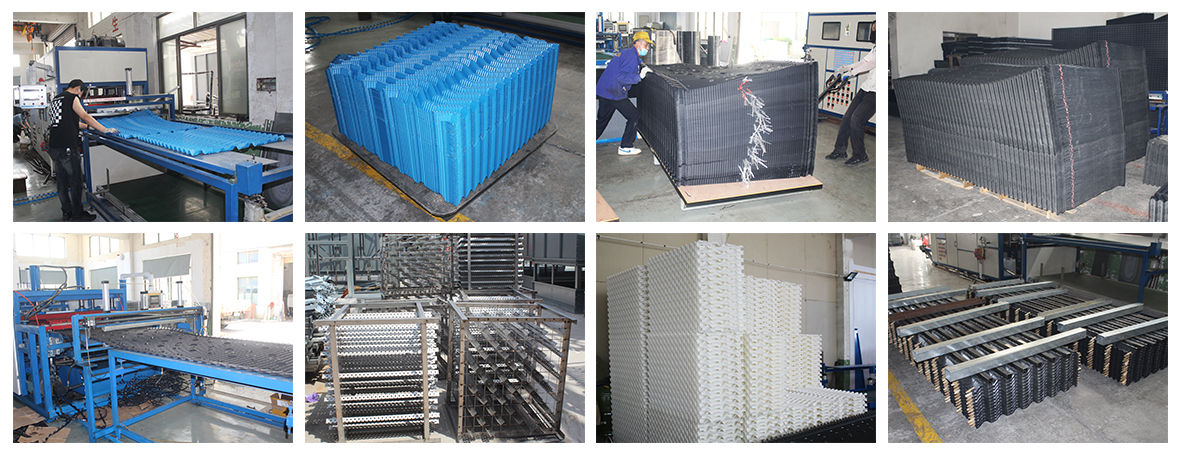
Fill for cooling tower systems is one of the most important components for efficient heat transfer. Cooling tower fill media increases the contact area between circulating water and air, helping remove heat through evaporation.
The three major cooling tower fill types are splash fill, film fill, and hybrid fill. Each type has different characteristics and is suitable for different water qualities, cooling requirements, and tower designs.
Whether you are designing a new cooling tower or looking for cooling tower fill replacement, understanding these fill media options can help you select the right product for your application.
What Is Fill for Cooling Tower?
Fill for cooling tower equipment is an internal heat-transfer media installed between the water distribution system and the air inlet or outlet.
Hot circulating water enters the tower and is distributed over the fill. As the water travels through the fill, air passes across or counter to the water flow. The fill increases water-air contact and promotes evaporation, which removes heat from the circulating water.
Common cooling tower fill materials include:
PVC
PP (polypropylene)
PE
Wood
Composite materials
Today, PVC cooling tower fill and PP cooling tower fill are widely used because they provide good durability, chemical resistance, and relatively low weight.
Why Is Cooling Tower Fill Important?
A cooling tower cannot efficiently transfer heat without sufficient water-air contact.
The fill helps:
Increase water-air contact area
Extend water residence time
Improve evaporation
Promote heat transfer
Support lower cold-water temperatures
Improve cooling tower thermal capacity
However, more surface area does not automatically mean better performance. If the fill becomes blocked by scale, dirt, algae, or suspended solids, airflow and water distribution can deteriorate.
Therefore, fill selection and regular maintenance are both essential.
Splash Fill for Cooling Tower
Splash fill cools water by repeatedly breaking it into smaller droplets as it falls through the tower.
Splash bars, grids, or other structures interrupt the water flow. This creates droplets and exposes more water to the moving air.
Common splash-fill designs include:
PP splash fill
PVC splash fill
Splash bars
Grid splash fill
Cellular splash fill
Benefits of Splash Fill
One major advantage of splash fill is its relatively open structure.
This makes it suitable for cooling tower systems where water contains suspended solids or where fouling is a significant concern.
Key benefits include:
Good resistance to blockage
Suitable for poor-quality water
Relatively easy inspection
Good mechanical durability
Suitable for many industrial applications
Available in PVC and PP
Splash fill is frequently considered for industrial cooling towers, wastewater-related systems, and applications where water treatment conditions can be challenging.
Film Fill for Cooling Tower
Film fill uses shaped sheets to spread water into a thin film over a large surface area.
The sheets normally contain corrugations or other surface patterns that increase turbulence and encourage water to remain in contact with the fill surface.
PVC film fill is particularly common in cooling tower applications.
Benefits of Film Fill
Film fill can provide a large effective surface area within a relatively compact volume.
Its main advantages include:
High heat-transfer efficiency
Large water-air contact area
Compact design
Lightweight construction
Efficient use of tower space
Suitable for clean and properly treated water
Film fill is commonly used in HVAC cooling towers, commercial facilities, manufacturing plants, process cooling systems, and many industrial applications.
When Should You Use Film Fill?
Film fill is generally appropriate when circulating water is reasonably clean and properly treated.
If the water contains high concentrations of suspended solids, biological contamination, or debris, narrow fill passages can become blocked. In these conditions, an open splash design may be easier to maintain.
The final choice should be based on the tower design and actual operating conditions.
Hybrid Cooling Tower Fill
Hybrid cooling tower fill combines characteristics of splash and film fill.
The objective is to balance the high surface-area characteristics of film fill with the fouling tolerance associated with more open splash-fill structures.
Hybrid designs vary considerably between manufacturers. Some use different fill geometries in different sections of the tower, while others use specially engineered sheets or blocks.
Advantages of Hybrid Fill
Depending on the specific design, hybrid fill can provide:
Balanced thermal performance
Improved fouling tolerance
Effective water distribution
Flexible retrofit options
Good performance in challenging applications
Hybrid fill can be considered when neither conventional film fill nor conventional splash fill completely meets the project's requirements.
Splash vs. Film vs. Hybrid Fill
| Feature | Splash Fill | Film Fill | Hybrid Fill |
| Heat transfer | Good | High | Good to high |
| Surface area | Moderate | High | Moderate to high |
| Fouling tolerance | High | Moderate | Moderate to high |
| Water quality tolerance | High | Lower | Moderate |
| Cleaning | Relatively easy | Requires care | Design dependent |
| Typical material | PP/PVC | PVC/PP | PVC/PP |
| Typical use | Industrial systems | HVAC & process cooling | Challenging applications |
These are general characteristics. Actual cooling tower performance depends on fill geometry, water loading, airflow, temperature conditions, and tower configuration.
How to Choose the Right Fill for Cooling Tower
Selecting fill for cooling tower applications requires more than comparing product prices.
1. Consider Water Quality
Start with the circulating water.
Check for:
Suspended solids
Hardness and scaling
Biological growth
Oil contamination
Chemical exposure
Debris
Poor water quality can significantly affect fill life and performance.
2. Check Thermal Requirements
Review the tower's:
The selected fill must be suitable for the required thermal duty.
3. Select the Correct Material
PVC and PP are common choices, but their suitability depends on operating temperature and water chemistry.
Always compare the manufacturer's material specifications with actual site conditions.
4. Consider Maintenance
A highly compact fill structure may offer excellent thermal performance but require more attention when fouling occurs.
For difficult water conditions, maintenance requirements should be considered alongside thermal performance.
Cooling Tower Fill Replacement
Cooling tower fill eventually requires cleaning, repair, or replacement.
Common reasons for cooling tower fill replacement include:
Before ordering replacement fill, measure the existing installation carefully.
Important specifications include:
The replacement fill for cooling tower should fit the existing tower structure and work with the current water distribution and airflow system.
PVC and PP Cooling Tower Fill
PVC cooling tower fill is widely used for film-fill applications because of its combination of rigidity, chemical resistance, and cost efficiency.
PP cooling tower fill is also widely used, especially for splash-fill applications and systems requiring specific temperature or chemical resistance characteristics.
The correct material depends on the tower's operating conditions, not simply on the material's purchase price.
Cooling Tower Fill Maintenance
Proper maintenance can extend the service life of cooling tower fill.
Recommended practices include:
Inspect the fill regularly.
Maintain proper water treatment.
Check spray nozzles for blockage.
Remove excessive scale and biological growth.
Inspect fill supports.
Monitor changes in cooling performance.
Look for damaged or collapsed fill.
Clean the fill using a suitable method.
Cleaning should be performed carefully because excessive mechanical force or unsuitable chemicals can damage PVC or PP fill.
Frequently Asked Questions
What are the main types of cooling tower fill?
The main types are splash fill, film fill, and hybrid fill. Splash fill breaks water into droplets, film fill spreads water into thin films, and hybrid fill combines characteristics of both approaches.
What is the best fill for a cooling tower?
There is no single fill that is suitable for every cooling tower. Selection depends on water quality, thermal requirements, airflow, tower configuration, operating temperature, and maintenance conditions.
Is PVC or PP better for cooling tower fill?
Both materials are widely used. PVC is common for film fill, while PP is frequently used for splash fill. The appropriate choice depends on temperature, chemical compatibility, mechanical requirements, and fill design.
When should cooling tower fill be replaced?
Fill should be replaced when it is significantly damaged, blocked, deteriorated, or when cleaning no longer restores acceptable performance. Actual service life varies by operating conditions.
Can film fill be used with dirty water?
Film fill can be used in some industrial applications with appropriate water treatment, but high levels of suspended solids and fouling can cause blockage. Water quality should therefore be evaluated before selecting film fill.
Conclusion
Choosing the right fill for cooling tower equipment is essential for maintaining heat-transfer performance and reliable operation.
Splash fill is a practical option for applications with fouling or suspended solids. Film fill provides high surface area and efficient heat transfer when water is properly treated. Hybrid cooling tower fill offers another option for systems requiring a balance between thermal performance and fouling tolerance.
For new installations and cooling tower fill replacement projects, consider water quality, cooling duty, fill dimensions, material compatibility, airflow, and maintenance requirements together.
Power Tower Cooling Technology (Shaoxing) Co.,Ltd provides PVC and PP cooling tower fill, film fill, splash fill, and replacement fill media for commercial and industrial cooling tower applications.
Internal Links for Other CoolingTowerParts
Cooling Tower Fill
Cooling Tower Nozzles
Cooling Tower Drift Eliminators
Cooling Tower Louvers
Cooling Tower Fan Blades
Cooling Tower Motors


