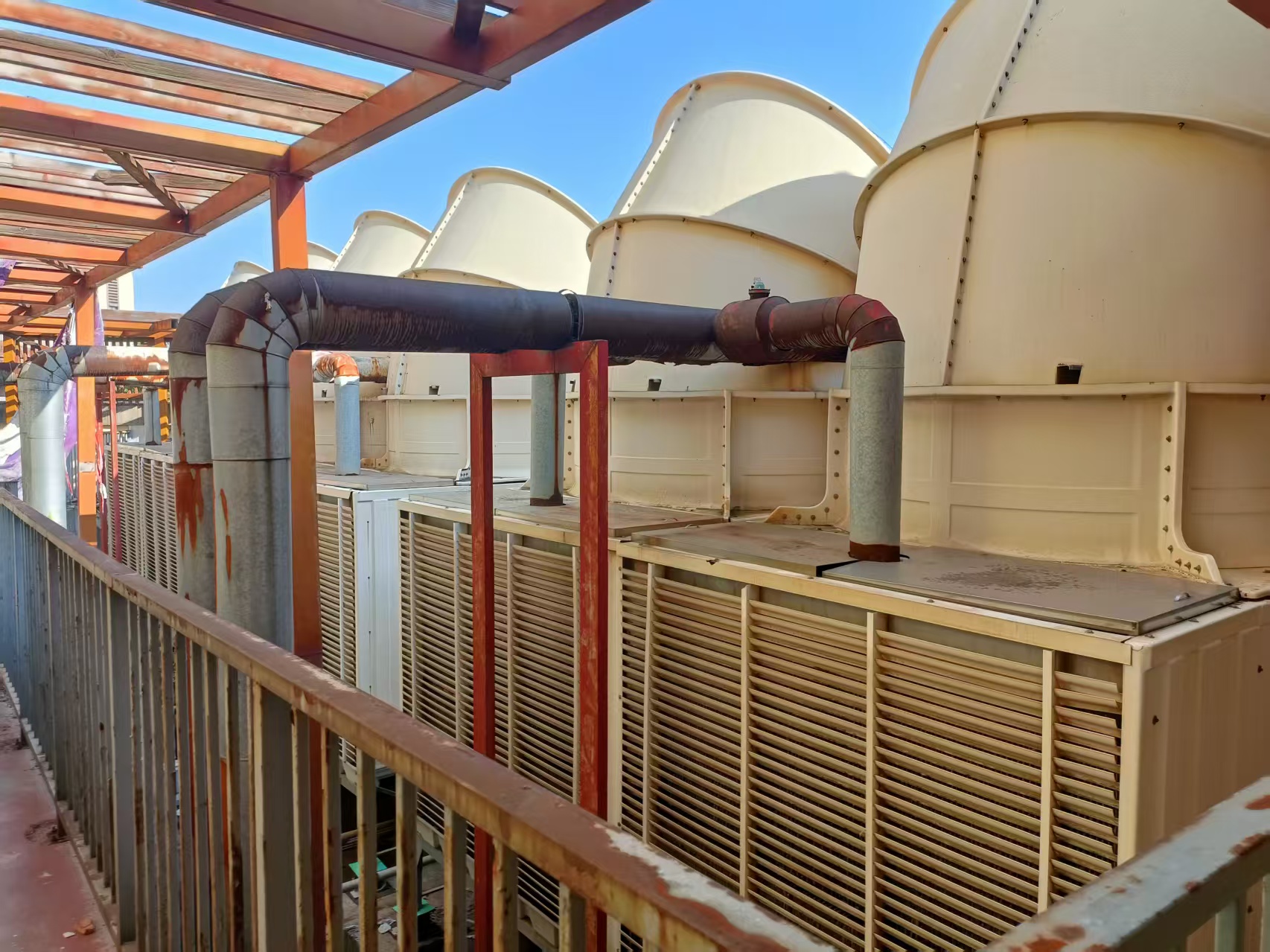
A fiberglass cooling tower fan stack is an important component of an industrial cooling tower. It surrounds the fan discharge area and helps guide airflow out of the tower. Correct fan stack dimensions, structural design, and material specifications are essential for reliable operation, safe installation, and long-term durability.
Fiberglass-reinforced plastic (FRP) fan stacks are widely considered for industrial cooling tower applications because they offer corrosion resistance, relatively low weight, and flexible customization options. They can be manufactured for new cooling towers, replacement projects, and retrofits involving different fan diameters and tower configurations.
This guide explains the key dimensions, design considerations, material specifications, and purchasing requirements for custom fiberglass cooling tower fan stacks.
What Is a Fiberglass Cooling Tower Fan Stack?
A fiberglass cooling tower fan stack is an enclosure installed around the fan outlet, commonly on induced-draft cooling towers. Its primary purpose is to provide a defined discharge path for air moving through the cooling tower.
Depending on the tower design, the stack may have a cylindrical, tapered, or flared profile. Its shape and height must be compatible with the fan arrangement, airflow requirements, structural supports, and surrounding equipment.
A typical FRP fan stack includes:
FRP shell: The main fiberglass structure.
Fan outlet section: Provides the required airflow passage.
Mounting flange: Connects the stack to the cooling tower structure.
Reinforcement sections: Provide stiffness and strength where required.
Fasteners and joints: Secure the stack and connect individual sections when applicable.
The exact configuration depends on the cooling tower model and project requirements.
Key Fiberglass Cooling Tower Fan Stack Dimensions
Accurate dimensions are essential when manufacturing or replacing a fan stack. A stack that does not match the original installation may create mounting difficulties, inadequate blade clearance, or airflow problems.
1. Stack Diameter
The diameter is one of the most important specifications.
Depending on the design, buyers may need to provide the internal diameter, external diameter, minimum throat diameter, and top outlet diameter.
The dimensions should be checked against the fan diameter and the manufacturer's required blade-tip clearance. Do not assume the fan diameter and stack diameter are identical.
2. Overall Height
Overall height affects the discharge geometry and installation space. The required height depends on the original tower design, fan arrangement, outlet profile, and applicable performance requirements.
When ordering a replacement, measure from the specified mounting reference point to the top edge of the stack.
3. Wall Thickness
FRP wall thickness depends on stack dimensions, laminate construction, reinforcement, wind loads, vibration, and other design conditions.
There is no single wall thickness suitable for every fiberglass cooling tower fan stack. The manufacturer or engineer should determine the required laminate thickness based on the intended service conditions.
4. Mounting Flange Dimensions
The mounting flange connects the stack to its support structure. Important details include:
Flange diameter and width
Flange thickness or laminate construction
Bolt-hole diameter and spacing
Number of bolt holes
Hole pattern and orientation
Gasket or sealing requirements
For replacement projects, confirm the flange dimensions and bolt-hole pattern using verified measurements or engineering drawings.
5. Stack Profile and Taper
Some fan stacks use a flared outlet or a tapered transition to guide discharged air. The profile should be designed for the specific fan and tower arrangement rather than selected solely for appearance.
Changes to the original profile may affect airflow and fan performance, so engineering review is recommended before modifying dimensions.
Fiberglass Cooling Tower Fan Stack Design Considerations
A reliable FRP fan stack requires more than the correct diameter and height. Material selection, structural design, airflow, and installation conditions must all be considered.
1. Aerodynamic Design
The fan stack should provide an appropriate discharge passage without introducing unnecessary flow restriction or separation.
Designers should consider fan diameter, blade-tip clearance, outlet geometry, operating speed, and the cooling tower's airflow requirements.
A flared stack may be appropriate for some designs, but its effectiveness depends on the complete fan and stack configuration.
2. Structural Strength
The stack must withstand the loads expected during operation and throughout its service life.
Important considerations include:
Wind pressure and suction
Fan-induced vibration
Self-weight and support conditions
Connection and flange loads
Transportation and lifting loads
Environmental and operating temperatures
Structural calculations should account for the properties of the FRP laminate and the geometry of the finished assembly.
3. Corrosion and UV Resistance
FRP is attractive for cooling tower applications because it does not rust like carbon steel. However, the resin system must be suitable for the expected temperature, moisture, chemical exposure, and outdoor conditions.
For stacks exposed to direct sunlight, UV-resistant resin or a compatible protective surface system may be necessary.
4. Installation and Maintenance Access
The design should allow safe lifting, positioning, fastening, and inspection. Large fan stacks may require sectional construction to simplify transportation or installation, depending on project requirements.
If a stack is supplied in multiple sections, the joint design must maintain the required structural integrity and dimensional alignment.
Fiberglass Cooling Tower Fan Stack Specifications
The following table outlines the specifications buyers should confirm when requesting a custom FRP fan stack.
| Specification | What to Confirm |
| Material | FRP, including the specified resin system |
| Diameter | Internal, external, throat, and outlet dimensions as applicable |
| Overall height | Finished height from the agreed reference point |
| Wall thickness | Engineered laminate thickness |
| Stack profile | Cylindrical, tapered, flared, or custom geometry |
| Flange design | Dimensions, reinforcement, and mounting interface |
| Bolt-hole pattern | Hole diameter, spacing, quantity, and orientation |
| Surface protection | UV resistance and compatible finishing system |
| Operating conditions | Temperature, humidity, chemicals, and outdoor exposure |
| Structural requirements | Wind loads, vibration, supports, and connection loads |
| Manufacturing method | Molding, hand lay-up, or another suitable fabrication process |
| Quality inspection | Dimensional checks and agreed visual or material inspections |
Actual specifications vary by cooling tower size and application. Buyers should obtain approved drawings and avoid relying on generic dimensions.
FRP vs. Steel Cooling Tower Fan Stack Specifications
FRP and steel stacks have different material properties, which influence their design and maintenance.
| Factor | FRP Fan Stack | Steel Fan Stack |
| Corrosion resistance | Generally excellent with a suitable resin system | Depends on steel grade and corrosion protection |
| Weight | Usually lightweight | Often heavier, depending on construction |
| Structural design | Based on laminate properties and reinforcement | Based on metal strength, thickness, and connections |
| Maintenance | Requires inspection for cracking and delamination | May require coating repairs and corrosion treatment |
| Customization | Flexible molding and fabrication options | Fabricated through suitable metalworking processes |
FRP can be advantageous in corrosive environments, while steel may be appropriate where project specifications, fabrication methods, or structural requirements favor metal construction.
How to Measure a Cooling Tower Fan Stack for Replacement
Before ordering a replacement fan stack, follow these steps:
Step 1: Identify the cooling tower. Record the manufacturer, model, and available equipment drawings.
Step 2: Measure the existing stack. Record overall height, internal and external diameters, taper, and outlet dimensions.
Step 3: Check the mounting interface. Measure the flange, bolt-hole pattern, and support arrangement.
Step 4: Verify fan clearance. Confirm the fan diameter and required blade-tip clearance using manufacturer specifications.
Step 5: Document the condition. Photograph cracks, damaged flanges, unusual deformation, and existing joints.
Step 6: Confirm the design. Have the proposed replacement drawings checked for dimensional compatibility, structural requirements, and airflow considerations before production.
If the original stack is damaged or distorted, do not rely on its deformed dimensions alone. Use original drawings or engineering measurements where possible.
How to Choose a Custom Fiberglass Cooling Tower Fan Stack Manufacturer
When sourcing a custom FRP fan stack, consider the supplier's ability to manufacture components that match your application.
Look for a supplier that can provide:
Custom dimensions and flange configurations
Appropriate FRP material selection
Engineering drawings and dimensional confirmation
Structural design information where required
Quality inspection documentation
Protective packaging for transportation
Technical support for replacement and retrofit projects
Provide the required dimensions, quantity, operating conditions, installation location, and delivery destination when requesting a quotation.
CoolingTowerPart.com can support inquiries for custom fiberglass cooling tower fan stacks for industrial maintenance, replacement, and retrofit applications. Confirm all technical specifications and compatibility requirements before placing an order.
Frequently Asked Questions
1. What dimensions are needed to order a fiberglass cooling tower fan stack?
The main dimensions include overall height, internal and external diameters, outlet geometry, wall thickness, flange dimensions, and bolt-hole pattern. Fan clearance and support details should also be confirmed.
2. What is the standard wall thickness of an FRP fan stack?
There is no universal standard thickness for every application. It depends on the stack geometry, laminate properties, reinforcement, wind loads, vibration, and operating conditions.
3. Can fiberglass cooling tower fan stacks be custom-made?
Yes. Manufacturers can customize the diameter, height, profile, flange configuration, laminate construction, and surface protection according to approved drawings and project requirements.
4. Does fan stack height affect cooling tower performance?
It can. Stack geometry and height influence the discharge flow and may affect airflow behavior. Changes should be evaluated against the cooling tower and fan manufacturer's design requirements.
5. Is FRP suitable for outdoor industrial cooling towers?
Yes, when the resin system, surface protection, and structural design are suitable for the site's UV exposure, weather, temperature, and operating environment.
Conclusion
Correct fiberglass cooling tower fan stack dimensions, design, and specifications are essential for safe installation, reliable airflow, and long-term service. Buyers should verify stack diameter, height, wall thickness, flange details, material properties, and structural requirements before ordering a new or replacement unit.
For industrial cooling tower projects, a custom FRP fan stack can provide corrosion resistance, lightweight construction, and flexible design options. Working with an experienced supplier and confirming approved drawings before manufacturing helps reduce installation problems and improve project reliability.
Recommended internal links for CoolingTowerPart.com:


