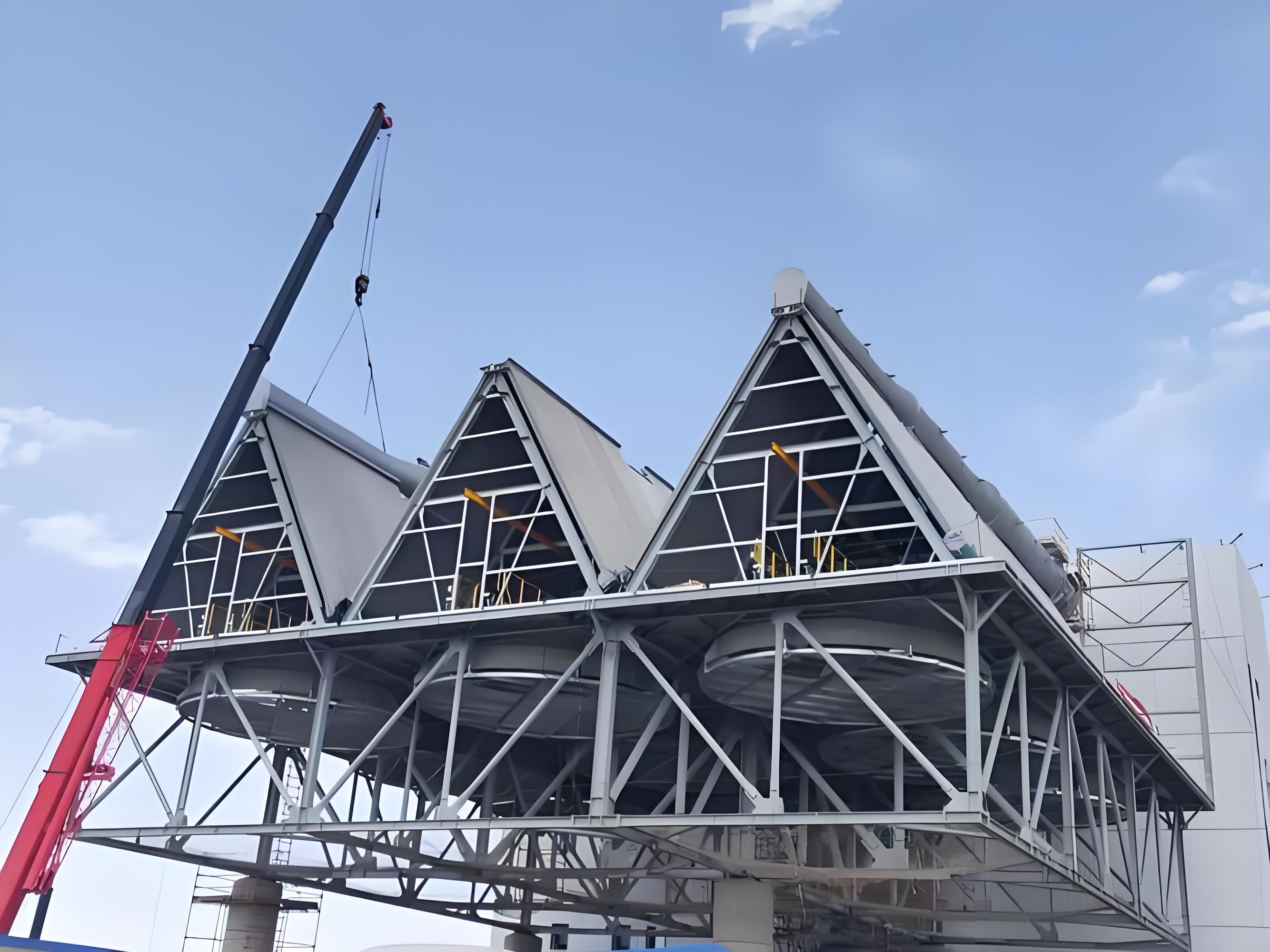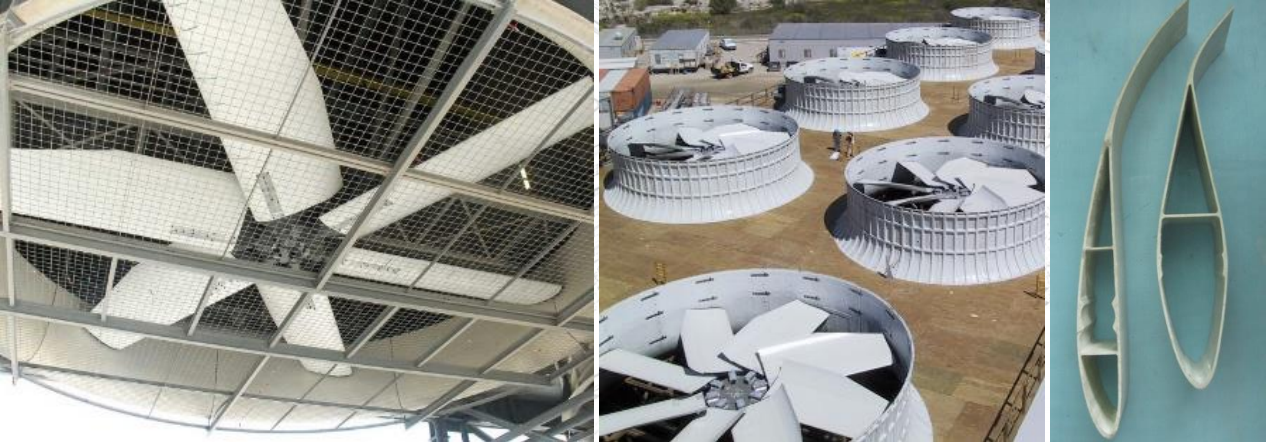
FRP Fan Blade Industrial Cooling Extrusion Profile
The FRP Fan Blade Industrial Cooling Extrusion Profile is a high-strength fiberglass reinforced plastic profile developed for industrial cooling tower fan blade applications. Designed as a structural and aerodynamic section of a cooling tower fan blade, the profile provides the required strength, stiffness, dimensional stability, and lightweight construction for continuous rotating operation. It is suitable for new cooling tower fan blade manufacturing, replacement projects, retrofit applications, and customized industrial ventilation equipment.
Made from FRP (Fiberglass Reinforced Plastic), this extrusion profile combines a strong fiberglass reinforcement structure with a corrosion-resistant resin matrix. Compared with conventional steel or aluminum blade components, FRP can provide a favorable strength-to-weight ratio while offering excellent resistance to moisture, corrosion, and many chemicals commonly encountered around industrial cooling towers.
For cooling tower operators, maintenance contractors, engineering companies, and industrial equipment manufacturers, the profile provides a practical solution for producing or replacing fan blade structural sections. Custom dimensions can be manufactured according to the required blade geometry, mounting arrangement, length, thickness, and application conditions.
What Is an FRP Fan Blade Extrusion Profile?
An FRP fan blade extrusion profile is a continuous composite profile manufactured into a specified cross-sectional shape. When used in an industrial cooling fan, the profile forms an important structural portion of the finished fan blade.
Its function is more specific than that of a general FRP structural extrusion. The profile is designed to help maintain the blade's required geometry while supporting the mechanical loads generated during fan operation. Depending on the fan design, it can serve as the primary blade section or as a structural component integrated with other blade materials and mounting components.
During operation, cooling tower fan blades rotate at relatively high speed. The blades are exposed to centrifugal forces, aerodynamic loads, vibration, moisture, and changing operating conditions. Therefore, the blade profile must maintain adequate stiffness and dimensional stability throughout its service life.
Exact Function in Cooling Tower Fan Blades
The primary function of the FRP fan blade profile is to provide the structural and aerodynamic section required for efficient fan operation.
A completed cooling tower fan blade must maintain a controlled shape as it rotates. The blade geometry determines how effectively the fan moves air through the tower. The FRP extrusion profile helps establish and maintain this geometry while carrying the loads generated during operation.
The profile can perform several important functions:
Structural support: Provides stiffness and mechanical strength to the blade.
Aerodynamic shaping: Forms or supports the blade cross-section needed to generate airflow.
Load transfer: Helps transfer aerodynamic and centrifugal loads toward the blade mounting or hub connection.
Dimensional stability: Helps the blade maintain its designed shape during continuous operation.
Weight reduction: Provides a lightweight alternative to many traditional metal structural sections.
Corrosion resistance: Helps the fan assembly withstand humid and chemically active cooling tower environments.
The exact configuration depends on the fan design and should be engineered according to the required operating speed, diameter, blade length, pitch, load, and mounting system.
FRP Material for Industrial Cooling Applications
Cooling towers operate in environments where components are continuously exposed to water, humid air, treatment chemicals, and outdoor conditions. Metal components can require protective coatings or regular maintenance to control corrosion.
FRP is well suited to these conditions because fiberglass reinforced composite materials offer strong resistance to moisture and corrosion. This makes an FRP cooling tower fan blade profile particularly useful in environments where long-term exposure to water and chemicals is expected.
The composite construction also provides a useful balance between strength and weight. A lighter blade component can reduce the rotating mass of the fan assembly and may simplify handling during installation and maintenance.
Material selection should still be based on the actual cooling tower environment. Resin type, fiberglass content, operating temperature, chemical exposure, UV exposure, and mechanical requirements should all be considered when specifying an FRP profile.
Key Benefits of FRP Fan Blade Profiles
Lightweight Construction
One of the main advantages of an FRP fan blade profile is its relatively low weight compared with many conventional metal alternatives. Lower component weight can make transportation, installation, and maintenance easier.
For rotating equipment, weight distribution is particularly important. A properly engineered lightweight blade can help support stable fan operation and reduce unnecessary mechanical loading.
High Strength and Stiffness
Fiberglass reinforcement provides the composite profile with good mechanical strength and rigidity. This allows the profile to maintain its designed geometry while operating under aerodynamic and centrifugal loads.
The required strength depends on the fan diameter, rotational speed, blade design, and installation configuration. Profiles can therefore be customized for specific engineering requirements.
Excellent Corrosion Resistance
The cooling tower environment can be highly corrosive. Water treatment chemicals, humidity, and continuous wetting can accelerate corrosion in unprotected metal components.
FRP is inherently resistant to many common corrosive conditions, making it a suitable material for cooling tower fan applications where corrosion resistance is an important purchasing consideration.
Dimensional Stability
Fan blade geometry directly affects airflow and cooling performance. Excessive deformation can change the blade's aerodynamic characteristics.
A properly designed FRP extrusion profile provides the stiffness and dimensional stability needed to maintain the intended blade shape during operation.
Low Maintenance Requirements
Because FRP does not rust like conventional steel, it can reduce maintenance associated with corrosion protection. This can be valuable for cooling towers operating continuously in industrial plants, power stations, manufacturing facilities, HVAC systems, and process cooling applications.
Custom FRP Fan Blade Extrusion
Cooling tower fans are available in many different diameters, configurations, and operating conditions. For this reason, a standard profile may not always meet a project's requirements.
The FRP Fan Blade Industrial Cooling Extrusion Profile can be customized according to the customer's technical specifications. Important parameters may include:
| Specification | Customization |
| Material | Fiberglass reinforced plastic |
| Profile shape | Customized according to blade design |
| Profile length | Custom |
| Wall thickness | Custom |
| Cross-section | Custom |
| Surface finish | Customized |
| Mounting dimensions | According to fan assembly |
| Resin system | Selected according to application |
| Color | Custom where required |
| Application | Industrial cooling tower fan blades |
Before ordering, buyers should provide detailed drawings, samples, existing blade dimensions, or other technical information whenever possible. This allows the profile to be manufactured according to the actual fan blade requirements.
Applications
The FRP extrusion profile is designed primarily for industrial cooling fan blade applications, including:
Industrial cooling towers
HVAC cooling towers
Power plant cooling systems
Process cooling systems
Factory cooling equipment
Chemical plant cooling systems
Manufacturing facility cooling towers
Industrial ventilation equipment
Cooling tower fan blade replacement projects
Cooling tower retrofit and refurbishment projects
It can be used for both new equipment manufacturing and replacement applications where an existing fan blade profile needs to be reproduced or upgraded.
FRP Profile for Cooling Tower Fan Replacement
Fan blades are critical rotating components of an induced-draft or other mechanical-draft cooling tower. Damage, deformation, corrosion, or fatigue can reduce fan performance and create operational risks.
When replacing a cooling tower fan blade, simply matching the external appearance is not enough. The replacement profile should be compatible with the existing fan geometry and operating conditions.
Important factors include:
Fan diameter and blade length
Operating rotational speed
Blade pitch and aerodynamic profile
Hub and mounting configuration
Centrifugal loading
Blade weight
Operating temperature
Environmental and chemical exposure
Required stiffness
Existing blade dimensions
A properly specified FRP cooling tower fan blade profile can help manufacturers and maintenance companies reproduce the required blade geometry while taking advantage of FRP's corrosion resistance and lightweight characteristics.
Why Choose FRP Instead of Metal?
Metal remains widely used in industrial fan components, but FRP offers several advantages for wet and corrosive environments. Steel can require coatings and periodic inspection to prevent corrosion, while aluminum may not provide the desired combination of strength, stiffness, and chemical resistance for every application.
FRP offers a useful alternative because it combines fiberglass reinforcement with a polymer resin system. The result is a material that is lightweight, strong, corrosion resistant, and adaptable to customized profile designs.
However, FRP should not be selected solely on material preference. The finished blade must be engineered for the fan's operating conditions. The profile, mounting system, blade geometry, and composite structure should work together as a complete rotating assembly.
Suitable for OEM and Replacement Manufacturing
The profile can be supplied for new fan blade production, replacement blade manufacturing, and cooling tower retrofit projects. Customers can provide drawings, dimensions, samples, or application requirements for evaluation.
For replacement projects, maintaining the original blade's critical dimensions is especially important. An incorrectly sized profile can affect blade balance, airflow, power consumption, vibration, and overall fan performance.
A customized FRP extrusion can therefore provide a practical option for companies that need replacement cooling tower fan blade components without redesigning the entire fan assembly.
Buyer Considerations
When sourcing an FRP fan blade extrusion profile, buyers should look beyond price and confirm whether the profile meets the mechanical and environmental requirements of the application.
Ask the supplier about:
FRP material composition
Fiberglass reinforcement
Resin type
Profile dimensions and tolerances
Mechanical strength
Operating temperature range
Chemical resistance
UV and outdoor durability
Surface finish
Available customization
Manufacturing tolerances
Sample availability
Compatibility with the existing fan assembly
For critical industrial cooling equipment, technical drawings and operating parameters should be reviewed before production.
Conclusion
The FRP Fan Blade Industrial Cooling Extrusion Profile is a specialized composite profile designed to provide the structural and aerodynamic foundation of an industrial cooling tower fan blade. Its combination of lightweight construction, fiberglass reinforcement, corrosion resistance, mechanical strength, and customizable geometry makes it suitable for demanding cooling applications.
Whether used for new fan blade manufacturing, replacement components, or cooling tower retrofit projects, the profile can be manufactured according to specific blade dimensions and mounting requirements. For industrial users seeking a durable alternative to conventional metal blade sections, FRP provides a practical solution for wet, corrosive, and continuously operating environments.
With customized cross-sections, lengths, thicknesses, and connection dimensions available, the FRP cooling tower fan blade profile can be adapted to different industrial fan designs and engineering requirements. Selecting the correct profile, however, requires consideration of the complete fan assembly, including blade geometry, rotational speed, loading, mounting method, and operating environment.
Internal Links for Other CoolingTowerParts
Cooling Tower Nozzles
Cooling Tower Drift Eliminators
Cooling Tower Louvers
Cooling Tower Fan Blades
Cooling Tower Motors