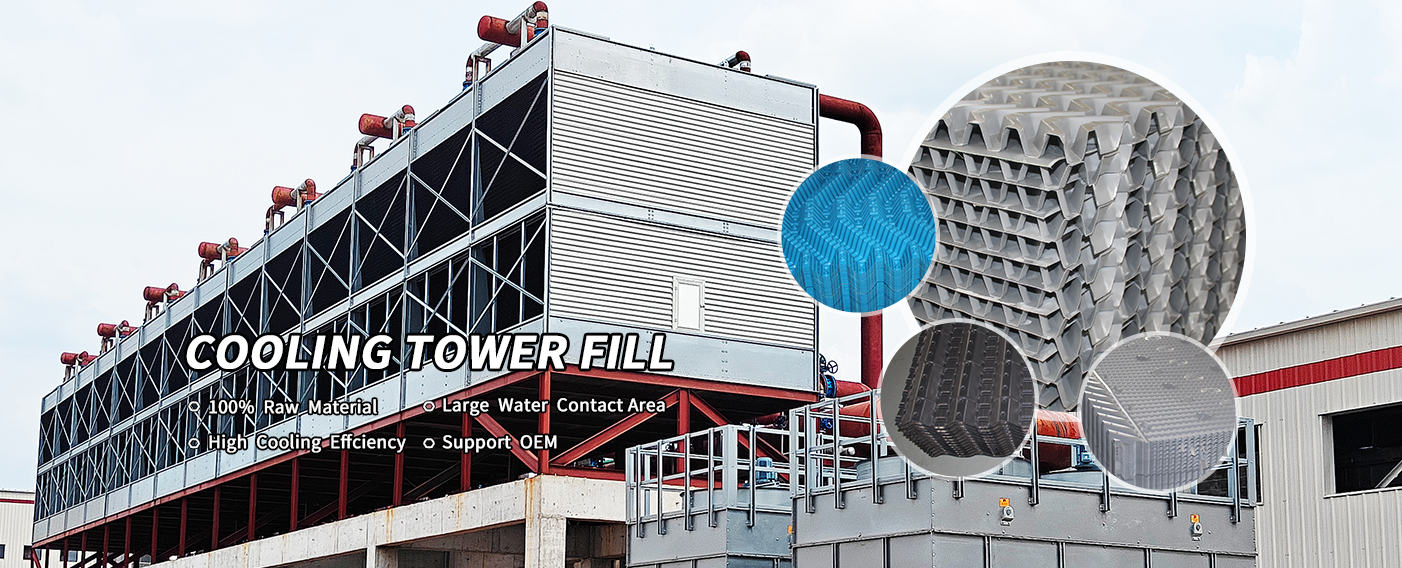
Cooling tower PVC fills are the core heat-exchange media of industrial cooling systems, directly determining the overall cooling efficiency, energy consumption, and operational stability of cooling towers. As the most widely used cooling tower fill material in HVAC, manufacturing, and industrial refrigeration industries, high-quality PVC cooling tower fill maximizes water-air contact area, accelerates evaporative heat dissipation, and delivers long-lasting, cost-effective cooling performance. This comprehensive SEO guide dives deep into everything you need to know about cooling tower PVC fills, including core functions, types, key benefits, selection criteria, installation tips, maintenance, and replacement standards to help you optimize your cooling tower system performance.
What Are Cooling Tower PVC Fills?
Cooling tower PVC fills refer to corrugated or splash-type media made of high-strength rigid PVC material, installed inside cooling towers as the key component for heat and mass transfer. Also known as cooling tower packing or cooling tower fill, these components work by spreading circulating cooling water into a thin film or fine droplets, enabling full contact with flowing air to complete evaporative cooling and heat exchange.
Unlike traditional wooden fills or low-grade plastic media, professional PVC cooling tower fill features standardized corrugated designs, stable physical properties, and excellent chemical resistance. It is the preferred fill solution for most commercial and industrial cooling towers due to its balanced performance in efficiency, durability, and cost.
Core Working Principle of Cooling Tower Fill
The entire cooling process of a cooling tower relies on cooling tower fill to create efficient heat exchange conditions. When hot process water flows down through the PVC fill layers, the special corrugated structure of cooling tower PVC fills disperses the water into a uniform thin water film. Meanwhile, ambient air flows upward or crosswise through the fill gaps, forming a reverse or cross flow with the water film. The large contact surface between water and air accelerates water evaporation, taking away massive heat from the circulating water, and finally realizes the cooling and recycling of industrial water.
Main Types of Cooling Tower PVC Fills
According to structural design and heat exchange modes, cooling tower PVC fills are mainly divided into two mainstream types: film-type PVC fills and splash-type PVC fills. Each type of cooling tower fill has unique performance characteristics and applicable scenarios, matching different water quality and industrial operating conditions.
Film-Type Cooling Tower PVC Fills
Film-type cooling tower PVC fills are the most popular high-efficiency cooling tower fill on the market, composed of multiple layers of rigid PVC corrugated sheets bonded into integrated fill blocks. Common corrugation angles include 30°×60° and 45°×45°, with standard flute spacing of 12mm, 19mm, 23mm, and 27mm to meet different cooling efficiency requirements.
Key Features of Film-Type PVC Cooling Tower Fill
Ultra-high heat transfer efficiency: The continuous corrugated structure forms a stable thin water film, greatly increasing the water-air contact area per cubic meter, significantly improving cooling efficiency
Low airflow resistance: Optimized flume design reduces wind resistance, lowers fan operating load, and saves system energy consumption
Uniform water distribution: Standard sheet structure avoids local water accumulation or dry areas, ensuring consistent overall cooling performance
Integrated rigid structure: Factory hot-melt bonded molding, no loose sheets, strong compression resistance, and stable long-term operation
Applicable Scenarios
Film-type cooling tower PVC fills are suitable for clean circulating water environments, widely used in commercial buildings, central air conditioning systems, pharmaceutical factories, electronic factories, and light industrial production lines with good water quality.
Splash-Type Cooling Tower PVC Fills
Splash-type cooling tower PVC fills adopt a multi-layer barrier structure without continuous corrugated channels. Instead of forming water films, this cooling tower fill breaks falling water into fine water droplets through layered splash bars, increasing water-air contact for heat exchange.
Core Advantages of Splash-Type PVC Fill
Anti-clogging performance: No narrow gaps, effectively avoiding blockage caused by sediment, impurities, and algae in water
Strong water quality adaptability: Tolerates dirty water, turbid water, and water with fine suspended particles
Easy maintenance: Simple structure, not easy to scale, convenient for daily cleaning and dirt removal
Impact resistance: Excellent structural toughness, resistant to damage from water flow impact and ice accumulation
Applicable Scenarios
This type of cooling tower PVC fills is ideal for industrial scenarios with poor water quality, such as chemical plants, steel mills, power plants, and sewage cooling systems, as well as outdoor towers with dusty environments.
Key Benefits of High-Quality Cooling Tower PVC Fills
Compared with PP fill, ABS fill, and traditional wooden fill, professional cooling tower PVC fills have comprehensive advantages in performance, cost, and service life, becoming the optimal choice for most cooling tower systems. Reasonably selecting high-quality cooling tower fill can effectively improve system efficiency and reduce long-term operating costs.
Excellent Temperature and Chemical Resistance
Standard cooling tower PVC fills support long-term stable operation within 60°C, adapting to conventional industrial circulating water temperature requirements. The modified PVC material has strong resistance to weak acid, weak alkali, and common water treatment chemicals, not easy to corrode, age, or deform in long-term water immersion environments. Compared with low-grade plastic fill, it avoids brittle cracking and structural collapse caused by chemical erosion.
Lightweight and High Structural Stability
PVC cooling tower fill features low density and light weight, which will not increase the overall load of the cooling tower frame. The factory-integrated bonding process ensures overall rigidity, avoiding sheet displacement and shedding during high-flow water and wind impact. It maintains stable structural performance in long-term continuous operation, reducing equipment failure rates.
Cost-Effective and Long Service Life
Cooling tower PVC fills have a much lower manufacturing and installation cost than CPVC and high-temperature PP fill, while achieving excellent heat exchange efficiency. Under standard maintenance conditions, the service life of high-quality PVC cooling tower fill can reach 5–8 years, far exceeding wooden fill and ordinary plastic fill, greatly reducing the frequency of replacement and later maintenance costs.
Anti-Algae and Anti-Scaling Performance
The smooth surface of cooling tower PVC fills is not easy to adhere to scale, sludge, and algae. It effectively inhibits the growth of microorganisms, avoids fill blockage and heat exchange efficiency decline caused by dirt accumulation, and keeps the cooling tower fill in optimal working condition for a long time.
Cooling Tower PVC Fills vs. PP/CPVC Cooling Tower Fill
Many users are confused about the material selection of cooling tower fill. Here is a detailed comparison of PVC, PP, and CPVC fill materials to help you select the most suitable cooling tower PVC fills according to operating conditions.
PVC vs. PP Cooling Tower Fill
PP cooling tower fill has a higher temperature resistance (up to 80–90°C), suitable for high-temperature water working conditions, but its cost is significantly higher than PVC fill. For conventional cooling systems with water temperature below 60°C, cooling tower PVC fills have higher cost performance, better water film forming effect, and higher heat exchange efficiency. PP fill is more suitable for special high-temperature industrial scenarios, while PVC fill is the best choice for conventional commercial and industrial cooling.
PVC vs. CPVC Cooling Tower Fill
CPVC fill is a modified high-temperature resistant material with stronger heat resistance and corrosion resistance, but its price is much higher. Cooling tower PVC fills fully meet the operating needs of most conventional cooling towers, with balanced performance and cost. Only in special scenarios with high water temperature and strong chemical corrosion is CPVC fill required to replace ordinary PVC cooling tower fill.
How to Select the Right Cooling Tower PVC Fills?
To maximize the performance of cooling tower fill, you need to select specifications and types according to actual working conditions. The following core selection criteria can help you avoid selection mistakes and match the most suitable cooling tower PVC fills for your system.
Confirm Operating Water Temperature
Standard cooling tower PVC fills are suitable for circulating water temperature ≤60°C. If the water temperature exceeds the standard for a long time, the PVC fill will warp and deform, affecting service life. For high-temperature working conditions, you need to choose high-temperature modified PVC fill or replace it with PP/CPVC cooling tower fill.
Match Water Quality Conditions
Clean water quality (air conditioning, light industry): Priority to choose film-type cooling tower PVC fills with high heat exchange efficiency. Poor water quality (chemical industry, steel industry, sewage cooling): Choose splash-type cooling tower PVC fills with anti-clogging performance to avoid frequent blockage.
Select Standard Sheet Thickness and Flute Spacing
The conventional sheet thickness of cooling tower PVC fills is 0.28–0.40mm. Thicker sheets have stronger durability and longer service life, suitable for long-term continuous operation. Flute spacing can be selected according to cooling demand: small spacing (12/19mm) for high cooling efficiency requirements, large spacing (23/27mm) for scenarios requiring low wind resistance and anti-blockage.
Installation and Maintenance Tips for Cooling Tower PVC Fills
Correct installation and daily maintenance are key to maintaining the long-term efficient operation of cooling tower PVC fills. Standard operation can effectively extend the service life of cooling tower fill and avoid efficiency attenuation caused by improper use.
Standard Installation Guidelines
Keep the cooling tower internal support frame flat and stable to avoid uneven stress on cooling tower PVC fills causing deformation
Install fill blocks closely without gaps to prevent short-circuit of air and water flow and reduce cooling efficiency
Avoid scratching and damaging the surface of cooling tower fill during installation to prevent local water film disorder
Arrange the fill direction according to the cooling tower air flow direction to ensure the best heat exchange effect
Regularly clean the surface of cooling tower PVC fills to remove surface scale, sludge, and algae deposits. For slightly clogged fill, use high-pressure water washing; for stubborn scale, use neutral water scale remover to avoid corrosive chemicals damaging the PVC material. Regularly check the bonding firmness of fill blocks to replace loose and damaged cooling tower fill in time.
Replacement Cycle and Judgment Standards
Under normal operating conditions, cooling tower PVC fills need to be replaced every 5–8 years. When the following problems occur, the cooling tower fill must be replaced in time: obvious warping, cracking, and brittleness of sheets; large-area scaling and blockage that cannot be cleaned; loose bonding and falling of fill blocks; obvious decline in cooling tower cooling efficiency and increased energy consumption.
Common Problems and Solutions of Cooling Tower PVC Fills
Cooling Tower Fill Blockage
Blockage is the most common problem of cooling tower PVC fills, mostly caused by excessive suspended impurities and algae growth in water. Solution: Regularly clean the fill, install water filtration equipment, add algae inhibitors appropriately, and replace film-type fill with splash-type cooling tower fill for poor water quality.
Fill Deformation and Warping
Main causes include excessive water temperature, uneven installation stress, and long-term overload operation. Solution: Strictly control the operating water temperature within the applicable range of PVC fill, re-level the support frame, and replace deformed cooling tower PVC fills in time to avoid affecting overall heat exchange.
Decline in Cooling Efficiency
Efficiency attenuation is mainly caused by fill scaling, blockage, aging, and water distribution unevenness. Solution: thoroughly clean the cooling tower fill, check the water spray system, replace aging and failed fill media, and restore the heat exchange performance of the cooling tower.
Conclusion
Cooling tower PVC fills are indispensable core components of industrial cooling tower systems, and the performance of cooling tower fill directly determines the cooling effect and operating cost of the entire equipment. High-quality PVC cooling tower fill has the advantages of high heat exchange efficiency, anti-corrosion, anti-clogging, low cost, and long service life, suitable for most commercial and industrial cooling scenarios.
By reasonably selecting film-type or splash-type cooling tower PVC fills according to working conditions, standardizing installation and daily maintenance, and timely replacing aging fill media, you can maximize the operating efficiency of the cooling tower system, reduce energy consumption and maintenance costs, and provide stable cooling guarantee for industrial production and HVAC systems.


