What Is Cooling Tower Fill Media and Why Is It Important?
Cooling tower fill media is a critical component in an evaporative cooling tower because it increases the contact area between circulating water and air, helping the system transfer heat more effectively. Although cooling tower fans, pumps, water distribution systems, and drift eliminators all contribute to overall performance, the fill media plays a particularly important role in determining how efficiently water can be cooled.
From commercial HVAC systems to power plants, manufacturing facilities, chemical processing plants, and industrial refrigeration systems, cooling towers are widely used to remove unwanted heat. The quality, configuration, and condition of the cooling tower fill media can influence cooling capacity, airflow resistance, maintenance frequency, and long-term operating costs.
Choosing the right cooling tower fill media requires more than selecting a suitable plastic material. Buyers must consider the cooling tower design, operating temperature, water quality, heat-transfer requirements, and available installation space. Understanding these factors helps facility managers, OEM manufacturers, maintenance contractors, and industrial purchasers make more informed decisions.
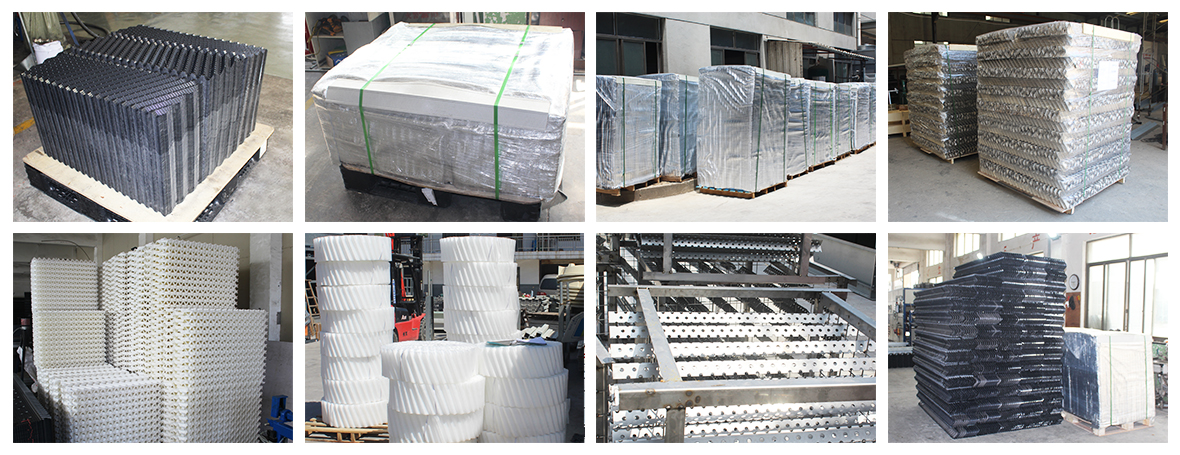
What Is Cooling Tower Fill Media?
Cooling tower fill media is an internal structure installed inside a cooling tower to increase the effective contact between water and air. It creates surfaces or flow paths that allow circulating water to spread out, remain in contact with moving air, and release heat more effectively.
Without suitable fill media, water would fall through the tower with less contact time and a smaller effective surface area. The cooling process would generally be less efficient, potentially requiring a larger cooling tower or more demanding operating conditions to achieve the required cold-water temperature.
What Is the Main Function of Cooling Tower Fill Media?
The primary function of cooling tower fill media is to support heat transfer by increasing the area available for water-air interaction.
When hot water enters the cooling tower, a distribution system spreads it over the fill. Air moves through the wetted surfaces, and a small portion of the water evaporates. This evaporation removes heat from the remaining water, allowing it to return to the cooling system at a lower temperature.
Cooling tower fill media helps achieve several important objectives:
Increases the effective contact area between air and water.
Improves water distribution across the fill section.
Supports efficient evaporative cooling.
Helps the cooling tower achieve its intended thermal performance.
Influences airflow resistance and overall system operation.
Supports compact cooling tower designs when appropriately engineered.
How Is Fill Media Different From Other Cooling Tower Components?
Every cooling tower component performs a specific function.
The fan moves air through the tower, while the pump circulates water through the cooling system. The water distribution system delivers water across the fill, and the drift eliminator captures entrained droplets to reduce water loss through the exhaust air.
Cooling tower fill media provides the contact surfaces that support the heat-transfer process.
These components work together. Even high-quality fill cannot deliver the expected cooling performance if the nozzles are blocked, the fan is malfunctioning, or water distribution is uneven.
Why Is Cooling Tower Fill Media Important?
Cooling tower fill media is important because it directly influences how effectively the cooling tower can transfer heat under its intended operating conditions. Its design affects the interaction between water and air, while its condition can influence maintenance requirements and system reliability.
How Does Fill Media Improve Cooling Efficiency?
Fill media increases the effective surface area over which water and air interact. In film-fill designs, water spreads across specially shaped sheets. In splash-fill designs, falling water breaks into smaller droplets as it strikes bars or other structural elements.
Both approaches create more opportunities for heat transfer than an arrangement in which water simply falls through open space.
Why Does Greater Contact Area Matter?
A larger effective wetted area provides more opportunities for heat and mass transfer. However, the actual benefit depends on how well the surface is wetted, how air moves through the fill, and whether the design matches the operating conditions.
For example, a fill block with narrow passages may offer substantial surface area but become less effective if mineral deposits or biological growth obstruct those passages.
The best design balances effective surface area, water distribution, airflow resistance, and resistance to fouling.
How Does Fill Media Affect Cooling Tower Capacity?
Cooling tower capacity depends on several factors, including entering water temperature, required leaving water temperature, air conditions, water flow rate, and airflow.
Fill media contributes by supporting the heat-transfer process. If the fill is damaged, clogged, or unsuitable for the required duty, the cooling tower may struggle to achieve its target cold-water temperature.
However, a cooling capacity problem should not automatically be attributed to the fill. Fan performance, nozzle condition, pump flow, ambient humidity, and process heat load should also be evaluated.
Can Cooling Tower Fill Media Help Reduce Operating Costs?
Appropriately selected fill media can help a cooling tower meet its cooling requirements without unnecessary increases in airflow or operating time.
When old or fouled fill is replaced, the system may recover some of its lost performance. Reduced blockage and improved water distribution can also make operation more predictable.
Which Costs Can Be Affected by Fill Performance?
Fill media can influence several operating expenses:
Fan electricity consumption through its effect on airflow resistance.
Maintenance labor associated with cleaning and inspection.
Replacement expenses caused by premature deterioration.
Production losses associated with inadequate process cooling.
Water treatment costs when fouling results from poor water management.
The actual savings depend on the original problem, replacement design, and operating conditions. Fill replacement should therefore be evaluated using engineering data rather than assuming that every new product will automatically reduce energy consumption.
What Are the Main Types of Cooling Tower Fill Media?
Cooling tower fill media is commonly classified into two principal types: film fill and splash fill. They differ in structure, water distribution behavior, fouling characteristics, and typical applications.
What Is Film Fill Media?
Film fill consists of closely arranged sheets with corrugated, embossed, or specially formed surfaces. Water flows across the sheets and forms a thin film, increasing the area available for heat transfer.
Film fill is widely used in commercial HVAC systems and industrial cooling towers where high thermal performance and compact installation are important.
What Are the Advantages of Film Fill?
Film fill can offer:
High heat-transfer performance in a compact volume.
Effective water spreading across designed surfaces.
Good cooling performance when water quality is suitable.
Multiple configurations for different cooling tower designs.
Practical replacement options for compatible existing systems.
Film fill is particularly useful when the cooling tower must provide substantial heat-transfer capability within a limited internal space.
What Are the Limitations of Film Fill?
The narrow passages between sheets can be vulnerable to suspended solids, scale, and biological growth. As deposits accumulate, airflow and water distribution may become less uniform.
For this reason, film fill generally benefits from suitable filtration, water treatment, and regular inspection.
What Is Splash Fill Media?
Splash fill uses bars, grids, or other structural elements to break falling water into smaller droplets. These droplets expose more water surface to moving air and support heat transfer.
Some splash-fill configurations have more open passages than film fill, making them worth considering for selected applications with challenging water quality.
When Is Splash Fill a Suitable Option?
Splash fill may be considered for:
Industrial cooling systems with suspended solids.
Applications where narrow passages are prone to blockage.
Selected wastewater and process-cooling applications.
Cooling towers designed around open splash-fill structures.
The suitability of splash fill depends on its geometry, water loading, solids characteristics, and thermal requirements. It is not automatically the best solution for every dirty-water application.
How Do Film Fill and Splash Fill Compare?
| Feature | Film fill | Splash fill |
| Heat-transfer method | Water spreads across sheet surfaces | Water breaks into droplets |
| Typical structure | Corrugated plastic sheets | Bars, grids, or open elements |
| Main advantage | High heat-transfer performance in suitable conditions | Some designs provide more open flow passages |
| Fouling sensitivity | Narrow channels can become blocked | Depends on element spacing and solids characteristics |
| Maintenance priority | Cleaning sheet passages | Inspecting and cleaning splash elements |
| Typical selection factor | Thermal performance and water quality | Fouling conditions and tower design |
Neither type is universally superior. The correct choice depends on the required cooling duty, water quality, tower configuration, and maintenance strategy.
Which Materials Are Used for Cooling Tower Fill Media?
Material selection influences the service life, temperature suitability, chemical compatibility, and mechanical performance of cooling tower fill media.
PVC and polypropylene are widely used in thermoplastic fill manufacturing. Other materials may be suitable for specialized environments, but the correct choice must be supported by application-specific technical information.
Why Is PVC Cooling Tower Fill Media Widely Used?
PVC, or polyvinyl chloride, is commonly used because it can provide a practical balance of manufacturing cost, formability, and performance in many conventional cooling applications.
PVC sheets can be formed into different surface patterns and assembled into blocks designed for specific cooling tower configurations.
What Are the Benefits of PVC Fill Media?
PVC cooling tower fill media may provide:
Cost-effective manufacturing.
Compatibility with many conventional HVAC and industrial systems.
Flexible block dimensions and sheet configurations.
Availability in different film-fill designs.
Convenient replacement options for existing equipment.
However, PVC is not suitable for every temperature or chemical environment. Buyers should confirm the manufacturer's recommended operating temperature, material formulation, and applicable fire-performance requirements.
When Should You Consider PP Cooling Tower Fill Media?
PP, or polypropylene, may be appropriate when its material properties better match the required operating temperature, chemical environment, or mechanical requirements.
What Should Buyers Check Before Choosing PP Fill?
Before selecting PP cooling tower fill media, evaluate:
Continuous and peak water temperatures.
Compatibility with water treatment chemicals.
Exposure to process contaminants.
Mechanical strength and support requirements.
Sheet thickness and block configuration.
Relevant fire-performance specifications.
PVC and PP should be compared based on actual product specifications rather than assuming one material always performs better.
How Can You Choose the Right Fill Material?
The right material depends on the cooling tower's operating environment.
A conventional HVAC system may use PVC fill successfully when its temperature and water quality fall within the manufacturer's recommended limits. An industrial system with different temperature or chemical requirements may benefit from evaluating PP or another suitable material.
A reliable supplier should provide technical information that explains material suitability and operating limitations.
How Does Cooling Tower Fill Media Work in Crossflow and Counterflow Towers?
Cooling tower configuration affects the direction of water and air movement, so fill media must be compatible with the tower's design.
What Is Crossflow Cooling Tower Fill Media?
In a crossflow cooling tower, water generally flows downward through the fill while air moves horizontally across it.
This arrangement is commonly used in HVAC and industrial cooling systems. The fill must distribute water effectively while allowing air to pass through the designed flow passages.
What Should Buyers Consider for Crossflow Fill?
Important considerations include block dimensions, water distribution, air passage geometry, support arrangements, and compatibility with the tower's existing layout.
Incorrectly positioned fill or gaps between blocks can encourage air or water bypass, reducing the effectiveness of the intended design.
What Is Counterflow Cooling Tower Fill Media?
In a counterflow cooling tower, water flows downward while air moves upward through the fill.
This arrangement allows air and water to move in opposite directions, supporting heat and mass transfer within the fill section.
Why Must Counterflow Fill Match the Tower Design?
Counterflow fill must suit the tower's water distribution arrangement, airflow requirements, support structure, and available installation space.
A replacement should be checked against the original specifications because different sheet geometries can affect thermal performance and pressure drop even when their external dimensions are similar.
What Factors Should You Consider When Selecting Cooling Tower Fill Media?
Selecting suitable fill media requires balancing thermal performance, material properties, water quality, installation requirements, and long-term maintenance.
How Does Water Quality Affect Fill Selection?
Water quality is one of the most important considerations when choosing cooling tower fill media.
Circulating water may contain suspended solids, dissolved minerals, microorganisms, and corrosion products. These materials can accumulate on fill surfaces and reduce effective heat-transfer performance.
Which Water Conditions Require Special Attention?
High suspended-solids concentration: Particles can accumulate between film-fill sheets and restrict airflow or water movement.
High mineral concentration: Scale can cover surfaces and interfere with water distribution.
Biological growth: Algae and slime can obstruct passages and increase maintenance requirements.
Elevated operating temperature: Material selection must account for continuous and peak temperatures.
Where fouling is a recurring problem, buyers should evaluate filtration, water treatment, and potentially more open fill configurations.
How Important Are Dimensions and Installation Space?
Fill media must fit the available internal space and the tower's support arrangement.
Before ordering replacement fill, confirm the cooling tower model, usable fill dimensions, block arrangement, number of layers, and access requirements.
What Information Should Be Provided to the Supplier?
Useful information includes:
Cooling tower manufacturer and model.
Crossflow or counterflow configuration.
Existing fill type and material.
Fill block length, width, and height.
Sheet thickness and surface pattern, where known.
Operating temperatures and water flow rate.
Available drawings and photographs.
Required quantity and delivery schedule.
Accurate information helps reduce the risk of ordering incompatible products.
Should You Choose Standard or Customized Fill Media?
Standard fill media may be suitable when the existing tower uses common dimensions and an established product configuration.
Customized fill media may be useful for OEM projects, discontinued products, older cooling towers, or installations with nonstandard dimensions.
Customization can involve block size, material, sheet thickness, surface pattern, and packaging. However, changes to geometry should be evaluated for their effect on thermal performance and airflow resistance.
When Should Cooling Tower Fill Media Be Cleaned or Replaced?
Cooling tower fill media does not have a universal replacement interval. Its service life depends on material quality, operating conditions, water treatment, maintenance practices, and mechanical damage.
Regular inspections help identify deterioration before it causes more serious performance problems.
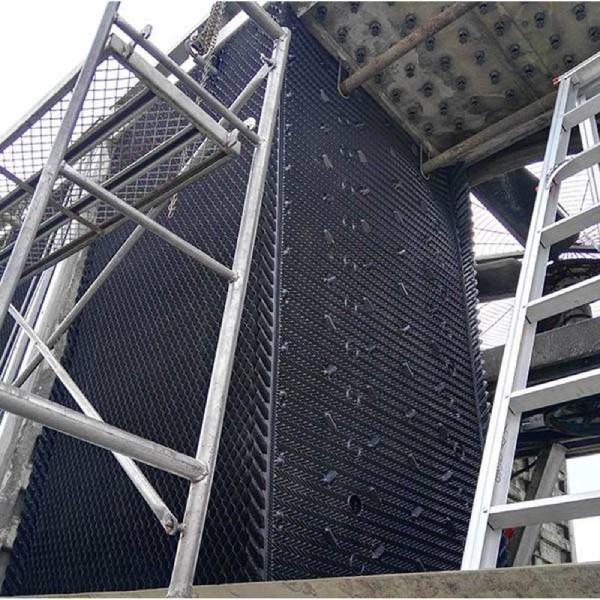
What Are the Signs of Damaged or Fouled Fill Media?
Common warning signs include:
Heavy scale or biological deposits.
Blocked passages between film-fill sheets.
Cracked, brittle, or deformed sheets.
Collapsed or displaced fill blocks.
Uneven water distribution.
Higher cold-water temperatures under comparable operating conditions.
Increased airflow resistance, where measurable.
These symptoms should be evaluated alongside fan, pump, and nozzle performance because other components can cause similar problems.
How Can Routine Cleaning Extend Fill Media Service Life?
Appropriate cleaning can remove deposits and preserve the effective wetted surface when the fill remains structurally sound.
What Cleaning Practices Should Be Followed?
A practical maintenance procedure includes inspecting the fill, identifying the type of deposit, selecting a compatible cleaning method, and checking the structure after cleaning.
Water pressure should be controlled to avoid damaging thin plastic sheets or separating assembled blocks. Any cleaning chemicals must be compatible with the fill material and approved for the system.
If deposits return quickly, review the water treatment program and investigate the underlying cause.
When Is Replacement More Practical Than Cleaning?
Replacement may be necessary when fill media is extensively deformed, brittle, structurally unstable, or severely blocked.
Cleaning cannot restore lost structural strength. Similarly, recurring blockage may indicate that the existing fill design is unsuitable for the circulating water quality.
Before installing new fill, identify the cause of deterioration to help prevent the same problem from occurring again.
How Can Cooling Tower Fill Media Improve Energy Efficiency?
Cooling tower fill media affects heat transfer and airflow resistance, both of which influence the way a cooling tower operates.
A suitable design helps the tower meet its cooling duty while maintaining appropriate water distribution and air movement.
How Does Fill Media Affect Fan Power?
Cooling tower fans move air through the fill and other internal components. The geometry and condition of the fill influence the resistance encountered by the air.
If passages become clogged, pressure drop may increase. Depending on the fan and control system, this may increase energy demand or reduce the airflow available for cooling.
Why Is Pressure Drop Important When Comparing Fill Products?
A fill design with high thermal performance may not be ideal if it creates excessive airflow resistance under actual operating conditions.
Engineers should compare thermal performance and pressure drop at relevant water and air loading conditions. This provides a more balanced view of the fill's contribution to overall system efficiency.
Can Replacing Old Fill Reduce Operating Costs?
Replacing damaged or severely fouled fill may help restore lost cooling performance. Potential benefits depend on the condition of the existing fill and the performance of the replacement.
A replacement assessment should consider cold-water temperature, fan power, water distribution, airflow, process heat load, and seasonal conditions.
Measuring system performance before and after replacement helps determine whether the project achieves its intended results.
What Should You Look for in a Cooling Tower Fill Media Manufacturer?
Choosing a reliable manufacturer is important for both new cooling tower production and replacement projects. A competitive price is valuable, but product compatibility, quality consistency, technical support, and delivery reliability also matter.
Can the Manufacturer Support Different Cooling Tower Designs?
A capable supplier should understand film fill, splash fill, crossflow towers, counterflow towers, and the requirements of different industrial applications.
The supplier should review the operating conditions and existing configuration before recommending a product.
Which Technical Documents Should Buyers Request?
Depending on project requirements, useful documents include:
Product drawings and dimensional specifications.
Material information and temperature limits.
Thermal performance data.
Pressure-drop information under stated test conditions.
Quality inspection records.
Applicable fire-performance documentation.
Installation and maintenance recommendations.
Technical performance claims should be supported by appropriate data, and comparisons should use equivalent test conditions.
How Important Are Quality Control and Customized Production?
For OEM manufacturers and large replacement projects, consistent dimensions and material quality help reduce installation problems.
Quality control may include checking sheet thickness, block dimensions, surface condition, assembly quality, and packaging.
For customized orders, approving drawings or samples before mass production can help prevent costly errors.
Why Do Packaging and Delivery Matter?
Cooling tower fill media can occupy substantial shipping volume. Packaging dimensions and pallet arrangements therefore affect transportation planning and project costs.
International buyers should confirm packaging specifications, loading plans, delivery terms, export documentation, and expected lead times before placing an order.
Which Industries Need High-Quality Cooling Tower Fill Media?
Cooling tower fill media is used across many industries, but each application has different cooling requirements and maintenance challenges.
How Is Fill Media Used in HVAC Systems?
Commercial buildings, hotels, hospitals, shopping centers, and office complexes use cooling towers to reject heat from water-cooled air-conditioning systems.
These systems generally prioritize reliable cooling, manageable maintenance, and energy-efficient operation.
Why Is Fill Media Important in Manufacturing Plants?
Manufacturing facilities may use cooling towers to cool machinery, compressors, heat exchangers, production lines, and process water.
Fill selection must account for the specific water temperature, circulating water quality, heat load, and operating schedule.
What Should Power Plants Consider?
Power plants may operate cooling towers continuously under substantial thermal loads. Fill selection should consider the required cooling duty, water chemistry, airflow resistance, material suitability, and long-term maintenance needs.
For these installations, technical verification and performance documentation are particularly important.
Can Fill Media Be Used in Specialized Industrial Applications?
Yes. Chemical processing, steel production, wastewater treatment, and other specialized applications may require additional evaluation of fouling, chemical exposure, suspended solids, and elevated temperatures.
The correct design depends on the actual process conditions rather than the industry category alone.
What Are the Most Common Mistakes When Purchasing Cooling Tower Fill Media?
Procurement mistakes can result in installation delays, additional costs, or disappointing cooling performance.
Is the Lowest-Priced Fill Media Always the Best Choice?
No. A low purchase price may be offset by unsuitable material properties, inconsistent dimensions, excessive pressure drop, or premature deterioration.
Compare products using equivalent specifications, including material, dimensions, design, performance data, quantity, and delivery terms.
Can Different Fill Designs Be Substituted Directly?
Not always. Products with similar external dimensions can have different surface geometries, water distribution characteristics, and airflow resistance.
Before approving a substitute, verify its physical compatibility and expected performance.
Can New Fill Media Solve Every Cooling Tower Problem?
No. Fill replacement cannot correct every issue involving insufficient airflow, incorrect fan rotation, poor nozzle performance, inadequate pump flow, or excessive heat load.
A complete system assessment helps determine whether fill replacement is necessary and whether other maintenance work should be included in the project.
How Can You Choose the Right Cooling Tower Fill Media?
Choosing the right cooling tower fill media involves balancing heat-transfer performance, material suitability, water quality, airflow resistance, installation requirements, and long-term maintenance costs.
Start by identifying the cooling tower configuration and operating requirements. Confirm the fill dimensions, material, water temperature, circulating water quality, and required cooling performance. For replacement projects, inspect the existing fill and determine why it needs to be cleaned or replaced.
Working with an experienced cooling tower fill media manufacturer or supplier can simplify technical selection, dimensional verification, customized production, quality control, and delivery planning.
For OEM manufacturers, industrial facilities, HVAC contractors, and maintenance teams, properly selected fill media supports reliable heat transfer and more predictable cooling tower operation.
Ultimately, cooling tower fill media is much more than an internal component. It is a fundamental part of the cooling process, and selecting the right design can help maintain performance, manage maintenance requirements, and support the long-term reliability of the entire cooling system.


