Why Is Cross Flow Cooling Tower Fill Important for Customized Industrial Cooling?
Industrial cooling systems operate under different conditions depending on the production process, heat load, water quality, ambient temperature, and equipment configuration. Standard cooling components may not always meet the requirements of specialized industrial facilities. For this reason, Cross Flow Cooling Tower Fill for Customized Industrial Cooling has become an important solution for businesses seeking reliable heat transfer, stable operation, and flexible replacement options.
Cross flow cooling towers are widely used in manufacturing plants, power facilities, commercial HVAC systems, chemical processing facilities, and other industrial applications. Their design allows air to move horizontally through the fill while hot circulating water flows downward. This arrangement creates opportunities for efficient heat exchange and convenient maintenance access.
However, the performance of a cross flow cooling tower depends heavily on the quality, structure, material, and installation of its fill. Customized cooling tower fill can help match the original tower design, accommodate specific operating conditions, and address challenges such as fouling, material degradation, and inconsistent water distribution.
Choosing the right fill involves more than selecting a product with suitable dimensions. Buyers should also evaluate thermal performance, airflow resistance, material compatibility, water quality, and long-term maintenance requirements.
What Is Cross Flow Cooling Tower Fill?
Cross flow cooling tower fill is an internal heat transfer component designed to increase the contact area between circulating water and ambient air. It is installed inside a cross flow cooling tower, where water flows vertically downward and air passes horizontally through the fill section.
The interaction between water and air allows sensible heat transfer and evaporation to remove heat from the circulating water. The cooled water is then collected in the basin and returned to the industrial process.
How Does Cross Flow Cooling Tower Fill Work?
The fill creates a controlled contact environment that improves heat and mass transfer within the tower.
Increasing the Effective Heat Transfer Area
Without fill, water would pass through the tower with comparatively limited contact with the air. Fill structures spread water over surfaces or break it into droplets, increasing the area available for heat exchange.
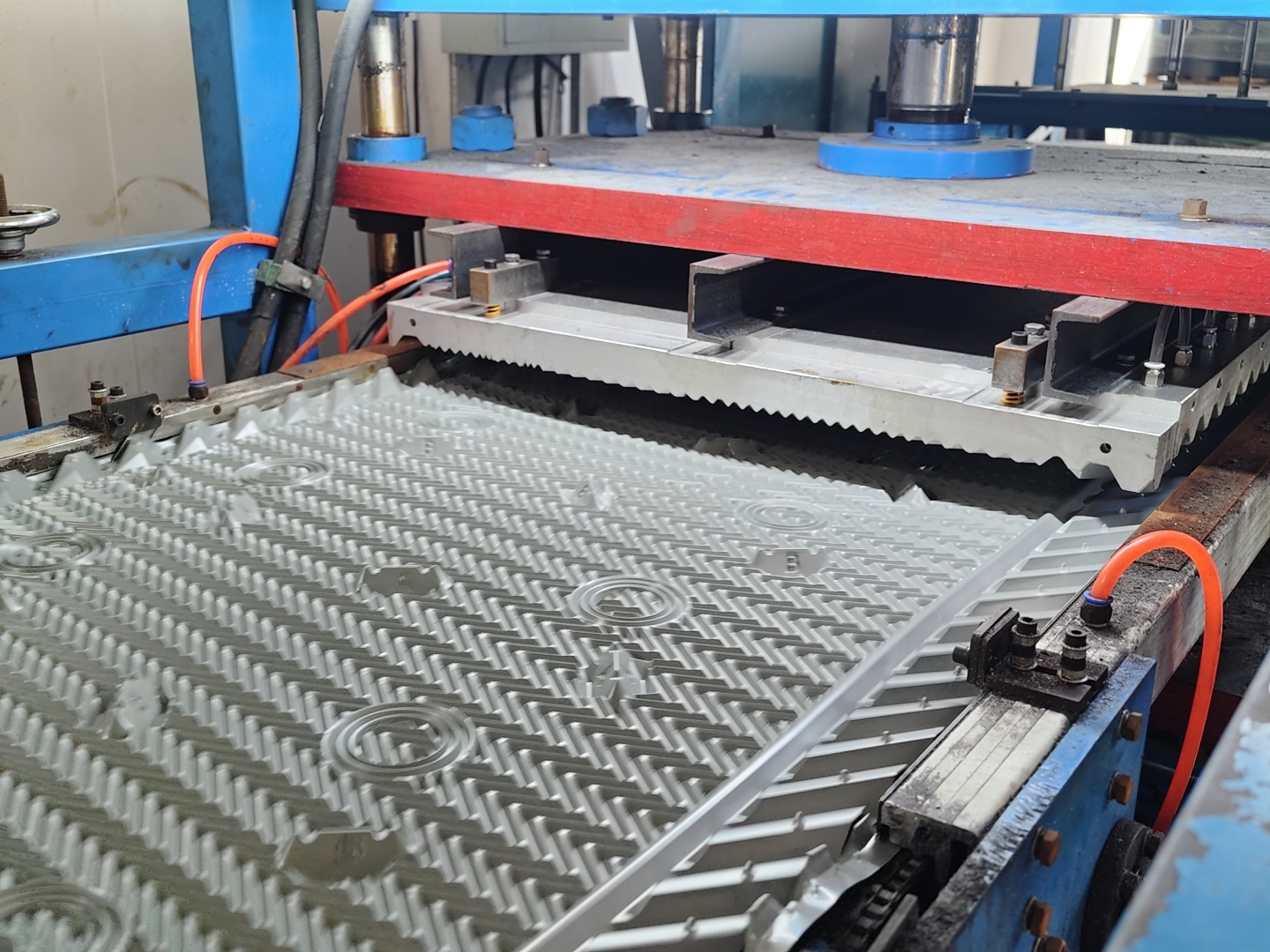
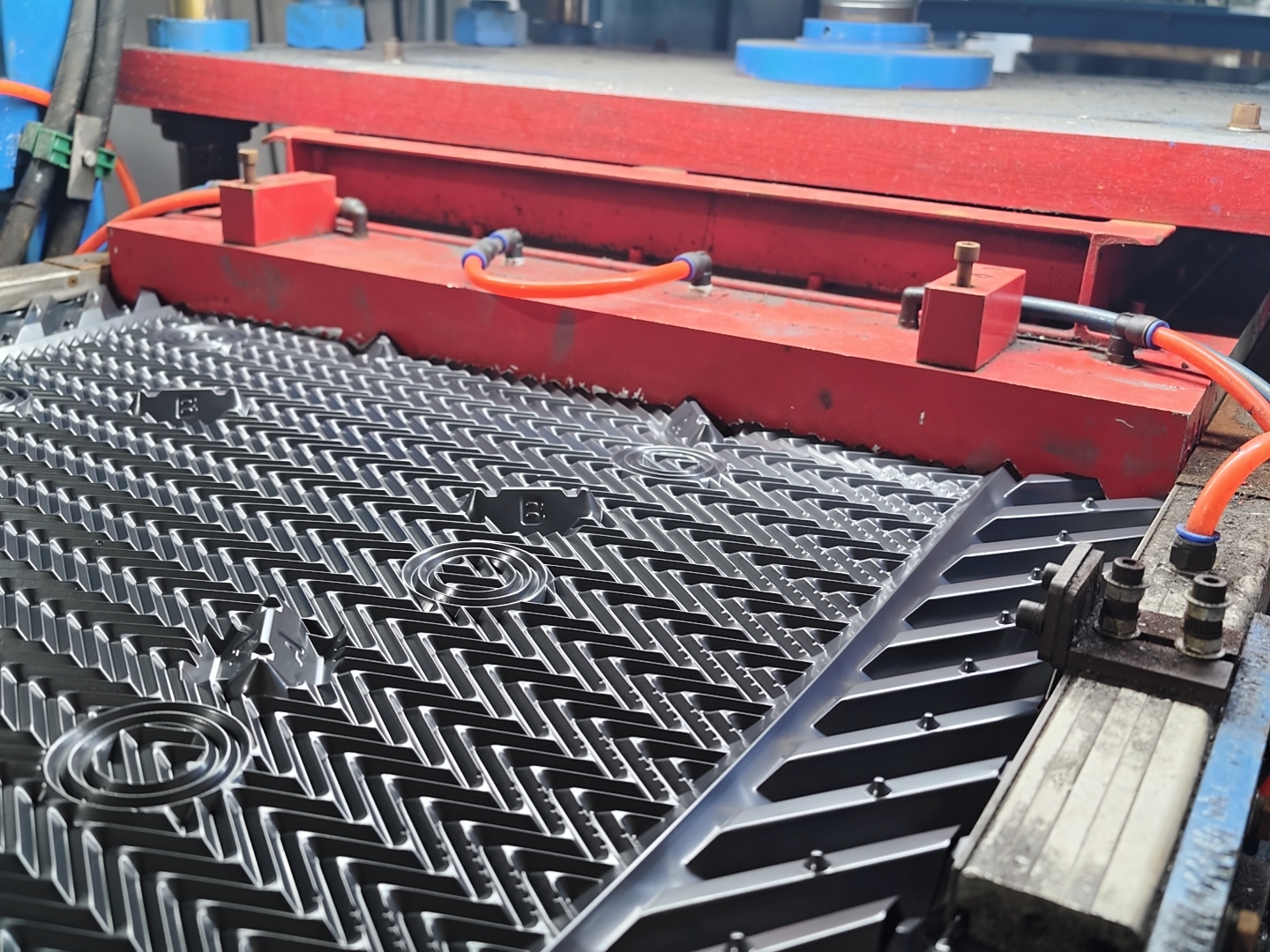
Film fill typically uses formed sheets with channels that guide water downward. The resulting water films provide a large contact area when the fill is properly designed and water quality is suitable.
Supporting Evaporative Cooling
As air passes through the falling water, a small portion of the water evaporates. This evaporation removes latent heat from the remaining water, helping reduce its temperature.
The actual cooling performance depends on several factors, including entering water temperature, ambient wet-bulb temperature, water flow rate, airflow, and fill condition.
Maintaining Balanced Air and Water Distribution
A cross flow cooling tower requires reasonably uniform water distribution across the fill surface. Uneven distribution can create dry areas, concentrated water channels, and inconsistent heat transfer.
Suitable fill geometry and proper installation help maintain the intended interaction between air and water.
What Makes Cross Flow Fill Different From Other Fill Types?
Cross flow fill is designed for towers in which air moves horizontally through the fill. Counterflow cooling towers use a different arrangement, with air generally moving upward against the downward flow of water.
Although both designs use fill to enhance heat transfer, their internal layouts and fill configurations are not necessarily interchangeable.
Cross Flow Cooling Tower Fill
Air passes horizontally through the fill.
Water flows downward across the fill surfaces.
The arrangement can provide convenient access to certain internal components.
Replacement dimensions must match the tower's original layout.
Water distribution design is important for consistent performance.
Air generally moves upward through the fill.
Water flows downward against the airflow.
Fill selection must account for the tower's vertical airflow path and water distribution arrangement.
When purchasing replacement fill, buyers should confirm the cooling tower type before selecting a product.
How Does Cross Flow Cooling Tower Fill Support Customized Industrial Cooling?
Customized cooling tower fill is designed around the specific requirements of a cooling system rather than relying entirely on standard dimensions or generic product specifications.
Matching Fill Dimensions to Existing Cooling Towers
Industrial cooling towers vary in size, capacity, structural arrangement, and original manufacturer design. Even towers with similar external dimensions may use different fill pack configurations.
Custom Length, Width, and Height
A replacement supplier may need to customize the dimensions of the fill packs to match the available installation space.
Accurate measurements help prevent gaps, excessive compression, unsupported sections, and interference with nearby components.
Before production, buyers should confirm:
Overall fill pack length and width.
Pack height and installation orientation.
Sheet thickness and channel configuration.
Support beam spacing and load requirements.
Available access space for installation.
Required quantity and replacement area.
Drawings, photographs, sample sheets, and original equipment specifications can help reduce measurement errors.
Matching Existing Water Distribution Systems
Cross flow cooling towers depend on effective water distribution across the fill. Customized fill should be compatible with the existing distribution arrangement so that water can reach the intended contact surfaces.
If the original system has damaged nozzles, blocked distribution channels, or uneven flow, replacing the fill alone may not solve the cooling problem. A complete inspection can help identify related issues before the replacement project begins.
Adapting Fill to Different Industrial Operating Conditions
Different industries place different demands on cooling tower components. A fill design suitable for a clean HVAC system may not be appropriate for a process using water with high suspended solids or aggressive chemical treatment.
Manufacturing Facilities
Manufacturing plants often require stable cooling for machinery, hydraulic systems, production lines, and process heat exchangers.
Customized cross flow cooling tower fill can help restore heat transfer performance when existing fill has deteriorated or no longer meets operating requirements.
Power Generation Facilities
Power plants use cooling systems to reject heat from condensers and auxiliary equipment. Fill condition can influence cooling tower performance, which in turn affects the overall heat rejection process.
Replacement fill should be selected according to the tower's design, operating temperatures, water quality, and required cooling duty.
Chemical and Process Industries
Chemical processing facilities may have more demanding water chemistry and operating conditions than conventional HVAC applications.
The supplier should review relevant chemical exposure, suspended solids, operating temperatures, and cleaning procedures before recommending a material or fill configuration.
Commercial HVAC and Large Buildings
Shopping centers, hospitals, hotels, office complexes, and other large buildings rely on cooling towers to support chiller operation.
Suitable replacement fill can help maintain heat rejection performance during periods of high cooling demand, provided that the fill is correctly selected, installed, and maintained.
Which Materials Are Suitable for Cross Flow Cooling Tower Fill?
Material selection directly affects the durability, temperature suitability, chemical compatibility, and maintenance requirements of cross flow cooling tower fill.
PVC and PP are two common thermoplastic materials used for cooling tower fill. The most appropriate choice depends on the actual operating environment rather than on a universal preference for one material.
PVC Cross Flow Cooling Tower Fill
Polyvinyl chloride (PVC) fill is widely used in many industrial and commercial cooling towers because it can provide an economical combination of formability, practical heat transfer performance, and manufacturing flexibility.
Advantages of PVC Fill
PVC fill can be produced in different sheet patterns and pack configurations to match many existing cross flow cooling towers.
Potential benefits include:
Compatibility with many standard cooling tower applications.
Flexible manufacturing options for customized dimensions.
Large contact areas in appropriately designed film-fill structures.
Practical replacement options for aging cooling tower installations.
Availability in different thicknesses and configurations, depending on the supplier.
Important Limitations
PVC fill must operate within its specified temperature range. Excessive heat, incompatible chemicals, or prolonged exposure to unsuitable conditions can contribute to deformation or material degradation.
Buyers should confirm the material grade and allowable operating conditions before ordering replacement fill.
PP Cross Flow Cooling Tower Fill
Polypropylene (PP) is another material used in cooling tower fill manufacturing. It may be appropriate for selected applications requiring particular chemical resistance or temperature characteristics.
When Should Buyers Consider PP Fill?
PP fill may be worth evaluating when the circulating water chemistry, process conditions, or material requirements make it a suitable alternative to PVC.
However, not all PP grades have the same performance characteristics. The supplier should confirm the selected grade's operating limits and compatibility with the application.
Comparing PVC and PP Fill
Selection factor | PVC fill | PP fill |
Common application | Many standard industrial and HVAC systems | Selected industrial applications |
Temperature suitability | Must remain within specified limits | Depends on the selected PP grade |
Chemical compatibility | Depends on chemical type and concentration | Depends on chemical type and concentration |
Customization | Available in various designs and dimensions | Available in various designs and dimensions |
Cost | Often economical for standard requirements | Varies by grade and manufacturing requirements |
Replacement compatibility | Must match the existing tower design | Must match the existing tower design |
Neither material should be selected based on price alone. Actual temperature, chemical exposure, mechanical loading, and water quality should guide the final decision.
How Can Fill Design Improve Cross Flow Cooling Tower Performance?
The effectiveness of cross flow cooling tower fill depends on more than its material. Channel geometry, contact area, sheet spacing, water distribution, and airflow resistance all contribute to system performance.
Choosing the Right Film Fill Structure
Film fill is commonly used in cross flow cooling towers because it can provide a large contact area within a relatively compact volume.
Channel Geometry and Water Flow
The formed channels guide water along the fill surfaces. Their geometry influences water spreading, drainage, contact time, and the resistance encountered by passing air.
A suitable design should support effective water distribution without creating unnecessary airflow restrictions.
Balancing Heat Transfer and Airflow Resistance
Increasing the amount of fill or using a more densely packed structure does not automatically improve overall cooling performance.
If airflow resistance becomes excessive, the tower's fan may need to overcome a higher pressure drop, potentially affecting airflow and energy consumption.
A customized fill design should balance thermal performance with the airflow capacity of the existing tower.
Selecting Fill for Challenging Water Conditions
Water quality is a major consideration in industrial cooling tower operation. Circulating water may contain mineral deposits, suspended particles, microorganisms, or treatment chemicals.
When Film Fill May Be Appropriate
Film fill can work well in systems where water treatment effectively controls suspended solids, scale, and biological growth.
Regular maintenance is important because narrow channels can become obstructed if water quality is poorly controlled.
When Splash Fill May Be Worth Considering
Splash fill breaks water into droplets as it passes through a structure. Depending on the design, it may be more suitable for some applications with higher fouling or suspended-solids risks.
However, switching from film fill to splash fill changes the tower's heat transfer characteristics and may require engineering evaluation. It should not be treated as a direct, universally compatible substitution.
What Should Buyers Consider When Ordering Customized Cross Flow Cooling Tower Fill?
A successful replacement project starts with accurate technical information and clear communication between the buyer and supplier.
Confirm the Cooling Tower Specifications
Before requesting a quotation, collect as much information as possible about the existing equipment.
Essential Information for a Quotation
Provide the following details where available:
Cooling tower manufacturer and model.
Cross flow configuration and fill type.
Existing fill dimensions and sheet thickness.
Required material, such as PVC or PP.
Operating water temperatures.
Circulating water flow rate.
Water quality and treatment conditions.
Quantity of fill required.
Delivery location and expected schedule.
These details help the supplier evaluate compatibility and identify missing information before production.
Request Drawings and Product Specifications
A professional supplier should provide sufficient technical information for the buyer to review the proposed product.
What Should the Documentation Include?
Depending on the project, useful documents may include:
Product drawings and pack dimensions.
Material specifications.
Sheet thickness and fill configuration.
Manufacturing tolerances.
Inspection and quality-control records.
Packing and shipment information.
Installation recommendations.
For customized orders, drawings should be checked and approved before manufacturing begins.
Evaluate Manufacturing Quality
Inconsistent dimensions or poor bonding can create installation problems and affect fill stability.
Key Quality Factors
Buyers should evaluate sheet thickness consistency, formed channel quality, pack dimensions, bonding strength where applicable, and resistance to expected operating conditions.
Quality requirements should be agreed upon in advance, particularly for large industrial projects in which replacement errors can result in expensive shutdown delays.
How Does Customized Cross Flow Cooling Tower Fill Replacement Work?
Replacing existing fill requires careful preparation, accurate installation, and appropriate post-installation checks.
Step 1: Inspect the Existing Cooling Tower
Start by assessing the condition of the fill and related components.
Identify the Main Performance Problems
Look for signs such as blocked channels, scale buildup, biological fouling, cracks, sagging sheets, collapsed packs, or uneven water distribution.
Also inspect the water distribution system, fill supports, drift eliminators, fan operation, and other components that may influence cooling performance.
If the fill is structurally sound and can be cleaned effectively, cleaning may be an alternative to full replacement. Severely damaged or persistently blocked fill may require replacement.
Step 2: Measure the Replacement Area
Measure the existing fill packs and inspect their support arrangement.
Confirm Pack Layout and Orientation
Record the fill dimensions, support spacing, installation direction, and any restrictions caused by internal piping or structural members.
Accurate measurements reduce the risk of ordering fill that is difficult to install or does not cover the required area.
Step 3: Select the Material and Fill Configuration
Use the operating conditions to determine the appropriate replacement specifications.
Verify Thermal and Mechanical Compatibility
The proposed fill should match the tower's intended water and air paths. Its material must also withstand the expected temperature, chemical exposure, and mechanical loading.
Any change from the original design should be reviewed for its potential impact on thermal performance and airflow resistance.
Step 4: Prepare the Tower for Installation
Before installing new fill, remove old material as required and inspect the support structure.
Clean and Repair Internal Components
Remove debris and deposits that could obstruct water flow. Repair damaged supports and inspect distribution nozzles to ensure that the new fill will receive an appropriate water supply.
All work should follow the facility's isolation, confined-space, and other applicable safety procedures.
Step 5: Install and Inspect the New Fill
Install the fill packs according to the approved layout and supplier instructions.
Verify Installation Quality
Check that the packs are properly supported, correctly oriented, and positioned without unintended gaps or obstructions.
After installation, confirm that water distribution is reasonably uniform and that the fill does not interfere with airflow or other internal components.
Step 6: Monitor Performance After Startup
Once the cooling tower returns to service, record its operating conditions.
Compare Results Under Similar Conditions
Useful indicators include hot-water inlet temperature, cold-water outlet temperature, water flow, ambient wet-bulb temperature, fan operation, and pressure drop where measurable.
Comparing data collected under similar operating conditions helps determine whether the replacement has restored the expected performance.
How Can Regular Maintenance Extend Cooling Tower Fill Service Life?
Customized fill provides value only when it is supported by an appropriate maintenance program.
Maintain Effective Water Treatment
Water treatment helps control scale, corrosion, suspended solids, and biological growth.
Reduce Scale and Biological Fouling
Poor water treatment can cause deposits to build up on fill surfaces and within channels. This reduces effective contact area and may restrict water flow or airflow.
Treatment procedures should be designed for the actual water chemistry and operating conditions, rather than relying on a universal chemical program.
Inspect Fill Condition Regularly
Routine inspections can identify problems before they cause serious performance deterioration.
What Should Maintenance Teams Check?
Look for:
Uneven deposits and blocked channels.
Cracked, brittle, or deformed sheets.
Sagging or collapsed fill packs.
Debris trapped in the fill.
Uneven water distribution.
Damage to supports or adjacent components.
Inspection frequency should reflect operating severity, water quality, and previous maintenance findings.
Keep Operating Records
Performance records help maintenance teams distinguish gradual fill deterioration from changes in production load, ambient weather, or other system conditions.
Use Data to Plan Replacement
Tracking cold-water temperature, fan performance, water flow, and maintenance history can support more accurate replacement planning.
Rather than replacing fill solely according to age, facilities should combine operating data with physical inspection and the manufacturer's recommendations.
How to Choose a Reliable Cross Flow Cooling Tower Fill Supplier?
Supplier selection affects product quality, project coordination, and the risk of replacement delays.
Evaluate Technical Knowledge and Customization Capabilities
A capable supplier should understand cross flow cooling tower structures and be able to review dimensions, material selection, and operating requirements.
Look for Application-Based Recommendations
The supplier should ask about the cooling tower model, water quality, temperature range, and intended use before recommending a product.
Be cautious of proposals that promise a fixed percentage of energy savings or guaranteed cooling improvements without reviewing the actual system.
Check Production Capacity and Delivery Reliability
Large industrial projects may require significant quantities of fill within a narrow shutdown window.
Confirm Lead Time and Packaging
Before placing an order, clarify manufacturing time, inspection arrangements, packing method, shipment dimensions, and delivery schedule.
Proper packaging helps prevent crushing, deformation, and damage during handling and transportation.
Review Quality Documentation and Commercial Terms
Buyers should confirm the technical specifications, acceptance criteria, warranty terms, payment arrangements, and responsibilities for resolving quality issues.
For international orders, clear communication about drawings, approved specifications, and delivery terms is especially important.
Consider Long-Term Cooperation
A reliable supplier can help with future replacement orders, customized dimensions, product consistency, and technical questions.
For facilities operating multiple cooling towers, consistent specifications and dependable communication can simplify maintenance planning and inventory management.
What Are the Main Benefits of Customized Cross Flow Cooling Tower Fill?
When properly specified and installed, customized fill can support several operational objectives.
Better Compatibility With Existing Equipment
Customized dimensions can help the replacement fit the original installation area and support structure, reducing the need for unnecessary modifications.
More Consistent Heat Transfer
A suitable fill configuration helps maintain the intended contact between air and water, provided that water distribution, airflow, and operating conditions are also appropriate.
Flexible Material Selection
PVC and PP options allow buyers to evaluate different material characteristics according to their application requirements.
More Predictable Replacement Projects
Approved drawings, clear specifications, and accurate production can reduce uncertainty during installation and help maintenance teams plan shutdown work.
Improved Maintenance Planning
Fill selected for the actual water quality and operating environment may be easier to maintain over its service life than a poorly matched alternative.
These benefits depend on correct engineering, manufacturing quality, installation, and maintenance. Customized fill alone cannot compensate for an undersized fan, faulty water distribution, poor water treatment, or an overloaded cooling tower.
Frequently Asked Questions About Cross Flow Cooling Tower Fill
Is Cross Flow Cooling Tower Fill Suitable for All Industrial Cooling Towers?
No. Cross flow fill is intended for cooling towers with a crossflow arrangement. Counterflow towers use a different airflow configuration and may require different fill products.
Always confirm the tower design and specific installation requirements before ordering.
Can Customized Cross Flow Cooling Tower Fill Replace Original Fill?
In many cases, replacement fill can be manufactured to match the original dimensions and configuration. However, compatibility must be verified for the specific tower model and operating conditions.
A physically similar product is not necessarily thermally equivalent to the original design.
Is PVC Cross Flow Cooling Tower Fill Better Than PP Fill?
Neither material is universally superior. PVC is widely used in many standard cooling applications, while PP may suit certain applications requiring different material characteristics.
The correct choice depends on operating temperature, chemical exposure, water quality, mechanical requirements, and the material specifications of the selected product.
How Do I Know When Cross Flow Cooling Tower Fill Needs Replacement?
Common indicators include severe blockage, persistent fouling, cracked or deformed sheets, collapsed packs, and reduced cooling performance that cannot be adequately restored through cleaning and maintenance.
Before replacement, inspect the entire cooling system to rule out other causes, such as poor water distribution, fan problems, or changes in operating load.
Can New Fill Reduce Cooling Tower Energy Consumption?
Suitable replacement fill may help restore thermal performance and avoid excessive airflow resistance associated with some damaged or obstructed configurations.
However, energy savings depend on the complete system, including fan design, operating conditions, water flow, and cooling demand. They should be assessed using engineering calculations and operating data rather than assumed.
What Information Is Needed for a Customized Fill Quotation?
Provide the cooling tower model, existing fill dimensions, fill type, material preference, operating temperatures, water quality, required quantity, and delivery destination.
Drawings and photographs are useful when original specifications are unavailable.
Conclusion: Choose Cross Flow Cooling Tower Fill for Customized Industrial Cooling
Cross Flow Cooling Tower Fill for Customized Industrial Cooling offers a practical approach to maintaining heat transfer performance in industrial and commercial cooling systems. By matching fill dimensions, material characteristics, and channel design to the existing tower, buyers can improve replacement compatibility and reduce avoidable installation problems.
The selection process should begin with an assessment of the existing fill, the cooling tower configuration, and the actual operating environment. PVC and PP fill should be evaluated according to their specified temperature limits, chemical compatibility, and mechanical requirements. Water quality, airflow resistance, and water distribution must also be considered when selecting the replacement design.
Working with a qualified cooling tower fill supplier helps ensure that drawings, specifications, manufacturing quality, packaging, and delivery arrangements are properly coordinated. Combined with correct installation and regular maintenance, customized cross flow cooling tower fill can support dependable heat rejection and long-term cooling system operation across a wide range of industrial applications.