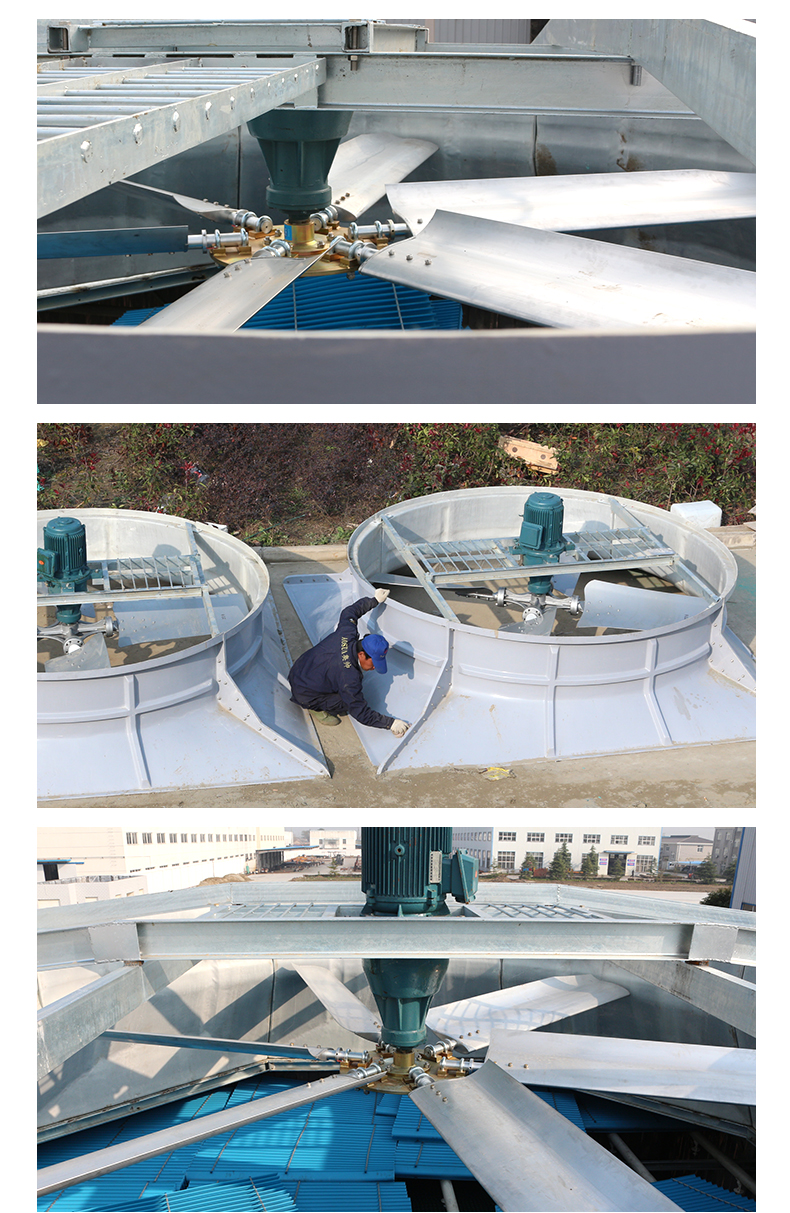
Choosing Cooling Tower Fan Blade Types for Long-Term Performance
Choosing the right cooling tower fan blade types is essential for maintaining reliable airflow, reducing operating costs, and extending the service life of industrial cooling equipment. Cooling tower fan blades operate in demanding environments where moisture, corrosion, temperature changes, vibration, and continuous rotation can affect their performance. Selecting unsuitable blades may lead to excessive energy consumption, frequent maintenance, and unexpected equipment downtime.
Different cooling tower applications require different blade materials, aerodynamic profiles, pitch settings, and structural designs. For example, a cooling tower in a chemical processing plant may prioritize corrosion resistance, while a large power plant may focus on airflow capacity, mechanical strength, and long-term operating stability.
This guide explains the main cooling tower fan blade types, compares common materials and designs, and provides practical recommendations for selecting fan blades that deliver dependable performance over time.
Why Is Choosing the Right Cooling Tower Fan Blade Type Important?
Cooling tower fan blades generate the airflow required to transfer heat from circulating water to the surrounding air. Their design directly affects fan performance, motor loading, vibration, noise, and maintenance requirements.
Maintain Consistent Airflow
The blade profile, diameter, pitch angle, and rotational speed influence the airflow a fan can deliver. Incorrectly selected blades may provide insufficient air volume or create excessive aerodynamic resistance.
Match the Blade to the Cooling Tower Design
When selecting replacement blades, consider the original fan diameter, hub configuration, operating speed, required airflow, and system static pressure. The replacement should be compatible with the complete fan assembly rather than selected by appearance alone.
Improve Energy Efficiency
Fan energy consumption depends on the airflow required, system resistance, blade geometry, rotational speed, and overall fan efficiency. A suitable blade design can help the fan meet its performance target without unnecessary power demand.
However, a lightweight blade or a larger blade angle does not automatically guarantee lower energy consumption. Actual efficiency must be evaluated using the manufacturer's performance data and operating conditions.
Reduce Vibration and Mechanical Stress
Blade mass consistency, pitch uniformity, structural integrity, and correct installation all contribute to smooth operation.
Poorly manufactured or improperly installed blades may cause vibration, uneven aerodynamic loading, or excessive stress on the hub, shaft, bearings, gearbox, and supporting structure.
Extend Equipment Service Life
Selecting blades that suit the operating environment can help reduce premature deterioration. Corrosion-resistant materials, suitable structural design, and regular maintenance are particularly important for cooling towers exposed to humidity, chemicals, salt, or airborne contaminants.
What Are the Main Types of Cooling Tower Fan Blades?
Cooling tower fan blades can be classified by material, pitch adjustment, aerodynamic design, and application. These categories overlap, so one blade may belong to several types at the same time.
Fixed-Pitch Cooling Tower Fan Blades
Fixed-pitch blades are manufactured or installed with a specified blade angle that is not intended for routine adjustment.
They are commonly used in applications where the fan is designed to operate at a defined speed and performance point.
Advantages of Fixed-Pitch Blades
Relatively straightforward installation
Consistent factory-defined blade geometry
Fewer pitch-adjustment components
Convenient replacement when the original specifications are available
Suitable for systems with stable operating requirements
The primary limitation is reduced flexibility when cooling demand changes significantly. Any proposed modification should be evaluated against the fan manufacturer's design and performance limits.
Adjustable-Pitch Cooling Tower Fan Blades
Adjustable-pitch blades allow the blade angle to be set within an approved range. This design can help match fan performance to specific airflow and motor-loading requirements.
When Are Adjustable-Pitch Blades Useful?
Adjustable-pitch blades may be appropriate when a cooling tower requires commissioning adjustments or when operating conditions differ from the original design assumptions.
However, adjustment must be carried out using the manufacturer's specified procedure. Unequal pitch settings can create uneven aerodynamic loading, vibration, and reduced performance.
A larger pitch angle should never be assumed to be better. The final setting must meet the required airflow while keeping motor power and mechanical loading within approved limits.
Axial-Flow Cooling Tower Fan Blades
Axial fans move air predominantly parallel to the fan shaft. They are widely used in induced-draft and forced-draft cooling tower configurations.
Key Characteristics of Axial Fan Blades
Axial fan blades are designed to move substantial volumes of air through a relatively compact arrangement. Their aerodynamic profile, blade twist, diameter, and pitch determine how effectively they perform against the tower's air resistance.
Common applications include:
Industrial cooling towers
HVAC cooling systems
Power generation facilities
Manufacturing plants
Process cooling installations
When selecting axial fan blades, confirm the required airflow, fan speed, static pressure, and compatibility with the existing fan cylinder and hub.
Centrifugal Fan Blades for Cooling Applications
Centrifugal fans move air radially outward from the rotating impeller. They are generally used where the system requires different pressure characteristics or ducting arrangements compared with typical axial cooling tower fans.
When Should Centrifugal Fans Be Considered?
Centrifugal fans may be suitable for specialized cooling or ventilation systems with relatively high resistance. Their impeller design, blade orientation, casing, and drive arrangement must be evaluated as a complete system.
Axial and centrifugal fans should not be treated as interchangeable replacement options without an engineering assessment.
Which Materials Are Best for Cooling Tower Fan Blades?
Material selection is one of the most important factors affecting durability and maintenance requirements. Common materials include fiberglass-reinforced plastic, aluminum, and engineering plastics.
The best choice depends on operating temperature, chemical exposure, mechanical loading, fan size, and the manufacturer's design.
FRP Cooling Tower Fan Blades
Fiberglass-reinforced plastic (FRP) blades are widely used in industrial cooling towers because they can provide low weight, corrosion resistance, and flexibility in blade design.
FRP blades can be suitable for environments where moisture and certain corrosive substances make material durability a major consideration.
Advantages of FRP Blades
Good corrosion resistance when the resin system is properly selected
Relatively low weight
Flexible aerodynamic design options
Potentially reduced mechanical loading compared with heavier designs
Suitability for many industrial cooling environments
What Should Buyers Check?
FRP performance depends on the resin, reinforcement, manufacturing process, blade geometry, and operating conditions. Buyers should verify temperature limits, chemical compatibility, UV resistance, fatigue performance, and inspection requirements.
Cracks, delamination, impact damage, or deterioration near the blade root should be assessed according to the manufacturer's criteria.
Aluminum Cooling Tower Fan Blades
Aluminum blades can offer a favorable strength-to-weight ratio and are used in selected industrial fan designs.
Their performance depends on alloy selection, blade geometry, surface treatment, manufacturing quality, and the operating environment.
Advantages of Aluminum Blades
Relatively low weight for many designs
Good structural properties when correctly engineered
Potentially suitable for large fan assemblies
Established manufacturing and repair practices for selected designs
Aluminum Blade Selection Considerations
Aluminum can be affected by corrosion in unsuitable environments. Protective coatings, alloy selection, and regular inspection may be necessary depending on exposure.
Dents, deformation, fatigue cracks, and mounting damage should be evaluated before reuse. Repairs or modifications should only be performed using methods approved for the specific blade design.
Engineering Plastic Cooling Tower Fan Blades
Engineering plastics can be used in selected cooling tower applications where low weight, corrosion resistance, and manufacturing flexibility are important.
What Are the Limitations of Plastic Blades?
Not every plastic is suitable for large industrial fan applications. Temperature resistance, stiffness, UV exposure, fatigue, creep, and chemical compatibility must be considered.
The material should be selected according to verified operating requirements rather than price alone.
Comparing Common Fan Blade Materials
| Factor | FRP | Aluminum | Engineering plastics |
| Corrosion resistance | Often good with suitable resin | Depends on alloy and protection | Often good, depending on polymer |
| Weight | Generally low | Generally low to moderate | Often low |
| Temperature suitability | Depends on resin system | Depends on alloy and design | Depends on polymer grade |
| Structural performance | Depends on layup and design | Depends on alloy and geometry | Depends on stiffness and design |
| Maintenance focus | Cracks, delamination, impact damage | Corrosion, fatigue, deformation | UV damage, cracking, deformation |
| Best selection basis | Environment and engineered blade design | Strength and application requirements | Verified load and temperature limits |
No material is best for every cooling tower. The complete blade design and its verified operating limits are more important than the material name alone.
How Does Blade Design Affect Long-Term Performance?
Material is only one part of the selection process. Blade geometry and manufacturing quality also influence performance, noise, vibration, and durability.
Blade Profile and Aerodynamic Efficiency
The blade profile determines how air flows around the blade and how aerodynamic forces are generated.
A well-designed profile can help deliver the required airflow efficiently while controlling power demand and noise.
Why Blade Geometry Matters
Blade width, chord length, twist distribution, thickness, and surface finish can all influence performance. Two blades with the same diameter may behave differently if their aerodynamic profiles are not equivalent.
When replacing a blade, confirm that its geometry matches the approved fan design or has been validated for the intended operating conditions.
Fan Diameter and Blade Length
Fan diameter determines the swept area and affects the amount of air the fan can potentially move. Larger fans may deliver greater airflow under suitable conditions, but they also require compatible structural support, hub design, drive capacity, and installation clearances.
Check Fan Cylinder Clearance
The clearance between the blade tips and fan cylinder affects airflow behavior and mechanical safety. Incorrect clearance may reduce performance or create a risk of contact during operation.
Confirm the manufacturer's specified clearance and account for the fan's operating conditions and structural movement.
Blade Pitch Angle and Airflow
Blade pitch influences the aerodynamic loading and operating point of the fan. An unsuitable pitch may cause insufficient airflow, excessive motor current, or unstable operation.
Choose the Correct Pitch Setting
Use the fan manufacturer's performance curves and approved pitch-angle range to select a suitable setting. Check motor power, airflow requirements, rotational speed, and system resistance before making adjustments.
Never increase the blade angle simply to achieve maximum airflow without verifying that the motor and fan assembly can safely support the resulting load.
Blade Weight and Balance
Consistent blade mass and geometry help support smooth fan operation. Differences between blades may create imbalance, while incorrect installation can introduce additional mechanical or aerodynamic problems.
Why Balancing Is Essential
Depending on the fan design, balancing requirements may apply to individual blades, the hub, or the complete rotating assembly.
Follow the manufacturer's balancing procedure and acceptance criteria. Do not use improvised weights, drilling, grinding, or other unauthorized modifications to correct an imbalance.
How to Choose Cooling Tower Fan Blades for Different Industries
Different industries have different cooling requirements, environmental conditions, and maintenance priorities.
Power Plants and Energy Facilities
Power plants often require reliable cooling tower operation under sustained thermal loads. Fan blade selection should prioritize verified airflow performance, structural reliability, and compatibility with the existing fan and drive system.
Recommended Selection Priorities
Evaluate fan performance curves, operating speed, motor capacity, blade material, balance requirements, and access for maintenance.
For critical installations, consider the availability of replacement blades and technical support to reduce the impact of unplanned downtime.
Chemical and Petrochemical Plants
Chemical processing environments may expose fan blades to corrosive moisture, chemical vapors, or airborne contaminants.
Material Compatibility Comes First
FRP or other corrosion-resistant designs may be appropriate, but compatibility must be confirmed against the actual chemicals, temperature, concentration, and exposure conditions.
Do not assume that every FRP resin or plastic material is resistant to every chemical.
HVAC and Commercial Buildings
HVAC cooling towers often experience variable cooling loads throughout the year. Fan blade selection should account for the intended operating range, energy consumption, noise requirements, and control strategy.
Consider Variable-Speed Operation
Where the system supports variable-frequency drive (VFD) control, fan speed can be adjusted to match changing cooling demand. The blade design and pitch must remain compatible with the manufacturer's approved speed range and operating limits.
Steel, Cement, and Manufacturing Plants
Industrial manufacturing facilities may expose cooling tower fans to dust, high ambient temperatures, and continuous operation.
Prioritize Durability and Inspectability
Select blades suited to the actual environment, and establish a maintenance program that covers contamination, erosion, corrosion, vibration, and mounting hardware.
If deposits accumulate on the blades, clean them using an approved method before assessing balance and operating performance.
How to Select Replacement Cooling Tower Fan Blades
Replacing damaged or obsolete blades requires more than finding a product with a similar diameter. Mechanical compatibility, aerodynamic performance, material suitability, and balance requirements should all be confirmed.
Step 1 — Identify the Existing Fan Model
Record the cooling tower manufacturer, fan model, fan diameter, blade count, hub configuration, and operating speed.
If the original documentation is unavailable, collect clear photographs and measurements of the fan, blades, hub, and mounting interfaces.
Step 2 — Confirm the Required Operating Parameters
Gather the information needed to evaluate the replacement:
Required airflow and static pressure
Fan rotational speed
Motor power and rated current
Blade pitch and measurement method
Fan cylinder dimensions and tip clearance
Operating temperature and environmental conditions
Existing vibration or performance problems
Do Not Select Blades by Diameter Alone
A blade may fit the fan diameter but still be unsuitable because of differences in profile, mounting geometry, pitch, mass, or structural capacity.
The supplier should verify compatibility with the complete fan assembly.
Step 3 — Evaluate the Blade Material
Choose a material that meets the requirements for corrosion resistance, temperature, stiffness, fatigue, and mechanical loading.
Request the manufacturer's material specifications and applicable operating limits before placing an order.
Step 4 — Verify Quality and Balancing Procedures
Ask the supplier how blade dimensions, pitch consistency, mounting interfaces, material quality, and balance are inspected.
Depending on the design, quality assurance may include dimensional inspection, mass checks, structural inspection, and balancing verification.
Request Relevant Technical Documents
Useful documents may include:
Blade drawings and dimensions
Material specifications
Installation instructions
Approved pitch settings
Balancing requirements
Inspection records, where applicable
Warranty and maintenance recommendations
Step 5 — Plan Installation and Commissioning
Before installation, confirm the compatibility of the blade set, hub, fasteners, and drive system. Installation should follow the manufacturer's instructions and applicable safety procedures.
After installation, perform the required checks for mounting security, blade pitch, clearance, rotation direction, vibration, and motor loading before returning the fan to normal service.
Cooling Tower Fan Blade Maintenance for Long-Term Reliability
Even high-quality fan blades require regular inspection. Preventive maintenance helps identify damage and deterioration before they cause major operational problems.
Inspect Blade Surfaces Regularly
Check the blades for cracks, corrosion, erosion, deposits, deformation, and impact damage. Pay particular attention to blade roots, mounting holes, and other areas where stress may concentrate.
Keep Inspection Records
Record the blade condition, inspection date, identified defects, corrective actions, and any measurements. Consistent records help maintenance teams identify recurring problems and plan replacement work.
Check Fasteners and Hub Connections
Loose or damaged mounting hardware can cause vibration and create a serious safety risk. Inspect fasteners, locking devices, hubs, and blade-root connections according to the manufacturer's maintenance schedule.
Use the specified torque values and approved replacement hardware.
Monitor Fan Vibration
Establish a vibration baseline when the equipment is operating correctly. Compare subsequent measurements using consistent sensor locations and operating conditions.
If vibration increases significantly, investigate imbalance, looseness, misalignment, bearing defects, blade damage, and structural resonance before deciding on corrective action.
Clean Blades Using Approved Methods
Remove dust and deposits without damaging the blade surface or protective coatings. Select cleaning agents and tools that are compatible with the blade material.
After cleaning, inspect the blades for defects that may have been hidden by deposits.
Check Blade Pitch and Motor Loading
Verify pitch settings against the approved specifications and monitor motor current and operating conditions.
If the fan cannot meet the cooling requirement, inspect the entire system, including the fan, fill, drift eliminators, water distribution, and air inlets, before changing the blade angle.
Plan Replacement Before Failure
Repeated repairs, structural cracks, severe corrosion, deformation, or deteriorating performance may indicate that replacement is more appropriate than continued maintenance.
For critical cooling systems, maintaining a suitable spare-blade strategy can help reduce downtime.
How to Evaluate a Cooling Tower Fan Blade Manufacturer
Choosing a reliable supplier is important when sourcing replacement blades or planning a cooling tower upgrade.
Check Manufacturing Capability
Look for a manufacturer that can provide blades compatible with the required fan design, operating speed, mounting interface, and material specifications.
Ask about production processes, dimensional inspection, material quality control, and balancing procedures.
Request Application-Specific Recommendations
A knowledgeable supplier should ask about the cooling tower model, operating conditions, required airflow, motor capacity, and environmental exposure before recommending a blade type.
Recommendations based only on price or general product appearance may not adequately address the application's requirements.
Compare Quality, Delivery, and Technical Support
Evaluate the supplier's technical documentation, delivery reliability, packaging, warranty terms, and after-sales support.
For customized projects, clarify drawing approval, dimensional tolerances, inspection requirements, and the process for verifying compatibility before production.
FAQ About Cooling Tower Fan Blade Types
Which Cooling Tower Fan Blade Material Is Best?
There is no universally best material. FRP, aluminum, and engineering plastics each have different strengths and limitations. The correct choice depends on temperature, chemical exposure, structural requirements, blade design, and maintenance conditions.
Are Adjustable-Pitch Fan Blades Better Than Fixed-Pitch Blades?
Not always. Adjustable-pitch blades offer flexibility when approved adjustments are needed, while fixed-pitch blades can be suitable for stable operating conditions. The best option depends on the fan design and the required operating range.
How Long Do Cooling Tower Fan Blades Last?
Service life depends on material quality, manufacturing, operating conditions, environmental exposure, maintenance, and mechanical loading. Follow the manufacturer's inspection recommendations and replace blades when damage or deterioration exceeds the applicable limits.
Can I Replace Only One Cooling Tower Fan Blade?
That depends on the fan design and manufacturer's instructions. A single-blade replacement may affect mass consistency, aerodynamic performance, and balance. Confirm compatibility and follow the required balancing and commissioning procedures.
How Can I Reduce Cooling Tower Fan Blade Maintenance Costs?
Use blades suited to the operating environment, inspect them regularly, maintain correct pitch settings, monitor vibration, clean deposits appropriately, and correct mechanical defects promptly. Proper selection and preventive maintenance can help reduce avoidable repairs and downtime.
Do Lightweight Fan Blades Always Improve Efficiency?
No. Lower blade mass may reduce some mechanical loads, but fan efficiency depends on aerodynamic design, airflow, pressure, speed, and the overall system. Performance data should be used to compare alternatives.
Conclusion
Choosing the right cooling tower fan blade types is a long-term decision that affects airflow, energy use, reliability, maintenance, and operating costs. Fixed-pitch and adjustable-pitch designs serve different operating needs, while FRP, aluminum, and engineering plastic blades offer different material characteristics.
The most effective selection process begins with the cooling tower's actual operating requirements. Confirm fan geometry, rotational speed, required airflow, static pressure, motor capacity, environmental conditions, and the manufacturer's approved blade specifications.
For replacement projects, prioritize compatibility, verified performance, manufacturing quality, correct balancing, and reliable technical support. Combine these factors with regular inspection, vibration monitoring, and preventive maintenance to help maintain stable cooling tower performance over the long term.