How to Choose a Cooling Tower Fill Media Manufacturer
Choosing the right cooling tower fill media manufacturer is an important decision for industrial facilities, cooling tower contractors, equipment distributors, and OEM buyers. Cooling tower fill plays a critical role in heat transfer by increasing the contact area between circulating water and air. The quality, design, and compatibility of the fill media can influence cooling performance, airflow resistance, maintenance requirements, and the overall reliability of a cooling tower.
However, not every manufacturer offers the same materials, product configurations, customization capabilities, or technical support. Some suppliers focus on standard replacement fill, while others provide customized solutions for specific cooling tower models and industrial applications. Understanding these differences can help buyers avoid purchasing unsuitable products and reduce unnecessary project costs.
For international buyers, selecting a manufacturer also involves evaluating production consistency, communication efficiency, packaging, delivery arrangements, and after-sales support.
This guide explains how to choose a reliable cooling tower fill media manufacturer, what technical factors to consider, and how to evaluate suppliers before placing an order.
Why Is Choosing the Right Cooling Tower Fill Media Manufacturer Important?
How Does Fill Media Affect Cooling Tower Performance?
Cooling tower fill provides a surface over which warm water spreads while air passes through the tower. This arrangement promotes heat and mass transfer, allowing heat to move from the circulating water into the surrounding air.
A suitable fill design helps balance several performance factors.
Heat Transfer Efficiency
Fill geometry influences the available contact area between water and air. A well-matched design can support effective cooling by distributing water across the intended fill surface.
However, greater surface area does not automatically guarantee better performance. Water distribution, airflow, operating temperature, and the condition of the fill all affect the final result.
Airflow Resistance
Air must pass through the fill to support heat exchange. If the fill creates excessive resistance, airflow may decrease or the fan may need to work harder to maintain the required operating conditions.
A reliable manufacturer should help buyers understand the relationship between fill geometry, airflow requirements, and the intended cooling tower configuration.
Long-Term Reliability
Fill media operates in a wet environment and may be exposed to scale, suspended solids, biological growth, chemicals, and temperature fluctuations.
Material suitability and structural stability are therefore essential considerations. Appropriate water treatment and maintenance are also necessary to protect the fill and maintain cooling performance.
What Problems Can an Unsuitable Manufacturer Cause?
Choosing a supplier based only on the lowest quotation can create problems later.
Common risks include:
Incorrect fill dimensions or incompatible configurations
Material that is unsuitable for the operating temperature
Poor fit with the existing tower structure
Unexpected installation adjustments
Inconsistent product specifications between orders
Packaging damage during transportation
Unclear technical communication
Delays caused by incomplete order information
Selecting a manufacturer through a structured evaluation process helps reduce these risks before production begins.
What Technical Factors Should You Evaluate Before Choosing a Manufacturer?
1. Cooling Tower Fill Media Materials
Material selection should match the cooling tower's operating environment. Buyers should discuss material characteristics, temperature limits, chemical compatibility, and structural requirements with the manufacturer.
Polyvinyl chloride (PVC) is widely used for structured cooling tower fill in many conventional industrial and commercial applications.
Potential advantages include lightweight construction, availability in different formed sheet configurations, and suitability for a wide range of standard cooling tower designs.
When evaluating a PVC cooling tower fill manufacturer, ask about:
Available sheet thicknesses
Fill geometry and dimensions
Recommended operating temperature
Chemical compatibility
Product consistency and inspection procedures
Suitability for your cooling tower model
PVC should only be selected when its specified operating conditions are compatible with the actual application.
PP Cooling Tower Fill
Polypropylene (PP) may be considered for applications requiring different temperature or chemical resistance characteristics.
Its suitability depends on the specific material grade, product design, and operating environment. Buyers should compare technical specifications rather than assuming that PP is always better than PVC.
How Should You Compare Different Materials?
Before making a decision, provide the manufacturer with information about circulating water temperature, water chemistry, and expected operating conditions.
A suitable supplier should help clarify which materials are available and what limitations apply to each option.
2. Fill Geometry and Product Design
Cooling tower fill is available in different configurations, and the correct design depends on the tower's airflow arrangement, water distribution system, and operating conditions.
Film Fill
Film fill spreads water across structured surfaces to create a large area for contact with air.
It is often considered for applications where compact heat exchange and effective surface wetting are important. However, narrow passages may be more vulnerable to blockage when water contains substantial suspended solids or deposits.
Splash Fill
Splash fill promotes repeated water breakup and redistribution as water falls through the fill structure.
Depending on the design, it may be suitable for applications where tolerance of certain water-quality conditions is an important consideration.
Which Fill Type Should You Choose?
Neither film fill nor splash fill is universally best. Buyers should evaluate:
Required cooling duty
Circulating water quality
Potential for scaling and fouling
Available airflow
Tower design and internal dimensions
Cleaning and maintenance requirements
A qualified manufacturer should help match the fill configuration to the application instead of recommending a product based on price alone.
3. Compatibility With Crossflow and Counterflow Cooling Towers
The fill media must match the tower's water-flow and airflow arrangement.
Crossflow Cooling Tower Fill
In a crossflow cooling tower, air generally moves horizontally through the fill while water flows downward. Fill dimensions and orientation must match the tower's internal structure and water distribution system.
Counterflow Cooling Tower Fill
In a counterflow cooling tower, air generally moves upward while water flows downward. The fill must accommodate the tower's design, water distribution arrangement, and airflow requirements.
Before ordering, confirm the cooling tower type, product orientation, support arrangement, and fill pack dimensions. Similar-looking products are not necessarily interchangeable.
4. Dimensional Accuracy and Customization
Dimensional compatibility is especially important for replacement projects and OEM manufacturing.
A fill pack that is too large may not fit the installation space. A pack that is too small may leave gaps or allow water to bypass parts of the intended fill area.
What Information Should You Provide?
To help a manufacturer confirm the correct dimensions, prepare:
Cooling tower manufacturer and model
Fill pack length, width, and height
Individual sheet dimensions, if available
Required material and thickness
Photographs of the existing fill
Technical drawings or installation measurements
Required quantity
If the original specifications are unavailable, provide as much information as possible and ask the manufacturer what additional measurements are required.
How Can You Evaluate a Manufacturer's Production and Quality Control?
Review the Manufacturing Process
A reliable cooling tower fill media manufacturer should be able to explain how products are produced and how specifications are checked.
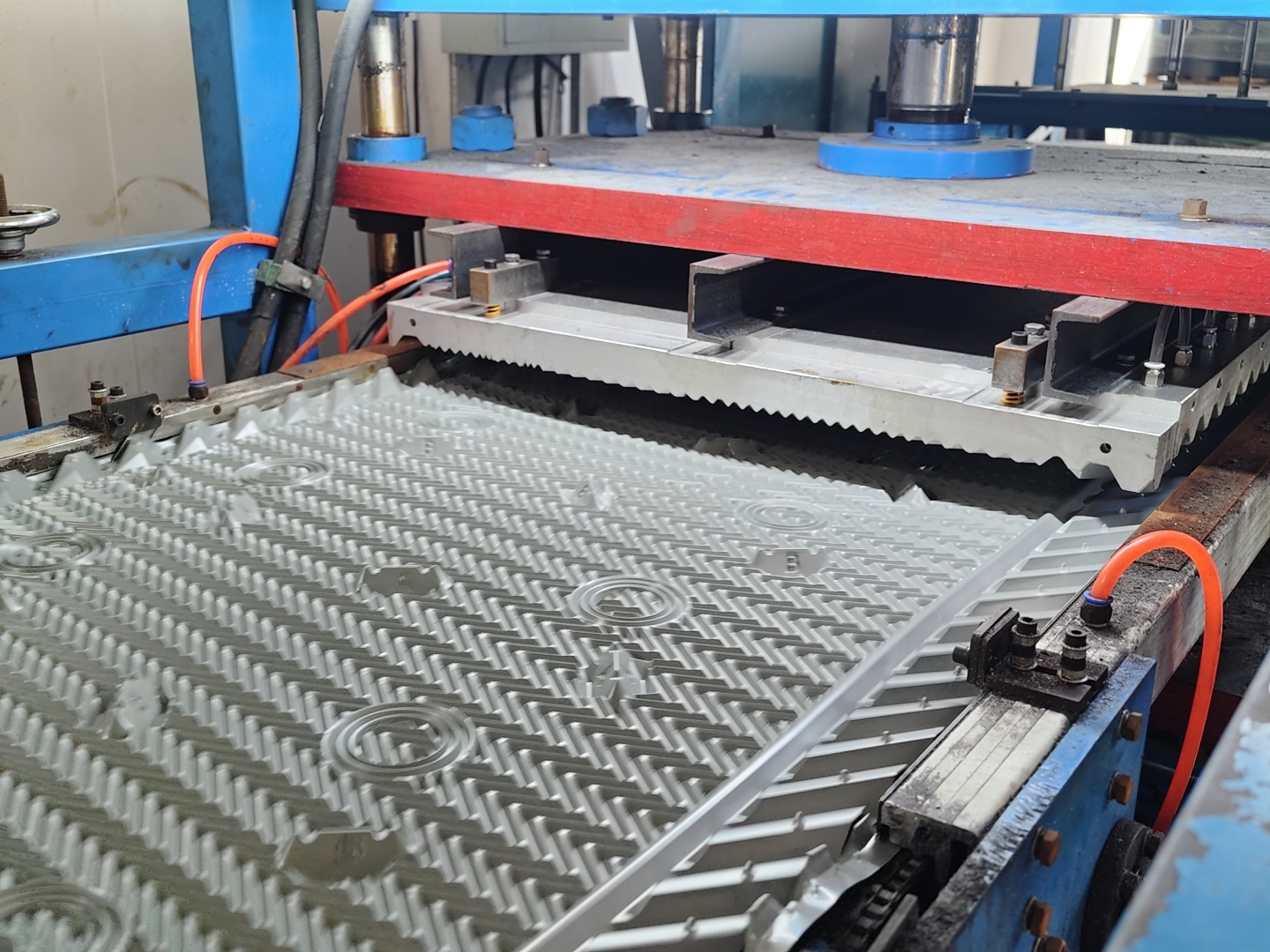
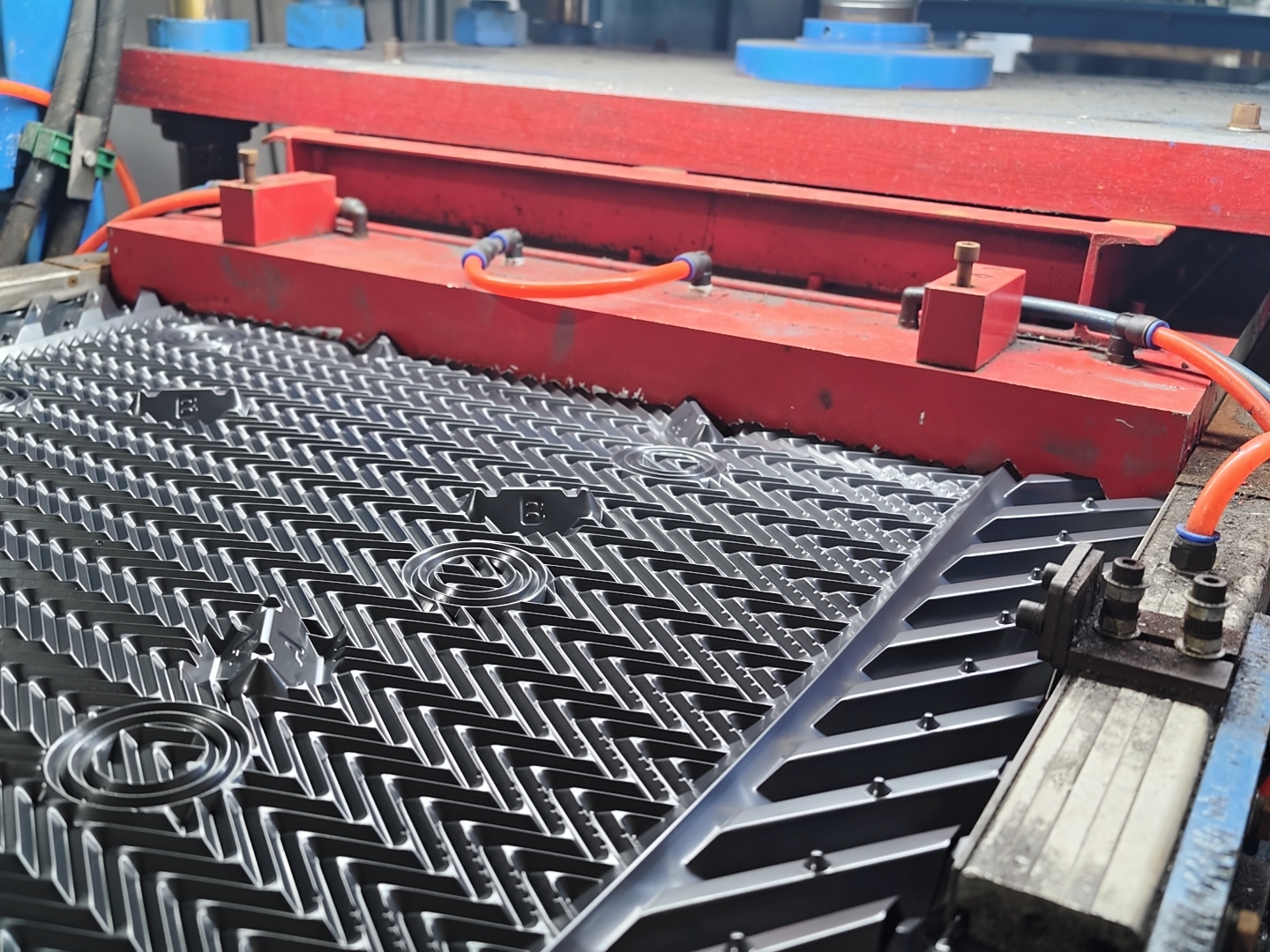
Depending on the product, manufacturing may involve sheet preparation, forming, cutting, bonding, assembly, and packing.
Why Does Process Consistency Matter?
Inconsistent dimensions or forming quality can create problems during installation. Poorly assembled packs may not maintain their intended configuration, while inadequate packaging can cause damage before the products arrive at the project site.
Buyers should ask how the manufacturer verifies the product against the agreed specification.
Check Available Quality Documentation
Not every project requires the same level of documentation. However, industrial buyers may need product specifications, inspection records, material information, or other supporting documents.
Questions to Ask About Quality Control
How are fill dimensions checked?
Can the manufacturer provide technical drawings?
What material specifications are available?
How are finished products inspected?
Can inspection records be provided when required?
How are nonconforming products handled?
Can the supplier confirm that repeat orders will follow the agreed specification?
Do not rely solely on general statements such as “high quality” or “strict quality control.” Ask for evidence that is relevant to the product and your project.
Consider Sample Evaluation
For a new supplier or a large customized order, reviewing a sample may help confirm material appearance, dimensions, surface pattern, and assembly details.
A sample does not replace a complete technical assessment, but it can help identify discrepancies before a larger order is manufactured.
For critical applications, agree on the acceptance criteria before production starts.
Why Is Customization Capability Important?
Customized Fill for Replacement Projects
Existing cooling towers may use nonstandard dimensions, older product designs, or fill configurations that are difficult to source.
A manufacturer with customization capabilities may be able to evaluate the original dimensions and identify an appropriate replacement option.
How Can Customization Reduce Installation Problems?
A correctly specified fill pack can help minimize unnecessary cutting, fitting adjustments, and gaps during installation.
However, customization should be based on accurate measurements and technical compatibility. A product should not be modified solely to match physical dimensions if its material or operating characteristics are unsuitable.
Customized Fill for OEM Manufacturers
OEM customers often require consistent specifications across multiple cooling tower units.
The manufacturer should understand the required drawings, material specifications, pack dimensions, quantity, and quality acceptance criteria.
What Should OEM Buyers Confirm?
Before placing an order, confirm:
Approved technical drawings
Material and thickness specifications
Product dimensions and tolerances
Packing requirements
Inspection and acceptance criteria
Expected production schedule
Procedures for handling specification changes
Clear documentation helps reduce variation between batches and simplifies future repeat orders.
Customized Fill for International Projects
International projects may involve different standards, operating conditions, installation practices, and transportation requirements.
Buyers should provide detailed project information at the beginning of the sourcing process. The manufacturer can then evaluate the requested configuration and identify any information that still needs confirmation.
How Should You Compare Cooling Tower Fill Media Manufacturers?
Compare More Than the Purchase Price
A low initial quotation does not necessarily represent the best overall value.
Buyers should compare the product specification, material suitability, dimensional accuracy, packaging, lead time, and technical support.
Build a Supplier Evaluation Checklist
Use the following factors when comparing manufacturers:
| Evaluation factor | What to verify |
| Product range | PVC, PP, film fill, splash fill, and other available options |
| Technical knowledge | Ability to discuss operating conditions and tower compatibility |
| Customization | Ability to evaluate nonstandard dimensions and configurations |
| Quality control | Relevant inspection procedures and documentation |
| Communication | Clear responses to technical and commercial questions |
| Production planning | Confirmed lead time and order requirements |
| Packaging | Protection against deformation and transportation damage |
| Export support | Shipping coordination and required commercial documents |
| After-sales service | Procedures for addressing product or specification issues |
The importance of each factor depends on the project. A standard replacement order may prioritize dimensional accuracy and delivery, while a customized OEM project may require more detailed technical coordination.
Calculate the Total Procurement Cost
The total cost of a cooling tower fill order includes more than the unit price.
Potential costs include:
Product purchase price
Packaging and palletization
International freight
Customs duties and applicable taxes
Installation labor
Additional fitting or modification
Maintenance and replacement requirements
A product with a lower initial price may become more expensive if it requires extensive installation adjustments or is unsuitable for the operating environment.
The best comparison uses equivalent technical specifications and clearly defined delivery terms.
What Should Global Buyers Know About Shipping and Delivery?
Confirm Packaging Requirements Before Production
Cooling tower fill is often lightweight but can occupy substantial shipping volume. Packaging design can influence freight costs, container utilization, and product protection.
Important Packaging Details
Ask the manufacturer to confirm:
Package dimensions and gross weight
Pallet or bundle arrangement
Loading and unloading requirements
Protection against deformation
Container loading plan, where applicable
Shipping marks and document requirements
For large-volume orders, reviewing the proposed packaging dimensions before shipment can help buyers plan warehouse space and transportation.
Verify Production and Delivery Lead Times
Lead times may depend on material availability, order quantity, customization requirements, production scheduling, and destination.
Buyers should confirm the estimated production period and shipping arrangements in writing rather than relying on a general delivery estimate.
For projects tied to a scheduled shutdown, allow sufficient time for specification approval, production, transportation, customs clearance, and installation.
Communicate Clearly Across Time Zones
International orders often require coordination among purchasing teams, technical departments, logistics providers, and installation contractors.
To reduce misunderstandings, keep the approved drawings, product specifications, quotation, and order details in a clear written record. Any changes should be confirmed before production or shipment.
Which Industries Need Reliable Cooling Tower Fill Manufacturers?
Industrial Manufacturing
Factories use cooling towers to remove heat from production equipment, machinery, and process water.
The manufacturer should understand the cooling requirements and help identify fill options that match the tower's design and operating conditions.
Commercial HVAC
Hotels, hospitals, shopping centers, and office buildings may rely on cooling towers for central air-conditioning systems.
In these applications, fill compatibility, airflow resistance, maintenance access, and replacement planning are important considerations.
Chemical Processing
Chemical plants may operate cooling systems with specific water chemistry and temperature conditions.
Material compatibility is especially important, and buyers should disclose relevant water-treatment chemicals and operating conditions before selecting a fill product.
Power Plants and Utilities
Large cooling systems may require significant quantities of fill and carefully coordinated replacement schedules.
Buyers should pay particular attention to technical documentation, product consistency, packaging, logistics, and installation planning.
Cooling Tower OEMs and Distributors
OEMs and distributors may need repeatable product specifications, customized dimensions, and predictable order processing.
A manufacturer that can communicate clearly and maintain agreed specifications can help simplify long-term purchasing.
Mach Industry (Zhejiang) Co., Ltd. for Cooling Tower Product Solutions
Mach Industry (Zhejiang) Co., Ltd. is a China-based company serving the cooling tower industry with cooling equipment and related components.
For buyers sourcing cooling tower fill media, selecting a supplier begins with matching the product to the project's technical requirements. Material, dimensions, fill geometry, operating temperature, and tower configuration should all be confirmed before an order is finalized.
How to Prepare an Inquiry for MACH
When contacting Mach Industry (Zhejiang) Co., Ltd., provide the available project information so the team can understand your requirements.
Recommended Inquiry Details
Include the following wherever possible:
Cooling tower type and model
Required fill material
Fill pack dimensions
Sheet thickness or existing product specifications
Operating water temperature
Water quality and chemical conditions
Required quantity
Delivery destination and preferred schedule
If you are replacing existing fill, photographs and measurements can be particularly helpful.
Supporting Replacement and Customized Projects
Customers may need standard fill products, replacement solutions, or components that match a particular cooling tower configuration.
A detailed inquiry helps clarify the required product and determine whether additional drawings, measurements, or technical information are needed.
For company and product information, visit the official website:
Mach Industry (Zhejiang) Co., Ltd.
Website: https://www.machcooling.com/
Confirm product availability, specifications, customization scope, and delivery arrangements directly with the company before placing an order.
What Questions Should You Ask Before Placing an Order?
Technical Questions
Before confirming the product, ask:
Is the proposed fill suitable for my tower type?
Does the material meet the required operating conditions?
Are the dimensions compatible with the existing structure?
What airflow or water-quality considerations should be reviewed?
Can technical drawings or samples be provided?
What maintenance requirements should be considered?
Commercial Questions
Also clarify:
What is the minimum order quantity?
What is the confirmed production lead time?
What packaging options are available?
Which shipping terms are offered?
What documents will be supplied?
How are specification changes managed?
What is the process for reporting quality issues?
These questions help both parties establish clear expectations before production starts.
Common Mistakes to Avoid When Choosing a Cooling Tower Fill Media Manufacturer
Selecting a Supplier Based Only on Price
Price should be compared alongside technical suitability, product consistency, packaging, and delivery. A low quotation is not useful if the product does not fit the tower or meet the operating requirements.
Ignoring Operating Temperature and Water Chemistry
The wrong material may deteriorate prematurely or fail to perform as expected. Always provide the manufacturer with relevant operating information.
Assuming Similar Products Are Interchangeable
Fill products can differ in geometry, dimensions, and airflow resistance even when they look similar. Confirm the exact specification before ordering.
Failing to Approve Drawings and Dimensions
Incomplete measurements may result in incompatible products or installation delays. Review the final specification and document any changes before production.
Overlooking Transportation and Installation
Packaging damage, incorrect quantities, or delayed delivery can disrupt a replacement project. Include shipping and installation requirements in the purchasing plan.
FAQ About Cooling Tower Fill Media Manufacturers
What Does a Cooling Tower Fill Media Manufacturer Produce?
A cooling tower fill media manufacturer produces fill products that increase water-air contact inside a cooling tower. Depending on its product range, a manufacturer may offer different materials, geometries, dimensions, and configurations for new equipment and replacement projects.
Which Material Is Best for Cooling Tower Fill Media?
PVC and PP are common options, but neither is universally best. Selection depends on operating temperature, water chemistry, fill design, mechanical requirements, and the manufacturer's recommended operating limits.
How Can I Check Whether a Manufacturer Is Reliable?
Review the manufacturer's product specifications, relevant technical documentation, quality-control procedures, customization capabilities, communication, and delivery arrangements. Samples or inspection records may also help verify suitability.
Can a Manufacturer Produce Customized Cooling Tower Fill?
Some manufacturers can evaluate customized dimensions, material requirements, and fill configurations. Buyers should provide technical drawings or accurate measurements and confirm the scope of customization before ordering.
How Often Should Cooling Tower Fill Be Replaced?
There is no universal replacement interval. Fill service life depends on material suitability, operating conditions, water quality, maintenance, and physical condition. Regular inspection helps determine whether cleaning, repair, or replacement is necessary.
What Information Is Needed to Request a Quotation?
Prepare the cooling tower model, fill dimensions, material requirements, operating temperature, water-quality information, order quantity, and delivery destination. If some details are unavailable, provide photographs and existing measurements as a starting point.
Conclusion: Choose a Cooling Tower Fill Media Manufacturer Based on Quality and Compatibility
Choosing a cooling tower fill media manufacturer requires a careful review of product design, material suitability, dimensional accuracy, customization capabilities, quality control, and international delivery arrangements.
The right manufacturer should help you identify a fill solution that matches your cooling tower and operating environment rather than simply offering the lowest price. Clear technical communication and a verified specification can reduce sourcing risks, simplify installation, and support long-term cooling tower maintenance.
Mach Industry (Zhejiang) Co., Ltd. provides cooling tower equipment and related component solutions for industrial and commercial applications. If you are sourcing cooling tower fill media for a replacement project, an OEM application, or a new cooling system, prepare your technical requirements and discuss suitable product options with the company.
Looking for a cooling tower fill media manufacturer for your next project? Visit https://www.machcooling.com/ to learn more about Mach Industry (Zhejiang) Co., Ltd. and discuss your requirements.