Cooling Tower Filler Manufacturer: PVC, PP and Custom Solutions
Choosing the right cooling tower filler manufacturer is an important step when building, upgrading, or maintaining an industrial cooling tower. Cooling tower fill is one of the most important components inside an evaporative cooling system because it increases the contact area between circulating water and air, supporting efficient heat transfer and evaporation.
Among the available materials, PVC cooling tower fill and PP cooling tower fill are widely used for different operating conditions. In addition to standard products, experienced manufacturers can provide custom cooling tower filler solutions based on tower dimensions, water quality, operating temperature, fill configuration, and installation requirements.
But how do PVC and PP cooling tower fill differ? When should you choose custom cooling tower fill? And what should you look for when selecting a cooling tower filler manufacturer?
This guide explains the key considerations for selecting cooling tower fill for HVAC, industrial, and process cooling applications.
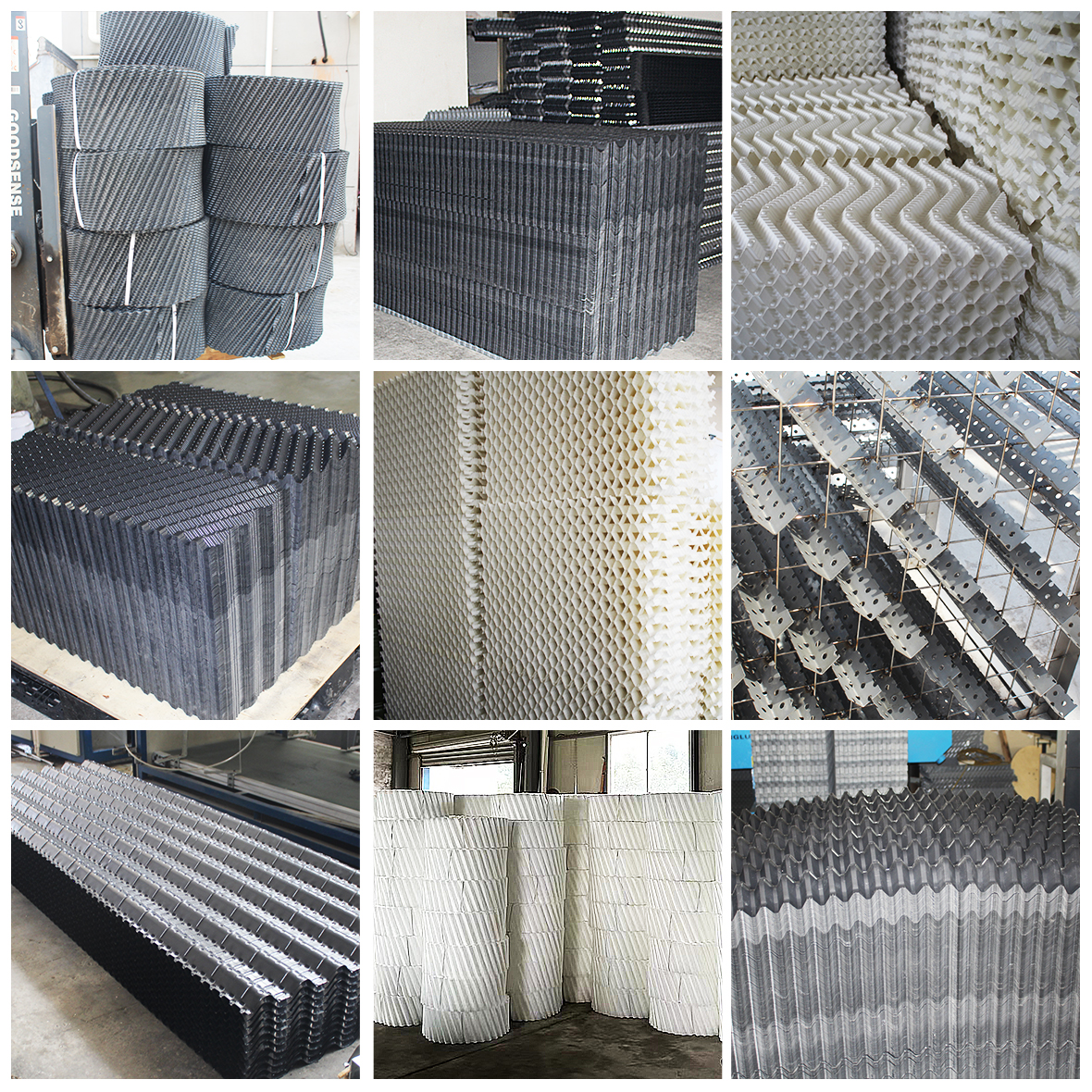
What Is Cooling Tower Filler and Why Does It Matter?
Cooling tower filler, also called cooling tower fill media, is installed inside an evaporative cooling tower to increase water-air contact.
How Does Cooling Tower Fill Work?
Hot water enters the tower and is distributed over the fill. As water moves through the structured surfaces, it spreads into thin films or breaks into droplets depending on the fill design.
Air simultaneously passes through the fill.
This creates a large interface between water and air, allowing heat to be transferred from the circulating water to the air. A portion of the water also evaporates, removing additional heat from the system.
What Does High-Quality Cooling Tower Fill Provide?
Properly selected cooling tower fill can help provide:
Efficient heat transfer
Better water distribution
Increased water-air contact
Stable cooling performance
Suitable airflow resistance
Long-term dimensional stability
Easier maintenance
The actual performance depends on the complete cooling tower design, including airflow, water loading, temperature, fill height, and water quality.
Why Choose a Professional Cooling Tower Filler Manufacturer?
Not all cooling tower fill products are manufactured with the same materials, geometry, or quality-control procedures.
What Can an Experienced Manufacturer Provide?
A professional cooling tower filler manufacturer may provide:
PVC cooling tower fill
PP cooling tower fill
Film fill
Splash fill
Counterflow fill
Crossflow fill
Custom fill dimensions
Replacement fill
Technical specifications
Installation guidance
Manufacturers with customization capabilities can also adjust products for unusual tower dimensions or special operating environments.
Why Is Manufacturer Experience Important?
Cooling tower fill affects water distribution and airflow inside the tower. Selecting an unsuitable fill design can influence cooling performance and maintenance requirements.
A knowledgeable manufacturer can help customers consider:
This makes the manufacturer's technical capability an important purchasing consideration.
What Is PVC Cooling Tower Fill?
PVC cooling tower fill is one of the most commonly used fill media for evaporative cooling systems.
Why Is PVC Used for Cooling Tower Fill?
PVC offers a useful combination of:
PVC can be formed into structured surfaces that promote water spreading and air-water contact.
Where Is PVC Cooling Tower Fill Commonly Used?
PVC fill can be found in many:
The suitability of PVC depends on actual operating conditions, particularly water temperature and chemical exposure.
What Are the Limitations of PVC Fill?
PVC should not be selected solely because it is common.
Applications involving elevated temperatures, aggressive chemicals, or unusual operating conditions may require another material.
A qualified cooling tower filler manufacturer should evaluate the application before recommending the material.
What Is PP Cooling Tower Fill?
PP, or polypropylene, is another material used for cooling tower fill.
Why Consider PP Cooling Tower Fill?
PP can provide useful characteristics for applications where higher temperature resistance or specific chemical compatibility is required.
Depending on the formulation and application, PP cooling tower fill can be considered for demanding industrial environments.
How Does PP Compare With PVC?
The choice between PVC and PP depends on the application.
| Factor | PVC Cooling Tower Fill | PP Cooling Tower Fill |
| General applications | Widely used | Suitable for selected applications |
| Temperature capability | Suitable within specified range | Often considered for higher-temperature applications |
| Chemical resistance | Good for suitable conditions | Good for suitable conditions |
| Cost | Generally economical | May be higher depending on specification |
| Customization | Available | Available |
| Typical use | HVAC and industrial cooling | Industrial and demanding applications |
The actual performance of either material depends on product formulation, design, operating conditions, and manufacturing quality.
PVC vs PP Cooling Tower Fill: Which Should You Choose?
There is no universal material that is best for every cooling tower.
When Is PVC a Practical Choice?
PVC may be appropriate when the system operates within the material's recommended temperature and chemical limits.
It can be attractive for projects where:
Cost efficiency is important
Operating temperatures are moderate
Water chemistry is compatible
Standard film fill is required
High-volume replacement is needed
When Should PP Be Considered?
PP may be worth considering when the application has more demanding temperature or chemical requirements.
Before choosing PP, buyers should evaluate the actual operating environment rather than assuming that PP is automatically better.
What Information Should Be Provided to the Manufacturer?
Provide:
This allows the manufacturer to make a more application-specific recommendation.
What Are Film Fill and Splash Fill?
Cooling tower filler can also be categorized according to how it increases water-air contact.
How Does Film Fill Work?
Film fill uses structured surfaces to spread water into thin films.
The thin water layer creates a large contact area between air and water.
Film fill is commonly selected when:
Water quality is relatively clean
High heat-transfer efficiency is required
Compact fill geometry is desirable
The cooling tower is designed for film fill
How Does Splash Fill Work?
Splash fill breaks falling water into droplets through repeated impacts against specially designed surfaces.
It can be considered for applications where water contains more suspended solids or where fouling resistance is a major concern.
Why Is Water Quality Important?
A fill design with narrow passages and high surface area can be more sensitive to fouling.
When water contains significant suspended solids, biological matter, or scale-forming substances, the fill selection should consider blockage risk and maintenance requirements.
What Is Custom Cooling Tower Filler?
Custom cooling tower filler is designed or manufactured according to project-specific requirements.
Why Do Buyers Need Custom Cooling Tower Fill?
Existing cooling towers may have:
Non-standard dimensions
Older fill configurations
Discontinued products
Unique support structures
Special operating temperatures
Specific water-quality conditions
A standard fill module may not fit these towers correctly.
What Can Be Customized?
Depending on the manufacturer, customization may include:
Fill sheet length
Fill sheet width
Sheet thickness
Fill height
Cell size
Corrugation geometry
Fill block dimensions
Material
Module configuration
Is Custom Fill Suitable for Replacement Projects?
Yes.
Custom cooling tower fill is particularly useful when replacing deteriorated or obsolete fill in an existing tower.
The manufacturer can use existing measurements, samples, photos, or drawings to determine suitable dimensions.
How Does Fill Geometry Affect Cooling Performance?
Material is only one part of cooling tower filler performance.
Why Does Surface Geometry Matter?
The geometry influences:
Water-film formation
Contact area
Airflow resistance
Turbulence
Water retention
Fouling behavior
Pressure drop
A cooling tower filler manufacturer should therefore consider both material and geometry.
Does More Surface Area Always Mean Better Cooling?
No.
Higher surface area can increase water-air contact, but extremely small passages may increase fouling risk under poor water-quality conditions.
A practical design balances:
Heat transfer + airflow + water quality + maintenance.
Why Does Pressure Drop Matter?
As airflow resistance increases, the cooling tower fan may need to work harder to maintain the required airflow.
Therefore, fill should not be selected based solely on maximum surface area. The complete air-side design must also be considered.
How Does a Cooling Tower Filler Manufacturer Control Quality?
Quality control is essential for both standard and custom cooling tower fill.
How Is Raw Material Quality Controlled?
Manufacturers should maintain consistent raw-material specifications.
Important factors can include:
Consistent raw materials help improve batch-to-batch consistency.
How Is Product Dimension Checked?
Quality inspections may measure:
Length
Width
Thickness
Cell dimensions
Corrugation height
Fill height
Module dimensions
Accurate dimensions are especially important for replacement fill.
Why Does Thickness Consistency Matter?
If fill sheets vary significantly in thickness, their mechanical characteristics and installation fit may also vary.
Consistent production helps ensure that large quantities of fill media perform and install predictably.
How Does a Manufacturer Customize Cooling Tower Filler?
Customization should begin with technical evaluation rather than production immediately.
What Is the Customization Process?
A typical process may include:
Application analysis → Dimension confirmation → Material selection → Fill geometry selection → Sample or drawing confirmation → Production → Quality inspection → Packaging
This process reduces the risk of producing an unsuitable product.
What Information Should You Send?
For a custom inquiry, provide:
Cooling tower type
Tower manufacturer and model
Existing fill dimensions
Fill material
Water temperature
Water flow
Water quality
Fill height
Required quantity
Photos or technical drawings
The more complete the information, the easier it is to develop a suitable solution.
How Does Cooling Tower Fill Quality Affect Service Life?
A cooling tower filler operates continuously in a wet environment.
What Causes Cooling Tower Fill to Deteriorate?
Common factors include:
The actual service life varies according to operating conditions.
How Can Proper Material Selection Extend Fill Life?
Selecting a material within its recommended operating range can help reduce premature deterioration.
For example, a demanding high-temperature application may require a material specifically suited to those conditions rather than a standard PVC product.
Does Regular Cleaning Help?
Yes, appropriate cleaning and water treatment can reduce deposits and biological fouling.
However, cleaning methods should be compatible with the fill material and manufacturer recommendations.
What Industries Use PVC, PP and Custom Cooling Tower Fill?
Cooling tower filler is used in many industries.
Which Industrial Applications Use Cooling Tower Fill?
Typical applications include:
Why Are Custom Solutions Useful in Industrial Cooling?
Industrial facilities often have unique process conditions.
A custom solution can help accommodate:
How Should You Select a Cooling Tower Filler Manufacturer?
Selecting a manufacturer should involve both technical and commercial evaluation.
What Should You Check First?
Consider the manufacturer's:
Product range
Material options
Manufacturing capability
Quality-control system
Customization capability
Technical support
Production capacity
Packaging method
Export experience
Why Is Technical Support Important?
Cooling tower fill is part of a larger system.
A manufacturer that understands cooling tower operation can help buyers evaluate whether the selected fill is appropriate for:
Water distribution
Airflow
Temperature
Water quality
Tower configuration
Should You Request Product Samples?
For large or customized projects, requesting a sample can be useful.
A sample can help confirm:
What Should You Consider When Buying Cooling Tower Fill?
A systematic purchasing process can reduce potential problems.
What Are the Main Buying Factors?
Consider these factors before placing an order:
1. Material: PVC, PP, or another suitable material.
2. Tower type: Counterflow or crossflow.
3. Water quality: Clean, treated, or contaminated water.
4. Operating temperature: Normal and maximum temperature.
5. Fill geometry: Film or splash configuration.
6. Dimensions: Sheet and module measurements.
7. Performance requirements: Cooling capacity and operating conditions.
8. Quantity: Required volume and production schedule.
9. Quality requirements: Inspection and documentation.
10. Installation: Existing support structure and replacement requirements.
Is Price the Most Important Factor?
Not necessarily.
The lowest initial price may not provide the lowest total cost if the fill requires frequent replacement, causes high maintenance requirements, or does not deliver the expected cooling performance.
A better approach is to consider the overall lifecycle cost.
How Can a Cooling Tower Filler Manufacturer Support Replacement Projects?
Replacement cooling tower fill requires more than simply supplying a similar-looking product.
What Problems Can Replacement Fill Solve?
Replacement fill may be required because of:
Can a Manufacturer Match Existing Fill?
In many cases, yes.
Customers can provide existing fill samples, dimensions, drawings, or photos. The manufacturer can then evaluate suitable material and geometry for the replacement project.
Why Is Accurate Measurement Important?
Incorrect dimensions can result in:
Accurate measurements help improve replacement compatibility.
What Makes a Reliable Cooling Tower Filler Manufacturer?
A reliable manufacturer should combine product quality with technical capability.
What Characteristics Should Buyers Look For?
Look for a manufacturer that offers:
Why Is Customization Capability Valuable?
Customization allows manufacturers to serve a broader range of industrial cooling towers.
Instead of forcing an existing tower to accommodate a standard product, the fill can be produced around the actual project requirements.
Conclusion
A cooling tower filler manufacturer can provide much more than standard fill media. By offering PVC cooling tower fill, PP cooling tower fill, film fill, splash fill, and custom cooling tower filler, manufacturers can support a wide range of HVAC and industrial cooling applications.
PVC is widely used for many general cooling applications, while PP can be considered for selected environments requiring different temperature or chemical characteristics. Custom cooling tower fill is particularly valuable for replacement projects, non-standard tower designs, and industrial systems with specific operating requirements.
When selecting a manufacturer, buyers should evaluate more than price. Material compatibility, fill geometry, dimensional accuracy, water quality, operating temperature, manufacturing consistency, customization capabilities, and technical support all play important roles.
The right cooling tower fill media should match the complete cooling system. Working with a capable cooling tower filler manufacturer can help ensure that the fill is properly matched to the tower, installation requirements, and operating environment.
Frequently Asked Questions About Cooling Tower Filler Manufacturers
What is a cooling tower filler manufacturer?
A cooling tower filler manufacturer produces fill media installed inside evaporative cooling towers. Products may include PVC, PP, film, splash, crossflow, counterflow, and customized cooling tower fill.
Is PVC or PP better for cooling tower fill?
Neither material is universally better. PVC is widely used for many applications, while PP can be considered for selected higher-temperature or chemically demanding environments. The correct choice depends on actual operating conditions.
Can cooling tower filler be customized?
Yes. Depending on the manufacturer, cooling tower fill can be customized in terms of material, thickness, dimensions, fill height, cell size, surface geometry, and module configuration.
What is the purpose of cooling tower fill?
Cooling tower fill increases the contact area between circulating water and air. This promotes evaporation and heat transfer inside the cooling tower.
How do I choose a cooling tower filler manufacturer?
Evaluate the manufacturer's material options, product range, customization capabilities, quality-control procedures, technical experience, production capacity, documentation, and support services.
Can custom cooling tower filler replace obsolete fill?
In many replacement projects, custom fill can be manufactured to match the dimensions and configuration of an existing cooling tower. Existing samples, drawings, photos, and measurements can help determine the appropriate replacement.
How does water quality affect cooling tower fill selection?
Poor water quality can increase scaling, biological growth, and clogging. Applications with high levels of suspended solids may require fill designs with larger passages or other fouling-resistant characteristics.
What information should I provide when requesting cooling tower fill?
Provide the tower type, existing fill dimensions, material, water temperature, water flow, water quality, fill height, required quantity, and any available drawings or photos. This information helps the manufacturer evaluate a suitable solution.


