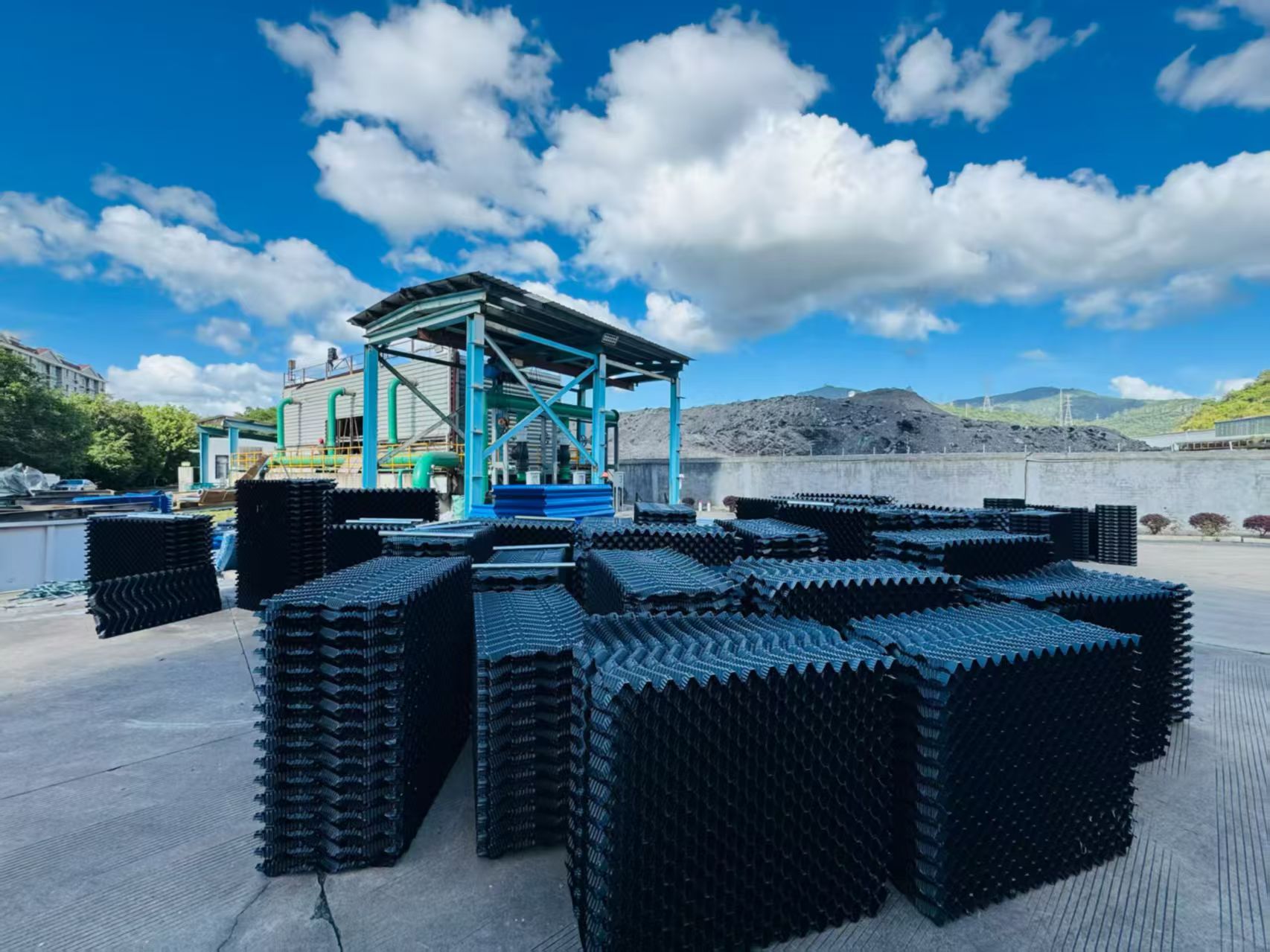
Choosing the right cooling tower media fill can make a surprisingly big difference in cooling performance, operating cost, maintenance frequency, and equipment life.
Whether you operate a counterflow cooling tower or a crossflow cooling tower, the fill is where much of the actual heat and mass transfer takes place. But which media fill is best? Should you choose PVC film fill, PP film fill, or splash fill?
The answer depends on more than just the tower type.
Your water quality, operating temperature, water loading, airflow, fouling potential, thermal requirements, and maintenance program all influence the right choice. A fill that performs exceptionally well in one cooling tower may not be suitable for another.
In this guide, we will explain the main types of cooling tower media fill, compare their use in counterflow and crossflow towers, discuss PVC and PP materials, and show you how to select the right solution for your application.
We will also introduce Power Tower Cooling Technology (Shaoxing) Co., Ltd., a cooling tower media fill manufacturer serving industrial and commercial cooling applications.
What Is Cooling Tower Media Fill?
Cooling tower media fill, also called cooling tower fill, cooling tower filler, or fill media, is the material installed inside a cooling tower to increase the contact area between circulating water and air.
Think of cooling tower fill as a three-dimensional heat-transfer highway.
Without fill, water would simply fall through the tower in relatively large streams. The contact area between the water and air would be limited, making evaporation and heat transfer much less effective.
Fill changes this.
As hot water enters the cooling tower, the fill spreads the water into thin films or breaks it into smaller droplets. At the same time, air moves through the fill. This creates a much larger water-air contact area.
A small portion of the water evaporates and carries heat away from the remaining water. The cooled water then returns to the process.
This basic process makes cooling tower media fill one of the most important internal components of a wet cooling tower.
Why Does Cooling Tower Media Fill Matter?
The primary purpose of cooling tower media fill is to improve heat and mass transfer between water and air.
Effective fill can provide:
Greater water-air contact area
Better evaporation
Improved thermal performance
More efficient use of tower volume
Potentially lower operating costs
Better cooling capacity within a compact design
However, higher thermal efficiency does not automatically mean better performance in every application.
For example, a tightly spaced film fill can provide excellent heat transfer with clean water. But if the circulating water contains high levels of suspended solids, biological growth, or scale-forming minerals, the narrow passages may become blocked.
So the best fill is not necessarily the fill with the highest surface area.
It is the fill that provides the right balance between heat transfer, water quality tolerance, airflow, maintenance, and service life.
How Cooling Tower Fill Improves Heat Transfer
Increasing Effective Surface Area
Film fill works by spreading water into thin layers across structured surfaces.
Instead of a few large streams, the water forms many small flow paths. This increases the area available for air-water contact.
The larger the effective wetted area, the more opportunity there is for evaporation and heat transfer.
This is why film fill is widely used in applications where thermal efficiency is a major design objective.
Improving Water and Air Contact
Water distribution and airflow are equally important.
If water does not spread evenly across the fill, some sections may remain dry while other sections receive excessive water loading.
Dry sections represent unused heat-transfer area.
Similarly, if airflow is poorly distributed, the tower cannot take full advantage of the available fill surface.
Good cooling tower design therefore requires the fill, water distribution system, air path, fan, and tower geometry to work together.
Counterflow vs. Crossflow Cooling Towers
Before selecting cooling tower media fill, it is important to understand the difference between counterflow and crossflow towers.
In a counterflow cooling tower, air generally travels upward while water flows downward.
In a crossflow cooling tower, water flows downward while air moves horizontally through the fill.
Both configurations can use film fill and splash fill, but their internal arrangements are different.
That means you should not select replacement fill based only on the material name.
The fill dimensions, flute design, channel spacing, support arrangement, water loading, and airflow characteristics all need to be considered.
How Counterflow Towers Use Cooling Tower Media Fill
Counterflow cooling towers often use high-efficiency film fill because the counter-current movement of air and water can provide effective heat and mass transfer.
Hot water moves downward through the fill while air travels upward.
This arrangement allows the two fluids to interact continuously along the fill height.
For applications with relatively clean circulating water, PVC film fill is a common option.
Its structured channels provide a large effective surface area while maintaining a relatively compact fill volume.
However, the exact fill design should be selected according to the tower's operating conditions.
Water flow, entering-water temperature, leaving-water temperature, design wet-bulb temperature, air velocity, and fouling potential all matter.
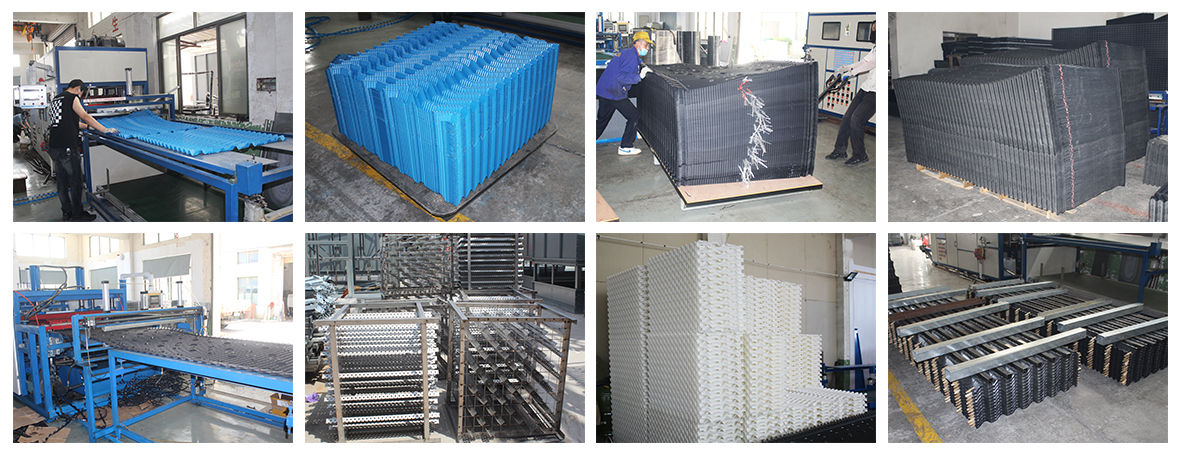
How Crossflow Towers Use Cooling Tower Media Fill
Crossflow cooling towers operate differently.
Water is distributed across the top of the fill and moves downward by gravity. Air enters horizontally through the fill.
This creates a large interface between falling water and horizontal airflow.
Film fill can provide strong thermal performance in crossflow applications when water quality is properly controlled.
Splash fill may also be considered when the system has a greater risk of fouling or suspended solids.
For a replacement project, the existing tower design is particularly important.
The new fill needs to match the available space, support structure, water distribution system, and airflow direction.
A theoretically high-performance fill is of little value if it cannot be installed correctly or does not work properly with the existing tower configuration.
Best Cooling Tower Media Fill Materials
Different cooling tower applications require different fill materials.
The most common choices include PVC and PP, while splash-type applications may use different plastic configurations.
PVC Cooling Tower Media Fill
PVC cooling tower fill is one of the most widely used choices for film-fill applications.
PVC provides a useful combination of:
PVC sheets can be thermoformed into corrugated or structured patterns that create extensive contact between water and air.
PVC film fill is widely considered for HVAC cooling towers, industrial process cooling systems, commercial cooling applications, and other systems where the circulating water is reasonably clean.
One important factor is operating temperature.
PVC has a defined temperature range, so the actual hot-water temperature should always be compared with the manufacturer's recommended operating conditions.
PP Cooling Tower Media Fill
PP cooling tower fill, or polypropylene fill, is another important option.
PP can provide higher temperature capability than standard PVC in certain applications and has good resistance to many chemicals.
This makes PP attractive for applications where temperature or chemical conditions may make standard PVC less suitable.
However, material selection should not be based on temperature alone.
You should also consider water chemistry, mechanical requirements, expected service life, and the specific design of the fill.
Other Cooling Tower Fill Materials
Depending on the application, cooling tower fill can also be manufactured using specialized plastic materials and different structural configurations.
The key point is that the material should match the actual operating environment.
A professional supplier should be able to discuss material selection based on:
Water temperature
Water chemistry
Fouling potential
Thermal requirements
Airflow
Installation conditions
Expected service life
What Is the Best Cooling Tower Media Fill for Counterflow Towers?
For many counterflow applications with relatively clean circulating water, high-efficiency PVC film fill is a practical choice.
The large effective surface area can provide strong thermal performance while keeping the required fill volume relatively compact.
However, "best" should always be understood in relation to the application.
If your water contains substantial suspended solids, biological deposits, oil, or scale-forming minerals, a highly compact film fill may require more intensive water treatment and maintenance.
In these conditions, a fill design with larger passages or a splash configuration may provide a better balance between cooling performance and fouling tolerance.
Film Fill for Counterflow Applications
Counterflow film fill is normally designed with channels that encourage water to spread across the sheet surfaces while allowing air to pass through.
The exact geometry influences:
Wetted surface area
Pressure drop
Water distribution
Airflow
Fouling resistance
Thermal performance
This explains why two products can both be described as "PVC film fill" but perform differently.
Sheet thickness, flute geometry, channel spacing, block dimensions, surface pattern, and installation quality can all affect performance.
When Should You Use High-Efficiency Film Fill?
High-efficiency film fill is particularly attractive when thermal performance is a priority and the circulating water can be maintained relatively clean.
It can be considered for:
HVAC cooling towers
Industrial process cooling
Commercial cooling systems
Power-related cooling applications
Manufacturing facilities
Chilled-water systems
But there is an important warning.
If your tower already suffers from repeated clogging, installing a tighter-pitch film fill may make the problem worse.
In that situation, it is better to investigate water treatment, filtration, biological control, and the existing fill design before selecting replacement media.

What Is the Best Cooling Tower Media Fill for Crossflow Towers?
Crossflow cooling towers can also use film fill effectively.
The falling water is distributed over the fill while air travels horizontally through it.
For clean-water applications, PVC film fill can offer an effective combination of surface area and thermal performance.
For systems with higher fouling potential, splash fill may deserve consideration.
Again, there is no universal winner.
The correct choice depends on the operating environment.
For replacement projects, always check:
Existing fill dimensions
Tower airflow direction
Water flow rate
Water distribution system
Fill support structure
Operating temperature
Water quality
Required cooling capacity
This information helps ensure that the new media actually fits and performs as expected.
Film Fill vs. Splash Fill: Which Is Better?
This is one of the most common questions in cooling tower fill selection.
The answer depends on your application.
Film fill increases contact area by spreading water into thin films across structured surfaces.
Splash fill works by breaking water into droplets as it falls through a series of splash bars or grids.
Film fill generally offers high heat-transfer efficiency within a compact volume.
Splash fill generally provides more open flow paths, which can be advantageous in some applications with higher suspended-solids or fouling risks.
Think about the difference between a fine kitchen strainer and a coarse screen.
The fine strainer provides more filtering surface, but it can also block more easily.
Cooling tower fill involves a similar engineering trade-off.
If clean water and thermal efficiency are your primary priorities, film fill may be attractive.
If fouling resistance and open passages are more important, splash fill may be worth considering.
How to Choose the Right Cooling Tower Media Fill
Choosing cooling tower media fill should start with your operating conditions rather than a product catalog.
Before requesting a quotation, gather as much technical information as possible.
Consider Water Quality
Water quality is one of the most important factors.
Look at:
Suspended solids
Hardness
Alkalinity
Biological activity
Oil contamination
Mineral concentration
Scaling tendency
Poor water quality can reduce the effective surface area of the fill.
Mineral deposits can cover the fill surface, while biological growth can block channels and restrict airflow.
If the circulating water is heavily contaminated, a more open fill design may be worth considering.
Check Operating Temperature
Always identify the normal and maximum water temperatures.
Different plastic materials have different temperature capabilities.
For example, PVC and PP should not automatically be treated as interchangeable simply because both are plastic.
The actual temperature conditions should be compared with the manufacturer's recommended operating range.
Evaluate Fouling and Clogging Risk
Channel spacing is an important design factor.
Smaller channels can provide a large effective surface area, but they can also be more sensitive to deposits.
Larger passages can provide better tolerance to suspended solids and fouling.
This is why the fill with the highest surface area is not necessarily the best choice for an industrial cooling tower.
Match the Thermal Requirements
Cooling tower media fill should be selected as part of the complete thermal design.
Important parameters include:
If you know these parameters, a manufacturer can make a much more meaningful recommendation.
Cooling Tower Media Fill Size and Configuration
Fill is available in different sizes and configurations.
Important dimensions include:
Fill height
Fill width
Fill length
Sheet thickness
Flute geometry
Channel spacing
Block configuration
These factors affect water distribution, airflow, pressure drop, thermal performance, and installation.
When replacing old cooling tower fill, measure the existing space carefully.
Also check the:
For a custom replacement project, photographs, drawings, old fill samples, tower dimensions, and operating data can help the manufacturer recommend a suitable configuration.
Common Cooling Tower Media Fill Problems
Even high-quality fill can experience problems if the tower is not properly operated or maintained.
The most common issues include fouling, scaling, biological growth, clogging, cracking, and deformation.
Scaling and Fouling
Mineral scale can accumulate on fill surfaces and reduce the available water-air contact area.
Biological deposits can create similar problems.
As deposits increase, thermal performance may gradually decline.
At the same time, airflow resistance can increase.
A proper water treatment program is therefore essential for maintaining film fill performance.
Fill Damage and Deformation
Physical damage can occur during transportation, installation, cleaning, or maintenance.
Excessive temperature can also cause some plastic fills to deform.
Collapsed channels can restrict both water flow and airflow.
During inspection, look for:
Cracked sheets
Collapsed channels
Deformation
Discoloration
Excessive deposits
Biological growth
Early detection can prevent a relatively small fill problem from becoming a larger cooling-system problem.
How to Extend Cooling Tower Fill Service Life
The easiest way to extend the life of cooling tower media fill is to control the conditions that cause damage.
Maintain appropriate water treatment.
Control blowdown.
Monitor biological growth.
Reduce excessive scaling.
Use suitable filtration where required.
Avoid unnecessarily aggressive cleaning methods that can damage the plastic structure.
During routine inspections, examine the fill for deposits, cracks, deformation, and blocked channels.
Regular inspection is much cheaper than discovering a serious cooling-capacity problem during the hottest part of the year.
Why Work With a Cooling Tower Media Fill Manufacturer?
Buying directly from a manufacturer can provide more than a product.
A manufacturer can help evaluate:
This is especially useful for cooling tower fill replacement projects.
Instead of simply asking for "cooling tower media fill," provide the tower type, dimensions, water flow, operating temperature, water quality, and thermal requirements.
The more information you provide, the easier it is to identify a suitable solution.
Power Tower Cooling Technology Cooling Tower Media Fill
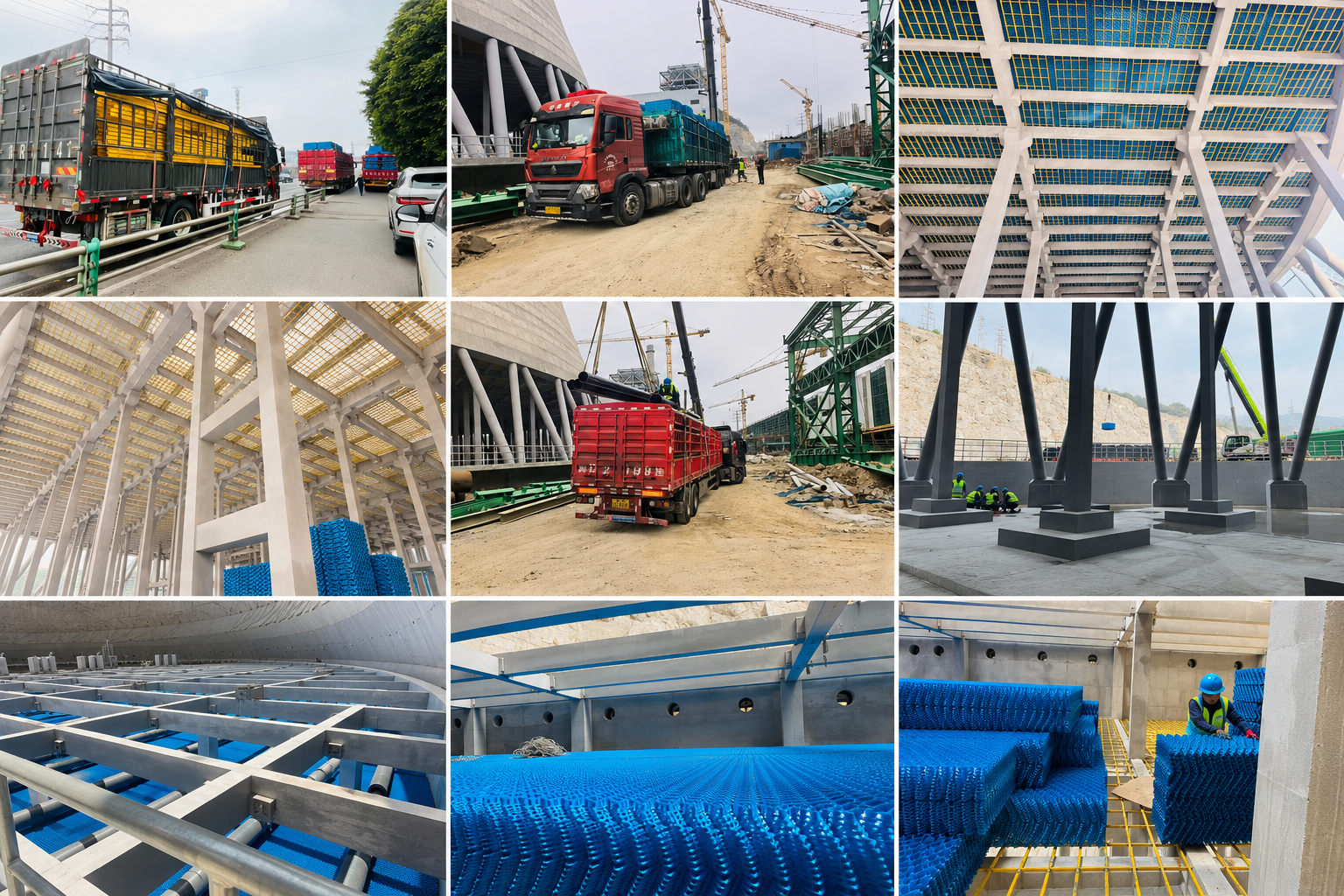
Power Tower Cooling Technology (Shaoxing) Co., Ltd. specializes in cooling tower fill and related cooling tower components for industrial and commercial applications.

As a cooling tower media fill manufacturer, the company can provide fill solutions for different cooling tower configurations and operating requirements.
The selection of cooling tower fill can be based on factors such as material, fill configuration, tower dimensions, operating conditions, and application requirements.
For buyers looking for cooling tower media fill manufacturers, cooling tower fill suppliers, PVC cooling tower fill, PP cooling tower fill, or replacement fill, working directly with a manufacturer can make the sourcing process more efficient.
You can learn more about cooling tower media products and related components at:
www.coolingtowerpart.com
Cooling Tower Media Fill Buying Checklist
Before ordering cooling tower fill, ask these questions:
1. What type of cooling tower do I have?
Is it counterflow or crossflow?
2. What is the water flow rate?
This affects the required fill configuration and water loading.
3. What is the operating temperature?
Make sure the selected material is suitable for both normal and peak conditions.
4. How clean is the circulating water?
High suspended solids or scaling potential may require a different fill design.
5. What is the required thermal performance?
The fill should be selected according to the actual cooling duty.
6. What are the existing fill dimensions?
This is particularly important for replacement projects.
7. Is PVC or PP more appropriate?
Material selection should consider temperature, water chemistry, and operating conditions.
8. What is the expected maintenance environment?
A fill that requires intensive cleaning may not be ideal for every facility.
Why the "Highest Efficiency" Fill Is Not Always the Best
It is tempting to look at a product specification and choose the fill with the highest surface area.
But cooling tower performance is not a simple numbers game.
Imagine putting a high-performance racing engine into a vehicle that operates on poor-quality fuel and rough roads. The engine may be impressive, but the complete system is not optimized.
Cooling tower fill works the same way.
A high-efficiency film fill may deliver excellent thermal performance when water quality is controlled.
But if the water contains excessive solids and the fill passages repeatedly clog, the real-world performance may be disappointing.
The best solution is therefore the one that matches your entire operating environment.
Conclusion: Choosing the Best Cooling Tower Media Fill
The best cooling tower media fill depends on several factors, including tower configuration, water quality, operating temperature, thermal requirements, airflow, fouling potential, and maintenance conditions.
For many clean-water counterflow and crossflow applications, PVC film fill provides an effective combination of heat-transfer performance, compact design, and cost efficiency.
PP cooling tower fill can be considered when higher temperature capability or specific chemical resistance is required.
For applications with significant fouling or suspended-solids concerns, splash fill may provide a more practical solution because of its more open flow paths.
The most important point is simple:
Do not choose cooling tower media fill based on the product name alone. Choose it according to the actual operating conditions of your cooling tower.
Whether you are building a new cooling tower or replacing existing fill, matching the material, geometry, dimensions, and performance characteristics to the application can help improve cooling efficiency, reduce maintenance problems, and extend service life.
For cooling tower media fill solutions and manufacturer support, contact Power Tower Cooling Technology (Shaoxing) Co., Ltd.
Official website: www.coolingtowerpart.com


