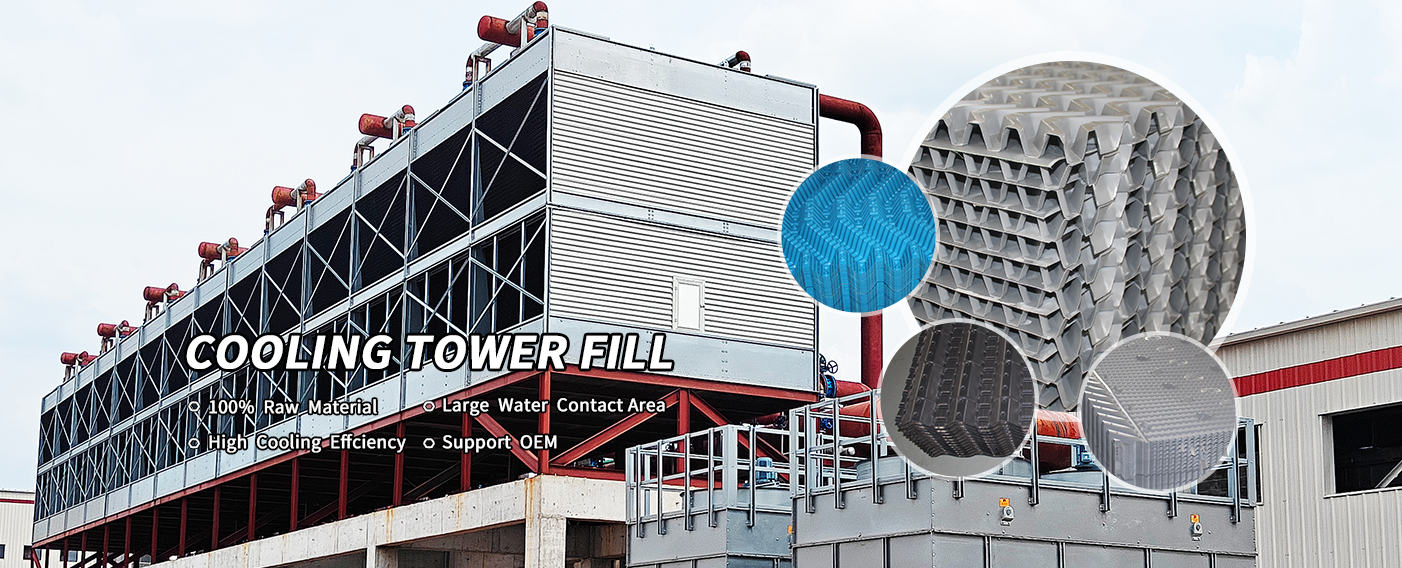
PVC Fills for Cooling Tower: Benefits, Types and Applications
Cooling tower fill plays a critical role in improving heat transfer and overall cooling efficiency. Among the many fill materials available today, PVC fills for cooling towers are widely used in industrial, commercial, HVAC, and process cooling applications because of their lightweight structure, good chemical resistance, and efficient heat transfer performance.
A properly selected PVC cooling tower fill increases the contact area between water and air, allowing heat to move from the circulating water into the air more effectively. However, not every PVC fill is suitable for every cooling tower. Factors such as water quality, temperature, airflow, tower design, fill type, and maintenance requirements should all be considered.
This guide explains what PVC cooling tower fills are, how they work, their main benefits and types, common applications, and how to select the right PVC fill media for your cooling tower.
What Are PVC Fills for Cooling Towers?
PVC fills are specially designed heat-transfer media made primarily from polyvinyl chloride (PVC). They are installed inside a cooling tower to increase the surface area available for water-air contact.
Instead of allowing water to fall directly through the tower, PVC fill distributes water across a large structured or splash surface. Air moves through the fill at the same time, promoting evaporation and heat transfer.
How Does PVC Cooling Tower Fill Work?
The working principle is relatively simple.
1. Hot Water Enters the Cooling Tower
Warm process water enters the cooling tower and is distributed over the fill media through spray nozzles or a water distribution system.
2. Water Spreads Across the Fill Surface
The PVC fill structure causes water to spread into thin films or droplets. This creates a larger effective contact area between water and air.
3. Air Moves Through the Fill
Depending on the tower design, air flows vertically upward or horizontally across the fill.
4. Heat Is Transferred to the Air
A portion of the circulating water evaporates. This evaporation removes heat from the remaining water, reducing its temperature.
The effectiveness of this process depends on the fill design, air velocity, water distribution, surface area, and operating conditions.
Why Are PVC Fills Widely Used in Cooling Towers?
PVC has become a popular material for cooling tower fill because it offers a useful combination of performance, durability, manufacturability, and cost.
What Are the Main Benefits of PVC Cooling Tower Fills?
High Heat Transfer Efficiency
Well-designed PVC fill creates a large contact area between air and water. This improves evaporation and heat transfer without requiring an excessively large cooling tower.
Lightweight Construction
PVC fill sheets are relatively lightweight compared with many traditional materials. This makes transportation, installation, handling, and replacement easier.
Good Corrosion Resistance
PVC is resistant to many common chemicals and moisture-related corrosion. Unlike metallic materials, PVC does not rust under normal cooling tower operating conditions.
Cost-Effective Solution
PVC cooling tower fill media can provide a practical balance between initial cost and cooling performance, making it suitable for many commercial and industrial installations.
Flexible Design Options
PVC fill can be manufactured in different sheet thicknesses, flute patterns, heights, and configurations. This allows manufacturers and cooling tower operators to select fill according to specific tower requirements.
Easy Replacement
When the fill reaches the end of its service life, individual fill packs or modules can often be removed and replaced without rebuilding the entire cooling tower.
What Types of PVC Cooling Tower Fills Are Available?
Different cooling towers require different fill configurations. PVC fills can generally be categorized according to their heat-transfer mechanism and tower airflow arrangement.
What Is Film-Type PVC Cooling Tower Fill?
Film fill uses thin sheets with specially designed surface patterns. Water spreads across the sheets as a thin film while air passes over or between the surfaces.
How Does Film Fill Improve Heat Transfer?
The primary objective is to create a large wetted surface area within a relatively compact volume.
The greater the effective contact area between water and air, the greater the opportunity for heat and mass transfer.
Advantages of Film Fill
High specific surface area
Efficient heat transfer
Compact installation
Suitable for many HVAC and industrial applications
Efficient use of tower volume
Film fill is commonly selected where the circulating water is relatively clean and the cooling tower requires high thermal performance.
What Is Splash-Type PVC Cooling Tower Fill?
Splash fill breaks falling water into smaller droplets as the water passes through a series of splash bars or surfaces.
Instead of maintaining a continuous water film, the fill repeatedly redirects and disperses the water.
When Is Splash Fill Useful?
Splash-type fill can be useful for applications where water contains suspended solids or where resistance to fouling and blockage is particularly important.
Key Characteristics of Splash Fill
Larger flow passages
Lower tendency to trap certain solids
Good water distribution
Suitable for some industrial water conditions
Relatively robust operation
The appropriate choice depends heavily on water quality and tower operating conditions.
What Is Crossflow PVC Cooling Tower Fill?
In a crossflow cooling tower, air generally moves horizontally across the fill while water flows downward.
Crossflow PVC fill is designed specifically to support this airflow and water distribution pattern.
Why Is Crossflow Fill Important?
The fill must provide enough surface area for effective water-air contact while maintaining acceptable airflow resistance.
Typical Crossflow Applications
Crossflow PVC fill can be used in:
HVAC cooling towers
Industrial process cooling
Commercial buildings
Power and manufacturing facilities
Large water-cooling systems
What Is Counterflow PVC Cooling Tower Fill?
In a counterflow cooling tower, air moves upward while water travels downward through the fill.
The two streams move in opposite directions, creating an effective heat and mass transfer arrangement.
How Does Counterflow PVC Fill Improve Cooling?
Counterflow fill is designed to maximize contact between rising air and descending water.
Common Benefits
Efficient heat transfer
High cooling performance within a compact volume
Suitable for industrial applications
Compatible with many induced-draft and forced-draft tower designs
The fill geometry must be matched to airflow, water loading, tower dimensions, and thermal requirements.
What Are the Applications of PVC Cooling Tower Fill?
PVC fills are used across a wide range of cooling systems.
HVAC Cooling Towers
Commercial HVAC systems use cooling towers to reject heat from chillers and other cooling equipment.
PVC cooling tower fill can improve heat rejection while helping keep the tower compact.
Industrial Process Cooling
Manufacturing facilities often require continuous cooling for process equipment, production lines, compressors, furnaces, and other heat-generating machinery.
A properly selected PVC fill can provide reliable heat transfer for these applications.
Power Generation
Cooling towers used in power-related facilities require large quantities of heat rejection. PVC fill can provide a high surface area for water-air heat transfer.
Chemical and Manufacturing Industries
Industrial cooling water may be used to control process temperatures in chemical plants, plastics manufacturing, metal processing, and other industries.
The correct PVC fill should be selected according to water chemistry and operating temperature.
Data Centers and Commercial Facilities
Cooling towers may also be integrated into large-scale cooling systems serving data centers, office buildings, hospitals, and other commercial facilities.
Clean water conditions often make high-efficiency film-type PVC fill an attractive option.
How Do You Choose the Right PVC Fill for a Cooling Tower?
Choosing PVC cooling tower fill should not be based on price alone. The fill needs to match the tower's thermal, hydraulic, and environmental requirements.
What Water Quality Should Be Considered?
Water quality is one of the most important factors.
Clean Water Applications
Film-type PVC fill can be appropriate for relatively clean circulating water because its narrow channels provide a large heat-transfer surface.
Dirty or High-Solids Water
When water contains significant amounts of suspended solids, biological growth, or debris, a more open fill configuration may be preferable to reduce blockage and simplify cleaning.
How Does Operating Temperature Affect PVC Fill Selection?
PVC has defined temperature limitations, and operating temperature should always be checked before selecting a fill.
Why Is Temperature Important?
Excessive operating temperatures can affect the mechanical properties and long-term stability of PVC.
When the circulating water temperature is unusually high, the cooling tower operator should verify the fill manufacturer's recommended operating range and consider alternative materials when necessary.
How Does Fill Thickness Affect Performance?
PVC fill is available in different sheet thicknesses.
Thinner PVC Fill
Thinner sheets may reduce material usage and weight while allowing manufacturers to create high surface-area structures.
However, mechanical strength and installation conditions must still be considered.
Thicker PVC Fill
Thicker sheets may provide additional rigidity and durability in demanding operating environments.
The best thickness depends on the tower design, support system, water conditions, and expected service life.
How Important Is Fill Flute Design?
Flute geometry directly influences water distribution, air movement, surface area, and pressure drop.
What Should You Look for in Fill Geometry?
A suitable design should provide:
Effective water spreading
Adequate air passage
High heat-transfer area
Acceptable pressure drop
Resistance to deformation
Compatibility with the tower structure
A high-surface-area design is not automatically the best choice if it causes excessive airflow resistance or becomes easily clogged.
How Can PVC Cooling Tower Fills Improve Cooling Efficiency?
Cooling efficiency depends on the entire cooling tower system, but fill media plays an important role.
Increasing Water-Air Contact
PVC fill increases the available surface area where water and air interact.
More effective contact can improve evaporation and heat transfer.
Improving Water Distribution
Properly designed fill helps distribute water throughout the available tower volume.
Uniform water distribution reduces dry areas and helps the tower use its available fill surface more effectively.
Supporting Compact Tower Design
High-performance fill can provide substantial heat-transfer surface area within a relatively small volume.
This can help manufacturers achieve the required cooling capacity without excessively increasing tower size.
What Causes PVC Cooling Tower Fill to Lose Performance?
Even high-quality PVC fill can lose performance when operating conditions deteriorate.
Scale Formation
Mineral deposits can accumulate on fill surfaces and reduce the effective heat-transfer area.
Biological Growth
Algae, bacteria, and other biological growth can create deposits that interfere with water and airflow.
Dirt and Suspended Solids
Dust, debris, and suspended particles can accumulate inside fill channels and restrict water or air movement.
Poor Water Distribution
Blocked or damaged nozzles can cause uneven water distribution. Some parts of the fill may receive excessive water while other areas remain relatively dry.
Physical Damage
Aging, excessive temperature, improper cleaning, or mechanical stress can damage PVC fill sheets.
How Should PVC Cooling Tower Fills Be Maintained?
Regular maintenance helps preserve heat-transfer performance and extend fill service life.
Inspect the Fill Regularly
Operators should check the fill for:
Keep the Water Distribution System Clean
Nozzles, pipes, and distribution channels should be inspected regularly.
Why Are Nozzles Important?
Even high-performance PVC cooling tower fill cannot compensate for severely uneven water distribution.
Clean and correctly functioning nozzles help ensure that the fill receives water consistently.
Use Appropriate Cleaning Methods
Cleaning procedures should match the fill material and the type of contamination.
Harsh chemicals, excessive water pressure, or inappropriate mechanical cleaning methods may damage PVC fill.
Always follow the fill manufacturer's cleaning recommendations.
When Should PVC Cooling Tower Fill Be Replaced?
There is no single replacement interval that applies to every cooling tower.
Replacement depends on water quality, operating temperature, maintenance practices, UV exposure, chemical conditions, mechanical stress, and overall tower operation.
What Are the Signs of PVC Fill Failure?
Consider inspection or replacement when you observe:
Why Is Timely Replacement Important?
Damaged or severely fouled fill can reduce heat-transfer efficiency and increase operating costs.
Replacing deteriorated fill can restore effective water-air contact and help the cooling tower return to its intended operating condition.
PVC Cooling Tower Fill vs. PP Cooling Tower Fill
PVC and polypropylene (PP) are both commonly used for cooling tower fill, but they have different characteristics.
PVC Fill
PVC is widely used because of its combination of affordability, rigidity, chemical resistance, and established cooling tower applications.
PP Fill
PP can provide advantages in certain higher-temperature or chemically demanding applications, depending on the specific formulation and operating conditions.
Which Material Should You Choose?
There is no universal answer.
The selection should consider:
Operating temperature
Water chemistry
Fouling potential
Mechanical requirements
Expected service life
Tower configuration
Project budget
Maintenance requirements
A professional cooling tower fill supplier can help determine the appropriate material based on actual operating conditions.
How Can You Improve the Service Life of PVC Cooling Tower Fill?
Proper operation and maintenance can significantly influence fill longevity.
Maintain Good Water Treatment
Effective water treatment can help control:
Prevent Excessive Fouling
Regular inspection and cleaning can prevent deposits from becoming difficult to remove.
Avoid Improper Cleaning
Excessive mechanical force or incompatible chemicals can damage PVC surfaces.
Monitor Cooling Tower Performance
Track parameters such as:
Changes in these parameters can help identify fill-related problems before severe performance degradation occurs.
How Do You Buy High-Quality PVC Fills for Cooling Towers?
Selecting a reliable supplier is just as important as selecting the correct fill design.
What Should You Check With a PVC Fill Supplier?
Product Specifications
Ask for information about:
Customization Capability
Different cooling towers have different dimensions and internal structures.
A supplier capable of producing customized PVC fill can help match the media to the existing tower.
Quality Control
A professional manufacturer should have consistent production processes and quality inspection procedures.
Technical Support
Technical support is valuable when replacing existing fill because the supplier may need to evaluate dimensions, water loading, airflow, and tower configuration.
Conclusion
PVC fills for cooling towers are an important component in modern evaporative cooling systems. By increasing water-air contact area, improving water distribution, and supporting efficient heat transfer, PVC cooling tower fill media can contribute significantly to overall tower performance.
Different applications require different fill designs. Film fill may be suitable for clean-water systems requiring high heat-transfer efficiency, while more open splash-type configurations may be considered for applications with higher fouling potential.
When selecting PVC cooling tower fills, consider water quality, operating temperature, tower type, airflow, water loading, fill geometry, maintenance requirements, and expected service life. Proper selection combined with effective water treatment and regular maintenance can help maintain stable cooling performance and extend fill service life.
For industrial cooling tower projects, choosing the right PVC cooling tower fill media is not simply a matter of selecting the highest surface area. The best solution is the one that provides the right balance of heat transfer, airflow, water distribution, durability, maintenance, and operating conditions.


