How Do Cooling Tower PVC Fills Reduce Water and Energy Loss?
Cooling tower PVC fills play an important role in improving heat transfer, controlling water circulation, and supporting efficient cooling tower operation. As one of the main heat-transfer components inside an evaporative cooling tower, PVC fill media increases the contact area between circulating water and air.
When properly selected and maintained, high-quality PVC cooling tower fill can help cooling systems use water and energy more effectively. Better water distribution, improved evaporation, suitable airflow resistance, and efficient heat transfer can all contribute to overall system performance.
But how exactly do cooling tower PVC fills reduce water and energy loss? What role does fill design play in cooling tower efficiency? And how should PVC fill be selected for industrial and HVAC applications?
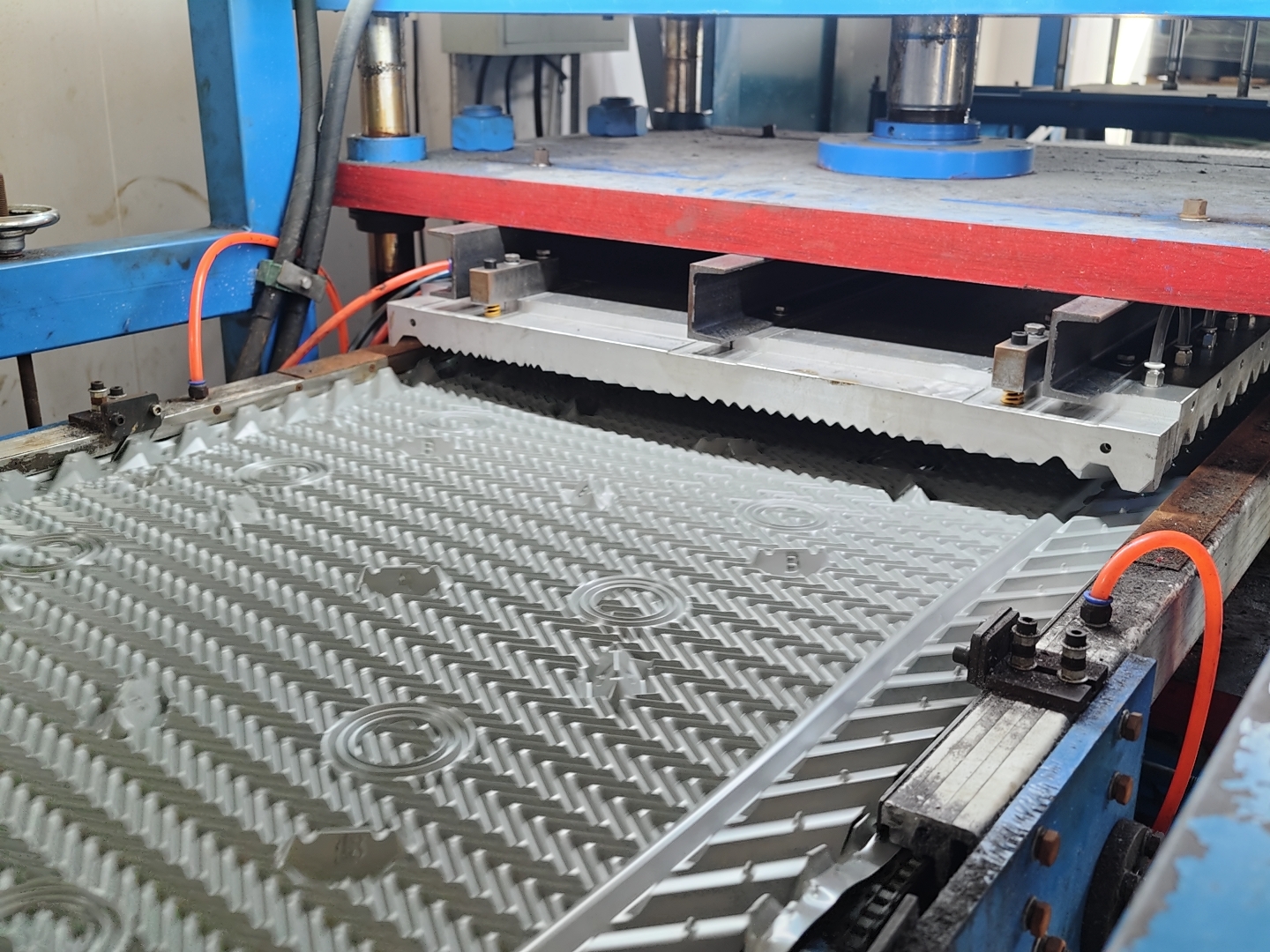
What Are Cooling Tower PVC Fills?
Cooling tower PVC fills are specially formed PVC sheets or blocks installed inside evaporative cooling towers. Their primary purpose is to increase the surface area available for water-air contact.
How Does PVC Cooling Tower Fill Work?
Hot circulating water enters the cooling tower and is distributed over the fill media. The PVC structure spreads the water across its surfaces while air moves through the fill.
What Happens During Water-Air Contact?
The basic process includes:
Hot water enters the tower.
The distribution system spreads water over the PVC fill.
Water forms thin films or flows through the fill channels.
Air passes through the fill.
Heat transfers from water to air.
A portion of the water evaporates.
The cooled water returns to the system.
This large-area water-air interaction is the foundation of evaporative cooling.
How Do Cooling Tower PVC Fills Improve Heat Transfer?
The primary function of PVC fill is to increase the effective contact area between water and air.
Why Is Surface Area Important?
Without fill media, water would fall through the tower relatively quickly, limiting the amount of contact with moving air.
PVC fill creates many surfaces and channels that allow water to spread over a larger area.
How Does a Larger Contact Area Help?
A larger effective contact area can promote:
When the fill is properly matched to the cooling tower, the system can achieve the required cooling duty within a practical fill volume.
Can Better Heat Transfer Reduce Energy Consumption?
Potentially, yes.
If the cooling tower can achieve the required heat rejection with an appropriately designed fill and airflow system, the system may operate more efficiently.
However, fill alone does not determine total energy consumption. Fan design, motor efficiency, airflow, water flow, ambient conditions, and system controls also have major effects.
How Do PVC Fills Help Reduce Cooling Tower Water Loss?
Water loss is an unavoidable part of evaporative cooling because some water must evaporate to reject heat.
However, proper fill design can help optimize water use.
Does Better Heat Transfer Reduce Excessive Water Circulation?
A well-designed cooling tower fill allows effective heat transfer without unnecessarily increasing water circulation.
Why Is Efficient Water Distribution Important?
If water is distributed unevenly, some areas of the fill may receive too much water while others receive too little.
This can reduce the effective use of the fill and create inefficient cooling.
Uniform distribution helps make better use of the available fill surface.
Can PVC Fill Reduce Drift-Related Water Loss?
PVC fill can support water retention by providing structured passages through which water travels.
However, drift eliminators are the primary component responsible for limiting water droplets carried out of the cooling tower with exhaust air.
Why Is This Distinction Important?
Cooling tower water loss can come from several sources:
Evaporation
Drift
Blowdown
Leakage
Splashing
PVC fill primarily supports efficient heat transfer and water distribution. Drift eliminators specifically address drift loss, while water treatment and blowdown control influence other forms of water consumption.
How Does Cooling Tower PVC Fill Affect Energy Efficiency?
Cooling tower energy consumption is strongly related to the amount of air and water that must be moved through the system.
Can Fill Geometry Influence Fan Energy?
Yes.
The geometry of cooling tower fill determines how easily air can pass through the media.
Why Does Pressure Drop Matter?
As air moves through the fill, it encounters resistance.
If pressure drop is excessively high, the cooling tower fan may need to provide greater static pressure, potentially increasing energy consumption.
Therefore, an effective cooling tower PVC fill should balance:
Does More Fill Always Mean Better Energy Efficiency?
No.
Simply adding more fill does not automatically improve cooling efficiency.
What Should Be Optimized?
The cooling tower should be designed around an appropriate relationship between:
Fill volume
Airflow
Water flow
Heat load
Approach temperature
Fill geometry
The goal is to achieve the required thermal performance without creating unnecessary airflow resistance.
How Does PVC Fill Support Efficient Water Distribution?
Water distribution is critical to the performance of cooling tower fill.
What Happens When Water Distribution Is Uneven?
Poor water distribution can create dry and overloaded areas within the fill.
What Problems Can This Cause?
Uneven distribution may result in:
A properly designed water distribution system should spread water consistently across the available fill area.
How Does Fill Geometry Improve Water Spreading?
Corrugated PVC sheets provide channels that guide water across the fill surfaces.
What Is the Role of Surface Pattern?
The surface pattern influences:
Water film formation
Water mixing
Contact time
Air passage
Surface area
Different fill designs are therefore developed for different cooling tower configurations and operating conditions.
Can PVC Cooling Tower Fill Reduce Pumping Energy?
Cooling tower fill does not directly reduce pump energy, but suitable fill design can influence the hydraulic requirements of the cooling system.
Why Does Water Distribution Matter to Pumping?
If the fill and distribution system are properly matched, water can be distributed effectively across the required fill area.
What Should Engineers Consider?
The system should consider:
Water flow rate
Distribution pressure
Nozzle design
Fill water loading
Pipe arrangement
Tower height
An optimized system avoids unnecessarily high water flow or pressure requirements.
How Does Fill Fouling Increase Water and Energy Loss?
Fouling is one of the major factors that can reduce cooling tower performance.
What Causes Cooling Tower Fill Fouling?
Common causes include:
Suspended solids
Scale
Algae
Slime
Dirt
Biological deposits
What Happens When PVC Fill Becomes Blocked?
Blocked fill passages restrict airflow and interfere with water distribution.
This can cause:
In severe cases, the cooling tower may need increased airflow or water flow to achieve the same cooling performance.
Can Regular Cleaning Improve Efficiency?
Yes.
Maintaining clean and open fill passages helps preserve the original airflow and water distribution characteristics.
What Should Maintenance Include?
A practical maintenance program may include:
How Does PVC Fill Material Affect Cooling Tower Performance?
Material selection affects the durability and operating range of the cooling tower fill.
Why Is PVC Widely Used?
PVC offers a useful combination of:
For many conventional cooling tower applications, PVC provides an economical and effective fill solution.
When Should PP Fill Be Considered?
PP cooling tower fill may be considered when the application requires higher temperature resistance or specific chemical compatibility.
Is PVC Always the Best Material?
No.
The appropriate material depends on:
Water temperature
Chemical conditions
Fouling characteristics
Cooling load
Tower configuration
Required service life
Material selection should be based on actual operating conditions.
How Do Crossflow and Counterflow PVC Fills Affect Efficiency?
PVC fill must be matched to the cooling tower configuration.
How Does Crossflow PVC Fill Work?
In a crossflow tower, air generally moves horizontally through the fill while water moves downward.
What Are the Main Characteristics?
Crossflow fill can provide:
Large contact area
Convenient water distribution
Effective air-water interaction
Practical maintenance access in many tower designs
How Does Counterflow PVC Fill Work?
In a counterflow tower, air moves upward while water flows downward.
Why Is Counterflow Fill Effective?
The opposing directions of water and air can provide efficient heat and mass transfer through the fill.
However, fill geometry, airflow resistance, and water distribution must be correctly matched to the tower design.
Can Cooling Tower PVC Fills Reduce Maintenance-Related Energy Loss?
Indirectly, yes.
Poorly maintained fill can force cooling equipment to work harder to achieve the required cooling temperature.
How Does Poor Fill Condition Affect Energy Use?
If fill becomes blocked or damaged, the tower may experience reduced thermal performance.
What Can Operators Observe?
Potential warning signs include:
Increasing outlet water temperature
Reduced cooling capacity
Higher fan load
Uneven water distribution
Increasing pressure drop
Frequent operational adjustments
Maintaining the fill can help preserve the intended performance of the cooling tower.
How Should Cooling Tower PVC Fills Be Selected for Water Efficiency?
Selecting the right fill starts with understanding the cooling water.
What Water Quality Factors Matter?
Consider:
Suspended solids
Hardness
pH
Biological activity
Scale potential
Chemical concentration
Oil contamination
Why Does Water Quality Matter?
Fine-channel film fill may perform very well with relatively clean water but can become more vulnerable to blockage under severe fouling conditions.
For more challenging water conditions, a wider-channel or splash-type design may be more appropriate.
How Does Cooling Tower Fill Replacement Affect Energy Performance?
Old or damaged fill can reduce the effective performance of the cooling tower.
When Should PVC Fill Be Replaced?
Replacement may be considered when fill shows:
Does Old Fill Always Need Replacement?
No.
Age alone does not determine replacement. The physical condition and actual cooling performance should be evaluated.
Can New PVC Fill Improve Cooling Performance?
If existing fill has deteriorated significantly, replacing it with properly selected fill may restore:
Water distribution
Heat-transfer area
Airflow passages
Cooling capacity
However, replacement should be based on the condition of the complete cooling system rather than fill age alone.
What Other Cooling Tower Components Help Reduce Water Loss?
PVC fill is only one component of an efficient cooling tower.
What Is the Role of Drift Eliminators?
Drift eliminators reduce the amount of water droplets carried out of the tower by exhaust air.
Why Are They Important?
Reducing drift can help:
How Does Water Treatment Help?
Water treatment can reduce scale, biological growth, and fouling.
Why Does This Matter?
Cleaner fill generally maintains better airflow and heat-transfer conditions.
Effective water treatment therefore supports both thermal performance and equipment longevity.
What Is the Role of Blowdown Control?
Blowdown removes concentrated dissolved solids from the circulating water.
Can Better Blowdown Control Save Water?
Yes, within appropriate water chemistry limits.
Reducing unnecessary blowdown can decrease water consumption, but blowdown must remain sufficient to control dissolved solids and prevent excessive scaling or corrosion.
How Can You Optimize Cooling Tower PVC Fill Performance?
A systematic approach can help maximize the benefits of PVC fill.
Step 1: Select the Correct Fill Design
Choose film or splash fill according to water quality and cooling requirements.
Step 2: Match the Fill to the Tower Type
Confirm whether the tower is crossflow or counterflow.
Step 3: Verify Operating Temperature
Make sure the PVC material is suitable for the actual water temperature.
Step 4: Optimize Water Distribution
Ensure that nozzles and distribution systems provide uniform coverage.
Step 5: Control Water Quality
Manage scale, biological growth, suspended solids, and chemical concentration.
Step 6: Monitor Airflow and Pressure Drop
Watch for increasing resistance through the fill.
Step 7: Inspect and Clean Regularly
Remove deposits before they significantly restrict airflow or water distribution.
Step 8: Replace Damaged Fill When Necessary
If the fill has severe structural or thermal deterioration, evaluate replacement options.
What Are the Key Benefits of Efficient Cooling Tower PVC Fills?
When correctly selected and maintained, PVC fill can contribute to efficient cooling tower operation in several ways.
How Can PVC Fill Support Water Efficiency?
It can help optimize water-air contact and water distribution, while other components such as drift eliminators and water treatment systems address additional sources of water loss.
How Can PVC Fill Support Energy Efficiency?
Proper fill geometry can help balance heat-transfer performance and airflow resistance.
What Does an Efficient Fill System Aim to Achieve?
An optimized system aims for:
Final Thoughts: How Do Cooling Tower PVC Fills Reduce Water and Energy Loss?
Cooling tower PVC fills support water and energy efficiency primarily by improving water-air contact and enabling effective heat transfer within a compact tower volume.
A properly designed PVC cooling tower fill can spread water across a large effective surface area, helping the cooling tower reject heat efficiently. Its geometry also influences airflow resistance, water distribution, fouling behavior, and overall system performance.
However, PVC fill should not be viewed as a standalone solution for water or energy conservation. Drift eliminators, water distribution systems, fans, pumps, water treatment, blowdown control, and regular maintenance all contribute to cooling tower efficiency.
For industrial and HVAC applications, the best results come from selecting fill according to the tower configuration, water quality, temperature, heat load, airflow, and maintenance requirements. When these factors are properly matched, cooling tower PVC fills can help support reliable heat transfer and more efficient long-term cooling operation.


