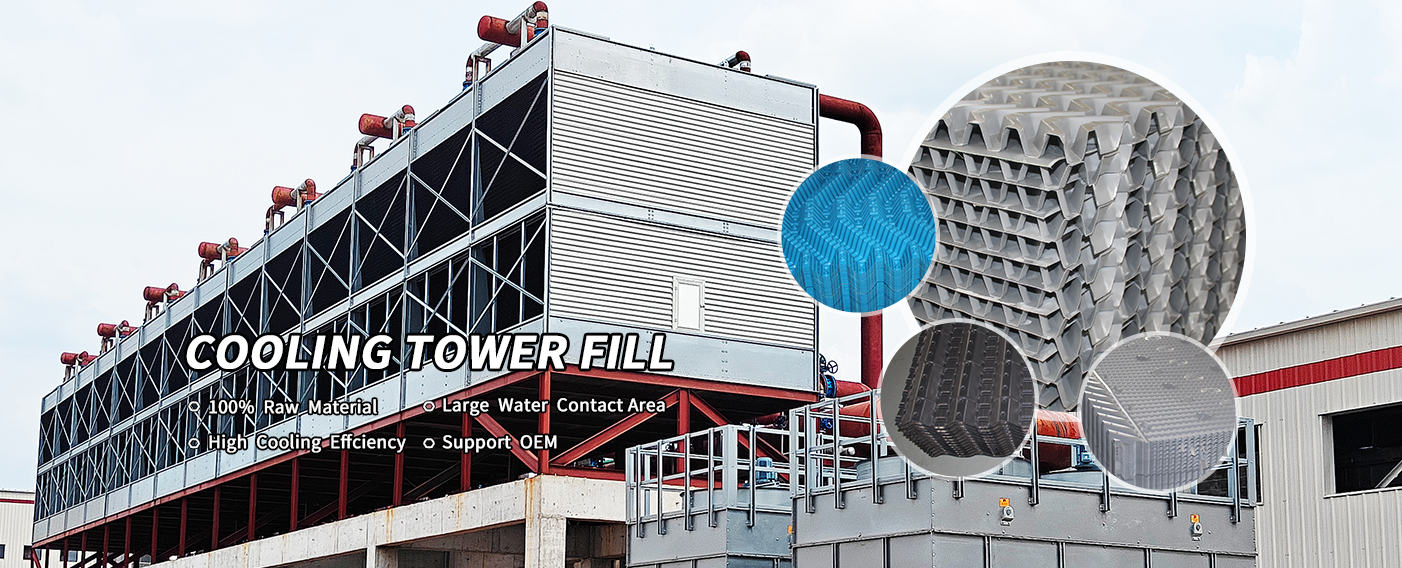
Cooling tower fill is one of the most important heat-transfer components inside an evaporative cooling tower. It increases the contact area between circulating water and air, allowing heat to be removed more effectively through evaporation. For industrial plants, HVAC systems, power facilities, semiconductor factories, petrochemical plants, and commercial buildings, selecting suitable cooling tower fill can directly affect cooling capacity, water consumption, maintenance requirements, and operating efficiency.
South Korea has a highly developed manufacturing and industrial sector, creating demand for reliable cooling tower systems and replacement components. Korean cooling tower suppliers cover a wide range of applications, including crossflow cooling towers, counterflow cooling towers, closed-circuit systems, industrial process cooling, and HVAC applications.
This guide introduces 10 cooling tower manufacturers, parts suppliers, engineering companies, and international suppliers relevant to the South Korean cooling tower fill market. Because some companies manufacture complete cooling towers rather than standalone fill media, buyers should confirm current product availability, fill specifications, and replacement services directly with each supplier.
What Is Cooling Tower Fill?
Cooling tower fill, also called cooling tower packing or cooling tower infill, is the heat-transfer media installed inside a cooling tower.
Its primary function is to increase the surface area available for contact between water and air. Hot circulating water flows over the fill while air moves through it. A portion of the water evaporates, carrying heat away from the remaining water.
How Does Cooling Tower Fill Work?
The cooling process can be simplified into several stages:
Hot water enters the cooling tower.
The water distribution system spreads water across the fill.
Cooling tower fill divides the water into thin films or smaller droplets.
Air passes through the fill media.
Heat and moisture transfer occur between water and air.
Evaporation removes heat from the circulating water.
Cooled water returns to the industrial or HVAC system.
Why Is Cooling Tower Fill Important?
A properly designed fill system can provide:
Increased water-air contact area
Improved evaporative heat transfer
Better cooling tower thermal performance
More effective use of tower volume
Potentially lower water and energy consumption
Improved performance during replacement and retrofit projects
The actual performance depends on fill geometry, material, water loading, airflow, operating temperature, water quality, and tower design.
What Types of Cooling Tower Fill Are Used in South Korea?
The Korean market uses several types of cooling tower fill depending on the application and water quality.
PVC film fill is widely used in HVAC and industrial cooling tower applications.
Its advantages include lightweight construction, good corrosion resistance, relatively low cost, and high effective surface area.
PVC cooling tower fill is particularly suitable for applications where the circulating water is relatively clean and operating temperatures remain within the material's recommended range.
Common PVC Fill Designs
Common designs include:
PP Cooling Tower Fill
Polypropylene, or PP, is another important material for cooling tower fill.
PP cooling tower fill can be considered for applications requiring higher temperature resistance than conventional PVC fill can provide. It is also used in industrial environments where material selection must account for operating conditions and water chemistry.
Splash Fill
Splash fill uses a series of bars, grids, or specially shaped surfaces to break water into droplets.
Compared with film fill, splash fill can be more suitable for applications where water contains suspended solids or where fouling is a significant concern.
Crossflow Cooling Tower Fill
In a crossflow cooling tower, air generally moves horizontally through the fill while water flows downward.
Crossflow fill is commonly used in large HVAC and industrial cooling systems because the tower configuration can provide convenient access for inspection and maintenance.
Counterflow Cooling Tower Fill
In a counterflow tower, air travels upward while water flows downward.
Counterflow fill is designed to maximize interaction between water and air within the available tower volume. It is widely used in compact industrial and HVAC cooling tower designs.
Top 10 Cooling Tower Fill Manufacturers in The South Korea
The following companies and supplier categories represent notable sources associated with cooling tower systems, fill media, replacement parts, engineering, or maintenance in the South Korean market.
1. Power Tower Cooling Technology (Shaoxing) Co., Ltd.

Power Tower Cooling Technology is a China-based cooling tower parts manufacturer serving international markets, including customers seeking replacement cooling tower components.
Its product range includes cooling tower fill for different tower configurations and replacement requirements.
Cooling Tower Fill Products
Common product categories include:
PVC cooling tower fill
PP cooling tower fill
UPVC cooling tower fill
Crossflow fill
Counterflow fill
Round cooling tower fill
S-wave fill
Replacement fill media
Why Consider an International OEM Supplier?
For Korean buyers, overseas OEM suppliers can be useful when standard local products do not match the dimensions of an existing tower.
Custom manufacturing can be based on:
This approach can be useful for cooling tower fill replacement and retrofit projects.
2. Kyung In Machinery Co., Ltd. (KIMCO)
Kyung In Machinery is an established Korean cooling tower company with a long history in cooling tower design and manufacturing.
Its cooling tower portfolio includes different industrial and packaged tower configurations. Public technical material also documents PVC fill as part of certain tower designs.
What Makes KIMCO Relevant to Cooling Tower Fill?
KIMCO's technical history includes cooling tower fill technology. A patent associated with Kyung In Machinery covers a fill film sheet for cooling towers, demonstrating its involvement in fill-related technology.
Its equipment portfolio can include:
For Korean industrial customers, an integrated cooling tower manufacturer can be useful when fill replacement needs to be evaluated together with airflow, water distribution, and tower structure.
3. Daeil Aqua Co., Ltd.
Daeil Aqua is associated with cooling tower design and manufacturing in South Korea.
Its product range includes cooling tower equipment and internal components, with PVC filler and drift eliminator products relevant to cooling tower applications.
What Applications Can Be Considered?
Daeil Aqua-type solutions can be relevant to:
When selecting replacement fill, buyers should confirm the required fill dimensions, material, thickness, and tower configuration before ordering.
4. SEONGDO Cooling Tower
SEONGDO is a Korean cooling tower company established in 1990. The company describes itself as a comprehensive cooling tower specialist involved in design, manufacturing, and installation.
Its product portfolio includes modular industrial cooling towers, crossflow and counterflow package towers, closed-circuit cooling towers, and other cooling-related systems.
Why Is Tower Design Important for Fill Selection?
Cooling tower fill cannot be selected independently from the rest of the tower.
The correct fill needs to match:
For replacement projects, measuring the existing fill before purchasing is particularly important.
5. Hyunchang Industrial Co., Ltd.
Hyunchang Industrial is a Korean manufacturer associated with cooling towers, cooling tower components, and FRP products.
Its product portfolio includes counterflow square cooling towers, crossflow cooling towers, and round FRP cooling towers.
What Should Buyers Check Before Replacing Fill?
For an existing Hyunchang or similar tower, buyers should check:
Existing Fill Dimensions
Measure the length, width, and height of the existing fill blocks.
Fill Material
Determine whether the existing media is PVC, PP, or another material.
Fill Configuration
Identify whether the tower uses crossflow or counterflow fill.
Operating Conditions
Record water temperature, flow rate, and water quality.
These details help prevent compatibility problems during cooling tower fill replacement.
6. KNECT / Gyeongnam Engineering
KNECT and Gyeongnam Engineering are associated with Korean cooling tower engineering and equipment.
Their cooling tower information emphasizes efficient filler technology for cooling tower applications.
How Can Fill Design Affect Tower Size?
A high-efficiency fill can provide a large effective heat-transfer area within a relatively compact volume.
However, thermal performance should not be evaluated by surface area alone.
Engineers also need to consider:
Pressure drop
Airflow distribution
Water distribution
Fouling potential
Fill spacing
Water loading
Fan performance
A fill with high nominal surface area may not provide the expected cooling performance if airflow or water distribution is poor.
7. SKCT Fill / Seonggwang Machinery
SKCT Fill, associated with Seonggwang Machinery, is another Korean cooling tower supplier relevant to cooling tower fill and internal components.
Its activities cover different cooling tower configurations, including crossflow, counterflow, industrial, and circular towers, as well as renovation and repair work.
Why Is Retrofit Experience Important?
Cooling tower fill replacement is often more complicated than simply removing old sheets and installing new ones.
A retrofit project may also require inspection of:
Fill support grids
Water distribution pipes
Spray nozzles
Drift eliminators
Louvers
Fan blades
Fan motors
Gearboxes
Structural components
A supplier with cooling tower retrofit experience can help identify related problems before the new fill is installed.
8. NCH Korea
NCH Korea is relevant to cooling tower maintenance and replacement services rather than being primarily a standalone cooling tower fill manufacturer.
Its cooling tower services include fill replacement, nozzle-related work, and high-pressure cleaning.
Why Combine Fill Cleaning and Replacement?
Cooling tower fill can accumulate:
Scale
Dirt
Biological deposits
Suspended solids
Algae
Corrosion products
If the fill is still structurally sound, cleaning may restore some performance.
However, heavily damaged, brittle, deformed, or permanently blocked fill may need replacement.
When Should Cooling Tower Fill Be Replaced?
Common warning signs include:
Broken fill sheets
Severe deformation
Persistent blockage
Excessive scale
Reduced cooling capacity
Poor water distribution
Increased pressure drop
Difficult cleaning
Material aging
A professional inspection should be performed before deciding whether cleaning or replacement is more appropriate.
9. Saegi Co., Ltd.
Saegi is associated with cooling tower manufacturing in South Korea and offers different cooling tower configurations, including open, crossflow, and counterflow systems.
How Can a Cooling Tower Manufacturer Help With Fill Selection?
A tower manufacturer understands how fill interacts with the complete cooling system.
For example, fill selection should be coordinated with:
Spray nozzles
Water distribution
Fan airflow
Drift eliminators
Tower casing
Basin design
Fill support structure
This integrated approach can be particularly useful for large industrial replacement projects.
10. CA Engineering Co., Ltd.
CA Engineering is associated with cooling tower engineering and replacement-related services.
For cooling tower fill projects, engineering companies can be valuable when the existing tower is old, modified, or no longer supported by the original manufacturer.
What Can an Engineering Supplier Provide?
Depending on the project, engineering support may include:
Existing tower inspection
Fill replacement assessment
Component selection
Retrofit recommendations
Cooling tower maintenance
Fill dimension confirmation
Performance evaluation
For industrial facilities, engineering support can help reduce the risk of selecting fill that does not match the existing tower.
How Should You Choose a Cooling Tower Fill Manufacturer in South Korea?
Choosing a supplier involves more than comparing the unit price of PVC fill.
Several technical factors should be evaluated.
Does the Supplier Offer the Correct Fill Material?
The most common materials include PVC and PP.
When Is PVC Fill Suitable?
PVC is commonly selected for:
When Should PP Be Considered?
PP may be considered when higher temperature resistance or different chemical resistance characteristics are required.
Always compare the manufacturer's recommended operating range with actual process conditions.
Does the Fill Match the Existing Tower?
Compatibility is one of the most important factors in replacement projects.
The supplier should be able to confirm:
Fill height
Fill width
Fill length
Sheet thickness
Pitch
Flute angle
Block configuration
Support arrangement
Providing drawings or samples can make the replacement process more accurate.
Can the Supplier Provide Custom Cooling Tower Fill?
Custom cooling tower fill can be important for older or non-standard towers.
A capable manufacturer may offer:
Custom fill block dimensions
Custom sheet thickness
Different PVC or PP materials
Custom flute patterns
OEM replacement
Replacement according to samples
Bulk production
This can be especially useful when original cooling tower fill is discontinued.
What Is the Water Quality?
Water quality has a major influence on fill selection.
Clean Water Applications
Film fill can provide excellent heat-transfer performance when the circulating water is relatively clean.
Dirty Water Applications
For water containing high levels of suspended solids, splash fill or a wider-pitch design may be more appropriate.
A narrow film-fill passage can become blocked more easily when water treatment and filtration are inadequate.
What Is the Operating Temperature?
Temperature is another important consideration.
PVC, PP, CPVC, and other materials have different temperature capabilities.
Before purchasing, provide the supplier with:
The supplier can then recommend a material suitable for the application.
PVC vs PP Cooling Tower Fill: Which Should You Use?
PVC and PP are both widely used for cooling tower fill, but they are not interchangeable in every application.
| Factor | PVC Fill | PP Fill |
| Cost | Generally economical | May be higher |
| Weight | Lightweight | Lightweight |
| Heat resistance | Suitable for many standard applications | Generally better for higher-temperature applications |
| Chemical resistance | Good for many applications | Good chemical resistance |
| HVAC use | Very common | Available |
| Industrial use | Widely used | Widely used |
| Customization | Available | Available |
| Replacement | Easy for many standard towers | Depends on tower design |
The correct material depends on the actual operating conditions rather than material preference alone.
What Cooling Tower Fill Specifications Should Buyers Provide?
When requesting a quotation, providing detailed technical information can make the purchasing process faster.
Basic Fill Information
Provide:
Cooling tower brand
Cooling tower model
Tower type
Fill material
Fill dimensions
Quantity
Existing fill photos
Drawings if available
Operating Information
Also provide:
Shipping Information
For international purchasing, include:
Destination country
Required quantity
Preferred packaging
Delivery deadline
Port of destination
These details allow the supplier to prepare a more accurate technical and commercial quotation.
How Can Cooling Tower Fill Improve Cooling Efficiency?
Cooling tower fill does not generate cooling by itself. Instead, it creates favorable conditions for heat and mass transfer.
Increasing Contact Area
Structured fill creates a large surface area over which water can spread.
Extending Contact Time
The fill slows the downward movement of water, increasing the opportunity for air-water interaction.
Improving Water Distribution
A properly designed fill helps distribute water through the available tower volume.
Supporting Evaporative Cooling
As air passes through the wet fill surface, a portion of the water evaporates and removes heat from the circulating water.
The final cooling performance depends on the entire tower system, including fans, nozzles, water distribution, airflow, fill, and ambient conditions.
How Often Should Cooling Tower Fill Be Replaced?
There is no universal replacement interval for every cooling tower.
Fill life depends on:
Water quality
Operating temperature
Chemical treatment
UV exposure
Mechanical damage
Scale formation
Biological growth
Cleaning frequency
Fill material
Operating hours
Signs That Replacement May Be Necessary
Inspect the fill if you notice:
Significant cooling performance reduction
Visible cracks
Brittle PVC sheets
Deformed fill packs
Heavy scaling
Permanent blockage
Excessive biological growth
Damaged support structures
Regular inspection is more useful than relying on a fixed replacement schedule.
How Can Cooling Tower Fill Be Maintained?
Proper maintenance can extend fill service life and maintain heat-transfer performance.
Clean the Fill Regularly
Cleaning should be based on water quality and operating conditions.
Depending on the application, maintenance may include:
Aggressive cleaning methods should be avoided if they can damage thin PVC or PP sheets.
Maintain Water Treatment
Good water treatment helps control:
Scale
Corrosion
Algae
Microbiological growth
Suspended solids
Water treatment is one of the most important factors affecting cooling tower fill life.
Inspect Water Distribution
Even high-quality fill cannot perform properly when water distribution is uneven.
Inspect:
Spray nozzles
Distribution pipes
Header systems
Orifices
Water pressure
Blocked nozzles can create dry zones and overloaded sections within the fill.
Why Is Cooling Tower Fill Replacement Important for Korean Industry?
South Korea has major industrial sectors that require dependable heat rejection and process cooling.
Cooling towers can be found in applications such as:
Semiconductor Manufacturing
Semiconductor production requires stable temperature control and reliable cooling-water systems.
Petrochemical Plants
Process cooling systems may operate continuously under demanding conditions.
Steel Manufacturing
Large industrial processes generate significant amounts of heat and require robust cooling systems.
Automotive Manufacturing
Cooling towers can support manufacturing processes, HVAC systems, and auxiliary equipment.
Commercial HVAC
Large buildings use cooling towers as part of central chilled-water systems.
Power Generation
Cooling systems play an important role in removing waste heat from power-generation processes.
For these applications, cooling tower fill replacement can be an important part of preventive maintenance and equipment refurbishment.
What Should You Ask a Cooling Tower Fill Supplier?
Before placing an order, buyers can ask the supplier several practical questions.
Technical Questions
Ask:
What material is the fill made from?
Is it PVC, PP, CPVC, or another material?
Is it suitable for crossflow or counterflow towers?
What is the recommended operating temperature?
What is the fill thickness?
What is the sheet pitch?
What is the effective surface area?
What water quality is recommended?
Can the fill be customized?
Commercial Questions
Also confirm:
Minimum order quantity
Production lead time
Packaging method
Loading quantity per container
Replacement availability
OEM service
Export experience
Warranty terms
Technical support
How Do You Compare Cooling Tower Fill Suppliers?
A useful supplier evaluation should consider multiple factors rather than price alone.
Product Compatibility
Can the supplier reproduce the required dimensions and geometry?
Material Quality
Does the supplier clearly identify PVC, PP, or other material specifications?
Production Capability
Can the manufacturer handle the required quantity and delivery schedule?
Customization
Can the supplier manufacture non-standard fill according to drawings or samples?
Quality Control
Ask about thickness inspection, dimensional inspection, material control, and finished-product inspection.
Technical Support
A supplier that can assist with fill selection, replacement dimensions, and installation requirements can reduce procurement risks.
Export Capability
For international buyers, experience with export packaging, container loading, documentation, and shipping is also important.
Conclusion
The South Korean cooling tower market includes domestic cooling tower manufacturers, engineering companies, maintenance providers, international brands, and overseas OEM cooling tower parts suppliers. When sourcing cooling tower fill, buyers should not focus only on the supplier's name or price.
The more important factors include fill material, tower configuration, dimensions, water quality, operating temperature, airflow, water loading, fouling conditions, and replacement requirements.
PVC cooling tower fill remains a common option for many HVAC and industrial applications, while PP and other materials can be considered for specific operating conditions. For retrofit projects, accurate measurements and compatibility checks are particularly important.
Whether you need crossflow cooling tower fill, counterflow cooling tower fill, PVC film fill, PP fill, or custom cooling tower fill replacement, comparing technical specifications and supplier capabilities can help ensure that the selected media matches the existing cooling tower and its operating environment.
FAQ About Cooling Tower Fill Manufacturers in South Korea
What Is the Most Common Material for Cooling Tower Fill?
PVC is one of the most widely used materials for film-type cooling tower fill. PP is another common option, particularly for applications where different temperature or material-resistance requirements need to be considered.
Can Cooling Tower Fill Be Customized?
Yes. Many cooling tower fill manufacturers can produce custom dimensions, thicknesses, flute patterns, and fill blocks according to drawings, samples, or existing tower specifications.
Is PVC Cooling Tower Fill Suitable for Industrial Applications?
PVC fill can be used in many industrial cooling applications, provided that the operating temperature, water chemistry, fouling conditions, and mechanical requirements are within the recommended range.
What Is the Difference Between Crossflow and Counterflow Fill?
Crossflow fill is designed for towers where air generally moves horizontally across downward-flowing water. Counterflow fill is designed for towers where air moves upward against the downward flow of water.
How Do I Buy Replacement Cooling Tower Fill in South Korea?
Start by identifying the cooling tower brand and model, measuring the existing fill, determining the material and fill configuration, and providing water flow and operating temperature information to the supplier.
How Long Does Cooling Tower Fill Last?
Service life varies considerably. Water quality, temperature, chemical treatment, cleaning, UV exposure, mechanical damage, and operating conditions can all affect fill life. Regular inspection is recommended instead of relying on a universal replacement interval.
Can Old Cooling Tower Fill Be Replaced With a Different Brand?
In many cases, replacement fill does not have to come from the original manufacturer, but the replacement must be compatible with the tower's dimensions, water loading, airflow, support structure, operating temperature, and thermal requirements.
What Information Should I Send for a Cooling Tower Fill Quote?
Send the cooling tower brand and model, fill dimensions, quantity, fill material, tower type, operating temperatures, water flow, photos, drawings, and destination. This information helps the supplier prepare a more accurate quotation.


