Marley Cooling Tower Fill: Design, Material and Performance
Marley cooling tower fill is an important heat-transfer component used in cooling towers to increase the contact area between circulating water and air. The design and material of the fill directly influence heat transfer, water distribution, airflow resistance, fouling resistance, maintenance requirements, and replacement costs.
Marley cooling tower fill products include different configurations for crossflow and counterflow towers. Depending on the application, options include PVC film fill, clog-resistant film fill, splash fill, and replacement fill packs. SPX Cooling Technologies, the manufacturer of Marley cooling tower products, provides multiple fill designs for different tower configurations and operating conditions.
For cooling tower owners planning maintenance or Marley cooling tower fill replacement, understanding fill design, material, and performance is essential.
What Is Marley Cooling Tower Fill?
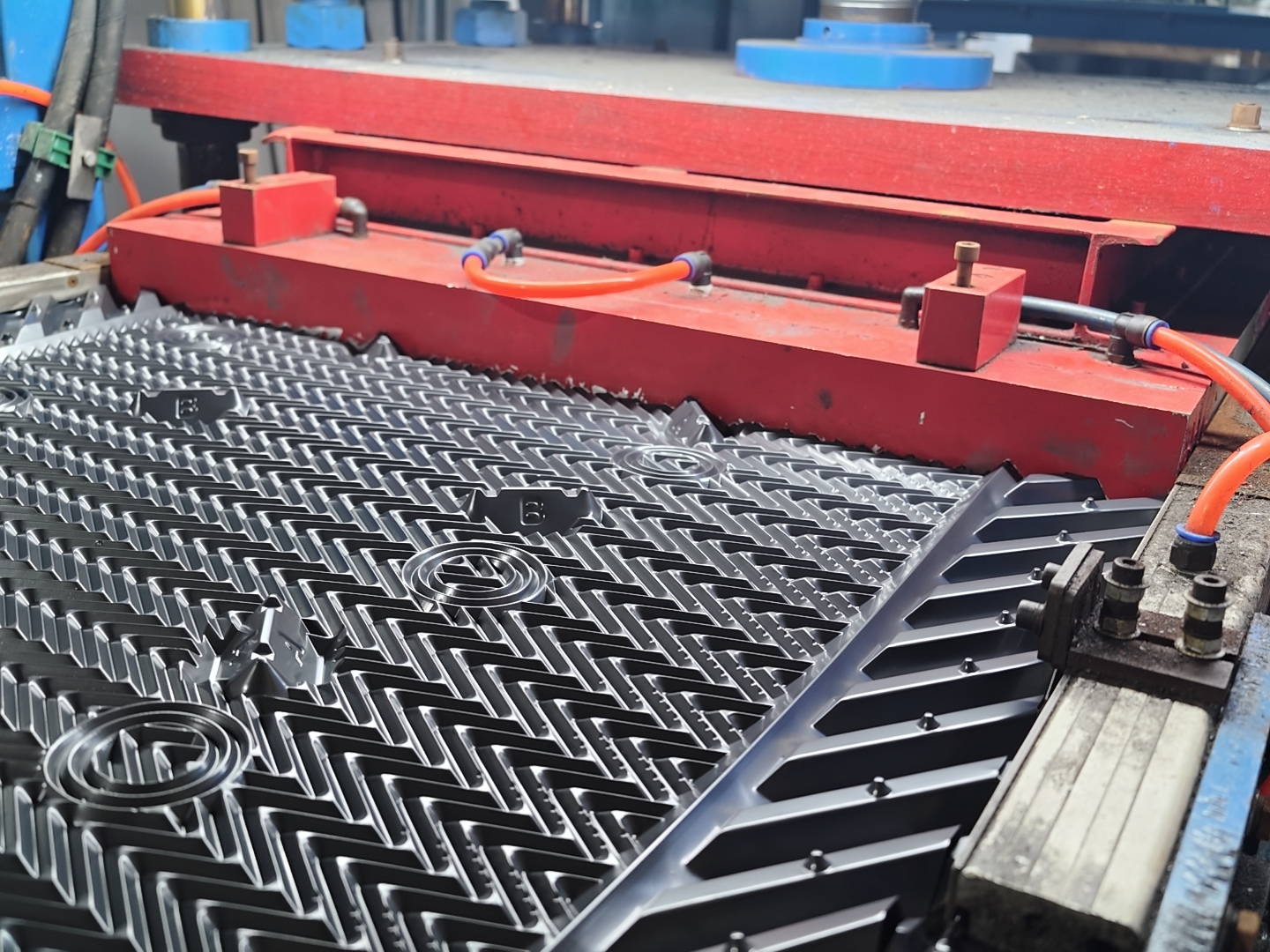
Marley cooling tower fill is a heat-transfer medium installed inside a cooling tower. Its main purpose is to distribute circulating water over a large surface area while allowing air to pass through the fill.
How Does Marley Fill Improve Heat Transfer?
When hot water enters the cooling tower, the fill spreads the water into a thin film or breaks it into droplets, depending on the fill design.
Air passing through the tower contacts the water, allowing sensible and evaporative heat transfer to occur.
Why Is Fill Surface Area Important?
The greater the effective water-air contact area, the more opportunity exists for heat and mass transfer.
Marley's film-fill designs use formed surfaces and corrugations to create additional contact area and turbulence. For example, the MC75 counterflow film fill uses crossed corrugations to develop surface area and turbulence for heat transfer.
What Types of Marley Cooling Tower Fill Are Available?
Different cooling tower configurations and water conditions require different fill designs.
What Is Marley PVC Film Fill?
PVC film fill uses formed PVC sheets to distribute water across a large surface area.
The Marley MBX and MX75 product families are examples of PVC film-fill systems designed for crossflow cooling towers. Marley MBX uses bottom-supported PVC pack fill with integrated louvers and drift eliminators, while MX75 is a hanging film-fill configuration.
What Is Marley Counterflow Film Fill?
Counterflow film fill is designed for towers where air and water move in opposite directions.
MC75 Counterflow Film Fill
Marley MC75 uses crossed corrugations to create surface area and turbulence. It is thermoformed from UV-inhibited, chemically resistant PVC.
MVC20 Counterflow Film Fill
MVC20 uses vertically channeled surfaces and corrugations designed to maintain thermal performance while allowing fouling material to migrate through the fill. Its aerodynamic flute design is also intended to reduce pressure drop.
What Is Marley Clog-Resistant Film Fill?
Some Marley fill designs are specifically developed for applications where fouling and biological growth are concerns.
For example, MCR uses open, offset vertical corrugations that allow debris and biological foulant to pass through while maintaining surface area and turbulence for evaporative heat transfer.
What Is Marley Splash Fill?
Marley also offers splash-fill solutions.
The Mesa crossflow splash fill uses corrosion-resistant PVC splash bars supported by a polypropylene system. It is designed for crossflow towers and can be used as a direct replacement for certain older wood-lathe or ACB fill configurations.
Why Is PVC Widely Used in Marley Cooling Tower Fill?
PVC is a common material for Marley cooling tower fill because it can be thermoformed into complex heat-transfer geometries while providing useful resistance to many cooling-water conditions.
What Are the Advantages of PVC Fill?
PVC cooling tower fill can provide several practical benefits.
Lightweight Construction
PVC fill is relatively lightweight compared with many traditional fill materials, making handling and installation more manageable.
Formability
Thermoforming allows PVC sheets to be produced with corrugations, channels, textures, and other geometric features that support heat-transfer performance.
Chemical Resistance
Specific PVC formulations can provide resistance to many chemicals found in cooling-water environments.
Long-Term Service Potential
When operating temperature, water chemistry, mechanical loading, and maintenance conditions are appropriate, PVC fill can provide long service life.
Marley products such as MC75, MCR, and DF381 are manufactured from PVC with product-specific thickness and formulation requirements.
How Does Marley Cooling Tower Fill Design Affect Performance?
Fill geometry has a major influence on how water and air interact inside the cooling tower.
How Do Corrugations Improve Heat Transfer?
Corrugations create additional surface area and change the direction of water and air movement.
This can increase turbulence and improve contact between the two fluids.
What Happens When Corrugations Are Properly Designed?
A suitable corrugation pattern can help:
Increase effective heat-transfer area
Distribute water across the fill
Promote air-water mixing
Maintain suitable airflow
Control pressure drop
The exact balance depends on the cooling tower design and operating conditions.
Why Does Flute Geometry Matter?
Flute geometry influences both thermal performance and fouling behavior.
For example, Marley MCR uses open, offset vertical corrugations and smooth surfaces intended to reduce restrictions where biological growth can begin.
How Does Marley Fill Handle Fouling?
Fouling is a major consideration when selecting cooling tower fill.
Cooling water can contain suspended solids, biological growth, scale, and other contaminants that accumulate on or inside the fill.
What Happens When Fill Becomes Clogged?
Heavy fouling can reduce the effective heat-transfer area and restrict water or airflow.
Potential effects include:
Lower cooling performance
Uneven water distribution
Higher airflow resistance
Increased maintenance requirements
Greater risk of fill deterioration
Which Marley Fill Designs Address Fouling?
Marley provides fill options specifically designed for applications where fouling is a concern.
DF381, for example, uses open angular cross-corrugations designed to allow debris and biological growth to pass through while maintaining heat-transfer surface area.
The AAFNCS anti-fouling film fill similarly uses vertically channeled surfaces and corrugation geometry intended to provide thermal performance while allowing fouling substances to migrate through the media.
How Does Marley Fill Design Affect Airflow?
Airflow is another important factor in cooling tower fill performance.
Why Is Pressure Drop Important?
Air must travel through the fill pack. Excessive resistance can increase the fan energy required to maintain the required airflow.
Therefore, fill design needs to balance heat-transfer surface area with acceptable airflow resistance.
How Do Aerodynamic Flutes Help?
Certain Marley counterflow fill designs use vertically oriented or aerodynamic flute configurations to reduce restrictions to airflow.
MVC20, for example, uses vertically and aerodynamically shaped flutes intended to reduce pressure drop.
What Are Integral Louvers and Drift Eliminators?
Some Marley crossflow fill systems integrate additional functions into the fill sheets.
How Do Louvers Work?
Louvers help control water movement and airflow at the air inlet area.
The MBX fill incorporates integral louvers that help prevent water from escaping and support air distribution through the tower.
What Do Drift Eliminators Do?
Drift eliminators reduce the amount of circulating water carried out of the tower with exhaust air.
Marley MBX incorporates cellular drift eliminators into the fill sheets, while the MBX EZ Pack design also integrates louvers and drift eliminators into the fill system.
What Is Marley MBX Cooling Tower Fill?
Marley MBX is a crossflow film-fill system designed for replacement and aftermarket applications.
What Are the Main Features of MBX Fill?
MBX is a bottom-supported PVC pack fill with integrated louvers and drift eliminators.
According to SPX, MBX packs are available in different heights and air travels and can be installed in many crossflow cooling towers regardless of tower age or manufacturer. Retrofit kits may also include fill packs, supports, hardware, and installation instructions.
Why Is MBX Useful for Replacement Projects?
The design is intended to simplify installation while providing a replacement solution without requiring major tower modifications.
This makes it relevant for cooling tower maintenance and refurbishment projects.
What Is Marley MBX EZ Pack Fill?
MBX EZ Pack is another Marley replacement fill solution for crossflow cooling towers.
How Is EZ Pack Designed?
It is a bottom-supported, two-piece PVC pack fill with integrated louvers and drift eliminators.
The modular design is intended to simplify handling and installation during fill replacement projects.
Can EZ Pack Be Modified for Different Applications?
SPX states that MBX EZ Pack is available in various heights and air travels and can be stocked and modified on-site for the required dimensions in crossflow towers.
How Does Marley Counterflow Fill Differ From Crossflow Fill?
The main difference is the direction of air movement relative to water.
Crossflow Cooling Tower Fill
In a crossflow tower, air generally moves horizontally through the fill while water flows downward.
Marley crossflow fill options include MBX, MX75, MBX EZ Pack, and Mesa splash fill.
Counterflow Cooling Tower Fill
In a counterflow tower, air moves upward while water flows downward.
Marley offers counterflow film-fill designs including MC75, MVC20, MCR, DF254, and DF381.
How Should You Choose Marley Cooling Tower Fill?
Fill selection should be based on the tower configuration and actual operating conditions rather than the product name alone.
What Factors Should Be Considered?
Important factors include:
Cooling tower type
Crossflow or counterflow configuration
Water flow rate
Airflow
Hot-water temperature
Cold-water temperature
Water quality
Suspended solids
Biological fouling risk
Existing fill dimensions
Available support structure
Required thermal performance
Why Is Water Quality Important?
Clean water systems can often use compact film-fill configurations.
Applications with significant suspended solids or biological fouling may require a more open or clog-resistant fill design.
How Does Marley Cooling Tower Fill Replacement Work?
Cooling tower fill replacement is commonly required when existing fill becomes brittle, damaged, deformed, heavily fouled, or otherwise unsuitable for continued operation.
What Should Be Inspected Before Replacement?
A detailed inspection should evaluate:
Fill Condition
Check for cracks, deformation, brittleness, scaling, biological growth, and structural deterioration.
Support Structure
Inspect fill supports for corrosion, damage, and deformation.
Water Distribution
Check spray nozzles, distribution pipes, basins, and other components that affect water coverage.
Tower Dimensions
Measure the existing fill pack and installation area before ordering replacement media.
Can Marley Fill Be Used in Non-Marley Cooling Towers?
Some Marley replacement fill systems are designed to adapt to towers from different manufacturers.
For example, SPX states that MBX can be installed in almost any crossflow cooling tower regardless of tower age or manufacturer, while several counterflow products are described as adaptable to towers regardless of age or manufacturer.
However, compatibility should be confirmed from actual tower dimensions, fill configuration, support structure, thermal requirements, and installation conditions.
How Should Marley Cooling Tower Fill Be Maintained?
Proper maintenance helps preserve heat-transfer performance and extend the useful service life of cooling tower fill.
How Can Fouling Be Reduced?
A suitable water treatment program can help control:
Scale
Corrosion
Algae
Biological growth
Suspended solids
How Often Should Fill Be Inspected?
Inspection frequency depends on water quality, operating conditions, environmental exposure, and tower duty.
During inspection, look for blocked passages, deposits, broken sheets, deformation, and biological growth.
How Should PVC Fill Be Cleaned?
Cleaning methods should be selected according to the fill material and contamination.
Low-Pressure Water Cleaning
Controlled water cleaning can remove loose dirt and sediment without placing excessive mechanical stress on the fill.
Chemical Cleaning
Chemical cleaning may be appropriate for certain mineral or biological deposits, but chemical compatibility with PVC and the cooling-water system should always be confirmed.
Avoid Excessive Pressure
Aggressive pressure washing can damage or deform thin PVC fill sheets.
What Makes Marley Fill Suitable for Replacement Projects?
Replacement projects often have different requirements from new cooling tower construction.
Existing Tower Dimensions
Replacement fill must fit the available space and support system.
Limited Shutdown Time
Industrial facilities may need to complete maintenance within a defined outage period.
Installation Access
Fill pack weight, modular design, support requirements, and cutting requirements can influence installation labor.
Marley provides different fill configurations intended to address these practical replacement considerations. The official Marley fill selection guide specifically identifies thermal performance, drift, handling, installation labor, durability, field modification, and support requirements as factors in fill replacement selection.
How Can Buyers Specify Marley Cooling Tower Fill?
When requesting replacement fill, providing accurate technical information can help avoid compatibility problems.
What Information Should Be Provided?
A buyer should ideally provide:
Cooling tower manufacturer
Tower model
Crossflow or counterflow configuration
Existing fill type
Fill dimensions
Fill height
Fill depth
Air travel
Water flow
Operating temperature
Photos of existing fill
Support structure details
Required quantity
Why Are Photos Useful?
Photos can help identify fill geometry, support arrangements, louvers, drift eliminators, and the general condition of the existing system.
Technical drawings and samples are even more useful for custom replacement projects.
How Does Fill Material Affect Long-Term Performance?
Material selection should match the tower's operating environment.
PVC Cooling Tower Fill
PVC is widely used for film fill because it can be thermoformed into complex heat-transfer surfaces and can provide suitable chemical and environmental resistance for many cooling-water applications.
PP Cooling Tower Fill
PP may be considered when its material properties better match a particular operating condition.
How Should Material Be Selected?
Consider:
Always verify the specific manufacturer's material specifications rather than assuming all PVC or PP fill has identical performance.
What Should You Look for in Marley Cooling Tower Fill Performance?
A suitable fill system should be evaluated as part of the complete cooling tower.
Thermal Performance
The fill should provide effective water-air contact and adequate heat-transfer area.
Hydraulic Performance
Water should distribute evenly through the fill without excessive channel blockage.
Airflow Performance
The fill should provide the required air-water interaction without creating unnecessary airflow resistance.
Fouling Performance
For challenging water conditions, clog-resistant designs may be more appropriate.
Mechanical Durability
The fill should withstand the expected operating environment, installation loads, water spray, and maintenance activities.
Why Is the Right Marley Cooling Tower Fill Important?
The fill is at the center of the cooling tower's heat-transfer process. SPX's Marley fill selection guide describes fill as a key component of the tower's thermal performance and highlights the need to consider thermal performance, drift, installation, handling, durability, and other factors when selecting replacement fill.
A suitable fill selection can therefore help align the cooling tower with its intended thermal and operating requirements.
Final Thoughts on Marley Cooling Tower Fill
Marley cooling tower fill is available in multiple designs for different cooling tower configurations and operating conditions. PVC film fill, clog-resistant fill, splash fill, crossflow fill, and counterflow fill each use different geometries to balance heat transfer, airflow, water distribution, fouling resistance, and installation requirements.
For replacement projects, the correct fill should not be selected only by brand or dimensions. Tower configuration, water quality, thermal duty, airflow, existing supports, fill condition, and maintenance requirements should all be considered.
Whether the project involves Marley cooling tower fill replacement, crossflow fill upgrades, counterflow fill replacement, or customized cooling tower fill, accurate measurements and application data can help ensure that the replacement media is compatible with the existing system.
For buyers comparing replacement options, working with a qualified cooling tower fill supplier or manufacturer can also simplify dimensional confirmation, material selection, packaging, and installation planning.


