Low Noise Industrial Cooling Tower Fan – Quiet Axial Cooling Tower Fan
Meta Description: Our low noise industrial cooling tower fan is an acoustically optimized axial fan assembly with FRP blades, engineered for noise-sensitive industrial sites, hospitals, campuses and urban facilities. It suppresses tip vortex noise, delivers stable heat rejection and supports retrofit replacement for mainstream cooling tower brands.
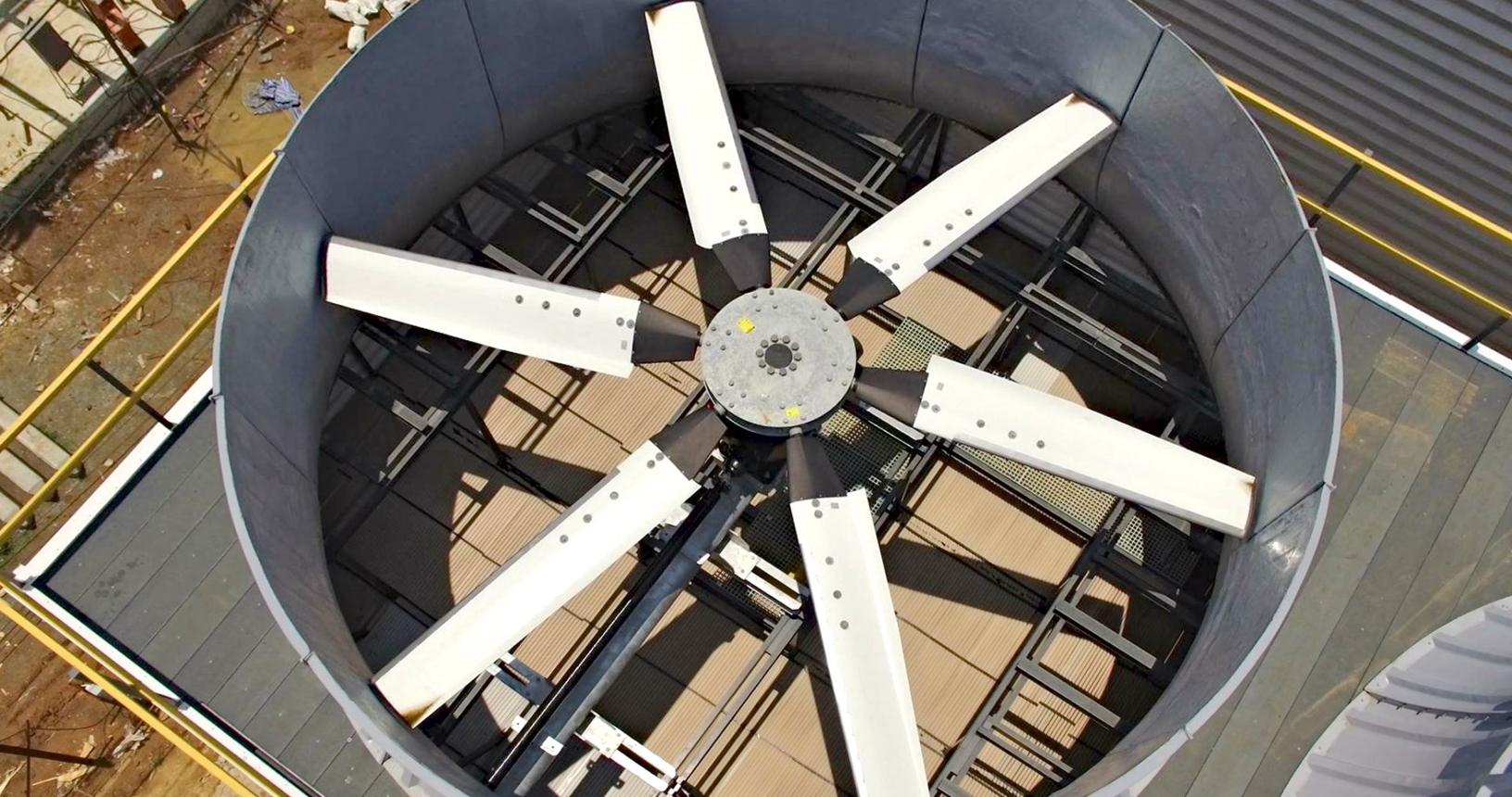
Why Noise Control Has Become a Non-Negotiable Specification for Industrial Cooling Tower Axial Fans
For decades, industrial cooling tower fan selection prioritized airflow volume, heat rejection capacity and upfront purchase cost. Facility engineers, EPC contractors and plant managers focused primarily on whether the fan could move enough air to maintain the designed cold water temperature under peak summer ambient conditions. Noise was treated as a secondary afterthought, a nuisance that could be addressed later with add-on acoustic barriers, sound insulation walls or restricted operating schedules. Today, this approach is no longer viable for a growing number of industrial and institutional cooling tower installations.
Local environmental protection regulations, municipal noise ordinances, workplace health standards and community complaints have pushed noise control to the top of the specification checklist. Cooling tower axial fans are inherently one of the loudest mechanical components within a process cooling system. Large diameter axial rotors spinning continuously generate a mix of tonal noise, broadband turbulence noise and low-frequency resonant rumble that can travel hundreds of meters across a site boundary. When cooling towers are built near residential neighborhoods, hospitals, laboratories, schools and office buildings, excessive fan noise can lead to fines, permit delays, forced operational limitations and costly redesign work.
A low noise industrial cooling tower axial fan solves this conflict at the source, rather than relying on passive noise mitigation accessories. Unlike sound barriers, silencer baffles or acoustic enclosures, which take up valuable space, block maintenance access, trap recirculating hot air and carry high installation costs, a quiet axial cooling tower fan is engineered from the blade airfoil outward to reduce sound generation before it propagates. This native acoustic design delivers a far more sustainable, efficient and space-saving solution for both new cooling tower builds and retrofit projects. Even for remote industrial sites without strict residential noise limits, quieter fan operation improves on-site working conditions for maintenance crews, reduces fatigue and improves overall site safety by making audible equipment fault detection easier for technicians.
The Two Primary Sources of Cooling Tower Fan Noise
Aerodynamic Noise
Aerodynamic noise accounts for most sound output of large axial cooling tower fans. Tip vortex shedding, flow separation along blade surfaces and turbulent wake behind trailing edges produce continuous noise as air passes through the rotating rotor. This noise rises sharply when blade tips run at excessive tip speed or when the gap between blade tips and the fan cylinder is poorly controlled.
Structural & Mechanical Noise
Vibration from unbalanced rotors, loose clamping joints and rigid metal-to-metal transmission creates resonant low-frequency noise that travels through steel support structures. FRP composite blades offer natural vibration damping, which is one key reason quiet axial fan assemblies favour FRP construction over conventional aluminum blade rotors.
Acoustic Engineering Behind Our Quiet Axial Cooling Tower Fan Design
Our low noise industrial cooling tower fan is not simply a standard axial fan running at lower RPM. Every element of the rotor is tuned by CFD simulation and acoustic testing to cut noise while preserving air delivery for crossflow and counterflow cooling towers.
Swept & Serrated Airfoil Blade Profiles
The core of noise reduction lies in the blade’s aerodynamic geometry. We adopt swept-back blade layout paired with serrated trailing edges, a biomimetic design inspired by owl wings that breaks up large, coherent air vortices into smaller, weaker turbulence structures.
The twisted spanwise airfoil equalizes lift distribution from blade root to tip, avoiding localized flow separation
Serrated trailing edges disrupt periodic vortex shedding, lowering tonal noise without sacrificing airflow
Blended rounded blade tips weaken tip leakage vortices, the dominant aerodynamic noise source for large-diameter cooling tower fans
FRP Composite Construction for Natural Vibration Damping
FRP (fiberglass reinforced polymer) is the preferred blade material for low noise axial cooling tower fan projects. Compared with aluminum alloy, FRP absorbs resonant vibration rather than transmitting it outward as sound waves.
Resin Formulation Matching Site Environment
Isophthalic polyester FRP: Standard low-noise option for freshwater HVAC and general manufacturing cooling towers
Vinyl ester FRP: Low noise blades for coastal and chemically aggressive process cooling towers, combining acoustic benefits with salt and chemical resistance
Fire-retardant FRP: Quiet axial fans for enclosed mechanical buildings and indoor cooling tower installations
Controlled Tip Clearance & Precision Dynamic Balancing
Even the best aerodynamic blade will produce extra noise if the rotor is unbalanced or tip clearance is inconsistent. Our low noise axial cooling tower fan undergoes factory moment sorting and dynamic balancing before shipment. We follow ISO 1940 balance grades to minimize cyclic vibration excitation, removing the low-frequency rumble common on poorly balanced fan rotors. A tightly controlled tip gap between blade and fan cylinder further prevents high-speed air leakage and associated turbulence noise.
VFD Compatibility for Intelligent Noise Adjustment
The low noise axial cooling tower fan assembly is fully compatible with variable frequency drives. When cooling load drops in off-peak seasons, operators reduce fan speed. Since fan noise is closely tied to tip speed, slowing rotation delivers immediate noise reduction while cutting power consumption at the same time. This dual benefit makes VFD paired quiet axial fans ideal for campuses, hospitals and mixed-use industrial parks with changing heat loads.
Ideal Application Scenarios for Low Noise Industrial Cooling Tower Axial Fans
These quiet axial cooling tower fan assemblies are specified most frequently for sites where noise limits are strict and shutdown windows are limited.
Noise-Sensitive Institutional & Commercial Industrial Sites
Hospitals, university campuses, laboratories and food processing facilities often sit adjacent to office buildings or residential zones. Local environmental authorities enforce daytime and nighttime sound limits. Upgrading old noisy aluminum fan rotors to our low noise axial cooling tower fan helps sites stay compliant and eliminates community noise complaints.
Urban Manufacturing & Data Center Cooling Towers
Hyperscale data centers and urban process plants need continuous cooling. A low noise axial cooling tower fan removes the need for bulky acoustic barriers that add capital cost, block maintenance access and trap heat around the fan stack inlet.
Coastal & Chemical Process Cooling Towers
Coastal and chemical cooling towers already require corrosion-resistant FRP blades. The low noise axial fan variant combines vinyl ester FRP’s anti-corrosion performance with acoustic optimization, perfect for refineries, desalination plants and chemical factories near residential districts.
Retrofit Replacement for Existing OEM Cooling Towers
Our low noise industrial cooling tower axial fan supports drop-in retrofit for mainstream cooling tower brands including BAC, Evapco and Liangchi. We match root geometry, hub mounting dimensions and pitch adjustment mechanisms, so plant teams can replace old fan rotors without modifying the cooling tower shell, fill media or support steel.
Performance Comparison: Low Noise Axial Fan vs Standard Cooling Tower Fan
Many buyers hold the misconception that quieter fans must sacrifice cooling capacity. Our optimized axial fan design avoids this tradeoff by refining aerodynamic efficiency.
Aerodynamic Efficiency & Heat Rejection
Standard cooling tower fans often waste energy generating turbulent noise. The low noise axial fan’s smooth airfoil profile delivers targeted airflow through fill media. Field test data shows our FRP low-noise axial fans can maintain equal heat rejection while reducing overall sound level by 5–8 dBA, depending on diameter and operating speed.
Long-Term Mechanical Reliability
Because low noise axial cooling tower fan rotors are dynamically balanced at the factory and built with vibration-damping FRP, they reduce recurring stress on gear reducers, bearings and fan hubs. This lowers wear rates and extends service intervals compared with conventional metal fan blades that transmit vibration into the drive assembly.
Installation & Retrofit Flexibility
Unlike custom sound attenuation systems, a low noise axial cooling tower fan is a direct rotating component swap. Installation timelines are similar to standard fan replacement, and no extra structural reinforcement is required in most retrofit projects.
Common Myths About Low Noise Cooling Tower Axial Fans
Myth 1: Low noise axial fans must run slowly and cannot deliver enough airflow
Noise reduction comes from aerodynamic optimization and vibration control, not simply reducing RPM. The same fan can operate at design speed while remaining quiet, as long as blade airfoil, tip geometry and balancing are properly engineered.
Myth 2: Only new cooling towers can use quiet axial fan assemblies
Retrofit is one of the largest use cases. If your existing cooling tower fan hub is structurally sound, you can replace legacy aluminum blades with our acoustically optimized FRP low noise axial fan set without replacing the whole tower.
Myth 3: Serrated blades are fragile and erode quickly in wet cooling tower air
Our serrated FRP blade trailing edges are protected by UV and erosion-resistant topcoat systems. When paired with proper material selection, serrated profiles maintain both acoustic performance and structural integrity for years of continuous industrial operation.
Myth 4: Noise from cooling tower fans can only be fixed by sound walls
Sound barriers add cost, block airflow and create trapped heat around the fan inlet. Source-level noise control via a low noise axial cooling tower fan is often the superior long-term technical and financial solution.
Matching Your Low Noise Axial Cooling Tower Fan to Site Requirements
To deliver the best acoustic outcome, we collect key engineering parameters before manufacturing each fan set: tower type (crossflow or counterflow), fan stack diameter, operating RPM, allowable sound level, ambient environment and existing hub root pattern. We provide full documentation including fan performance curves, acoustic test reports, balancing certificates and installation torque guidelines. For retrofit orders, our technical team verifies compatibility to ensure the quiet axial fan drops smoothly into your current cooling tower system.
Whether you are specifying a new-build industrial cooling tower for a noise-restricted zone or planning a retrofit to bring an aging tower into noise compliance, our low noise industrial cooling tower axial fan balances stable heat rejection, corrosion resistance, low vibration and controlled acoustic output for reliable, quiet year-round operation.


