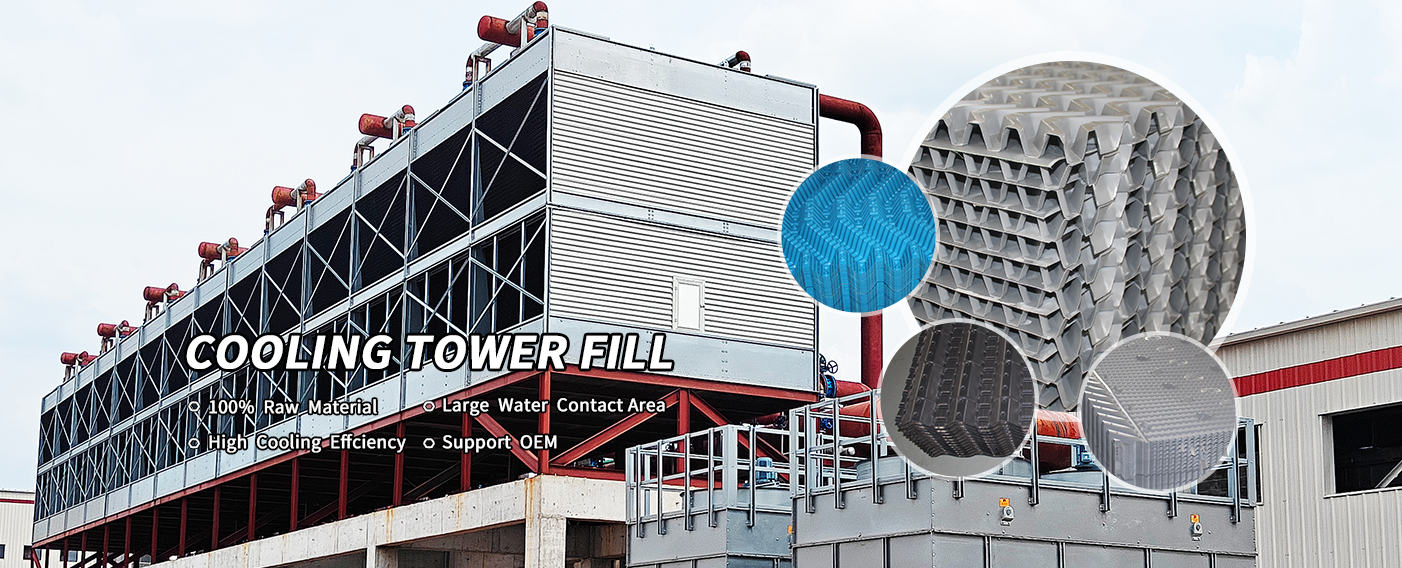
How Does Cooling Tower Fill Media Affect Performance?
Cooling tower performance depends on several components working together, but cooling tower fill media plays one of the most important roles in the heat transfer process. The fill provides a large surface area where hot circulating water comes into contact with moving air, allowing heat to transfer from the water to the atmosphere.
The right fill media cooling tower design can improve heat transfer efficiency, maintain stable operating temperatures, reduce water consumption, and support reliable long-term operation. On the other hand, poorly selected, damaged, or clogged cooling tower fill media can restrict airflow and water distribution, reducing overall cooling performance.
This guide explains how cooling tower fill media affects performance, what factors should be considered when selecting fill, and how proper maintenance can extend its service life.
What Is Cooling Tower Fill Media?
Cooling tower fill media is the internal material installed inside a cooling tower to increase the contact area between water and air. Instead of allowing water to fall directly from the distribution system to the basin, the fill breaks the water into thin films or droplets and spreads it over a larger surface.
What Does Cooling Tower Fill Media Do?
The primary function of cooling tower fill media is to improve the interaction between air and water.
When warm process water enters the tower, it is distributed over the fill. As the water flows across or through the fill, air passes through the media. A portion of the water evaporates, carrying heat away from the circulating water.
Main Functions of Cooling Tower Fill Media
Increase water-to-air contact area
Improve heat and mass transfer
Promote uniform water distribution
Increase contact time between air and water
Support efficient evaporative cooling
Help achieve the required cooling range
Reduce the size of cooling equipment required for a given duty
Because of these functions, the structure and material of the fill can have a direct impact on cooling tower performance.
How Does Fill Media Cooling Tower Performance?
The performance of a fill media cooling tower is strongly influenced by how efficiently the fill manages water and airflow.
How Does Fill Increase Heat Transfer?
Cooling tower fill creates a large wetted surface area. When water spreads into thin films over the fill surface, the contact area between water and air increases significantly.
This larger contact area allows heat and moisture to transfer more efficiently. A well-designed fill can therefore provide effective cooling without requiring excessive tower size or airflow.
Why Surface Area Matters
More effective surface area generally gives the air and water more opportunity to exchange heat and moisture. However, simply increasing the amount of fill is not always the solution.
The fill must balance:
Surface area
Water loading
Airflow resistance
Pressure drop
Fouling resistance
Water distribution
Operating temperature
A properly engineered cooling tower fill media system must maintain an appropriate balance between these factors.
What Factors of Cooling Tower Fill Media Affect Performance?
Several characteristics determine how effectively cooling tower fill media performs in real operating conditions.
Fill Surface Area
Surface area is one of the most important characteristics of film fill. A greater effective surface area can provide more contact between air and water.
However, a very dense fill design can increase resistance to airflow or become more vulnerable to fouling. Therefore, the ideal surface area depends on the application and operating conditions.
Fill Geometry
The shape and configuration of cooling tower fill media determine how water spreads and how air moves through the tower.
Film Fill
Film fill uses closely spaced sheets to spread water into thin films.
It is commonly used where relatively clean water is available and high heat transfer efficiency is required.
Splash Fill
Splash fill uses bars, grids, or other structures to break water into smaller droplets.
It is often selected for applications where water quality, suspended solids, or fouling conditions make film fill less suitable.
Fill Thickness and Spacing
The thickness and spacing of fill sheets influence both heat transfer and airflow.
Narrower spacing can provide greater surface area, but it may also increase the possibility of clogging when water contains debris, biological growth, or suspended solids.
Wider spacing can improve fouling resistance but may provide less effective surface area.
Therefore, fill spacing should be selected according to water quality and tower operating conditions.
How Does Water Distribution Affect Cooling Tower Fill Media?
Even high-quality cooling tower fill media cannot perform efficiently if water is distributed unevenly.
Why Is Uniform Water Distribution Important?
The entire fill surface should receive an appropriate amount of water. Dry areas inside the fill contribute little to heat transfer, while overloaded areas can cause excessive water flow and increase pressure losses.
A good distribution system helps ensure that water is spread consistently across the available fill area.
What Happens When Water Distribution Is Poor?
Poor distribution can result in:
For this reason, spray nozzles, distribution pipes, and cooling tower fill media should be considered as one integrated system.
How Does Airflow Affect Cooling Tower Fill Media?
Airflow is another critical factor affecting fill performance.
Cooling tower fill media must allow sufficient air to pass through the wetted surfaces. If airflow is restricted, the evaporation process becomes less effective.
What Causes Airflow Restriction?
Common causes include:
Dirt accumulation
Scale
Algae and biological growth
Damaged fill sheets
Excessive fill density
Incorrect fill installation
Foreign objects inside the tower
Why Is Pressure Drop Important?
As air moves through the fill, it encounters resistance. This resistance is commonly expressed as pressure drop.
A fill design with excessive pressure drop can increase fan power requirements. Therefore, cooling tower fill media should provide effective heat transfer without creating unnecessary airflow resistance.
How Does Fill Material Affect Cooling Tower Performance?
The material used to manufacture cooling tower fill media affects its durability, temperature resistance, chemical resistance, and service life.
Why Is PVC Commonly Used for Cooling Tower Fill?
PVC is widely used for cooling tower fill because it offers a combination of:
Good corrosion resistance
Lightweight construction
Cost efficiency
Good formability
Suitable mechanical strength
Good performance in many HVAC and industrial applications
PVC cooling tower fill media is particularly common in film-fill applications.
When Is PP Cooling Tower Fill Used?
Polypropylene, or PP, can be selected for applications where higher temperature resistance is required.
PP cooling tower fill can be suitable for certain industrial processes where operating water temperatures are beyond the preferred range of standard PVC fill.
PVC vs PP Cooling Tower Fill Media
The appropriate material depends on operating temperature, water chemistry, mechanical requirements, and application conditions.
| Factor | PVC Fill | PP Fill |
| Cost | Generally economical | Usually higher |
| Temperature resistance | Suitable for many standard applications | Better for higher-temperature applications |
| Corrosion resistance | Good | Excellent |
| Weight | Lightweight | Lightweight |
| Typical applications | HVAC and industrial cooling | Higher-temperature industrial systems |
The correct material should always be selected according to the actual operating environment rather than price alone.
How Do Different Cooling Tower Designs Use Fill Media?
The fill configuration must match the type of cooling tower.
Counterflow Cooling Tower Fill
In a counterflow cooling tower, water moves downward while air travels upward through the fill.
This arrangement provides strong contact between air and water and is widely used in industrial and HVAC cooling systems.
Advantages of Counterflow Fill
Efficient air-water contact
Compact tower design
Effective heat transfer
Suitable for many industrial applications
Flexible fill configurations
Crossflow Cooling Tower Fill
In a crossflow tower, air generally moves horizontally through the fill while water flows downward.
Crossflow cooling tower fill media is commonly designed to provide effective water distribution while maintaining appropriate airflow.
Crossflow Fill Considerations
The fill should be compatible with the tower's water distribution system and operating water quality. Easy access for inspection and maintenance can also be important for long-term performance.
How Does Cooling Tower Fill Media Affect Energy Efficiency?
Cooling tower fill media can indirectly influence the energy consumption of fans and pumps.
Can Better Fill Reduce Fan Energy?
A properly designed fill can provide the required heat transfer with an appropriate airflow resistance.
If the fill offers good thermal performance without excessive pressure drop, the fan may not need to operate at unnecessarily high power levels to achieve the required airflow.
The Importance of Fill and Fan Matching
Cooling tower fill should not be selected independently from the fan.
The following factors should be considered together:
Fill pressure drop
Required airflow
Fan capacity
Fan speed
Motor power
Water flow rate
Required cooling range
A balanced system can provide reliable cooling while avoiding unnecessary energy consumption.
How Does Water Quality Affect Cooling Tower Fill Media?
Water quality is one of the most important factors determining the service life of cooling tower fill.
What Happens When Fill Becomes Fouled?
Scale, dirt, algae, and suspended solids can accumulate on the fill surface.
This can reduce the effective contact area between water and air and restrict airflow through the fill.
Common Signs of Fouled Fill
Regular inspection can help identify these problems before they significantly affect tower performance.
How Should Cooling Tower Fill Media Be Maintained?
Proper maintenance helps preserve the heat transfer performance and service life of the fill.
How Often Should Cooling Tower Fill Be Inspected?
Inspection frequency depends on water quality, operating conditions, tower design, and environmental exposure.
For systems operating under challenging conditions, more frequent inspections may be necessary.
What Should Be Checked?
During inspection, operators should check for:
Can Cooling Tower Fill Be Cleaned?
In many applications, cooling tower fill can be cleaned when deposits or biological growth begin to affect performance.
Cleaning methods should be selected according to the fill material and type of contamination. Excessive mechanical force or unsuitable chemicals may damage the fill.
When Should Cooling Tower Fill Media Be Replaced?
Cleaning cannot restore fill that has suffered severe physical or chemical deterioration.
Signs That Fill Replacement Is Needed
Replacement may be considered when the fill has:
Why Is Proper Replacement Important?
Old or damaged fill can affect water distribution and airflow throughout the tower. Installing suitable replacement cooling tower fill media can restore the intended water-air contact conditions.
How to Choose the Right Cooling Tower Fill Media?
Selecting the right cooling tower fill media requires more than choosing a standard size.
Consider the Operating Temperature
Temperature is an important factor when selecting PVC, PP, or other fill materials.
The material should be suitable for both normal and peak operating temperatures.
Consider Water Quality
If the circulating water contains significant suspended solids or biological contaminants, a fill with appropriate fouling resistance may be required.
Match Fill Design to Water Conditions
For relatively clean water, high-efficiency film fill may be appropriate.
For dirtier water, a more open fill configuration may provide better operational reliability.
Consider Cooling Tower Type
The fill should be compatible with:
Consider Dimensions and Installation
Replacement fill must match the existing tower dimensions and support structure.
Important specifications may include:
Fill height
Fill width
Sheet thickness
Block dimensions
Flute configuration
Material
Temperature rating
Installation orientation
How Can the Right Fill Media Improve Cooling Tower Performance?
The correct fill media cooling tower solution can contribute to more stable and efficient operation.
Improved Heat Transfer
Effective fill increases the water-air contact area and supports evaporation, helping the tower achieve the desired cooling range.
Better Cooling Capacity
A properly selected fill can help the cooling tower maintain the required outlet water temperature under designed operating conditions.
Reduced Maintenance Problems
A fill design that matches water quality can reduce the risk of rapid blockage, fouling, and premature deterioration.
Longer Service Life
Choosing a suitable material and maintaining proper operating conditions can extend the useful life of cooling tower fill media.
Why Should You Work With an Experienced Cooling Tower Fill Supplier?
Cooling tower fill is not a universal component. Different towers require different fill designs, materials, dimensions, and configurations.
An experienced supplier can help customers evaluate:
Cooling tower type
Water temperature
Water flow rate
Airflow requirements
Water quality
Fill dimensions
Material selection
Replacement requirements
Can Cooling Tower Fill Media Be Customized?
Yes. Depending on the manufacturer and application, cooling tower fill media can be supplied in different sizes, thicknesses, configurations, and materials.
Custom Fill Solutions for Industrial Cooling
Customized fill can be useful when standard products do not match an existing tower or when an industrial cooling system has specific operating requirements.
Conclusion
Cooling tower fill media has a direct influence on water-air contact, heat transfer, airflow resistance, water distribution, and overall cooling tower efficiency. The right fill design can help a cooling tower achieve stable cooling performance while supporting reliable long-term operation.
When selecting fill media cooling tower solutions, users should consider material, fill geometry, water quality, operating temperature, airflow, tower configuration, and maintenance requirements.
PVC and PP are widely used materials, while film fill and splash fill serve different operating conditions. Regular inspection and timely cleaning or replacement can also help maintain the performance of the cooling tower.
For HVAC, industrial, and process cooling applications, choosing the right cooling tower fill media is an important step toward maintaining efficient heat transfer and dependable cooling performance.


