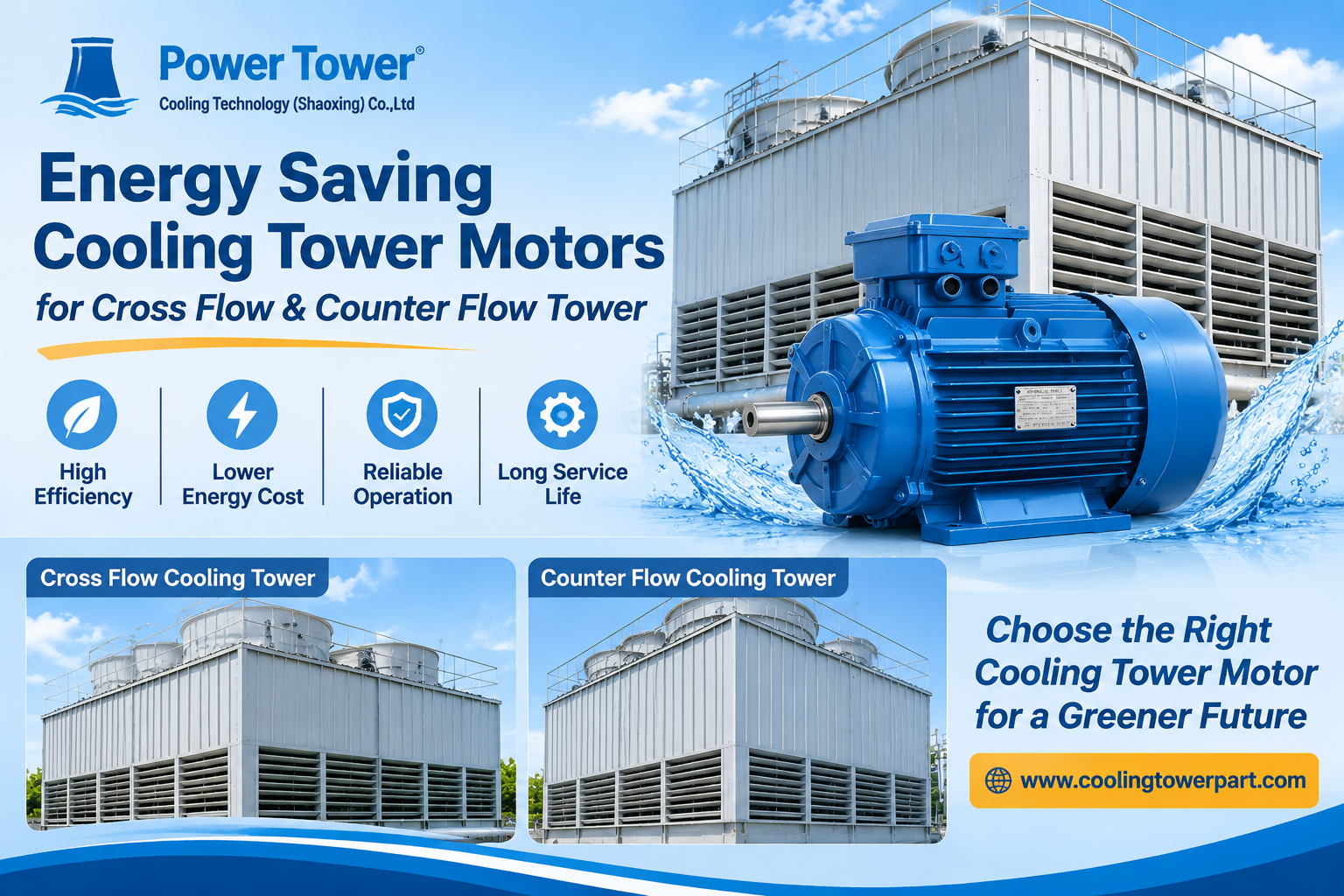
Cooling towers play an important role in industrial cooling systems, commercial HVAC installations, power plants, and many other applications. They remove unwanted heat from circulating water and help keep industrial processes operating within the required temperature range.
But have you ever considered how much electricity your cooling tower motor consumes every year?
The motor is one of the most important components in a mechanical-draft cooling tower. It drives the fan, moves air through the tower, and directly affects the system's ability to reject heat. If the motor operates inefficiently, electricity costs can increase month after month.
That is why energy saving cooling tower motors are becoming an important consideration for cooling tower owners and maintenance teams.
Whether you operate a crossflow cooling tower or a counterflow cooling tower, selecting an efficient motor can help reduce operating costs, improve system control, and support reliable long-term operation.
However, choosing the right motor involves more than comparing rated power or purchase prices. You also need to consider motor efficiency, fan requirements, voltage, frequency, environmental protection, and compatibility with the existing drive system.
In this guide, we will explain how to choose energy efficient cooling tower motors for crossflow and counterflow towers, what technical specifications matter, and how to avoid common replacement mistakes.
1. Why Cooling Tower Motor Efficiency Matters
A cooling tower motor may operate for thousands of hours every year. In facilities with continuous production, it may run almost around the clock.
Even a relatively small improvement in motor efficiency can therefore make a noticeable difference over time.
Consider a cooling tower motor operating for 6,000 hours annually. If its electrical consumption decreases by 1 kW under comparable operating conditions, the annual electricity saving would be approximately 6,000 kWh.
That is a meaningful reduction for a component that runs so frequently.
Motor efficiency also affects more than the electricity bill. An appropriately selected motor can help reduce unnecessary heat generation and support stable operation. When combined with proper fan selection, airflow control, and maintenance, it can contribute to better overall cooling tower performance.
The key point is simple: a cooling tower motor should be evaluated as a long-term operating investment, not just an item on a purchasing list.
2. What Is an Energy Saving Cooling Tower Motor?
An energy saving cooling tower motor is an electric motor designed to convert electrical energy into mechanical power with relatively low losses.
Its job is to drive the cooling tower fan at the required speed and provide sufficient power for the fan to move air through the tower.
During operation, some electrical energy is inevitably lost as heat because of winding resistance, magnetic losses, friction, and other factors. A high-efficiency motor is designed to reduce these losses.
For cooling tower applications, energy efficiency must be considered together with the motor's operating environment. A motor may have an excellent efficiency rating but still be unsuitable if it cannot withstand moisture, temperature changes, vibration, or the required operating duty.
2.1 How Motor Efficiency Works
Motor efficiency describes how much of the electrical input is converted into useful mechanical output.
The basic formula is:
Motor Efficiency = Mechanical Output Power ÷ Electrical Input Power × 100%
For example, if a motor receives 10 kW of electrical power and delivers 9 kW of mechanical output, its efficiency is:
9 ÷ 10 × 100% = 90%
The remaining energy is lost through heat and other losses.
A motor with higher efficiency generally needs less electrical input to deliver the same mechanical output, assuming comparable operating conditions.
However, remember that the actual electricity consumption of a cooling tower also depends on fan loading, operating speed, airflow resistance, and control strategy. Replacing a motor alone does not automatically guarantee a specific percentage of total system energy savings.
2.2 Common Motor Efficiency Classes
Industrial motors are commonly classified using international efficiency levels.
The commonly encountered IEC efficiency classes include:
Higher efficiency classes generally indicate lower motor losses under the applicable testing conditions.
For cooling tower applications, IE3 and IE4 motors may be worth evaluating when the operating hours are high and the project economics support the investment.
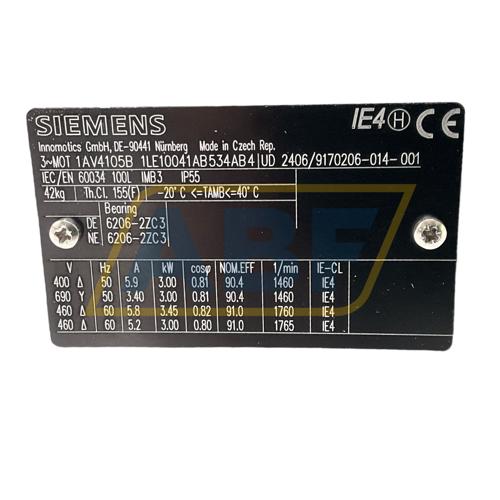
But don't select a motor based on the IE label alone. Confirm its rated output, speed, voltage, frequency, mounting arrangement, protection rating, and suitability for the cooling tower environment.
3. Understanding Crossflow and Counterflow Cooling Towers
Before selecting a motor, it helps to understand how crossflow and counterflow cooling towers differ.
Both tower types use air and water to transfer heat. The main difference is how air moves through the tower in relation to the falling water.
These differences influence the tower's internal layout, fan arrangement, and airflow path. They can therefore affect the motor and fan specifications required by the system.
3.1 Cooling Tower Motors for Crossflow Towers
In a crossflow cooling tower, air generally moves horizontally through the fill while hot water flows downward.
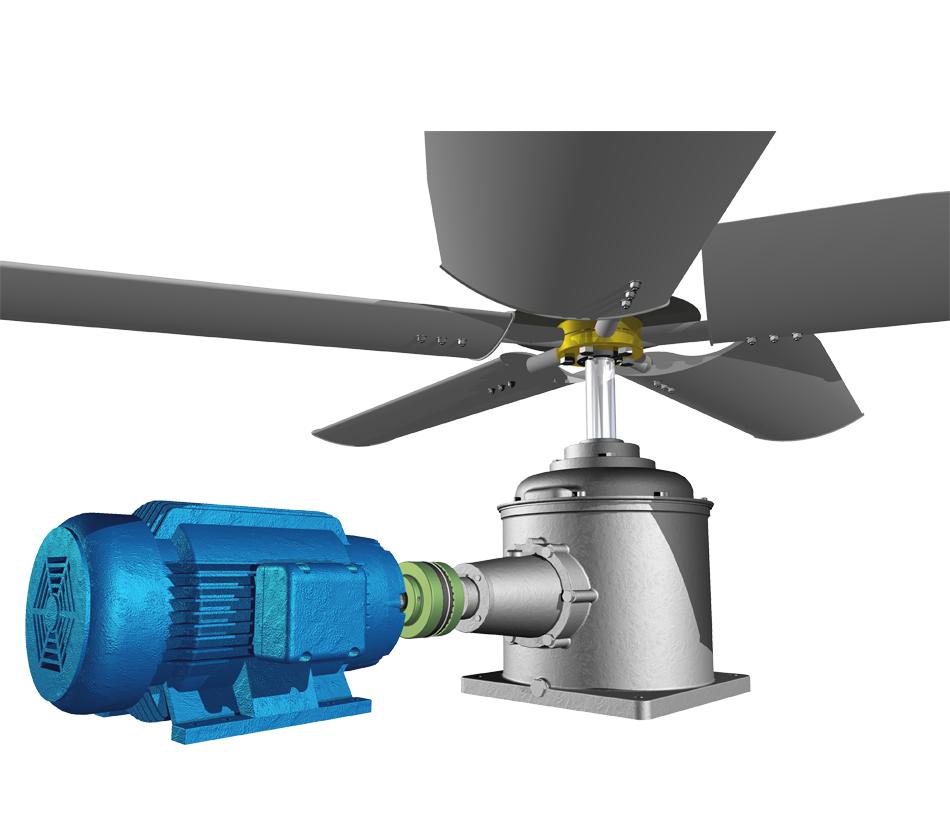
Many mechanical-draft crossflow towers use axial fans installed near the upper section of the tower. Depending on the design, the fan may be driven by a motor through a gearbox, belt arrangement, or another transmission system.
When selecting a motor for a crossflow tower, consider:
Required fan power.
Fan diameter and operating speed.
Drive system configuration.
Motor mounting arrangement.
Environmental protection requirements.
Continuous operating hours.
Crossflow towers often have accessible side air inlets, but this does not mean the motor is exposed to less demanding conditions. Moisture, vibration, outdoor weather, and maintenance access still need attention.
3.2 Cooling Tower Motors for Counterflow Towers
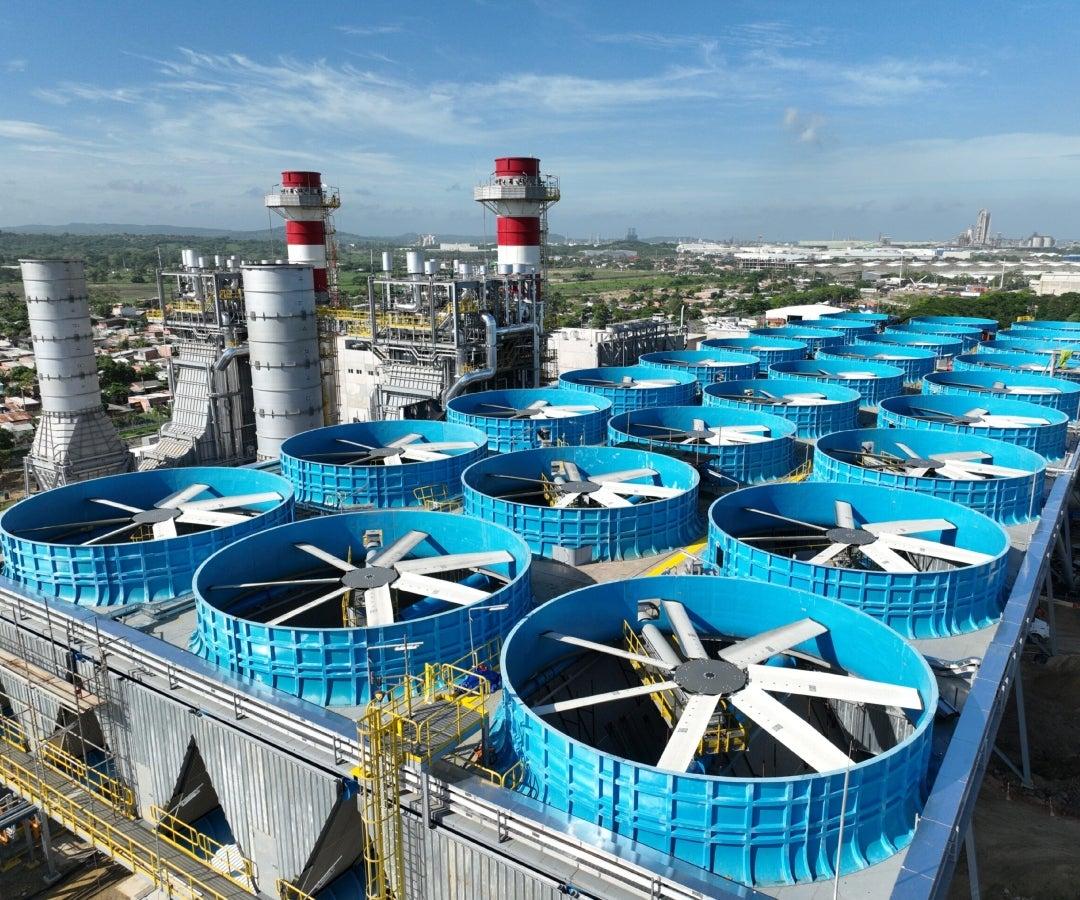
In a counterflow cooling tower, air generally moves upward while water flows downward. The air and water therefore travel in opposite directions through the heat exchange section.
Mechanical-draft counterflow towers commonly use an axial fan at the top of the tower to draw or push air through the system, depending on the configuration.
The motor selection process should focus on the actual fan and transmission arrangement.
Important considerations include:
Fan power and speed requirements.
Gearbox or direct-drive compatibility.
Shaft and mounting dimensions.
Motor protection against moisture.
Operating temperature and humidity.
Vibration and alignment requirements.
The motor should provide the required mechanical output without being unnecessarily oversized.
3.3 Are the Motors Interchangeable?
Not always.
Crossflow and counterflow cooling towers may use similar motor technologies, but that does not mean every motor can be installed in either tower.
The correct motor depends on the fan load, speed, mounting dimensions, shaft configuration, electrical supply, and transmission arrangement.
For example, two motors may both have a rated output of 15 kW but have different speeds, mounting structures, or shaft dimensions. One may fit the existing installation while the other requires substantial modifications.
Before replacing a motor, check the original motor nameplate and the cooling tower manufacturer's technical documentation.
4. Key Features of Energy Efficient Cooling Tower Motors
A suitable cooling tower motor needs to combine energy efficiency with reliable operation in a demanding environment.
Here are several features worth examining.
4.1 High-Efficiency Motor Design
The first consideration is the motor's rated efficiency.
High-efficiency motors are designed to reduce electrical and mechanical losses. Depending on the design, improvements may involve optimized magnetic circuits, winding arrangements, electrical steel, and bearing systems.
When comparing products, request the rated efficiency at the motor's specified operating point.
Also check whether the motor is appropriately sized for the actual fan load. An oversized motor may operate inefficiently when it is consistently lightly loaded, while an undersized motor may overheat or fail to deliver the required power.
The goal is not simply to purchase the motor with the highest rated output. It is to match the motor to the cooling tower's real operating requirements.
4.2 Variable Frequency Drive Compatibility
A variable frequency drive (VFD) adjusts motor speed by changing the frequency supplied to the motor.
This can be particularly useful in cooling towers because the cooling demand changes with weather conditions, production loads, and process requirements.
For example, a cooling tower may not need to operate at full fan speed during cooler weather or periods of reduced heat load.
A VFD can help reduce fan speed when less cooling capacity is required.
For many axial fan applications, reducing speed can significantly reduce fan power demand. Under similar aerodynamic conditions, fan power often changes approximately with the cube of rotational speed.
This is commonly expressed as:
Fan Power ∝ Speed³
For example, reducing fan speed to 80% may reduce theoretical fan power demand to around 51.2%, assuming comparable system conditions.
Actual savings depend on the fan curve, system resistance, control strategy, and operating conditions.
What Should You Check Before Using a VFD?
Not every motor and drive combination is automatically suitable.
Confirm:
The motor is approved for the intended variable-speed application.
The VFD has suitable current and power ratings.
Minimum and maximum operating speeds are acceptable.
Motor cooling remains adequate at reduced speed.
Insulation and bearing arrangements are suitable for the drive conditions.
Appropriate protection and control settings are provided.
A qualified electrical engineer should review the motor and VFD combination before commissioning.
4.3 Protection Against Moisture and Corrosion
Cooling towers operate in humid environments. Motors may also be exposed to water droplets, outdoor weather, dust, and chemicals.
Therefore, the motor enclosure and protection rating are important.
For example, IP55 is a commonly used enclosure protection rating for industrial motors. It indicates protection against harmful dust deposits and water jets under specified test conditions.
However, an IP rating does not mean that the motor can be submerged or exposed to every type of water spray.
Depending on the installation, additional attention may be needed for:
Corrosion-resistant external surfaces.
Suitable cable glands and terminal boxes.
Protection against condensation.
Appropriate drainage arrangements.
Chemical compatibility.
Weather protection.
The correct protection level should be selected according to the actual installation environment.
4.4 Insulation, Bearings, and Cooling
Motor insulation helps protect the windings from electrical stress and heat.
Insulation classes such as Class F are commonly found in industrial motors. The appropriate insulation system should be selected based on the motor design, ambient conditions, temperature rise, and operating duty.
Bearings are equally important.
A cooling tower motor may experience vibration, continuous operation, and varying loads. Suitable bearings, correct lubrication, and proper shaft alignment help support reliable service.
Motor cooling should also be considered. A motor operating at reduced speed with a VFD may receive less cooling from its own shaft-mounted fan. In some applications, this may require a separate cooling arrangement or operating limitations.
5. How to Choose the Right Cooling Tower Motor
Choosing a suitable motor requires more than checking the rated kilowatts.
A good selection process starts with the cooling tower's actual operating requirements and works through the mechanical and electrical specifications.
5.1 Calculate the Required Motor Power
The motor must provide enough mechanical power to drive the fan under the intended operating conditions.
The required power depends on factors such as:
If the cooling tower has an existing motor, its nameplate rating provides a useful starting point. However, do not automatically assume that the original motor rating is ideal. Previous modifications or operating problems may have affected the selection.
For a replacement project, confirm the fan manufacturer's required power and the cooling tower's design specifications.
Avoid choosing a motor that is too small, but do not oversize it without a technical reason.
5.2 Check Voltage and Frequency
Electrical compatibility is essential.
Before ordering, confirm the site's electrical supply and the motor's nameplate information.
Common details include:
Rated voltage.
Rated frequency.
Number of phases.
Rated current.
Rated speed.
Power factor.
Connection method.
Starting method.
For example, a motor designed for a 50 Hz supply may operate differently when connected to a 60 Hz supply. Changes in frequency can influence speed, torque, current, and mechanical loading.
Never assume that a motor with the correct kilowatt rating will work properly with the site's electrical system.
5.3 Consider Fan Type and Drive System
The fan and motor must work together.
Cooling towers commonly use axial fans because they can move large volumes of air at relatively low pressure differences.
However, the motor connection can vary.
Some systems use a gearbox, others use belt drives, and some use direct-drive arrangements.
When checking compatibility, review:
Motor shaft diameter and length.
Mounting dimensions.
Frame size.
Coupling or pulley arrangement.
Gearbox input requirements.
Fan operating speed.
Rotation direction.
A motor that has the correct electrical specifications may still be mechanically unsuitable.
5.4 Evaluate Operating Conditions
A motor installed indoors in a clean environment has different requirements from one installed outdoors beside a cooling tower.
Think about the actual conditions at your facility.
Is the tower exposed to direct sunlight? Does the motor experience heavy humidity? Is the surrounding environment dusty or corrosive? Does the equipment operate continuously?
These factors influence enclosure protection, insulation, bearing selection, surface treatment, and maintenance requirements.
The more demanding the environment, the more carefully the motor specification should be reviewed.
6. Energy Saving Benefits of High-Efficiency Motors
Why invest in an energy efficient cooling tower motor?
The main reason is lower energy consumption over the motor's operating life. But the benefits can extend beyond electricity savings.
6.1 Reduce Electricity Consumption
A more efficient motor can deliver the same mechanical output with less electrical input.
For a motor operating many hours per year, even a modest efficiency improvement can produce meaningful savings.
A simplified annual energy consumption calculation is:
Annual Energy Consumption (kWh) = Electrical Input Power (kW) × Operating Hours
For example:
Motor electrical input: 20 kW.
Annual operating time: 6,000 hours.
Annual energy consumption: 120,000 kWh.
If a replacement motor reduces the actual electrical input by 1 kW under equivalent operating conditions, the annual saving is:
1 kW × 6,000 hours = 6,000 kWh.
To estimate the financial benefit, multiply the energy saving by your electricity tariff.
Remember to compare motors at the same mechanical output and operating conditions. Comparing nameplate efficiency figures alone may not accurately predict real-world savings.
6.2 Use Variable Speed Control
Cooling demand is rarely constant throughout the year.
During hot weather, the cooling tower may need high fan speed. During cooler periods, lower speed may be sufficient.
A properly designed VFD control system can adjust fan speed according to cooling water temperature or another suitable process signal.
This avoids running the fan at full speed when the system does not need maximum cooling capacity.
However, the control system must maintain the required process temperature and respect the fan, gearbox, and motor operating limits.
6.3 Reduce Maintenance and Downtime
Energy efficiency does not automatically guarantee a longer service life. However, a correctly selected motor with suitable protection and operating conditions can support reliable operation.
A well-matched motor helps avoid unnecessary overload and excessive operating stress.
Combined with proper alignment, lubrication, electrical protection, and vibration monitoring, it can help reduce unexpected maintenance problems.
For industrial facilities, avoiding unplanned downtime can be just as important as reducing electricity consumption.
7. Common Mistakes When Replacing Cooling Tower Motors
Motor replacement is a common maintenance task, but several mistakes can create unnecessary costs.
Choosing only by kilowatt rating. Two motors with the same output may have different speeds, mounting dimensions, and electrical characteristics.
Ignoring the original fan requirements. The replacement motor must match the fan load and drive arrangement.
Overlooking voltage and frequency. Electrical incompatibility can cause poor operation or equipment damage.
Selecting an unsuitable protection rating. Cooling tower environments require appropriate moisture and dust protection.
Ignoring VFD compatibility. A motor used with variable-speed control must be suitable for the intended frequency range and operating conditions.
Oversizing the motor. A larger motor is not automatically more efficient. It must be correctly matched to the load.
Buying without checking dimensions. Shaft, frame, and mounting differences can make installation difficult.
Before placing an order, compare the complete motor specification rather than relying on one or two headline parameters.
8. How to Replace an Existing Cooling Tower Motor
If you are planning a cooling tower motor replacement, preparation is essential.
Start by collecting the existing motor information.
A useful replacement checklist includes:
Existing motor brand and model.
Rated output power in kW or HP.
Rated voltage and frequency.
Rated current and speed.
Number of phases.
Efficiency class.
IP protection rating.
Insulation class.
Frame size and mounting type.
Shaft diameter and length.
Drive arrangement.
Fan and gearbox information, where applicable.
Take clear photographs of the motor nameplate, mounting arrangement, terminal box, and connection points.
Also record any operating problems with the existing motor. For example, does it overheat, produce abnormal vibration, trip frequently, or make unusual noise?
These details can help identify whether the issue comes from the motor itself or from the fan, gearbox, electrical supply, or installation.
Motor removal and installation should be performed by qualified personnel. Isolate electrical power, follow site lockout and tagout procedures, and verify that the fan cannot rotate unexpectedly before starting work.
After installation, check alignment, electrical connections, rotation direction, vibration, current, and operating temperature.
9. Cooling Tower Motor Maintenance Tips
Even a high-efficiency motor needs regular maintenance.
A practical maintenance program can help identify developing problems before they cause a shutdown.
9.1 Inspect Motor Temperature and Noise
Monitor the motor during normal operation.
Unusual temperature increases, abnormal noise, or changes in vibration may indicate bearing problems, overload, misalignment, electrical faults, or ventilation issues.
Compare readings with the motor manufacturer's operating limits and previous inspection records.
9.2 Check Bearings and Lubrication
Bearings require suitable lubrication and correct maintenance intervals.
Too little lubrication can increase friction and wear. Excessive or incorrect lubrication can also create problems.
Follow the manufacturer's instructions for grease type, quantity, and lubrication frequency.
9.3 Keep the Motor Clean and Dry
Dust, dirt, and moisture can affect motor cooling and electrical insulation.
Inspect the enclosure, ventilation openings, cable glands, and terminal box.
Clean the motor using methods that do not force water or contaminants into the enclosure.
9.4 Monitor Electrical Performance
Record operating voltage, current, and other relevant electrical readings.
Unexpected current imbalance or abnormal operating values may indicate a supply problem, winding issue, mechanical overload, or incorrect motor configuration.
For VFD-driven motors, also check drive alarms, operating frequency, cooling conditions, and parameter settings.
10. Why Choose a Reliable Cooling Tower Parts Supplier?
A cooling tower motor is part of a larger mechanical system. Its performance depends on the fan, transmission, electrical supply, and overall tower design.
That is why selecting a supplier with cooling tower industry knowledge can be helpful.
When evaluating a supplier, consider the following:
Can the supplier understand your cooling tower model and application?
Can it review the motor nameplate and technical specifications?
Can it help confirm mechanical and electrical compatibility?
Are product specifications and documentation available?
Can it communicate clearly about delivery and replacement requirements?
Does it understand related cooling tower components?
A reliable supplier should help you confirm what you actually need instead of recommending a motor based only on its rated power.
For replacement projects, provide the original motor information, photographs, and operating requirements before requesting a quotation.
11. Power Tower Cooling Technology (Shaoxing) Co.,Ltd
Power Tower Cooling Technology (Shaoxing) Co.,Ltd focuses on cooling tower components and related replacement parts.
For cooling tower maintenance and upgrading projects, choosing compatible components is essential. Motor replacement should be considered together with the fan, transmission system, mounting arrangement, and operating conditions.
When discussing cooling tower motor requirements, it is helpful to prepare the existing motor nameplate, cooling tower model, fan specifications, and electrical supply information.
This makes it easier to evaluate the required specifications and identify suitable replacement solutions.
Power Tower also provides a range of cooling tower-related product information through its website.
Company: Power Tower Cooling Technology (Shaoxing) Co.,Ltd
Website: https://www.coolingtowerpart.com
If you are planning a cooling tower maintenance project, contact the company with your equipment details to discuss your component requirements.
12. Frequently Asked Questions About Energy Saving Cooling Tower Motors
12.1 What Is the Best Motor Efficiency Class for a Cooling Tower?
IE3 and IE4 motors are worth considering for applications with long operating hours and significant energy consumption.
However, the best choice depends on purchase cost, operating hours, electrical conditions, motor loading, and expected service life.
12.2 Can I Use the Same Motor for Crossflow and Counterflow Cooling Towers?
Not necessarily.
Both tower types may use similar motor technologies, but their fan arrangements, power requirements, mounting structures, and drive systems can differ.
Always confirm the mechanical and electrical specifications before selecting a replacement.
12.3 Can a VFD Reduce Cooling Tower Motor Energy Consumption?
Yes. A VFD can reduce motor speed when full cooling capacity is unnecessary.
Because fan power demand can decrease significantly as speed is reduced, variable-speed control may offer substantial energy-saving potential.
Actual savings depend on system characteristics and operating conditions.
12.4 What IP Rating Is Suitable for a Cooling Tower Motor?
The required IP rating depends on the motor's installation location and exposure to dust and water.
IP55 is a commonly used industrial motor protection level, but the final selection should consider the actual environment and manufacturer recommendations.
12.5 How Do I Calculate Cooling Tower Motor Power?
Motor power selection depends on fan power requirements, operating speed, transmission losses, and the cooling tower's design conditions.
Use the fan manufacturer's data and original equipment specifications as the starting point. Avoid estimating motor size from tower capacity alone.
12.6 How Often Should a Cooling Tower Motor Be Maintained?
Maintenance frequency depends on operating hours, environmental conditions, motor design, and manufacturer instructions.
Regular inspection should include temperature, vibration, bearings, lubrication, electrical connections, and enclosure condition.
12.7 Does a Higher-Power Motor Always Provide Better Cooling?
No. Cooling performance depends on the complete cooling tower system, including fan design, airflow, fill condition, water distribution, and operating conditions.
An unnecessarily large motor does not automatically improve cooling and may increase equipment and operating costs.
13. Conclusion
Energy saving cooling tower motors can help industrial facilities reduce electricity consumption and improve the long-term operating economics of their cooling systems.
However, selecting the right motor requires more than choosing a high-efficiency model.
You need to consider the cooling tower type, fan requirements, motor power, efficiency class, voltage, frequency, protection rating, drive arrangement, and operating environment.
For crossflow and counterflow cooling towers, the most important principle is to match the motor to the actual fan and system requirements. A well-designed VFD control strategy can provide additional energy-saving opportunities when cooling demand changes throughout the day or year.
Before replacing an existing motor, collect the nameplate information, check the mounting dimensions, and confirm electrical and mechanical compatibility.
For cooling tower replacement parts and related product requirements, Power Tower Cooling Technology (Shaoxing) Co.,Ltd provides a point of contact through https://www.coolingtowerpart.com.
The right motor is not simply the one with the highest efficiency rating or lowest purchase price. It is the one that delivers the required performance, uses energy effectively, and operates reliably in your cooling tower environment.


