Cooling Tower Fill Types: Design, Material and Performance
Cooling tower fill is one of the most important components inside a cooling tower. It increases the contact area between circulating water and air, allowing heat to transfer more effectively from water to the surrounding air. The right cooling tower fill type can influence cooling capacity, water distribution, airflow resistance, maintenance requirements, and service life.
Cooling tower fills are available in different designs, materials, and configurations. Common options include PVC cooling tower fill, PP cooling tower fill, film fill, splash fill, crossflow fill, and counterflow fill.
Understanding the differences between these cooling tower fill types can help industrial facilities, HVAC operators, cooling tower manufacturers, and replacement buyers select a suitable solution for their applications.
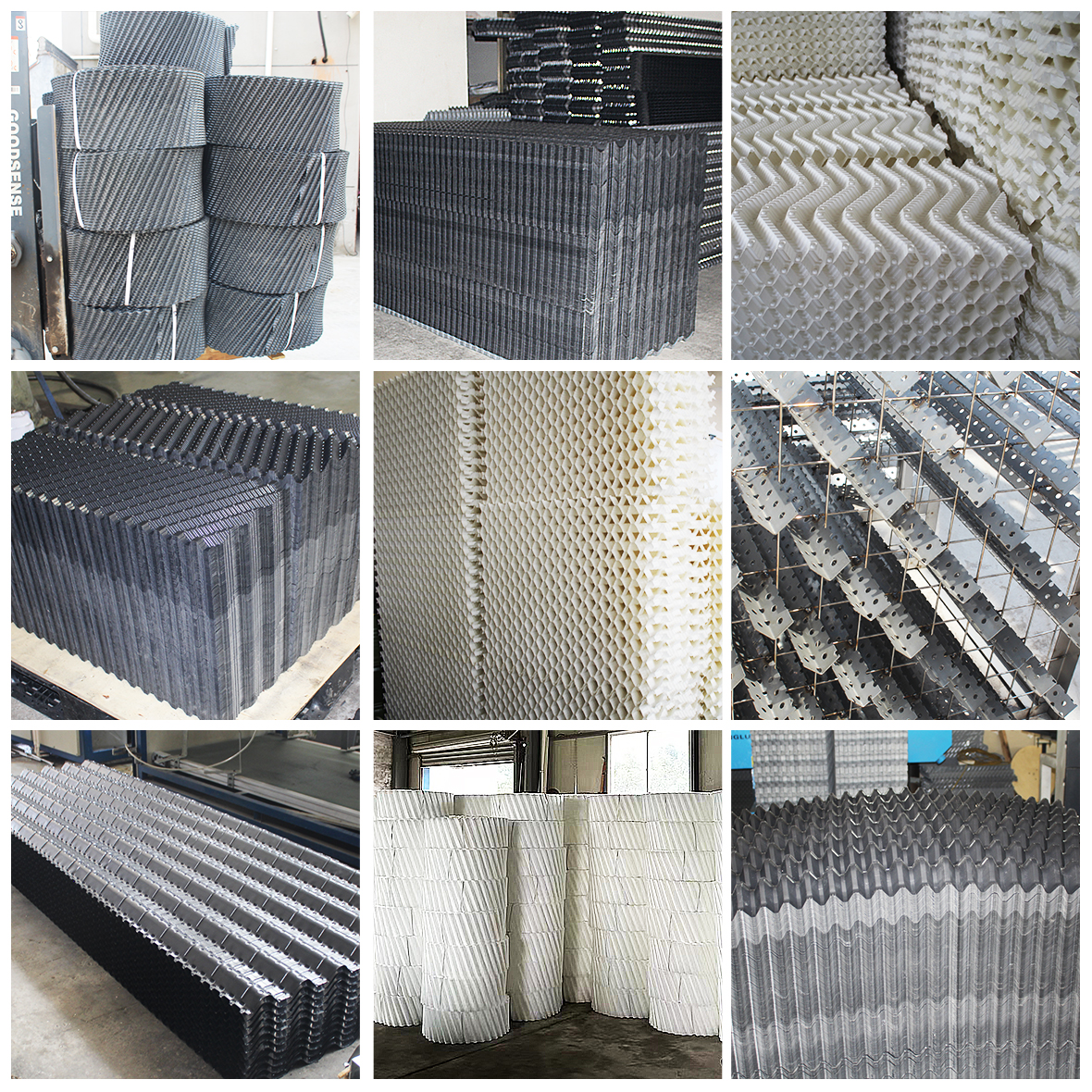
What Is Cooling Tower Fill?
Cooling tower fill is a structured or non-structured heat-transfer medium installed inside a cooling tower. Its primary purpose is to increase the surface area available for contact between water and air.
How Does Cooling Tower Fill Work?
Hot circulating water enters the cooling tower and flows over or through the fill media. At the same time, air moves through the tower.
The fill distributes water into thin films or droplets and increases the interaction between water and air.
Why Is Surface Area Important?
A larger effective contact area gives heat and moisture more opportunity to transfer between the water and air.
This is why cooling tower fill design has a direct relationship with cooling performance.
What Are the Main Types of Cooling Tower Fills?
Cooling tower fills can be classified according to their material, structure, and tower configuration.
What Are Film Fills?
Film fill consists of closely spaced sheets or surfaces designed to spread water into a thin film.
How Does Film Fill Improve Cooling?
As water flows over the large surface area of the fill, it forms a relatively thin layer. Air passes across or through the fill, increasing water-air contact.
Film fill can provide high surface area within a compact volume.
Where Is Film Fill Commonly Used?
Film fill is widely used in HVAC and industrial cooling towers where relatively clean circulating water can be maintained.
What Are Splash Fills?
Splash fill uses a series of bars, grids, or specially shaped surfaces to break falling water into smaller droplets.
How Does Splash Fill Work?
Water repeatedly impacts the fill surfaces and breaks into droplets. This increases the available water-air interface for heat transfer.
When Is Splash Fill Useful?
Splash fill can be considered for applications where water contains higher levels of suspended solids or where resistance to fouling is particularly important.
How Do Crossflow and Counterflow Fill Differ?
Another important way to classify cooling tower fill types is by airflow configuration.
What Is Crossflow Cooling Tower Fill?
In a crossflow tower, air generally moves horizontally through the fill while water flows downward.
What Are the Characteristics of Crossflow Fill?
Crossflow fill is designed to work with the tower's horizontal airflow pattern and vertical water flow.
Its geometry needs to support effective water distribution while allowing air to pass through the fill.
What Is Counterflow Cooling Tower Fill?
In a counterflow cooling tower, air generally moves upward while water flows downward.
How Does Counterflow Fill Work?
Water enters the upper portion of the fill and moves downward while air travels in the opposite direction.
This countercurrent arrangement can provide effective heat and mass transfer when the fill geometry, airflow, and water distribution are properly matched.
Which Fill Type Should Be Used?
There is no universal choice between crossflow and counterflow fill.
The appropriate type depends on the cooling tower design, water flow, airflow, thermal requirements, available space, and operating conditions.
What Materials Are Used for Cooling Tower Fill?
Material selection is another important factor when comparing cooling tower fill types.
Why Is PVC Commonly Used?
PVC cooling tower fill is widely used because it offers a combination of processability, corrosion resistance, lightweight construction, and cost efficiency.
What Are the Benefits of PVC Fill?
PVC fill can provide:
Large heat-transfer surface area
Lightweight construction
Good resistance to many cooling-water conditions
Flexible manufacturing options
Practical replacement costs
Compatibility with many HVAC and industrial applications
However, actual temperature and chemical resistance depend on the specific PVC formulation and product design.
What Is PP Cooling Tower Fill?
Polypropylene, commonly called PP, is another material used for cooling tower fill.
Why Choose PP Fill?
PP can provide useful chemical resistance and can be suitable for applications requiring different material characteristics from standard PVC fill.
PP fill may also be considered for certain higher-temperature or specialized operating conditions, depending on the product design.
Are Other Materials Used?
Other materials may be used for specialized cooling tower applications, including FRP and other engineered materials.
The material should always be selected according to operating temperature, water chemistry, mechanical requirements, and manufacturer specifications.
How Does Cooling Tower Fill Design Affect Performance?
Material is only one part of cooling tower fill performance. Geometry is equally important.
What Is Fill Surface Area?
The effective surface area determines how much opportunity exists for water-air interaction.
A carefully designed fill can provide a large effective area without excessively increasing the physical size of the cooling tower.
How Does Corrugation Affect Cooling?
Corrugated PVC fill sheets create channels and surfaces that guide water and air through the fill.
The angle, spacing, height, and shape of these channels can influence:
Water distribution
Airflow
Pressure drop
Heat transfer
Fouling characteristics
Why Is Channel Design Important?
Channels that are too narrow may increase the risk of blockage in dirty water applications.
Channels that are too open may reduce the available surface area.
Therefore, fill geometry needs to balance cooling performance and operating conditions.
What Is the Difference Between High-Efficiency and Fouling-Resistant Fill?
Cooling tower fill selection often involves balancing heat-transfer efficiency with water quality.
High-Efficiency Film Fill
High-efficiency film fill typically uses closely spaced surfaces to maximize water-air contact.
What Are Its Advantages?
It can provide high heat-transfer performance within a relatively compact volume.
What Is Its Limitation?
Closely spaced passages can be more sensitive to suspended solids, scale, algae, and other contaminants.
Fouling-Resistant Fill
Fouling-resistant designs generally provide larger or more open passages.
Why Is This Useful?
Larger passages can make it more difficult for suspended solids to completely block the fill.
This type of design can be useful in applications where water quality is difficult to control.
How Does Water Quality Affect Cooling Tower Fill Selection?
Water quality is one of the most important considerations when selecting cooling tower fill.
What Happens When Fill Becomes Fouled?
Scale, algae, sediment, and biological deposits can accumulate on fill surfaces.
This may lead to:
Reduced heat-transfer area
Restricted water flow
Increased airflow resistance
Uneven water distribution
Reduced cooling performance
How Can Fouling Be Controlled?
An effective cooling tower water treatment program can help control scaling, corrosion, biological growth, and suspended solids.
Regular inspection and cleaning are also important.
Should Fill Be Selected According to Water Quality?
Yes. A fill design that performs well with clean water may not be suitable for heavily contaminated or high-solids water.
How Do Cooling Tower Fill Types Affect Energy Efficiency?
Cooling tower fill can indirectly influence fan energy consumption and overall cooling system efficiency.
Why Does Pressure Drop Matter?
Air must pass through the fill. If the fill creates excessive resistance, the cooling tower fan may require more energy to maintain the required airflow.
How Can Fill Design Balance Heat Transfer and Airflow?
A well-designed fill provides sufficient surface area for heat transfer while maintaining reasonable airflow resistance.
The ideal balance depends on the cooling tower's thermal and mechanical design.
How Should You Choose the Right Cooling Tower Fill Type?
Choosing the right fill requires consideration of more than cooling capacity.
What Should You Check First?
Start by identifying the cooling tower configuration and operating requirements.
Check the Tower Type
Determine whether the tower uses a crossflow or counterflow configuration.
Check Water Flow
Water flow rate affects water loading and fill selection.
Check Operating Temperature
The fill material must be suitable for the expected water temperature.
Check Water Quality
Evaluate suspended solids, hardness, biological activity, and chemical treatment.
Check Available Space
Replacement projects require fill dimensions that fit the existing tower structure.
What Should You Consider When Replacing Cooling Tower Fill?
Cooling tower fill replacement is common when existing media becomes damaged, clogged, deformed, or severely scaled.
Can New Fill Be Customized?
Yes. A professional cooling tower fill manufacturer can often customize fill dimensions and configurations according to the existing tower.
What Information Should Buyers Provide?
Useful information includes:
Why Are Existing Fill Dimensions Important?
Even small dimensional differences can affect installation and water distribution.
Accurate measurements help the manufacturer produce compatible replacement fill.
How Can Cooling Tower Fill Be Maintained?
Proper maintenance can help preserve fill performance and extend its service life.
How Often Should Fill Be Inspected?
Inspection frequency depends on operating conditions and water quality.
Systems with high suspended solids or heavy biological activity may require more frequent inspection.
What Should Be Checked?
Look for:
Scale
Algae
Sludge
Blocked channels
Broken sheets
Deformation
Discoloration
Structural deterioration
How Should Cooling Tower Fill Be Cleaned?
Cleaning should be selected according to the contamination and material.
Water Cleaning
Controlled water cleaning can remove loose dirt and sediment.
Chemical Cleaning
Suitable chemical cleaning may be used for certain scale or biological deposits.
The chemical must be compatible with the fill material and cooling-water system.
Avoid Excessive Pressure
Very high-pressure cleaning can damage thin PVC fill sheets or deform the fill structure.
What Are the Most Important Cooling Tower Fill Performance Factors?
When evaluating different cooling tower fill types, several factors should be considered together.
Heat Transfer Performance
The fill should provide sufficient effective surface area and promote good water-air contact.
Airflow Resistance
The design should allow the required airflow without creating unnecessary pressure drop.
Water Distribution
The fill should support uniform water spreading across the available surface.
Fouling Resistance
Applications with poor water quality require careful consideration of passage size and fill geometry.
Material Durability
The material should withstand the expected temperature, water chemistry, and operating environment.
Installation Compatibility
For replacement projects, dimensions and configuration must match the existing cooling tower.
What Are the Applications of Different Cooling Tower Fill Types?
Different fill types can serve different industries and operating conditions.
HVAC Cooling Towers
Film fill is commonly used in HVAC systems where water quality can be effectively controlled.
Industrial Process Cooling
Industrial cooling systems may use PVC, PP, splash, or specialized fill designs depending on water quality and temperature.
Power Generation
Cooling towers in power-related facilities require reliable heat rejection and carefully selected fill systems.
Chemical and Petrochemical Plants
These facilities may require fill materials and designs selected according to process temperature and water chemistry.
Steel and Manufacturing Facilities
Industrial manufacturing processes can generate substantial heat loads, requiring cooling tower fill designed for continuous operation.
How Do You Compare Different Cooling Tower Fill Types?
A useful comparison should consider the entire operating environment rather than focusing on a single specification.
| Factor | Film Fill | Splash Fill |
| Heat-transfer surface | High | Moderate |
| Passage structure | Relatively compact | More open |
| Fouling sensitivity | Generally higher | Generally lower |
| Water quality requirement | More demanding | More tolerant |
| Typical application | Cleaner water systems | Higher-solids applications |
The actual performance depends on the specific fill design, material, operating conditions, and cooling tower configuration.
How Can a Cooling Tower Fill Manufacturer Help?
An experienced manufacturer can help customers select fill based on actual operating conditions instead of using a one-size-fits-all approach.
What Can a Manufacturer Provide?
A professional supplier may provide:
PVC cooling tower fill
PP cooling tower fill
Film fill
Splash fill
Crossflow fill
Counterflow fill
Custom dimensions
Replacement fill packs
Technical specifications
Packaging solutions
Why Is Customization Valuable?
Custom manufacturing can be particularly useful when replacing fill in an existing cooling tower.
The manufacturer can work with drawings, measurements, samples, or photos to develop a compatible solution.
Final Considerations for Cooling Tower Fill Selection
There are many cooling tower fill types, and each design has its own characteristics.
Film fill can provide a large effective surface area and compact heat-transfer performance, while splash fill can be useful where fouling resistance and larger passages are important. PVC and PP are common material choices, while crossflow and counterflow configurations require different fill arrangements.
The best selection depends on the complete operating environment, including water quality, temperature, water flow, airflow, cooling load, tower configuration, maintenance requirements, and available installation space.
For new cooling towers and replacement projects, working with a qualified cooling tower fill manufacturer can help ensure that the selected fill media matches the equipment and operating conditions.
Conclusion
Understanding cooling tower fill types, materials, and performance is essential for maintaining efficient heat transfer and reliable cooling tower operation.
PVC cooling tower fill, PP fill, film fill, splash fill, crossflow fill, and counterflow fill each serve different requirements. Rather than selecting fill based only on price or surface area, buyers should evaluate water quality, thermal conditions, airflow resistance, fouling risk, durability, and installation compatibility.
With the right fill design and proper maintenance, cooling tower systems can achieve stable water distribution, effective heat transfer, and dependable long-term operation.


