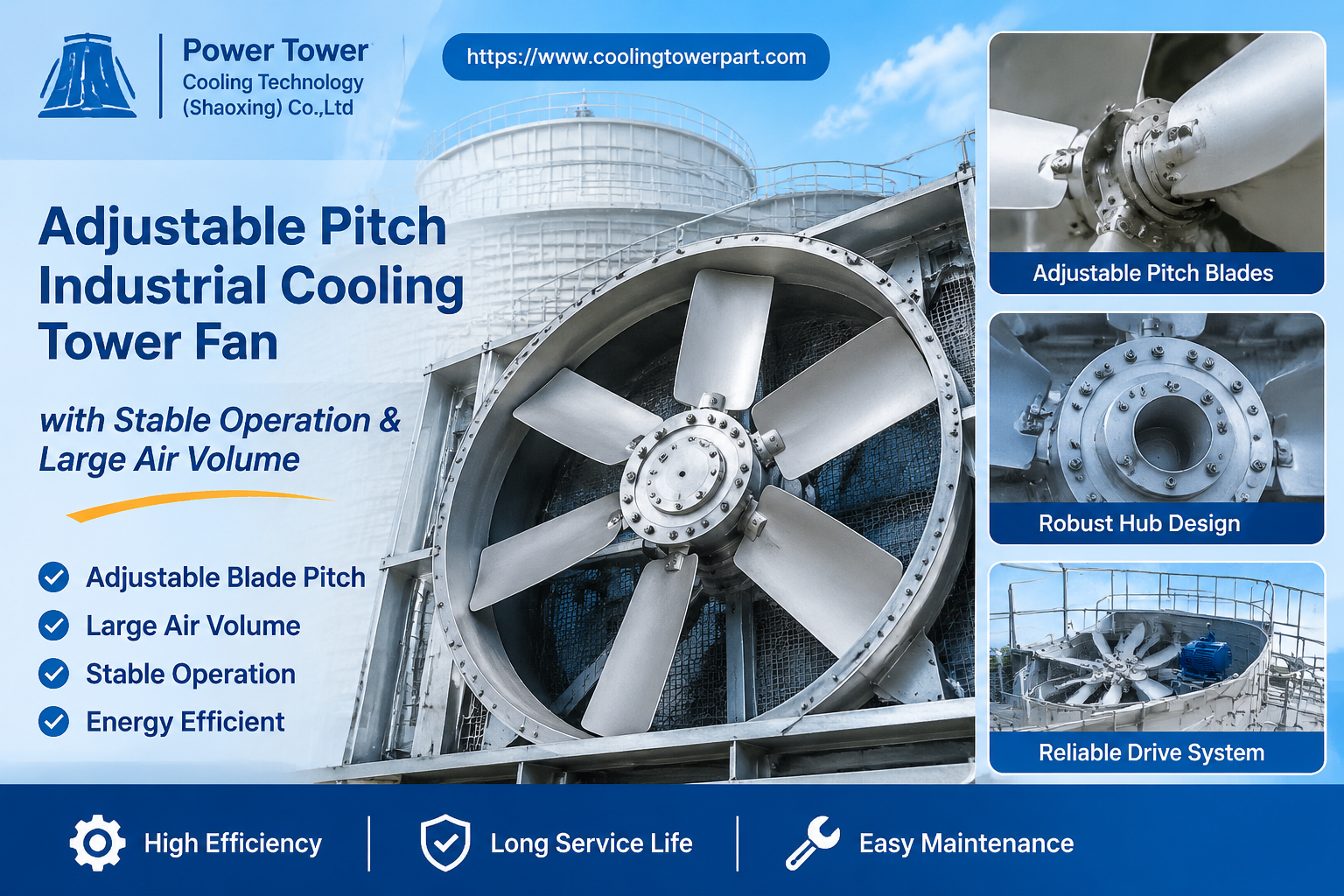
Industrial cooling towers play an essential role in removing excess heat from manufacturing processes, power generation systems, chemical plants, and large HVAC installations. To achieve reliable cooling performance, a tower needs more than efficient fill and proper water distribution. It also needs sufficient and consistent airflow.
This is where an adjustable pitch industrial cooling tower fan makes a difference.
Unlike a fixed-pitch fan, an adjustable pitch fan allows its blade angle to be configured within the manufacturer's specified range. This flexibility helps match fan performance to the cooling tower's actual operating requirements. When correctly selected and installed, it can deliver large air volume, stable operation, and dependable heat rejection.
But how does an adjustable pitch fan work? What should you consider before purchasing one? And how can you keep it operating efficiently over the long term?
In this guide, we will explore the design, advantages, applications, selection criteria, and maintenance requirements of adjustable pitch industrial cooling tower fans.
1. What Is an Adjustable Pitch Industrial Cooling Tower Fan?
An adjustable pitch industrial cooling tower fan is a mechanical ventilation device designed to move air through a cooling tower. Its blades can be set at different pitch angles during installation, commissioning, or planned maintenance, subject to the fan manufacturer's design limits.
The blade pitch angle affects how the blades interact with the surrounding air. Changing this angle changes the aerodynamic loading of the fan and can influence airflow, pressure, and power consumption.
Think of it like adjusting the angle of a boat propeller. The angle affects how effectively the propeller pushes water. A cooling tower fan works with air instead, but the basic principle is similar.
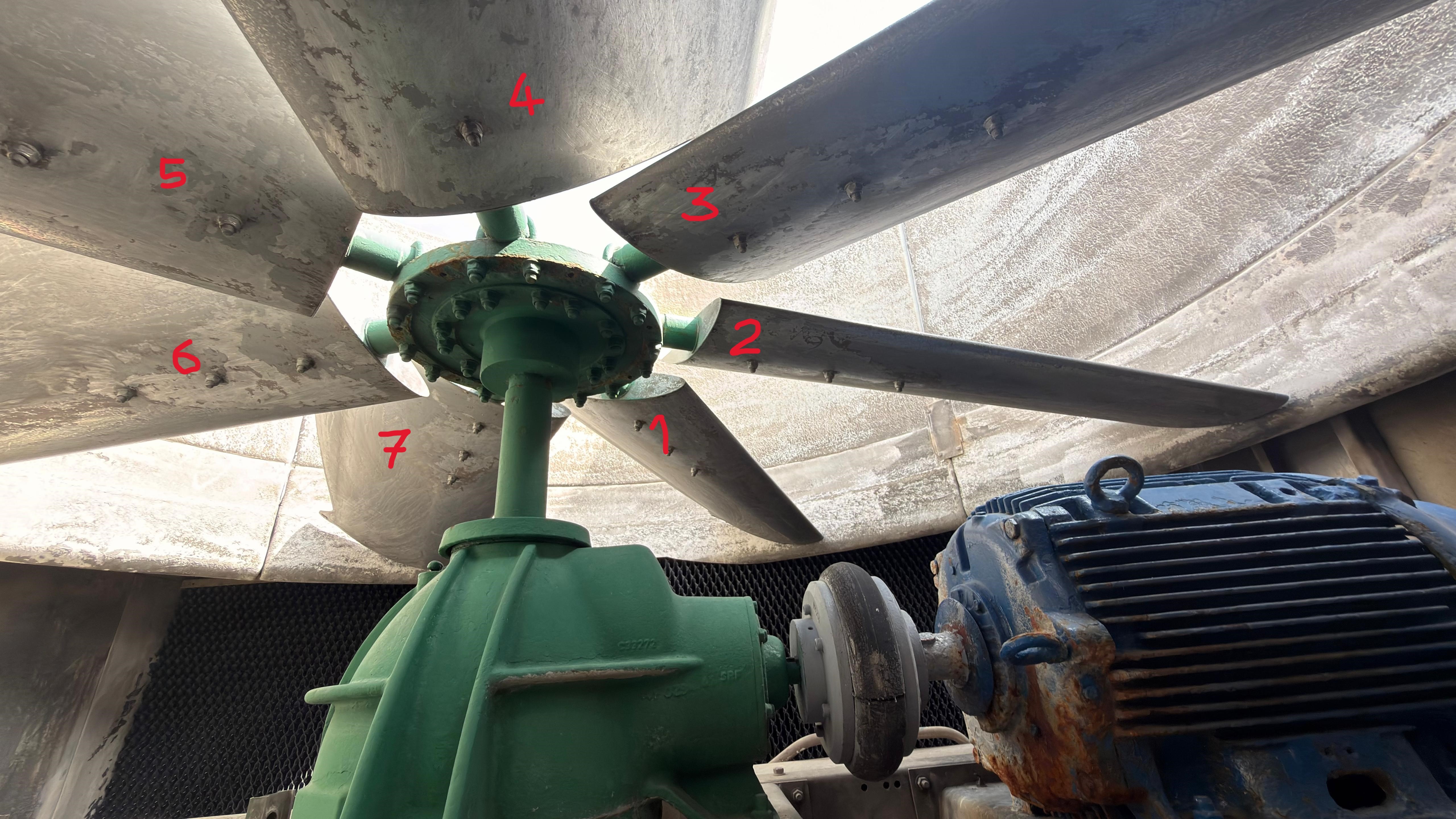
A typical adjustable pitch cooling tower fan consists of:
Fan blades
A central fan hub
Blade mounting and locking components
A drive shaft or gearbox connection
An electric motor and drive system
Supporting structures and protective components
These components must work together as a balanced assembly. Even a high-quality blade cannot deliver reliable performance if the hub, drive system, or installation is unsuitable.
Adjustable pitch industrial fans are commonly used in mechanical-draft cooling towers where airflow requirements need to match changing thermal loads or specific operating conditions.
2. Why Fan Blade Pitch Matters in Cooling Tower Performance
A cooling tower fan does more than circulate air. It creates the airflow needed for heat and mass transfer between warm circulating water and the air passing through the tower.
If airflow is too low, the cooling tower may struggle to achieve its required outlet water temperature. If airflow is unnecessarily high, the fan may consume more electricity than the process requires.
Blade pitch is one of the factors that helps determine this balance.
2.1 Understanding Blade Pitch Angle
Blade pitch angle describes the orientation of a fan blade relative to a defined reference plane or direction of rotation. The exact measurement method depends on the fan design and the manufacturer's specifications.
A higher pitch setting generally increases the aerodynamic loading on the fan. However, the actual result depends on several factors, including:
It is important not to assume that a larger pitch angle always produces better cooling. If the angle is too aggressive, the motor may become overloaded, and the fan may operate outside its recommended performance range.
2.2 How Pitch Adjustment Changes Airflow
When the blade pitch changes, the fan's operating point changes as well.
A suitable pitch setting can help the fan provide the airflow required by the cooling tower. A different setting may be appropriate when the thermal load changes, provided the fan and motor remain within their design limits.
For example, a cooling tower serving a facility with varying production loads may need different airflow configurations at different times. An adjustable pitch fan gives engineers more flexibility when configuring the system.
However, pitch adjustment should never be based on guesswork. The correct setting should be determined using manufacturer performance data, motor-load checks, and actual operating measurements.
3. How an Adjustable Pitch Cooling Tower Fan Works
The operating principle is straightforward: the motor drives the fan, the rotating blades accelerate air, and the resulting airflow passes through the cooling tower.
Reliable operation, however, depends on the relationship between the fan blades, hub, motor, drive system, and tower structure.
3.1 Fan Blades and Hub Assembly
The blades are the main aerodynamic components of the fan. Their shape, length, surface condition, and pitch angle all influence performance.
The hub holds the blades in position and transfers rotational force from the drive system. In an adjustable pitch design, the hub includes a blade mounting arrangement that allows the pitch angle to be set and secured.
A well-designed hub should provide:
Secure blade mounting
Consistent pitch adjustment
Adequate mechanical strength
Reliable locking against unwanted movement
Compatibility with the specified shaft and drive arrangement
All blades should be set to the manufacturer's specified angle. Unequal blade settings can create uneven aerodynamic loading and contribute to vibration.
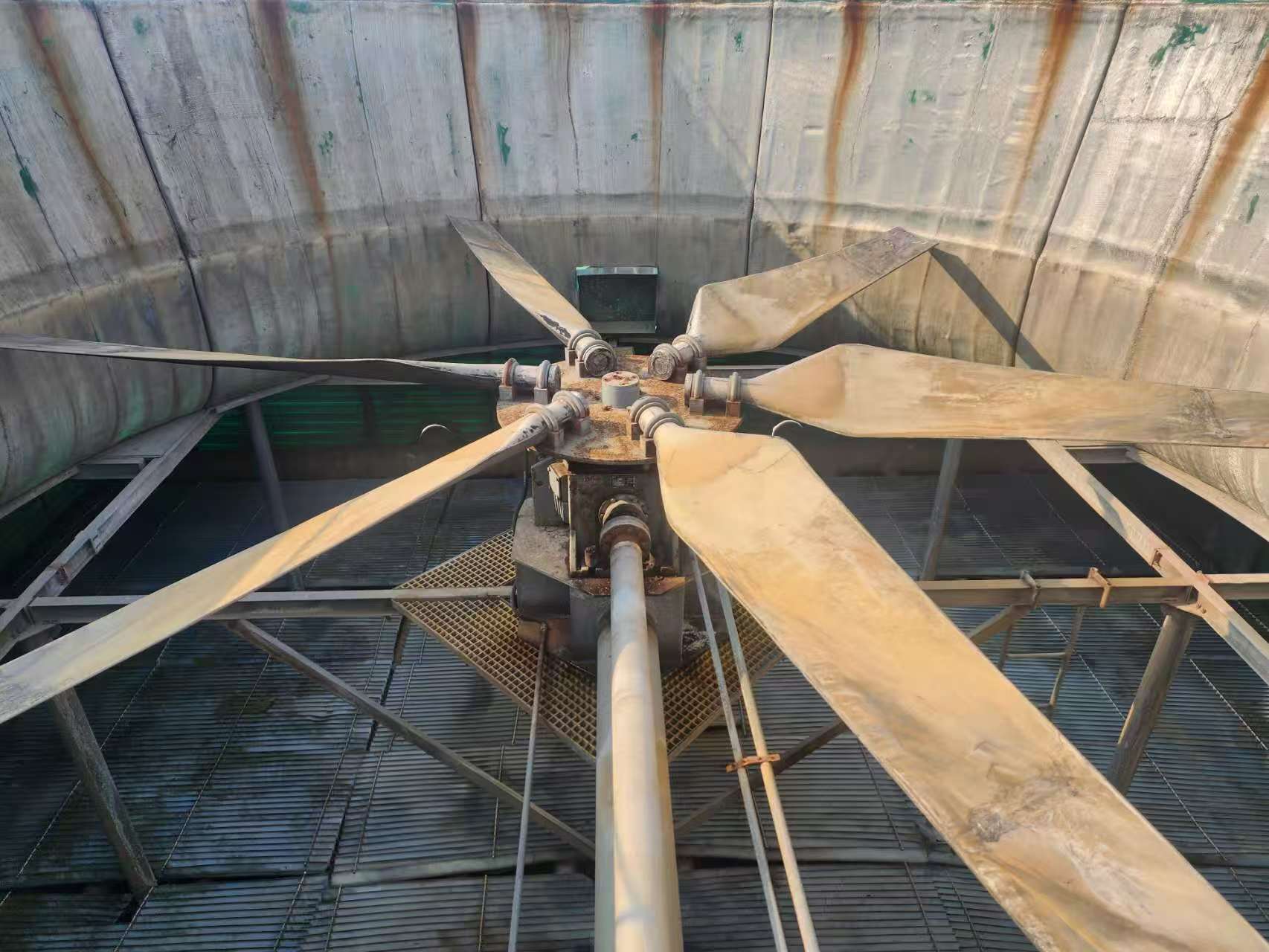
3.2 Motor and Drive System
The motor provides the power needed to rotate the fan. Depending on the cooling tower design, the drive arrangement may include a gearbox, drive shaft, coupling, or other transmission components.
The motor must be matched to the fan's operating requirements. Rated power, rotational speed, operating conditions, and starting characteristics should all be considered during selection.
The drive system also needs correct alignment and sufficient mechanical support. A well-designed fan cannot compensate for a poorly maintained gearbox or an incorrectly aligned shaft.
3.3 Airflow Through the Cooling Tower
As the fan rotates, it moves air through the tower. In a typical induced-draft cooling tower, air enters through the inlet openings, passes through the fill where it contacts circulating water, and is discharged through the upper fan stack.
This airflow supports heat rejection through evaporation and sensible heat transfer.
Actual cooling performance depends on several factors, including:
Circulating water flow rate
Hot water inlet temperature
Ambient wet-bulb temperature
Fill condition and cleanliness
Air distribution inside the tower
Fan airflow and operating efficiency
The fan is therefore one part of a complete cooling system. Its performance should always be evaluated alongside the other tower components.
4. Key Advantages of an Adjustable Pitch Industrial Fan
Why would an industrial facility choose an adjustable pitch fan instead of a conventional fixed-pitch model?
The main reason is flexibility. It allows operators and engineers to configure fan performance around the cooling tower's requirements instead of relying on one permanent blade setting.
4.1 Large Air Volume and Improved Heat Rejection
A cooling tower needs sufficient airflow to support heat rejection. An adjustable pitch fan can be configured to deliver the airflow required by the tower, subject to its aerodynamic and motor limits.
This is especially useful in large industrial facilities where heat loads can be substantial.
However, large air volume alone does not guarantee better cooling. Air must be distributed effectively through the fill, and the fan must operate against the tower's actual system resistance.
The goal is to achieve the required airflow throughout the tower, not simply to maximize fan output.
4.2 Stable Operation Under Different Conditions
Industrial cooling towers rarely operate under exactly the same conditions throughout the year.
Production schedules change. Ambient temperatures rise and fall. Process loads increase or decrease. Water conditions may also vary.
An adjustable pitch fan offers the flexibility to select a suitable operating configuration for the required duty. Once correctly set, secured, and balanced, it can provide reliable airflow for continuous industrial service.
Stable operation also depends on proper installation, blade balance, hub integrity, drive alignment, and regular maintenance.
4.3 Flexible Performance Adjustment
One major advantage is the ability to modify blade pitch during planned maintenance or commissioning.
For example, a cooling tower may initially be configured with a conservative fan setting. After the system is tested, engineers may determine that a different setting is more suitable for the actual operating conditions.
Adjusting pitch can help bring the fan closer to the required duty point, provided the change is supported by performance calculations and motor-load checks.
This makes adjustable pitch fans useful for installations where the required operating conditions may change over time.
4.4 Potential Energy Savings
Energy consumption is a major concern for facilities operating large cooling towers.
An adjustable pitch fan may help reduce unnecessary fan loading when the tower does not require maximum airflow. However, energy savings are not automatic. They depend on the fan design, operating schedule, system resistance, and how the pitch setting is selected.
For installations with changing cooling demand, combining a suitable fan design with variable-frequency drive control may provide additional operating flexibility.
The control strategy must be engineered carefully to avoid unstable operation or operation outside approved limits.
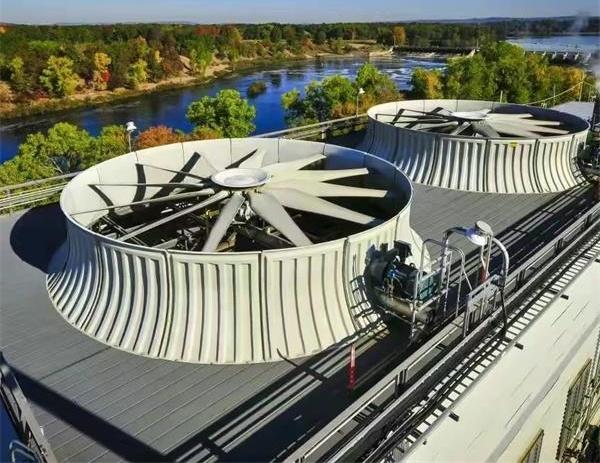
5. Common Materials Used for Cooling Tower Fan Blades
Material selection affects blade weight, corrosion resistance, stiffness, fatigue performance, and maintenance requirements. Different cooling tower environments require different material choices.
5.1 Fiber Reinforced Plastic (FRP)
FRP is widely used in industrial cooling tower fans. It offers a favorable strength-to-weight ratio and can provide good corrosion resistance when the resin system and manufacturing process are suitable for the operating environment.
Its relatively low weight can also help reduce the mechanical load on the drive system.
5.2 Aluminum Alloy
Aluminum alloy is another option for cooling tower fan blades. It is relatively lightweight and can be manufactured into aerodynamic blade profiles.
Its suitability depends on the alloy, surface protection, mechanical loading, and exposure conditions.
5.3 Stainless Steel
Stainless steel may be considered for specialized applications requiring particular mechanical or corrosion-resistance properties.
However, its higher weight can affect drive requirements and mechanical loading. The material should therefore be selected according to the complete fan design rather than corrosion resistance alone.
5.4 How to Choose the Right Blade Material
Before choosing a blade material, consider the cooling tower's:
Operating temperature
Humidity and moisture exposure
Water chemistry
Airborne contaminants
Coastal or corrosive atmosphere
Mechanical loading and rotational speed
The best material is not necessarily the most expensive one. It is the material that meets the fan's mechanical, environmental, and operating requirements over its intended service life.
6. Adjustable Pitch Fan vs. Fixed Pitch Fan
Both adjustable pitch and fixed pitch fans have important roles in industrial cooling towers.
A fixed-pitch fan is designed with a predetermined blade angle. It can be a practical choice when operating conditions are relatively consistent and the required fan duty is well established.
An adjustable pitch fan allows the blade angle to be changed during setup or planned maintenance. This provides greater flexibility when the actual operating duty needs to be fine-tuned.
| Comparison Item | Adjustable Pitch Fan | Fixed Pitch Fan |
| Blade angle | Adjustable within design limits | Predetermined |
| Commissioning flexibility | Higher | Lower |
| Initial setup | Requires accurate pitch setting | Usually simpler |
| Pitch adjustment | Possible during approved maintenance procedures | Not normally adjustable |
| Maintenance | Requires inspection of blade mounting and locking components | Requires routine blade and hub inspection |
| Typical application | Systems needing configuration flexibility | Systems with stable, known operating requirements |
Neither design is automatically better for every cooling tower. The correct choice depends on the tower's duty, control strategy, budget, maintenance capability, and expected operating conditions.
7. How to Select the Right Adjustable Pitch Cooling Tower Fan
Choosing a fan based only on diameter or motor power is risky. A fan is part of a complete air-moving system, so several parameters must be evaluated together.
7.1 Airflow and Static Pressure Requirements
Start with the required airflow and the pressure loss through the cooling tower.
The fan must overcome resistance from the air inlet, louvers, fill, drift eliminators, internal structures, and discharge arrangement.
Ask the supplier for fan performance data at the required operating point. A fan that delivers a large airflow under one test condition may perform differently when installed in a tower with higher system resistance.
7.2 Fan Diameter and Blade Number
Fan diameter influences the volume of air that can be moved and the space required for installation.
The number of blades also affects aerodynamic loading, vibration behavior, and mechanical design.
The fan must have suitable clearance from the fan cylinder or stack. Blade tips should not contact surrounding structures during operation, including under expected operating deflection.
7.3 Motor Power and Operating Speed
Motor power must be sufficient for the fan's required duty without exceeding the motor's rated limits.
When evaluating an adjustable pitch setting, check motor current and power consumption during commissioning. A pitch adjustment that increases airflow may also increase the power required by the fan.
Operating speed must match the fan manufacturer's approved range. Never increase speed simply to compensate for an unsuitable fan selection.
7.4 Blade Material and Operating Environment
Consider the cooling tower's temperature, humidity, water chemistry, airborne contaminants, and exposure to corrosive substances.
For example, an industrial cooling tower near a coastal facility may need materials and protective measures that can withstand a more corrosive atmosphere.
The supplier should understand the operating environment before recommending blade materials and hub components.
7.5 Compatibility with Existing Cooling Tower Equipment
For replacement projects, compatibility is especially important.
Check the existing fan diameter, hub connection, shaft dimensions, blade clearance, rotation direction, and mounting arrangement. Also confirm the motor and gearbox specifications.
A fan that looks similar to the original may still have different aerodynamic or mechanical characteristics. Confirming technical details before ordering can help avoid installation problems and unnecessary downtime.
8. Applications of Adjustable Pitch Industrial Cooling Tower Fans
Adjustable pitch industrial fans can be used in many mechanical-draft cooling tower applications.
Common examples include:
Power plants: Supporting heat rejection in cooling water systems where large volumes of process heat must be removed.
Chemical plants: Removing process heat from industrial equipment and supporting stable production conditions.
Petrochemical facilities: Providing airflow for large cooling tower cells operating under demanding industrial conditions.
Steel and metallurgy plants: Supporting high-temperature industrial cooling processes.
HVAC systems: Moving air through commercial and industrial cooling towers.
Manufacturing facilities: Maintaining cooling water conditions for production machinery and process equipment.
The fan configuration must always match the specific cooling tower design. A fan suitable for one tower should not be assumed to fit another simply because the diameter appears similar.
9. Common Problems and Practical Solutions
Even a well-designed industrial fan can develop problems if it is incorrectly installed, operated outside its design range, or poorly maintained.
Understanding common symptoms helps maintenance teams identify problems before they lead to major downtime.
9.1 Excessive Vibration
Vibration can result from blade imbalance, unequal pitch settings, loose fasteners, shaft misalignment, damaged blades, or worn drive components.
Start by inspecting the fan assembly and checking the blade pitch against the manufacturer's specifications. Also examine the hub, shaft, gearbox, and supporting structure.
Do not continue operating a fan with severe or rapidly increasing vibration. Shut it down safely and arrange a qualified inspection.
9.2 Insufficient Air Volume
Low airflow may be caused by an unsuitable pitch setting, incorrect fan rotation, low rotational speed, excessive system resistance, damaged blades, or air recirculation.
Check the actual operating speed and compare it with the fan design data. Inspect the air inlet, fill, louvers, and drift eliminators for blockages.
Increasing blade pitch without identifying the cause may overload the motor and fail to solve the underlying problem.
9.3 Blade Pitch Inconsistency
If blades have different pitch angles, the fan may develop uneven aerodynamic loading.
This can reduce operating stability and increase vibration.
During inspection, measure each blade using the method and reference points specified by the manufacturer. Adjust and secure the blades according to the approved procedure.
9.4 Unusual Noise and Mechanical Wear
Unusual noise may indicate loose components, damaged bearings, gearbox problems, blade contact, or structural resonance.
Inspect the complete drive system rather than focusing only on the blades. A noise that appears to come from the fan may actually originate from the motor or gearbox.
Record changes in noise and vibration over time. Trend data often helps maintenance teams identify developing problems earlier.
10. Installation and Commissioning Considerations
Correct installation is essential for stable fan operation.
Before installation, verify the fan diameter, hub configuration, shaft connection, rotation direction, blade clearance, and compatibility with the cooling tower structure.
During assembly, all blade mounting components must be installed and tightened according to the manufacturer's instructions. Pitch angles should be measured consistently, and the fan assembly should be checked for balance.
Before commissioning, inspect:
Blade condition and mounting security.
Pitch angle consistency.
Hub and shaft connections.
Motor and gearbox alignment.
Electrical connections and motor protection.
Fan cylinder clearance.
Guards and other safety devices.
The first start-up should be performed by qualified personnel using an approved commissioning procedure. Monitor vibration, motor current, rotational speed, noise, and airflow where measurement equipment is available.
If any reading exceeds the manufacturer's permitted range, stop and investigate before returning the fan to normal service.
11. Maintenance Tips for Long-Term Stable Operation
Regular maintenance helps protect the fan and the complete cooling tower drive system.
A practical maintenance program should include:
Inspecting blades for cracks, erosion, deformation, or surface damage.
Checking the hub and blade fasteners for looseness or corrosion.
Verifying blade pitch during scheduled inspections.
Monitoring fan vibration and unusual noise.
Inspecting the gearbox, bearings, coupling, and shaft.
Checking motor current and operating temperature.
Removing dirt and deposits that may affect blade balance.
Confirming that guards and safety devices remain in place.
Inspection frequency should be based on the manufacturer's recommendations, operating hours, site conditions, and maintenance history.
Important safety note: Never adjust blade pitch while the fan is rotating unless the fan is specifically engineered and approved for live adjustment. For conventional adjustable pitch assemblies, isolate the electrical supply, apply lockout/tagout procedures, verify zero energy, and follow the manufacturer's maintenance instructions.
12. How Adjustable Pitch Fans Support Energy Efficiency
Energy efficiency is not simply about using a smaller motor. It is about matching fan performance to the cooling tower's actual requirements.
A fan that operates at excessive airflow may use more power than necessary. On the other hand, insufficient airflow can reduce cooling performance and affect the wider process system.
Adjustable pitch provides a way to configure fan duty within the design limits. This can help operators find a practical balance between cooling capacity and energy consumption.
For variable-load applications, a properly engineered variable-frequency drive may offer another way to control fan speed.
Fan affinity laws provide a useful theoretical guide. For a given fan operating under comparable conditions:
Airflow varies approximately in proportion to rotational speed.
Pressure varies approximately with the square of rotational speed.
Power varies approximately with the cube of rotational speed.
Actual results depend on system resistance, fan efficiency, and operating conditions. Energy-saving estimates should therefore be based on engineering calculations and measured operating data rather than assumptions.
13. Why Choose a Professional Cooling Tower Fan Manufacturer?
A cooling tower fan is a critical rotating component. Its performance affects heat rejection, electricity consumption, mechanical reliability, and plant operation.
Choosing a professional manufacturer can help reduce selection and compatibility risks.
When comparing suppliers, consider the following factors.
Engineering Capability
Can the manufacturer evaluate airflow, static pressure, rotational speed, fan diameter, and motor power? A supplier should understand the operating requirements before recommending a fan configuration.
Product Quality
Are blade materials, hub components, and mounting parts suitable for the intended operating environment? Consistent manufacturing quality is essential for mechanical reliability.
Customization Capability
Can the supplier provide a fan configuration compatible with the existing cooling tower? Replacement projects often require careful attention to dimensions and connection details.
Technical Support
Can the supplier assist with pitch setting, installation, commissioning, and maintenance guidance? Technical support is particularly important when replacing an existing fan or modifying a cooling tower.
Manufacturing Experience
Does the supplier understand industrial cooling tower applications and the practical demands of continuous operation?
A reliable supplier should ask for operating information before recommending a product. If a supplier offers a fan based on diameter alone, request a more complete technical evaluation.
14. Power Tower Cooling Tower Fan Solutions
Power Tower Cooling Technology (Shaoxing) Co.,Ltd focuses on cooling tower components and related industrial cooling solutions.
For customers looking for an adjustable pitch industrial cooling tower fan, selecting a suitable product requires more than matching dimensions. The fan must be compatible with the cooling tower's airflow requirements, drive arrangement, installation space, and operating environment.
Power Tower aims to support customers with cooling tower component solutions for industrial applications.
When requesting a fan quotation or technical recommendation, customers can prepare the following information:
Cooling tower manufacturer and model
Existing fan diameter
Required airflow, if available
Fan rotational speed
Motor power and operating voltage
Hub and shaft connection dimensions
Number of blades
Existing blade material
Operating environment and service conditions
Providing these details makes it easier to evaluate compatibility and recommend a suitable configuration.
To learn more about cooling tower components and product solutions, visit:
Power Tower Cooling Technology (Shaoxing) Co.,Ltd
Website: https://www.coolingtowerpart.com
15. Frequently Asked Questions
15.1 What Is the Main Benefit of an Adjustable Pitch Cooling Tower Fan?
Its main benefit is configuration flexibility. The blade angle can be set to match the cooling tower's required operating duty, helping balance airflow, motor load, and cooling performance.
15.2 Can the Blade Pitch Be Adjusted During Operation?
For most conventional adjustable pitch industrial fans, pitch adjustment is performed when the fan is shut down and safely isolated. Live adjustment is only possible when the fan is specifically designed and approved for that purpose.
Always follow the manufacturer's instructions and safety procedures.
15.3 Does a Larger Pitch Angle Always Mean More Airflow?
No. A larger pitch angle generally changes aerodynamic loading, but the resulting airflow depends on the fan design, rotational speed, air density, and system resistance.
An excessive setting may increase motor load or cause the fan to operate outside its recommended range.
15.4 How Often Should a Cooling Tower Fan Be Inspected?
Inspection frequency depends on operating hours, environmental conditions, and manufacturer recommendations. Routine visual checks and vibration monitoring should be combined with scheduled mechanical inspections.
Pay particular attention to blade condition, pitch consistency, hub fasteners, shaft connections, and drive system components.
15.5 Can an Adjustable Pitch Fan Replace an Existing Fixed Pitch Fan?
It may be possible, but compatibility must be verified first. Check the fan diameter, airflow requirement, static pressure, rotational speed, motor capacity, hub connection, and installation dimensions.
A replacement fan should be selected based on the complete operating requirements rather than physical dimensions alone.
16. Conclusion
An adjustable pitch industrial cooling tower fan can provide valuable flexibility for facilities that need reliable airflow and stable cooling tower operation. By allowing the blade angle to be configured within approved limits, it helps match fan performance to actual operating requirements.
But remember: a good cooling tower fan is not just about blade pitch. Fan diameter, blade material, hub design, motor power, rotational speed, system resistance, and installation quality all matter.
The right selection starts with accurate operating data and a clear understanding of the cooling tower's requirements. Combine that with proper commissioning and regular maintenance, and your fan system can deliver dependable performance over the long term.
For industrial cooling tower fan and component solutions, contact Power Tower Cooling Technology (Shaoxing) Co.,Ltd or visit https://www.coolingtowerpart.com to discuss your application.


