PVC vs PP Cooling Tower Fill: Which Is Better?
Choosing the right cooling tower fill is essential for maintaining efficient heat transfer, reliable cooling performance, and long service life. Among the most commonly used plastic fill materials, PVC cooling tower fill and PP cooling tower fill are two popular options for industrial and commercial cooling towers.
But which one is better?
The answer depends on several factors, including operating temperature, water quality, chemical exposure, cooling tower design, maintenance requirements, and budget.
In this guide, we compare PVC vs PP cooling tower fill in detail to help you determine which material is more suitable for your cooling tower application.
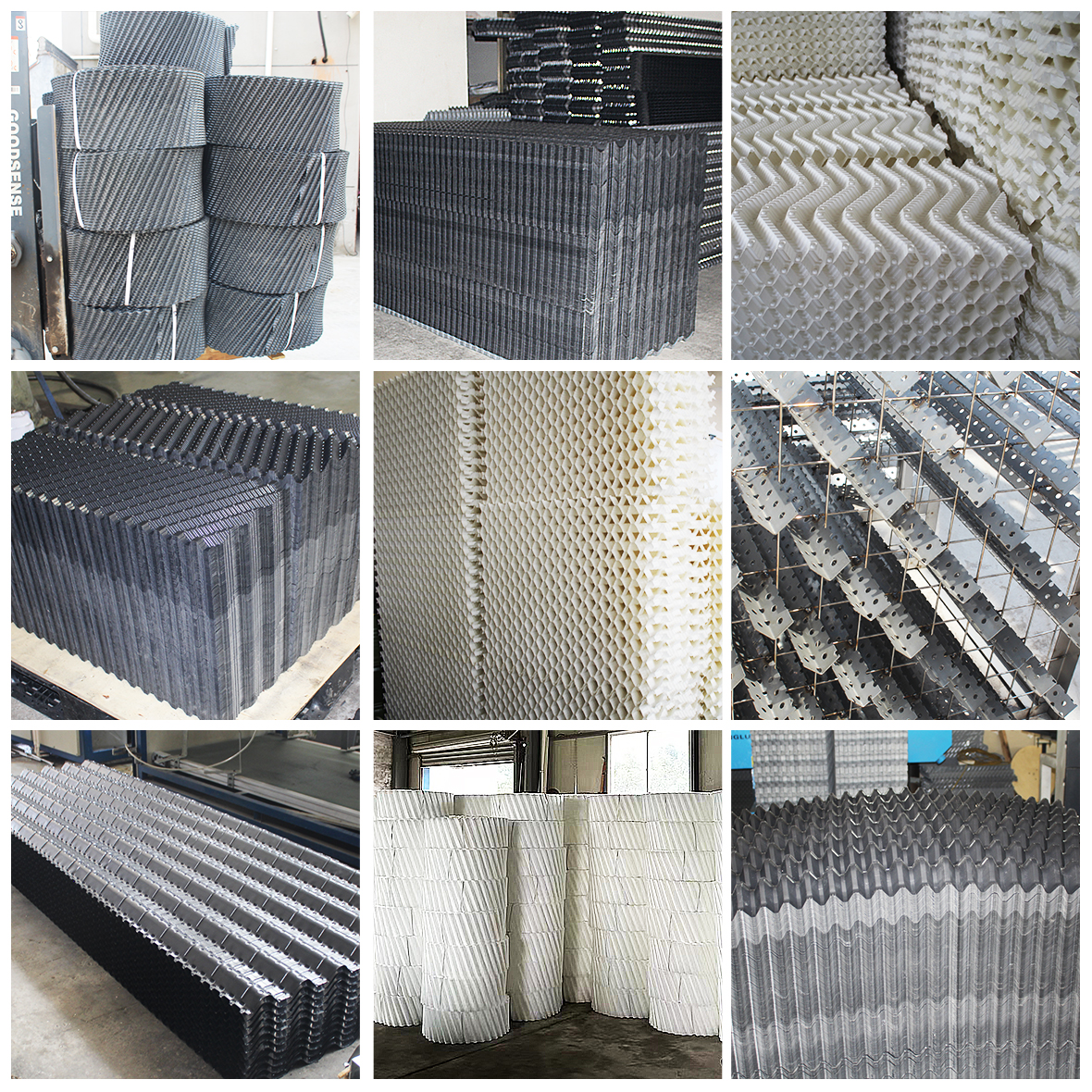
What Is Cooling Tower Fill?
Cooling tower fill is the heat-transfer media installed inside a cooling tower. Its primary function is to increase the contact area between circulating water and air.
Hot water enters the cooling tower and flows over the fill surface. Air passes through the fill at the same time. The increased contact between water and air promotes heat and mass transfer, allowing heat to be removed from the circulating water.
Why Is Cooling Tower Fill Important?
High-quality cooling tower fill can help:
Increase heat-transfer efficiency
Improve cooling capacity
Reduce the required tower size
Optimize water distribution
Improve cooling tower performance
Support lower operating costs
The performance of a cooling tower depends not only on the fill material but also on fill design, sheet thickness, water distribution, airflow, and operating conditions.
PVC vs PP Cooling Tower Fill: Quick Comparison
PVC and PP are both thermoplastic materials, but they have different performance characteristics.
| Feature | PVC Cooling Tower Fill | PP Cooling Tower Fill |
| Heat-transfer performance | Excellent | Excellent |
| Temperature resistance | Good | Better |
| Chemical resistance | Good | Excellent |
| Low-temperature performance | Good | Good |
| Lightweight | Yes | Yes |
| Cost | Generally lower | Generally higher |
| Fire characteristics | Better in many formulations | Typically more combustible |
| Common applications | General cooling towers | Higher-temperature or demanding applications |
| Maintenance | Easy | Easy |
| Service life | Good | Good to excellent |
The best choice depends on the specific operating environment.
What Is PVC Cooling Tower Fill?
PVC cooling tower fill is manufactured from polyvinyl chloride and is widely used in film-type cooling towers.
PVC is popular because it offers a combination of good heat-transfer performance, chemical resistance, mechanical strength, availability, and cost-effectiveness.
Advantages of PVC Cooling Tower Fill
PVC fill provides several important benefits.
1. Good Heat-Transfer Performance
PVC film fill is designed with corrugated or structured surfaces that spread water into thin films.
This increases the water-to-air contact area and promotes efficient heat transfer.
2. Cost-Effective
One of the biggest advantages of PVC cooling tower fill is its relatively competitive price.
For general industrial and commercial cooling applications, PVC can provide a good balance between performance and investment cost.
3. Easy to Process
PVC can be formed into various fill geometries and thicknesses, allowing manufacturers to produce different designs for crossflow and counterflow cooling towers.
4. Good Chemical Resistance
PVC provides good resistance to many chemicals commonly encountered in cooling tower water.
However, chemical compatibility should always be evaluated based on concentration, temperature, and exposure time.
Limitations of PVC Cooling Tower Fill
PVC is not ideal for every application.
Its limitations may include:
Lower temperature resistance than PP
Potential degradation under excessive heat
Sensitivity to certain chemicals
Reduced mechanical strength at elevated temperatures
For applications involving continuously high water temperatures, PP may be a more suitable option.
What Is PP Cooling Tower Fill?
PP cooling tower fill is manufactured from polypropylene.
PP is known for its excellent chemical resistance, low density, and relatively high temperature resistance. It is often selected for demanding cooling tower applications where operating conditions exceed the practical limits of standard PVC fill.
Advantages of PP Cooling Tower Fill
1. Higher Temperature Resistance
One of the most important advantages of PP is its higher temperature capability compared with standard PVC.
This makes PP cooling tower fill particularly attractive for applications where circulating water operates at elevated temperatures.
2. Excellent Chemical Resistance
PP generally provides strong resistance to many acids, alkalis, and industrial chemicals.
This can make PP suitable for challenging industrial environments.
3. Good Mechanical Performance
PP maintains useful mechanical properties across a relatively broad range of operating conditions.
It can be a suitable choice when both temperature and chemical resistance are important.
Limitations of PP Cooling Tower Fill
PP also has some disadvantages.
These may include:
Higher initial material cost
Different fire characteristics compared with PVC
Potential UV degradation if exposed to direct sunlight without suitable protection
Different processing and manufacturing requirements
Therefore, PP should be selected based on the actual application rather than simply assuming it is better than PVC.
PVC vs PP Cooling Tower Fill: Which Is Better?
There is no universal winner in the PVC vs PP cooling tower fill comparison.
The better material depends on your operating conditions.
Choose PVC Cooling Tower Fill When:
PVC is often a good choice when:
Water temperatures are within the recommended PVC range
The cooling water is relatively well treated
Cost efficiency is important
Standard industrial cooling is required
Excellent heat-transfer performance is needed
The operating environment is not extremely aggressive
For many conventional cooling towers, PVC provides an excellent balance of performance and cost.
Choose PP Cooling Tower Fill When:
PP may be preferable when:
Operating temperatures are relatively high
Chemical exposure is more aggressive
Long-term material resistance is important
The application requires higher temperature capability
The additional material cost is justified
PP is particularly attractive for demanding industrial cooling applications.
PVC vs PP Cooling Tower Fill: Temperature Resistance
Temperature is one of the most important differences between PVC and PP.
PVC Temperature Performance
PVC cooling tower fill performs well under normal cooling tower operating conditions. However, prolonged exposure to excessive temperatures can cause deformation or loss of mechanical strength.
What Happens to PVC at High Temperatures?
Excessive heat can cause PVC fill to:
Soften
Warp
Deform
Lose structural strength
Collapse under load
Therefore, the actual water temperature should always be compared with the manufacturer's recommended operating range.
PP Temperature Performance
PP generally offers better temperature resistance than standard PVC.
This makes PP more suitable for cooling systems involving higher-temperature water.
However, PP also has a maximum recommended operating temperature. Selecting PP does not mean that the fill can operate indefinitely at any temperature.
PVC vs PP Cooling Tower Fill: Chemical Resistance
Chemical exposure is another important consideration.
PVC Chemical Resistance
PVC offers good resistance to many chemicals and is widely used in water treatment environments.
It can perform well when cooling water chemistry is properly controlled.
PP Chemical Resistance
PP is known for excellent resistance to a wide range of chemicals.
This can make it advantageous in industrial applications where cooling water contains aggressive chemical compounds.
Why Does Chemical Resistance Matter?
Chemical degradation can result in:
Selecting a chemically compatible fill material can help reduce premature cooling tower fill replacement.
PVC vs PP Cooling Tower Fill: Heat-Transfer Performance
Many buyers assume that PP automatically provides better cooling performance than PVC.
This is not necessarily true.
Fill Geometry Matters
Heat-transfer performance depends heavily on fill geometry.
Important design factors include:
Corrugation angle
Surface area
Sheet thickness
Flute design
Water distribution
Airflow resistance
Fill depth
A well-designed PVC fill can provide excellent cooling performance, while poorly designed PP fill may not provide the expected results.
Water Distribution Is Critical
Even the best cooling tower fill cannot perform effectively if water is distributed unevenly.
Blocked nozzles, damaged pipes, or poor distribution can create dry areas within the fill.
Therefore, fill material should always be evaluated together with the complete cooling tower design.
PVC vs PP Cooling Tower Fill: Service Life
The service life of cooling tower fill depends on more than material selection.
Factors Affecting Fill Life
Important factors include:
Water quality
Operating temperature
Chemical concentration
Biological growth
Scaling
Suspended solids
Cleaning methods
Mechanical loading
UV exposure
Under suitable operating conditions, both PVC and PP fill can provide years of reliable service.
How to Extend Cooling Tower Fill Life
To maximize service life:
Maintain Good Water Treatment
Proper water treatment helps control scale, corrosion, algae, bacteria, and other deposits.
Inspect the Fill Regularly
Look for:
Cracks
Deformation
Scaling
Biological fouling
Blockages
Collapsed sections
Clean the Fill Properly
Avoid aggressive cleaning methods that can damage thin fill sheets.
Cleaning procedures should be appropriate for the specific fill material and tower design.
PVC vs PP Cooling Tower Fill: Cost Comparison
Cost is often an important factor when selecting fill media.
PVC Fill Cost
PVC is generally considered a cost-effective solution for standard cooling tower applications.
It can provide good thermal performance without significantly increasing initial project costs.
PP Fill Cost
PP may have a higher initial material cost, but its additional temperature and chemical resistance may justify the investment in demanding applications.
Consider Total Cost of Ownership
Instead of comparing purchase prices alone, consider:
Initial fill cost
Installation cost
Cleaning cost
Maintenance cost
Energy consumption
Replacement frequency
Production downtime
A more expensive fill can sometimes provide better long-term value if it lasts longer in a demanding environment.
PVC vs PP Cooling Tower Fill for Crossflow Towers
Crossflow cooling towers commonly use film-type fill designed to distribute water across a large surface area.
PVC is widely used in these applications because of its cost-effectiveness and good heat-transfer characteristics.
PP can be selected when higher temperature or chemical resistance is required.
What Should You Consider?
For crossflow towers, consider:
The replacement fill should be compatible with the tower's existing distribution and support system.
PVC vs PP Cooling Tower Fill for Counterflow Towers
Counterflow towers require fill specifically designed to operate with water and air moving in opposite directions.
Both PVC and PP can be used for counterflow applications.
Why Fill Design Matters
Counterflow performance depends heavily on:
Water loading
Air velocity
Fill surface area
Pressure drop
Fill height
Droplet distribution
Choosing the correct fill geometry can be just as important as choosing between PVC and PP.
How to Choose Between PVC and PP Cooling Tower Fill
Before purchasing cooling tower fill, evaluate the following factors.
1. Check Operating Temperature
Determine the normal and maximum circulating water temperature.
If the application involves higher temperatures, PP may offer a greater safety margin.
2. Analyze Water Chemistry
Review:
pH
Chlorine concentration
Biocide concentration
Total dissolved solids
Hardness
Suspended solids
Select a material compatible with the actual water chemistry.
3. Consider Cooling Tower Design
Determine whether the tower is:
Crossflow
Counterflow
Mechanical draft
Induced draft
Forced draft
The fill design must be compatible with the tower configuration.
4. Compare Initial and Long-Term Costs
Do not evaluate price alone.
Consider the expected service life, maintenance requirements, energy consumption, and replacement costs.
5. Work With an Experienced Manufacturer
A professional cooling tower fill manufacturer can help determine:
Can PVC and PP Cooling Tower Fill Be Used Interchangeably?
Not always.
Although PVC and PP fill may have similar physical appearances, their thermal, chemical, and mechanical characteristics are different.
Before Replacing PVC With PP
Check:
Fill dimensions
Fill geometry
Operating temperature
Water chemistry
Support structure
Airflow resistance
Water loading
Before Replacing PP With PVC
The same evaluation is necessary.
PVC should not automatically be used as a lower-cost substitute if the original application requires the higher temperature or chemical resistance of PP.
FAQ
Is PVC or PP better for cooling tower fill?
Neither material is universally better. PVC is often preferred for standard cooling applications because of its performance and cost-effectiveness, while PP can be a better choice for higher-temperature or chemically demanding applications.
Is PP cooling tower fill more durable than PVC?
PP can offer better temperature and chemical resistance, which may provide a longer service life in demanding environments. However, actual durability depends on operating conditions and maintenance.
Is PVC cooling tower fill cheaper than PP?
Generally, PVC is more cost-effective than PP for many standard applications. However, total project cost should also include service life, maintenance, and replacement frequency.
Which cooling tower fill is better for high-temperature water?
PP is generally more suitable for higher-temperature applications because it typically provides better temperature resistance than standard PVC.
Can PVC cooling tower fill be used for industrial cooling towers?
Yes. PVC cooling tower fill is widely used in industrial and commercial cooling towers, provided that the operating temperature and water chemistry are compatible with the material.
How often should cooling tower fill be replaced?
There is no fixed replacement interval. Cooling tower fill should be replaced when it becomes severely fouled, cracked, brittle, deformed, collapsed, or unable to provide the required cooling performance.
Conclusion: PVC vs PP Cooling Tower Fill
When comparing PVC vs PP cooling tower fill, the best choice depends on the specific application.
PVC cooling tower fill is an excellent option for many standard cooling tower systems because it offers good heat-transfer performance, chemical resistance, availability, and cost-effectiveness.
PP cooling tower fill is often more suitable for applications involving higher operating temperatures or more aggressive chemical environments.
The key is to select cooling tower fill based on temperature, water chemistry, tower design, cooling requirements, maintenance, and total cost of ownership.
Whether you need new PVC fills for cooling tower applications, PP fill media, or cooling tower fill replacement, choosing the correct material and fill design is essential for reliable long-term cooling performance.


