How to Select the Right Cooling Tower Fill for Your Application
Selecting the right
cooling tower fill is the most critical step to guarantee stable thermal performance, low energy consumption, and long service life for any wet cooling tower system. Many cooling tower operation problems, such as poor cooling efficiency, frequent clogging, and short replacement cycles, stem from mismatched cooling tower fills that fail to fit actual working conditions.
Whether you are designing a new industrial cooling tower, upgrading existing equipment, or replacing aging cooling tower fills, a scientific selection standard helps you avoid unnecessary costs and performance losses. This complete SEO guide breaks down all core factors, types, material differences, and application scenarios to help you pick the most suitable cooling tower fill for your project.
What Is Cooling Tower Fill and Why It Matters
Cooling tower fill (also known as cooling tower packing or coolingtower filler) is the core internal component of wet cooling towers. All cooling tower fills are designed to maximize the contact area between circulating water and flowing air, enabling efficient heat and mass transfer through evaporation and heat conduction.
Without properly selected cooling tower fill, cooling towers cannot reach rated cooling capacity, even with high-performance fans and water pumps. High-quality and application-matched cooling tower fills directly reduce fan energy consumption, lower maintenance frequency, and extend the overall service life of cooling tower equipment.
Core Functions of Qualified Cooling Tower Fills
Maximize Heat Exchange Efficiency
Professional
cooling tower fill forms uniform water films or fine water droplets, greatly increasing air-water contact time and area. This significantly improves evaporation heat transfer efficiency, which is the key to reducing circulating water temperature.
Stabilize System Operation
Standard cooling tower fills maintain stable airflow and water distribution, avoiding local overheating, uneven water flow, and excessive wind resistance. It ensures the cooling tower runs continuously and stably under long-term industrial working conditions.
Reduce Long-Term Operating Costs
Well-matched cooling tower fill reduces fan load and avoids frequent blockage cleaning and replacement. It effectively cuts down labor costs, energy consumption, and equipment maintenance expenses for industrial and HVAC systems.
Two Main Types of Cooling Tower Fill: Film Fill vs Splash Fill
All cooling tower fills fall into two mainstream categories: film cooling tower fill and splash cooling tower fill. Each type has unique structural advantages and applicable scenarios, and choosing according to water quality is the primary selection principle.
Film Cooling Tower Fill
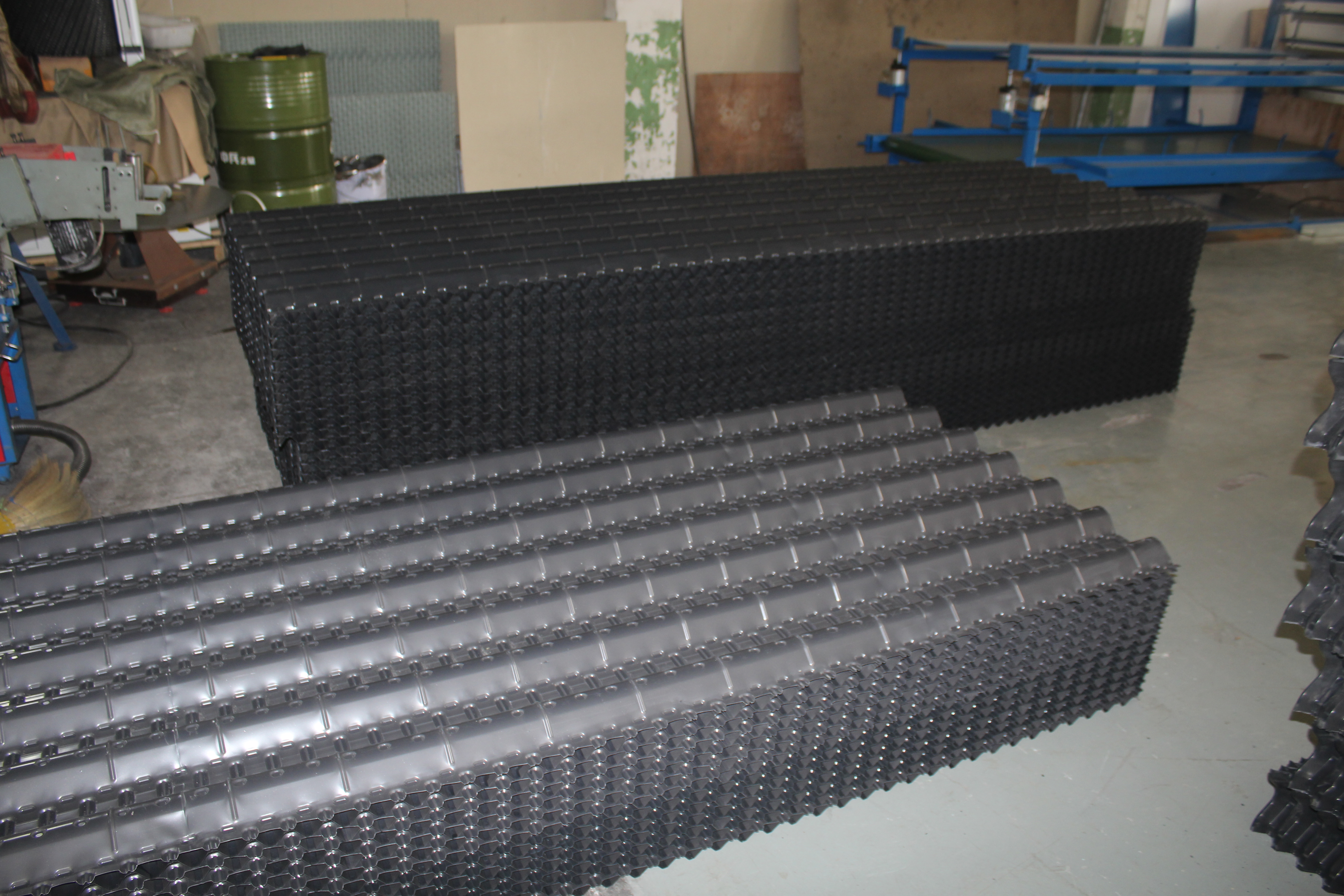
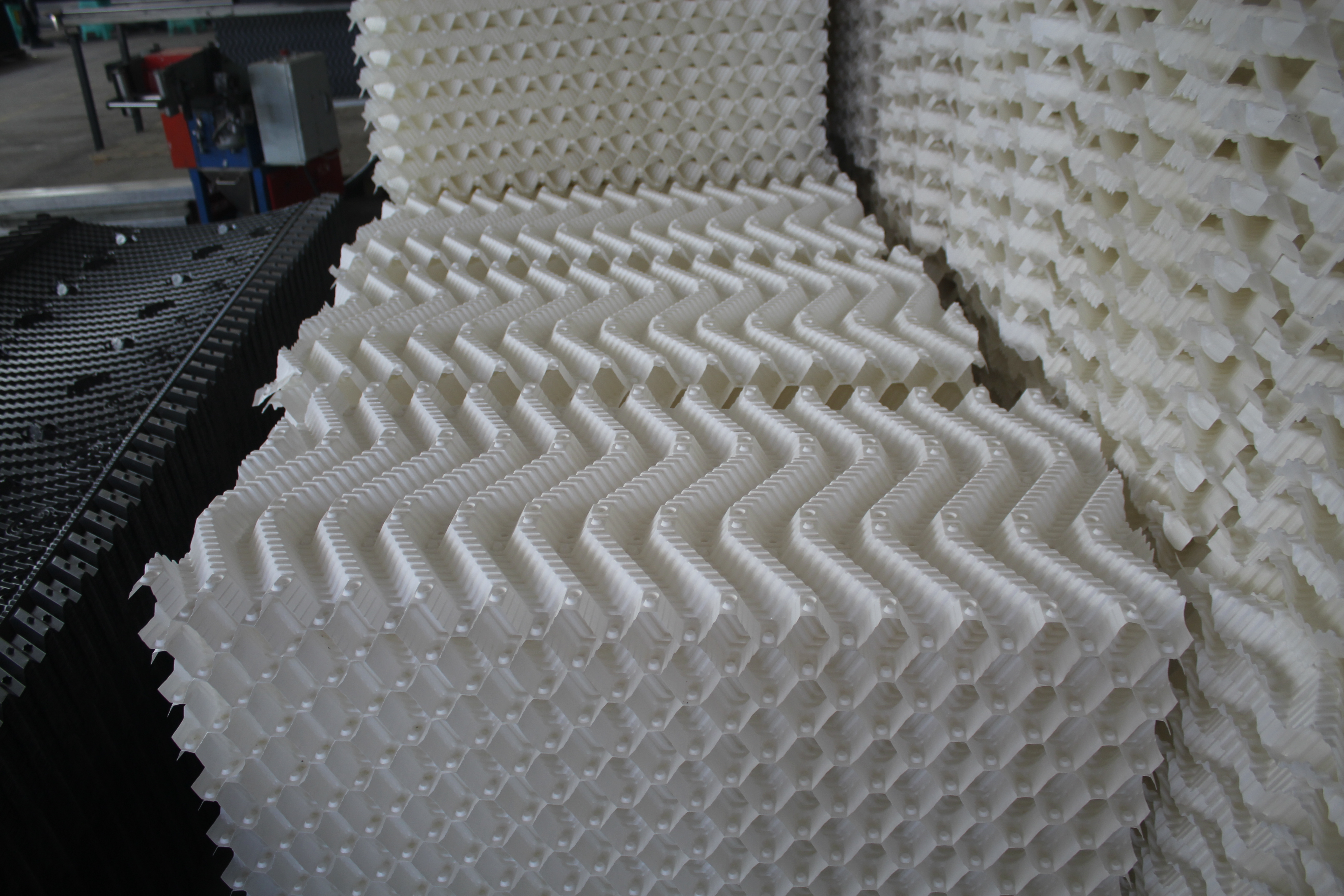
Film cooling tower fill is the most widely used cooling tower fill for high-efficiency cooling systems. It adopts corrugated sheet structures to form continuous thin water films, achieving ultra-large heat exchange area and excellent cooling performance.
Key Advantages
High heat transfer efficiency, compact installation space, low wind resistance, and stable cooling effect. It can improve the comprehensive cooling capacity of the tower by 20%-40% compared with traditional splash cooling tower fills.
Best Application Scenarios
Suitable for clean circulating water environments, including commercial HVAC systems, central air conditioning cooling towers, and industrial production lines with low suspended solids and low impurity content.
Splash Cooling Tower Fill
Splash cooling tower fill adopts special structural design to break falling water into fine droplets, realizing heat exchange through droplet-air contact. This type of cooling tower fill focuses on anti-clogging performance rather than extreme efficiency.
Key Advantages
Excellent anti-fouling and anti-clogging ability, not easy to accumulate sediment, sludge and impurities. It features simple structure, easy cleaning and maintenance, and strong environmental adaptability.
Best Application Scenarios
Ideal for poor water quality conditions with high suspended solids, industrial wastewater circulation, chemical plants, steel mills, and sewage treatment supporting cooling towers.
Cooling Tower Fill Material Selection: PVC vs PP
The material of cooling tower fill determines its temperature resistance, chemical corrosion resistance, service life and safety. PVC and PP are the two mainstream materials for industrial and commercial cooling tower fills, with obvious performance differences.
PVC Cooling Tower Fill
PVC cooling tower fill is the most cost-effective and versatile cooling tower fill material, widely used in conventional cooling projects.
Performance Features
Light weight, high toughness, good flame retardancy, stable chemical properties, and low cost. The maximum continuous working temperature is 55°C-60°C, meeting most HVAC and normal-temperature industrial cooling demands.
Applicable Cases
Commercial buildings, shopping malls, office building central air conditioning cooling towers, food processing factories, and general light industrial cooling systems with normal water temperature and clean water quality.
PP Cooling Tower Fill
PP cooling tower fill is a high-grade industrial cooling tower fill, designed for high-temperature and corrosive working conditions.
Performance Features
Super high temperature resistance (up to 75°C-80°C), excellent acid and alkali corrosion resistance, strong anti-aging ability, and longer service life than PVC cooling tower fills. The only disadvantage is higher production cost.
Applicable Cases
Chemical industry, pharmaceutical factories, power plants, steel mills, and high-temperature process cooling systems with corrosive circulating water or long-term high water temperature.
Key Technical Factors to Select Cooling Tower Fills
Besides type and material, multiple technical parameters must be confirmed to select the most matching cooling tower fill. Ignoring these details will lead to reduced cooling efficiency, clogging deformation or premature aging of cooling tower fills.
Cooling Tower Structure Type
Cross-Flow Cooling Tower
Cross-flow towers require large-area and low-resistance cooling tower fills. S-wave film cooling tower fills and conventional splash cooling tower fills are the best choices, matching the horizontal air intake structure to ensure uniform heat exchange.
Counter-Flow Cooling Tower
Counter-flow towers have higher heat exchange requirements, suitable for high-density corrugated film cooling tower fills. The vertical air-water countercurrent structure gives full play to the high-efficiency heat transfer advantage of film cooling tower fills.
Actual Water Quality Condition
Water quality is the core factor determining the type of cooling tower fills. Clean water with low suspended solids adapts to high-efficiency film cooling tower fills; water containing sludge, sediment, oil and industrial impurities must choose anti-clogging splash cooling tower fills or wide-flute film cooling tower fills.
Operating Temperature Range
Confirm the maximum continuous working water temperature of the cooling tower. Below 60°C, PVC cooling tower fill is sufficient and cost-effective; above 60°C, PP cooling tower fill must be used to avoid thermal deformation, aging and damage of cooling tower fills.
Installation Requirements: Glued vs Unglued
Pre-Glued Cooling Tower Fill Blocks
Pre-assembled glued cooling tower fills are easy to install, no on-site assembly required, suitable for rapid replacement and new tower projects, saving construction time.
Unglued Loose Cooling Tower Fills
Unglued loose sheets have lower transportation costs, flexible combination dimensions, suitable for special-sized cooling towers and customized engineering projects.
Industry-Specific Cooling Tower Fill Selection Guide
Different industries have differentiated demands for cooling tower fills. Targeted selection according to industry working conditions can maximize the service performance and lifespan of cooling tower fill.
HVAC & Commercial Cooling
Working conditions are stable with clean water and normal temperature. Recommended configuration: PVC film cooling tower fill, which balances high efficiency and low cost, fully meeting building cooling demands.
Chemical & Pharmaceutical Industry
Circulating water has weak corrosiveness and high temperature. Recommended configuration: PP high-temperature resistant cooling tower fill to resist chemical corrosion and thermal aging.
Metallurgy & Power Industry
Water contains a large amount of suspended solids and high-temperature process water. Recommended configuration: PP splash cooling tower fill, anti-clogging and high-temperature resistant, adapting to harsh industrial environments.
Sewage & Wastewater Treatment
Water quality is complex with many impurities. Recommended configuration: anti-fouling splash cooling tower fills, easy to clean and not easy to accumulate dirt.
Common Selection Mistakes to Avoid for Cooling Tower Fills
Blindly Pursue High Efficiency
Many buyers only choose high-density film cooling tower fills for efficiency, ignoring poor on-site water quality. This will cause rapid clogging of cooling tower fills, increased wind resistance, and sharp drop in cooling effect, resulting in frequent replacement.
Ignore Temperature Resistance Parameters
Using ordinary PVC cooling tower fills in high-temperature working conditions will cause permanent deformation and aging of cooling tower fills in a short time, greatly shortening service life and increasing maintenance costs.
Mismatch Tower Structure and Fill Size
Unmatched size and structural type of cooling tower fills will lead to air and water leakage, reduce overall heat exchange efficiency, and cannot give full play to the performance of qualified cooling tower fill products.
FAQ About Cooling Tower Fill Selection
Which is better, film fill or splash cooling tower fill?
There is no absolute better option. Film cooling tower fill has higher heat transfer efficiency for clean water systems; splash cooling tower fills are more practical and durable for dirty and high-impurity water environments.
How long does cooling tower fill last?
Under matched working conditions, PVC cooling tower fills can last 3-5 years, and PP cooling tower fills can last 5-8 years. Unmatched selection will reduce the service life by more than half.
Is customized cooling tower fill necessary?
For non-standard cooling tower sizes and special industrial working conditions, customized cooling tower fills can ensure perfect fitting, optimize cooling performance, and avoid equipment hidden dangers caused by size mismatch.
Final Conclusion
Selecting the right cooling tower fill is a systematic work that combines working conditions, equipment parameters and industry attributes. The best cooling tower fills are not the most expensive ones, but the ones that perfectly match your water quality, temperature, tower type and application scenarios.
By distinguishing film and splash cooling tower fills, choosing PVC or PP materials reasonably, and avoiding common selection mistakes, you can maximize cooling tower efficiency, reduce operating costs, and ensure long-term stable operation of cooling equipment. For professional customized cooling tower fill solutions, you can consult reliable cooling tower fill manufacturers for targeted technical support.