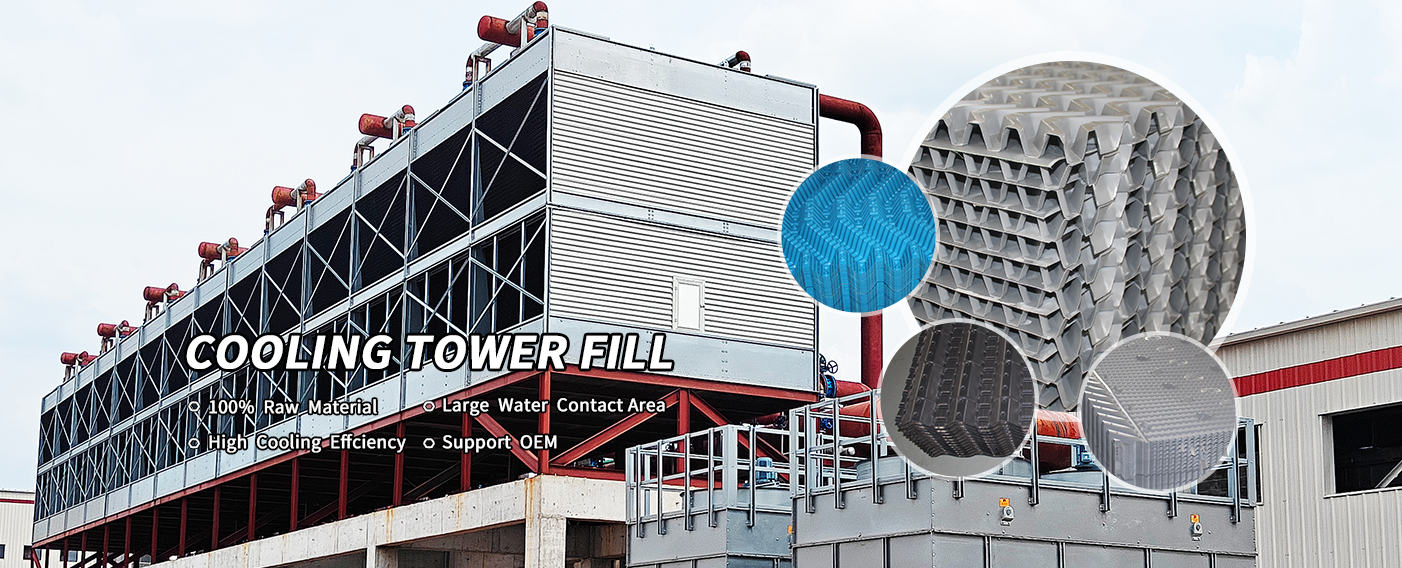
If you operate an industrial cooling tower in Malaysia, you already know that cooling performance cannot be taken for granted.
A tower may run continuously for years, but its internal components do not last forever. Eventually, the cooling tower fill can become clogged, brittle, warped, scaled, or simply less effective than it was when new.
And when that happens, replacing the fill can be far more practical than replacing the entire cooling tower.
But here's the catch: not every replacement fill is suitable for every industrial tower.
The right choice depends on tower configuration, water quality, operating temperature, thermal duty, fill geometry, and installation dimensions.
This guide explains what Malaysian industrial buyers should know before purchasing cooling tower replacement fill in Malaysia.
Why Cooling Tower Replacement Fill Matters in Malaysia
Cooling tower fill is the heat-transfer media installed inside the tower.
Its basic job is to increase the effective contact between hot water and air. As water flows over the fill, air passes through it, creating the conditions needed for heat and mass transfer and evaporation.
In other words, the fill is where much of the cooling action actually happens.
Brentwood explains that fill media increase the contact surface area and contact time between air and water, helping more waste heat evaporate.
So what happens when the fill becomes damaged?
The water may no longer distribute properly. Air passages can become blocked. Heat transfer can decline.
It is a little like trying to breathe through a dirty filter.
The cooling tower may still be running, but it is no longer working as efficiently as it should.


The Role of Fill in Industrial Cooling
Industrial cooling towers often have one job that cannot be postponed: reject heat continuously.
Depending on the facility, that heat may come from:
Cooling tower fill helps create a large water-air interface inside a relatively compact space.
That is why the fill geometry matters so much.
A well-designed film fill can spread water into thin layers across structured sheets. Splash fill, on the other hand, breaks water into droplets as it falls through the tower.
Different roads, same destination: better heat transfer.
Why Old Fill Loses Performance
Cooling tower fill does not necessarily fail overnight.
Usually, performance declines gradually.
Scale starts building up.
Algae or biological deposits appear.
Suspended solids settle inside channels.
Plastic sheets become brittle.
Some sections deform.
Water distribution becomes uneven.
Eventually, the tower may struggle to reach the required cold-water temperature.
This gradual decline is precisely why industrial operators sometimes miss the warning signs.
The tower is still running.
The fan is still turning.
The pump is still circulating water.
But the system is quietly losing efficiency.
When Should Industrial Cooling Tower Fill Be Replaced?
There is no universal replacement interval for every cooling tower.
Instead, replacement should be based on actual condition and operating performance.
Here are some of the biggest warning signs.
Reduced Cooling Performance
If the tower previously delivered a certain cold-water temperature but now consistently performs worse under similar conditions, the fill deserves inspection.
Of course, fill is not the only possible cause.
Fan performance, water flow, nozzle condition, ambient wet-bulb temperature, drift eliminators and water distribution can also affect performance.
But if the fill is visibly damaged or fouled, it becomes an obvious suspect.
Scaling, Fouling and Blockage
This is one of the biggest problems in industrial applications.
Scale and suspended solids can gradually narrow the passages between fill sheets.
Biological growth can create another layer of resistance.
The result?
Less effective heat-transfer area and potentially more airflow resistance.
For replacement projects, simply installing another identical fill may not always be the smartest solution. If the original design fouled quickly, it may be worth considering a more fouling-resistant alternative.
Brentwood specifically notes that replacing a fouled film fill with an identical design can lead to the same problem again, and recommends considering fouling-resistant alternatives where appropriate.
Cracked, Brittle or Deformed Fill
Physical damage is another obvious warning sign.
Look for:
Cracked sheets
Broken modules
Collapsed fill
Warped sections
Loose blocks
Missing pieces
Heavy discoloration
Excessive deposits
Once the fill loses its original shape, water and air may no longer follow the intended paths.
That can reduce the effective cooling area.
Types of Cooling Tower Replacement Fill for Malaysia
Choosing replacement fill starts with understanding the available types.
For industrial cooling towers, the most common options include PVC film fill, PP fill, and splash fill.
PVC Film Fill
PVC film fill is widely used because it provides a practical combination of thermal performance, cost, weight, and processability.
It uses corrugated sheets to spread water across a large surface area.
Power Tower's cooling tower fill portfolio includes PVC film fill and replacement products for different cooling tower configurations. (Cooling Tower Parts)
PVC can be suitable for:
The important point is to select the PVC formulation and fill design according to actual operating conditions.
PP Cooling Tower Fill
PP, or polypropylene, is another important option.
It is often considered for applications where operating temperature or chemical conditions are more demanding.
For example, Power Tower's product information describes PP as an option for applications requiring higher temperature or chemical resistance than conventional PVC can provide. (Cooling Tower Parts)
But don't make the mistake of thinking:
"PP is always better than PVC."
It isn't.
The material should match the application.
A properly designed PVC fill can outperform an unsuitable PP product simply because it is better matched to the tower and operating conditions.
Splash Fill for Poor Water Quality
Industrial water is not always clean.
That's reality.
If your circulating water contains high levels of suspended solids, dust, sand, sludge, or process contaminants, tightly spaced film fill may be more vulnerable to fouling.
This is where splash fill can become attractive.
Splash fill breaks falling water into smaller droplets, increasing the air-water interface while maintaining a more open structure.
Brentwood specifically positions modular and splash fills for applications where poor water quality and high suspended solids make conventional film fill less suitable. (Brentwood Industries)

PVC vs PP Cooling Tower Replacement Fill
So, PVC or PP?
The answer depends on your conditions.
| Factor | PVC Fill | PP Fill |
| Initial cost | Generally lower | Generally higher |
| Typical temperature capability | Suitable for many standard applications | Often preferred for higher-temperature applications |
| Chemical resistance | Good in many applications | Generally stronger in demanding conditions |
| Common use | HVAC and general industrial cooling | Demanding industrial/process applications |
| Processing | Excellent | Excellent |
| Weight | Lightweight | Lightweight |
| Best approach | Standard operating conditions | Higher-temperature or aggressive conditions |
These are general selection principles, not universal material limits. Always confirm the actual specifications of the product being purchased.
When PVC Is the Better Choice
PVC is often the sensible option when:
Water chemistry is reasonably controlled
Operating temperature is within the product's rated range
The tower uses film fill
Initial project cost matters
The application is conventional industrial cooling
For many industrial facilities, there is no reason to pay extra for a material capability they do not actually need.
When PP Makes More Sense
PP deserves closer attention when:
Water temperature is higher
Chemical exposure is more demanding
Material stability is a major concern
The application is difficult for standard PVC
Long-term durability justifies a higher initial investment
Again, don't select PP simply because it sounds more "industrial."
Select it because your operating conditions require it.
Crossflow vs Counterflow Replacement Fill
This is one of the first questions your supplier should ask:
Is your cooling tower crossflow or counterflow?
Why?
Because the airflow and water-flow arrangements are different.
Crossflow Cooling Tower Fill
In a crossflow tower, air generally moves horizontally through the fill while water flows downward.
The fill must therefore work with the existing air inlet, water distribution and tower geometry.
Crossflow replacement fill is commonly available in hanging-sheet and modular pack configurations.
Some replacement products are designed specifically to replace original hanging sheets with rigid modules, making installation and basin maintenance easier. Brentwood's XF75 is one example of a crossflow replacement fill designed for package towers. (Brentwood Industries)
Counterflow Cooling Tower Fill
In a counterflow tower, air travels upward while water flows downward.
This creates a different heat-transfer environment.
The fill needs to be compatible with:
Air velocity
Water loading
Fill height
Flute design
Pressure drop
Water distribution
Don't assume that crossflow and counterflow fill are interchangeable.
They aren't.
Industrial Applications in Malaysia
Malaysia has a broad industrial base, and cooling towers are used across many facilities where continuous heat rejection is necessary.
Power Plants and Energy Facilities
Power-generation facilities place heavy demands on cooling equipment.
Cooling tower fill may need to handle:
Power Tower's industrial cooling information includes PVC film fill applications for power-plant cooling, while also identifying splash-type solutions for higher-TSS and more demanding water conditions. (Cooling Tower Parts)
For these projects, material selection should be based on actual plant conditions rather than generic product descriptions.
Chemical and Petrochemical Plants
Chemical facilities can expose cooling tower fill to more challenging water chemistry.
Chemical compatibility becomes particularly important.
In these environments, PP may deserve consideration depending on temperature and chemical exposure.
But material selection should always be checked against the actual chemical composition, concentration and operating temperature.
Manufacturing and Process Cooling
Manufacturing facilities can have very different cooling requirements.
A plant may use a cooling tower for:
Injection molding
Metal processing
Compressor cooling
Furnace auxiliaries
Heat exchangers
Process equipment
Here, reliability often matters just as much as peak thermal performance.
A fill that requires constant cleaning may be a poor choice even if it offers excellent theoretical performance.
Food and Beverage Plants
Food and beverage facilities also use cooling towers for process and utility cooling.
In these applications, water treatment, cleanliness, fouling control and maintenance accessibility can become important factors.
The replacement fill should be selected around the complete cooling-water system, not in isolation.

How Malaysian Water Quality Affects Fill Selection
Here's something every industrial buyer should remember:
Water quality can matter more than the product catalog.
You might find a fill with excellent thermal performance on paper.
But if your water contains large amounts of suspended solids, that fill may become clogged much faster than expected.
High TSS and Suspended Solids
High total suspended solids can enter cooling systems through makeup water, process contamination, environmental dust, or inadequate water treatment.
For these conditions, more open fill structures may be preferable.
Brentwood's splash-fill products are specifically positioned for highly compromised waters and applications with high levels of suspended solids. (Brentwood Industries)
Scale and Biological Growth
Scale and biological growth create another challenge.
They gradually cover surfaces and restrict passages.
A cooling tower fill cleaning program can help, but once the fill is severely damaged or permanently deformed, cleaning may no longer be enough.
At that point, replacement becomes the more practical option.
Power Tower's replacement guidance recommends inspecting the fill together with supports, nozzles, distribution pipes, drift eliminators and other tower components during a replacement project. (Cooling Tower Parts)
How to Measure Cooling Tower Fill Before Replacement
Before asking for a quotation, measure the existing fill.
This sounds obvious.
Yet it is one of the most common places where replacement projects go wrong.
Record:
Fill length
Fill width
Fill height
Number of blocks
Fill volume
Sheet thickness
Flute spacing
Flute direction
Material
Support arrangement
Take photographs from several angles.
If possible, provide the tower model and original drawings.
Dimensions and Fill Volume
Don't estimate dimensions by looking at the tower from outside.
Open the access area and measure the actual fill section whenever it is safe to do so.
For replacement projects, even a relatively small dimensional error can cause installation problems.
Flute Direction, Spacing and Thickness
These details matter because fill geometry influences:
Water distribution
Airflow
Heat transfer
Pressure drop
Fouling tendency
Power Tower recommends providing tower dimensions, existing fill dimensions, operating temperature, water flow, water quality and photos when requesting customized replacement fill. (Cooling Tower Parts)

How to Choose a Cooling Tower Replacement Fill Supplier in Malaysia
You don't necessarily need a supplier located inside Malaysia.
For many industrial projects, an experienced overseas manufacturer can provide the fill directly, while a local contractor handles inspection and installation.
The key is to make sure the supplier understands replacement applications.
Check Custom Manufacturing Capability
An older cooling tower may use:
A supplier that can manufacture according to drawings, dimensions or samples gives you more options.
Power Tower's product range includes multiple cooling tower fill configurations, including crossflow, counterflow, PVC and PP replacement products. (Cooling Tower Parts)
Ask for Material and Quality Information
Don't just ask:
"How much per cubic meter?"
Ask:
What material is used?
What is the sheet thickness?
What is the flute spacing?
What temperature range is supported?
Is the fill suitable for my water quality?
What tower configurations does it fit?
Can you manufacture to my dimensions?
What quality checks are performed?
A serious manufacturer should be able to answer these questions clearly.
Consider Shipping and Installation
For Malaysian industrial projects, logistics should be considered from the beginning.
Replacement fill can occupy significant shipping volume even when the material itself is lightweight.
Therefore, ask about:
This helps avoid a situation where the fill arrives but the project team is still missing critical information.
Why Choose Power Tower Cooling Technology?
Power Tower Cooling Technology (Shaoxing) Co.,Ltd. specializes in cooling tower components and replacement solutions, including PVC and PP cooling tower fill.
Its official cooling tower fill portfolio includes crossflow and counterflow products, PVC film fill, PP filler, replacement fill packs and products compatible with a range of established cooling tower configurations. (Cooling Tower Parts)
For an industrial buyer, the biggest advantage is flexibility.
Instead of treating replacement fill as a simple commodity, the project can be evaluated around:
Tower type
Existing fill
Dimensions
Material
Water temperature
Water quality
Fouling risk
Thermal requirements
Installation conditions
This is particularly useful when the original cooling tower fill is discontinued or when the existing tower has been modified over the years.
For product information and quotation requests, visit the official website of Power Tower Cooling Technology (Shaoxing) Co.,Ltd..
Cooling Tower Fill Replacement Process
Replacing cooling tower fill is not simply a matter of removing the old plastic and dropping in new material.
The entire heat-transfer section should be inspected.
Inspection and Preparation
Before starting:
Shut down the cooling tower.
Isolate electrical equipment.
Stop water circulation.
Drain the basin as required.
Follow site safety procedures.
Confirm the replacement fill specifications.
Inspect the support structure.
Power Tower's replacement guidance recommends checking the tower's supports, water-distribution components and internal condition before installing new fill. (Cooling Tower Parts)
Removing Old Fill
Old fill may be brittle or heavily fouled.
Remove it carefully.
Do not allow broken pieces, scale or debris to enter pumps or other equipment.
Heavily fouled fill may need to be removed in smaller sections.
Safety matters here. Cooling tower interiors can be slippery, confined, wet and structurally complex.
Installing New Fill
Before installation, clean the basin and fill-support area.
Then:
Check support beams
Install fill blocks correctly
Maintain the correct orientation
Avoid unnecessary gaps
Secure the blocks
Check edge sealing
Restore drift eliminators
Restore water distribution components
Incorrect flute orientation can affect water flow, airflow and heat-transfer performance. (Cooling Tower Parts)
Final Testing and Commissioning
After installation, restart the tower and monitor:
Hot-water temperature
Cold-water temperature
Water flow
Fan operation
Airflow
Spray pattern
Vibration
Motor load
Pressure drop
Compare the results with historical operating data where possible.
A new fill should not be judged simply by whether it "fits."
The real test is whether the cooling tower performs as required.


Common Mistakes to Avoid
Choosing Only by Price
The lowest quotation is not automatically the lowest-cost solution.
Consider energy consumption, maintenance, service life and installation cost.
Ignoring Water Quality
A high-efficiency film fill may not be suitable for heavily contaminated water.
Failing to Measure Existing Fill
"Almost the same size" is not good enough.
Ignoring Tower Configuration
Crossflow and counterflow towers require different fill arrangements.
Replacing Fill Without Inspecting Supports
Damaged support beams can cause new fill to deform or collapse.
Installing Without Checking Water Distribution
Even excellent fill cannot perform properly when the water distribution system is blocked or uneven.
Final Takeaway
Finding the right cooling tower replacement fill in Malaysia is not simply about buying plastic fill media at the lowest price.
For industrial applications, you need to consider the entire operating environment.
Start with the basics:
What type of tower do you have?
What is the water quality?
What are the operating temperatures?
What are the existing fill dimensions?
How severe is the fouling problem?
Do you need PVC, PP, film fill or splash fill?
Once these questions are answered, selecting the right replacement becomes much easier.
For standard industrial applications, PVC film fill can provide an attractive balance of thermal performance and cost. For higher-temperature or chemically demanding applications, PP may deserve consideration. For heavily contaminated water, splash or other fouling-resistant designs may provide better long-term reliability.
Most importantly, don't treat replacement fill as an isolated component.
It is part of a complete cooling system.
The right fill should work with your water distribution, airflow, fan, support structure, operating temperature and water-treatment strategy.
For Malaysian industrial buyers looking for customized cooling tower fill and replacement solutions, Power Tower Cooling Technology (Shaoxing) Co.,Ltd. can evaluate requirements based on tower configuration, dimensions, material and operating conditions. (Cooling Tower Parts)
Frequently Asked Questions
What is cooling tower replacement fill?
Cooling tower replacement fill is new heat-transfer media installed in an existing cooling tower after the original fill has become damaged, fouled, deformed, or thermally ineffective.
What type of fill is best for industrial cooling towers?
There is no universal answer. PVC film fill is widely used for conventional applications, while PP and splash-type fill may be better suited to higher-temperature, chemically demanding, or high-solids water conditions.
How do I know if my cooling tower fill needs replacement?
Common signs include declining cooling performance, visible scale, heavy fouling, cracked or brittle sheets, deformation, blocked passages, poor water distribution, and increased operating problems.
Can Power Tower supply cooling tower replacement fill to Malaysia?
Power Tower Cooling Technology (Shaoxing) Co.,Ltd. provides cooling tower fill and replacement solutions for different tower configurations and can evaluate customized requirements based on dimensions, materials and operating conditions. (Cooling Tower Parts)
What information should I send when requesting a quotation?
Provide the cooling tower brand and model if available, crossflow or counterflow configuration, existing fill dimensions, fill depth, water flow, hot and cold water temperatures, water quality, photographs, drawings, and material requirements.
Is PVC or PP better for Malaysian industrial cooling towers?
It depends on the operating environment. PVC is often a practical choice for conventional applications, while PP can be considered where higher temperature resistance or more demanding chemical conditions justify it. Material selection should always follow the manufacturer's actual specifications.
Can replacement fill improve cooling tower performance?
Yes, when degraded or fouled fill is limiting heat transfer. A properly selected replacement can restore effective water-air contact and thermal performance. However, fan, nozzle, water-distribution and airflow problems should also be checked rather than assuming fill is the only cause. BAC, for example, markets engineered replacement kits specifically to recover thermal performance in compatible equipment. (baltimoreaircoil.com)


