When a cooling tower is not performing as expected, many people immediately look at the fan, pump, nozzle, or water temperature.
But have you checked the cooling tower infill?
It may not be the most visible component inside the tower, yet it plays one of the most important roles in heat transfer. In simple terms, cooling tower infill creates the environment where hot water and moving air can interact efficiently.
Think of it like turning a wide river into thousands of small streams. The more effectively you spread the water without creating excessive airflow resistance, the more opportunity air has to remove heat.
So, how does cooling tower infill actually improve cooling efficiency?
Let's break it down.
What Is Cooling Tower Infill?
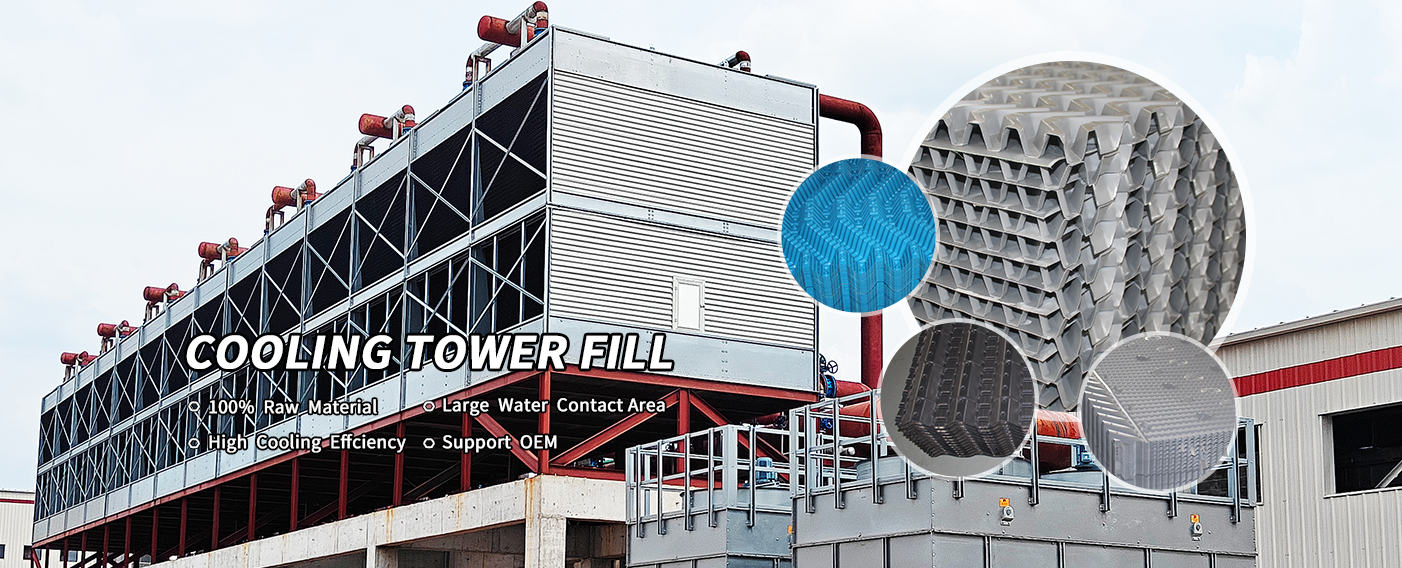
Cooling tower infill, commonly called cooling tower fill or cooling tower fill media, is the heat-transfer material installed inside a cooling tower.
Its main job is not to "cool water" by itself. Instead, it creates more effective contact between circulating water and air.
Hot water enters the tower and is distributed over the infill. At the same time, air moves through the infill. The structure of the infill spreads, slows, redirects, or breaks up the water so that a much larger water-air interface is created.
SPX describes fill as one of the most important cooling tower components because its ability to promote contact surface and contact time between air and water directly affects tower efficiency.
That is the basic idea.
More effective contact + enough contact time + proper airflow = better heat transfer.
Why Is Infill Important Inside a Cooling Tower?
Imagine pouring a bucket of hot water onto the floor and blowing air across it.
Some heat will leave the water, but the process is not particularly efficient.
Now imagine spreading that same water across thousands of thin, structured surfaces. The water becomes much more exposed to moving air.
That's essentially what cooling tower infill does.
A properly designed infill can:
Increase effective water-air contact area
Improve water distribution
Increase contact time
Promote evaporation
Improve heat transfer
Support higher cooling capacity
Help maintain the required cold-water temperature
Allow a compact tower design
Modern cooling tower systems commonly use film-type or splash-type infill, with the choice depending heavily on water quality and operating conditions.
How Does Cooling Tower Infill Work?
The operating principle is surprisingly simple.
Hot circulating water enters the cooling tower through a distribution system. The water then reaches the infill while air passes through the tower.
The infill changes how the water behaves.
Instead of allowing water to fall quickly in large streams, the structure can spread it into thin films or repeatedly break it into droplets.
At the same time, the air contacts a much larger amount of water surface.
The result?
More effective heat and mass transfer.
A typical evaporative cooling process can be thought of as a continuous cycle:
Hot water → distribution → infill → air-water contact → evaporation → heat rejection → cooled water
The cooled water then returns to the process, condenser, or HVAC system.
Increasing Water-to-Air Contact Area
This is probably the most important function of cooling tower infill.
Heat transfer becomes much more effective when a larger water surface is exposed to moving air.
Without infill, water would simply fall through the tower. The contact area would be relatively limited.
With structured infill, the water spreads over numerous surfaces.
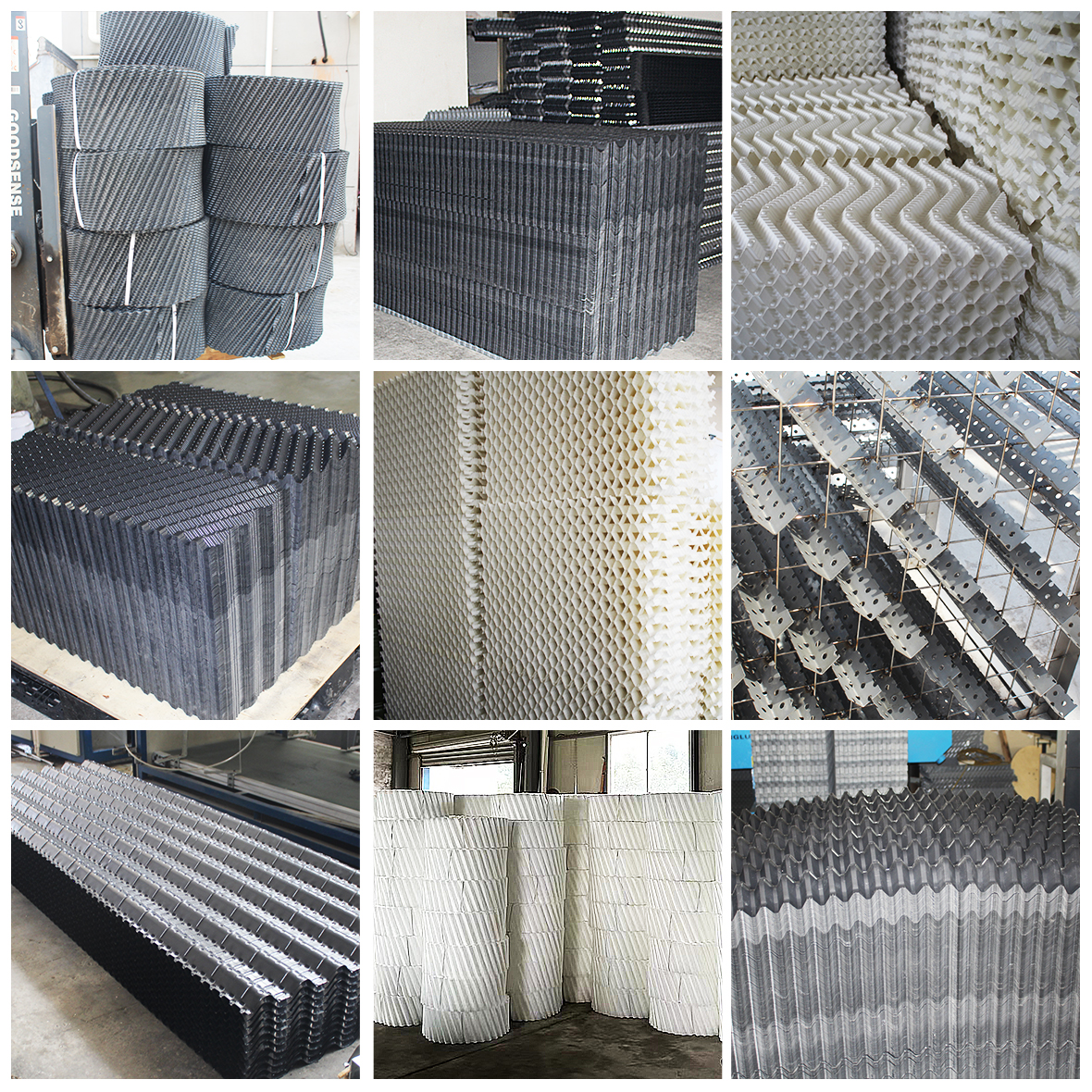
Film fill takes this idea even further by creating thin layers of water over corrugated sheets. SPX notes that film fill spreads water into a thin film and provides greater water surface exposure than splash-type fill in suitable applications.
It is similar to the difference between drying one wet towel folded into a ball and spreading that towel completely open in the wind.
Same water.
Very different exposure.
Extending Air-Water Contact Time
Surface area is only half the story.
The water also needs enough time to interact with the air.
Cooling tower infill slows the downward movement of water and guides it through a longer interaction path.
This gives evaporation and heat transfer more opportunity to occur.
SPX's technical explanation describes fill as a medium that increases both exposed water surface and air-water contact time.
This is especially important when engineers are trying to achieve a specific approach temperature without making the tower unnecessarily large.
Creating Better Water Distribution
Even the best infill cannot compensate for poor water distribution.
If one part of the fill is completely wet while another part remains dry, the available heat-transfer area is not being used efficiently.
Good cooling tower infill works together with the distribution system to encourage relatively uniform wetting.
That means the design needs to consider:
A cooling tower is a system, not a collection of isolated parts.
The fill, fan, nozzles, eliminators and water distribution system all have to work together.
The Role of Evaporation in Cooling Efficiency
Here's the interesting part.
Cooling towers do not primarily cool water simply by blowing air over it. Evaporation is a major part of the heat-rejection process.
When a small amount of water changes from liquid into vapor, it takes heat energy with it.
That is why evaporative cooling can remove substantial amounts of heat without requiring an enormous heat-transfer surface made from metal.
SPX explains the process as hot water contacting air, with a small portion of the water evaporating and removing heat from the remaining water.
This is where good cooling tower infill becomes valuable.
It creates the conditions needed for evaporation to happen effectively.
Why Evaporation Removes Heat
Think about sweat.
When sweat evaporates from your skin, you feel cooler. The cooling tower uses essentially the same physical principle on a much larger industrial scale.
The infill helps expose more water to air.
The air carries away moisture.
The evaporation process removes heat.
The cooled water collects in the basin and returns to the system.
Simple concept. Powerful result.
How Film-Type Infill Improves Cooling Performance
Film fill is one of the most widely used forms of cooling tower infill, especially where circulating water is sufficiently clean.
Its structure typically consists of formed sheets with carefully designed corrugations.
Water flows across these surfaces and forms a thin film.
This produces a large effective water-air contact area within a relatively compact volume.
That is one reason film fill can deliver high thermal performance in properly designed applications.
Thin Water Films and Large Surface Area
Why make the water thin?
Because thin water films expose more of the water to the surrounding air.
Instead of one thick stream, the same amount of water is distributed across many surfaces.
This increases the effective interface available for heat and mass transfer.
For clean-water applications where fouling is controlled, this can be a highly efficient approach.
But there is a catch.
High surface area is not automatically better if the water quality is poor.
That brings us to infill geometry.
Why Corrugated Infill Designs Matter
Look closely at a piece of cooling tower infill and you'll notice that it is rarely flat.
It may contain waves, channels, cross-flutes, offsets, or other structured patterns.
Why?
Because geometry controls how water spreads and how air moves.
Cross-fluted designs can promote mixing between air and water, while carefully shaped channels can help manage airflow resistance.
For example, SPX's MVC20 fill uses vertically channeled surfaces and horizontal corrugations designed to promote air-water mixing while reducing pressure drop.
So when you're buying cooling tower infill, don't ask only:
"Is it PVC or PP?"
Also ask:
"What is the actual fill geometry?"
How Splash-Type Infill Improves Cooling Efficiency
Splash fill takes a different approach.
Instead of spreading water into a continuous thin film, splash bars or grids repeatedly break the water into smaller droplets.
Each splash creates additional water-air interface.
This can be particularly useful when the circulating water contains suspended solids or other contaminants that could clog closely spaced film fill.
SPX identifies film fill as a common solution for clean water and splash fill as an option for water with higher suspended solids.
So splash fill may have lower theoretical surface area than high-performance film fill, but it can deliver better real-world efficiency when water quality is difficult.
That's an important distinction.
Cooling Tower Infill and Airflow Resistance
Here's something buyers sometimes overlook:
More surface area isn't always better.
Why?
Because air has to move through the infill.
If the infill creates excessive resistance, the fan has to work harder to maintain the required airflow.
That can increase energy consumption.
Therefore, cooling tower infill design is a balancing act.
You want:
High heat transfer + good water distribution + manageable pressure drop.
Modern fill designs therefore pay close attention to flute shape, spacing, channel geometry and airflow path.
A well-designed fill does not simply put as much plastic inside the tower as possible.
It creates a controlled environment for heat transfer.
Balancing Heat Transfer and Pressure Drop
Suppose two infill designs provide similar thermal performance.
One requires significantly more fan power.
Which one is really more efficient?
The answer becomes obvious when you look at the entire system.
Cooling efficiency should not be measured only by cold-water temperature.
You should also consider:
This is why the right cooling tower infill should be evaluated as part of the complete tower system.
How Water Quality Affects Infill Efficiency
Water quality can make or break cooling tower infill performance.
A fill that performs beautifully with clean water may struggle when exposed to heavy fouling.
Common problems include:
Scale
Algae
Biofilm
Suspended solids
Oil contamination
Dirt
Corrosion products
These materials can accumulate on fill surfaces or inside passages.
Once that happens, two things can occur:
Less effective heat-transfer area + more airflow resistance.
That's a double hit.
Scaling and Fouling
Imagine painting over the surface of a radiator with several layers of dirt.
The radiator is still physically there, but its ability to exchange heat is compromised.
Cooling tower infill can experience a similar problem.
As deposits accumulate, water distribution becomes less uniform and airflow passages can become restricted.
BAC recommends checking for clogging, improper water distribution and airflow restrictions when evaluating tower performance.
This is why water treatment and fill maintenance are closely connected.
When Splash Infill Is Better for Dirty Water
If your cooling water contains significant suspended solids, choosing extremely fine film fill simply because it offers high theoretical heat-transfer performance may be a mistake.
A more open splash-fill structure may provide better long-term reliability.
The goal is not to buy the fill with the highest specification on paper.
The goal is to choose the fill that delivers the best actual performance under your operating conditions.
That's a much smarter way to approach cooling tower design.
PVC vs PP Cooling Tower Infill
PVC and PP are two common materials used for cooling tower infill.
But which one is better?
There is no universal winner.
When PVC Infill Makes Sense
PVC cooling tower infill is widely used because it offers a strong combination of:
Good thermal performance
Chemical resistance
Mechanical strength
Processability
Cost-effectiveness
For many conventional HVAC and industrial cooling applications, PVC provides an attractive balance between performance and price.
When PP Infill Is a Better Choice
PP, or polypropylene, is often considered when operating conditions are more demanding.
It can provide higher temperature resistance and strong chemical resistance compared with standard PVC in many applications.
This can make PP attractive for:
Higher-temperature process cooling
Chemically aggressive environments
Certain industrial applications
Difficult water conditions
However, actual temperature limits depend on the specific material formulation and product design. Always use the manufacturer's specifications rather than relying on a generic temperature number.

Crossflow vs Counterflow Cooling Tower Infill
Cooling tower configuration also matters.
In a crossflow cooling tower, air generally moves horizontally across falling water.
In a counterflow tower, air moves upward while water moves downward.
Because the flow arrangements are different, the infill design and installation configuration must also be appropriate for the tower.
This includes:
Fill height
Fill depth
Width
Sheet spacing
Flute direction
Air travel
Water loading
Support structure
You should never assume that any cooling tower infill can simply be installed in any tower.
Correct fit matters.
How Infill Condition Affects Cooling Efficiency
Even the best cooling tower infill eventually ages.
Depending on the operating environment, it can become:
Brittle
Cracked
Deformed
Collapsed
Fouled
Discolored
Mechanically damaged
Once the structure changes, water distribution and airflow can also change.
The result may be higher outlet-water temperature and declining cooling capacity.
Modern replacement-fill programs specifically focus on recovering lost thermal performance rather than simply replacing plastic components. BAC, for example, offers replacement fill kits designed to restore thermal performance in compatible towers.
Signs Your Infill Is Reducing Cooling Performance
How do you know your cooling tower infill may be the problem?
Watch for several warning signs:
1. Higher Cold-Water Temperature
If the tower no longer reaches its expected leaving-water temperature under comparable conditions, investigate the heat-transfer section.
2. Visible Fouling
Heavy deposits, algae or blocked channels can indicate reduced effective surface area.
3. Collapsed or Deformed Fill
Physical deformation can change the intended water and airflow path.
4. Increasing Fan Energy
If airflow resistance increases because passages are blocked, fan power requirements may rise.
5. Uneven Water Distribution
Dry areas and heavily saturated areas indicate that the water is not using the available fill surface effectively.
Of course, these symptoms can also result from fan problems, nozzle blockage, ambient conditions or water-flow changes. Proper diagnosis should consider the complete cooling tower.
Can Replacing Cooling Tower Infill Improve Efficiency?
Absolutely—when old or damaged infill is the limiting factor.
Replacement does not magically make every cooling tower more efficient. But if existing fill has become badly fouled, damaged, collapsed or thermally outdated, a properly engineered replacement can restore lost heat-transfer performance.
A BAC case study illustrates why replacement-fill design matters: a lower-cost block-fill option initially appeared attractive but ultimately resulted in higher energy and maintenance costs because of performance deficiencies.
That leads to an important purchasing lesson:
Don't judge cooling tower infill by purchase price alone.
Why Cheap Replacement Infill Can Be Expensive
Imagine buying a cheaper pair of shoes that lasts three months instead of buying a better pair that lasts two years.
The cheaper option wasn't actually cheaper.
Cooling tower infill works the same way.
Consider the total cost:
Purchase price + installation + fan energy + maintenance + cleaning + downtime + replacement frequency
A slightly more expensive infill with better geometry, material compatibility and dimensional accuracy may provide much better value over its operating life.
How to Choose the Right Cooling Tower Infill
Before ordering cooling tower infill, collect as much information as possible.
At minimum, you should know:
Power Tower Cooling Technology specifically recommends considering factors such as fill geometry, material, flute spacing, dimensions, thermal requirements, water quality and operating temperature when selecting replacement cooling tower fill.
Key Parameters to Check Before Ordering
Dimensions, Flute Design, Material and Temperature
Do not send a supplier only the words:
"I need cooling tower infill."
That's not enough information.
Instead, provide drawings, measurements, photographs, tower model information and operating conditions whenever possible.
Important specifications include:
Dimensions:
Length × width × height must match the available space.
Material:
PVC, PP or another suitable material should be selected according to operating conditions.
Flute geometry:
Different corrugation patterns affect water distribution, air mixing and pressure drop.
Spacing:
Tighter spacing may provide higher surface area but can increase fouling risk in poor-quality water.
Temperature:
Material selection must match actual operating temperature.
Water quality:
TSS, scale, biological growth and chemical exposure all matter.
The more accurate the information, the easier it is for a manufacturer to recommend the right solution.
Why Choose Power Tower Cooling Technology?
Power Tower Cooling Technology (Shaoxing) Co.,Ltd. focuses on cooling tower components and replacement solutions, including PVC and PP cooling tower fill, film fill, crossflow and counterflow configurations, and customized replacement products.
Power Tower Cooling Technology official website

For a replacement project, the important advantage is not simply having a catalog of cooling tower infill.
It is being able to look at the whole application.
For example:
What tower are you using?
What are the existing fill dimensions?
What is the water temperature?
Is the water clean or heavily fouled?
Do you need PVC or PP?
Is the goal replacement, capacity improvement, or both?
These questions help move the conversation from "What plastic fill do you sell?" to "What fill will actually work in my cooling tower?"
That is a much more useful conversation for an engineer or purchasing manager.
Final Takeaway
So, how does cooling tower infill improve cooling efficiency?
The answer comes down to four fundamental functions:
It increases water-air contact area.
It extends the time water and air interact.
It improves water distribution across the heat-transfer section.
It creates favorable conditions for evaporation and heat rejection.
But there is another important lesson.
The best cooling tower infill is not necessarily the one with the largest surface area or the lowest price.
It is the one that matches your tower design, water quality, temperature, airflow, thermal duty and maintenance conditions.
For clean water, high-efficiency film fill can be an excellent choice. For difficult water, a more open splash or anti-fouling design may provide better long-term results.
And when old infill becomes damaged or severely fouled, replacing it with a properly matched product can help recover lost thermal performance.
In other words, cooling tower infill is much more than "packing."
It is the stage where the cooling tower's most important performance—air-water heat and mass transfer—actually happens.
Frequently Asked Questions
What is the main purpose of cooling tower infill?
The main purpose of cooling tower infill is to increase the effective contact area and contact time between circulating water and air, improving heat and mass transfer.
Does cooling tower infill improve cooling capacity?
Yes. Properly selected and maintained infill can improve heat-transfer performance and help a tower achieve its required cooling duty more effectively.
Is film fill more efficient than splash fill?
Film fill generally provides high thermal performance in suitable clean-water applications because it creates a large effective surface area. Splash fill is often more appropriate when suspended solids or fouling make closely spaced film fill unsuitable.
How often should cooling tower infill be replaced?
There is no universal replacement interval. Condition, water quality, operating temperature, material, mechanical damage and actual cooling performance should all be considered.
Can PVC cooling tower infill improve efficiency?
Yes. PVC film fill is widely used because it can provide strong heat-transfer performance while offering a practical balance of cost, durability and chemical resistance.
Is PP cooling tower infill better than PVC?
Not necessarily. PP may be more appropriate for higher-temperature or chemically demanding conditions, while PVC can be an excellent choice for many conventional cooling applications. The correct choice depends on the actual operating conditions.
What information should I provide when buying cooling tower infill?
Ideally, provide the tower type, existing fill dimensions, fill depth, water flow, hot- and cold-water temperatures, water quality, existing material, photographs and drawings. This allows the manufacturer to evaluate compatibility more accurately.


