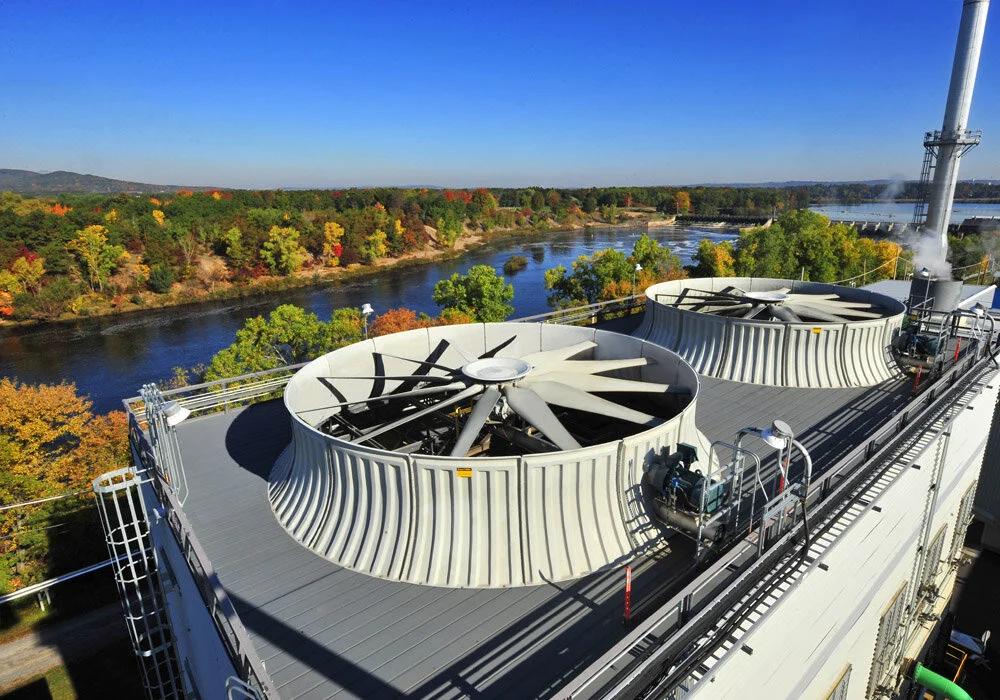
Cooling tower fan blade pitch adjustment is essential for maintaining proper airflow, cooling capacity, and energy efficiency in industrial cooling towers. When fan blades are set at the wrong angle, the system may experience insufficient airflow, excessive motor current, high energy consumption, or abnormal vibration.
However, not every cooling tower performance problem is caused by incorrect blade pitch. Damaged blades, poor water distribution, clogged fill media, incorrect fan rotation, and mechanical drive issues can produce similar symptoms.
This guide covers the most common cooling tower fan blade pitch adjustment problems, their causes, practical solutions, and maintenance practices that help keep fan systems operating safely and efficiently.
1. What Is Cooling Tower Fan Blade Pitch Adjustment?
Cooling tower fan blade pitch adjustment involves changing the angle of adjustable fan blades to achieve the airflow and operating performance specified by the manufacturer.
The pitch angle influences the aerodynamic loading on the fan, which affects airflow, motor power consumption, and cooling tower performance.
Correct pitch adjustment can help:
Maintain the airflow required for heat rejection
Control fan motor power consumption
Prevent excessive aerodynamic loading
Support stable fan operation
Improve cooling tower operating efficiency
The correct pitch depends on fan diameter, blade geometry, rotational speed, motor capacity, and system operating conditions. There is no universal pitch angle suitable for every cooling tower fan.
2. Common Cooling Tower Fan Blade Pitch Adjustment Problems
Problem 1: Incorrect Fan Blade Pitch Angle
Symptoms: Low airflow, insufficient cooling capacity, or unexpectedly high motor power consumption.
Possible causes:
Incorrect initial pitch setting
Improper adjustment during maintenance
Blade movement caused by loose mounting hardware
Incorrect settings after fan blade replacement
Solutions:
Check the fan manufacturer's recommended pitch angle and compare it with the measured setting. Use the specified measurement location and reference plane because blade angle can vary along a twisted blade.
If adjustment is necessary, set every blade according to the manufacturer's instructions. Tighten the mounting hardware to the specified torque and verify the settings before restarting the fan.
Do not increase the pitch automatically to correct low cooling performance. First confirm that insufficient airflow is actually caused by the blade setting.
Problem 2: Uneven Blade Pitch
Symptoms: Abnormal vibration, inconsistent airflow, or differences between individual blade angle measurements.
Possible causes:
Inconsistent measurement methods
Incorrect blade positioning
Improper adjustment after maintenance
Damaged blade clamps or hub components
Solutions:
Shut down and isolate the fan before inspecting the assembly. Measure each blade at the same radial position using the same pitch gauge and reference plane.
Adjust the blades to the specified setting and inspect the hub, clamps, and fasteners for damage. If vibration persists, investigate blade imbalance, shaft alignment, and other mechanical causes.
Uneven pitch should not be treated as a minor issue because it can contribute to inconsistent aerodynamic loading.
Problem 3: High Motor Current After Pitch Adjustment
Symptoms: Motor current increases after maintenance, protective devices trip, or the fan operates outside its approved power limits.
Possible causes:
Excessive blade pitch
Incorrect fan speed
Increased airflow resistance
Mechanical problems in the drive system
Electrical supply or motor faults
Solutions:
If current or power exceeds an approved operating limit, stop the fan and investigate before continuing operation.
Verify the blade pitch, rotational speed, motor nameplate ratings, and fan manufacturer's operating limits. Inspect the gearbox, bearings, and other drive components as appropriate.
Remember that motor current alone does not always provide a complete picture of power consumption. Where practical, evaluate measured electrical power and operating conditions as well.
Problem 4: Low Airflow Despite Correct Pitch
Symptoms: Cooling water outlet temperature remains high, heat rejection is insufficient, or measured airflow is below the required level.
Possible causes:
Solutions:
Confirm fan rotation direction and operating speed. Inspect the airflow path for obstructions and check whether the fill media is dirty, scaled, or blocked.
Examine the water distribution system to ensure that water reaches the fill evenly. Compare cooling performance with the design requirements while considering ambient wet-bulb temperature and actual heat load.
If the pitch already meets the manufacturer's specifications, investigate these other factors instead of increasing the blade angle.
Problem 5: Excessive Fan Vibration
Symptoms: Unusual noise, vibration alarms, loose fasteners, or visible movement of the fan assembly.
Possible causes:
Uneven blade pitch
Damaged or unbalanced blades
Loose hub fasteners
Shaft misalignment
Worn bearings or gearbox components
Blade contact with the fan cylinder
Solutions:
Stop the fan if vibration is severe or exceeds the manufacturer's limits. Inspect the blades, hub, fasteners, shaft, and drive components.
Verify blade pitch, tracking, and tip clearance. If necessary, arrange professional vibration analysis and balancing.
Pitch adjustment may resolve vibration caused by inconsistent blade settings, but it will not correct every mechanical fault.
Problem 6: Incorrect Blade Tracking or Tip Clearance
Symptoms: Blade tips follow an uneven path, clearance varies significantly, or blades contact the fan cylinder.
Possible causes:
Incorrect blade installation
Uneven blade positioning
Hub or support deformation
Improper assembly after replacement
Solutions:
Check blade tracking and tip clearance against the manufacturer's requirements. Confirm that all blades are installed correctly and that the hub and supporting structure are in suitable condition.
Do not assume that matching pitch angles guarantees correct tracking. These are separate measurements and must be verified independently.
Problem 7: Poor Energy Efficiency After Adjustment
Symptoms: Fan power consumption remains high even though cooling performance appears satisfactory.
Possible causes:
Pitch remains unsuitable for the required operating conditions
Fan runs at a higher speed than necessary
Cooling demand varies throughout the day
Airflow resistance is excessive
The system is operating inefficiently for its current load
Solutions:
Compare fan power consumption before and after adjustment under similar operating conditions. Record fan speed, cooling water temperatures, ambient wet-bulb temperature, and cooling load.
If cooling demand varies significantly, evaluate whether variable-frequency drive (VFD) control could improve energy performance. Any speed-control strategy must remain within the fan and motor manufacturer's approved operating range.
3. Cooling Tower Fan Pitch Problems: Quick Troubleshooting Table
| Problem | First check | Recommended action |
| Low airflow | Pitch, fan rotation, and speed | Verify settings and inspect the airflow path |
| High motor current | Pitch and operating limits | Stop if limits are exceeded and investigate |
| Uneven blade angles | Measurement consistency | Re-measure and adjust all blades uniformly |
| Excessive vibration | Blades, hub, and fasteners | Shut down and inspect the assembly |
| Poor cooling performance | Fill, water distribution, and heat load | Evaluate the complete cooling tower |
| High energy consumption | Power, speed, and cooling demand | Compare operating data and optimize the system |
| Uneven tip clearance | Blade tracking and hub condition | Check installation and manufacturer's tolerances |
4. How to Prevent Cooling Tower Fan Pitch Adjustment Problems
Preventive maintenance reduces the risk of incorrect settings and unnecessary equipment downtime.
Follow Manufacturer Specifications
Use the approved pitch angle, measurement reference, and adjustment procedure for the specific fan model. Avoid copying settings from a different fan design.
Measure Every Blade Consistently
Use the same instrument, radial position, and measurement method for every blade. Record the readings for future comparison.
Inspect Fasteners and Hub Components
Check mounting hardware, clamps, and hub components during scheduled maintenance. Tighten fasteners according to the manufacturer's torque specifications.
Monitor Fan Operating Conditions
Track motor power, current, rotational speed, vibration, and cooling water temperatures. Changes in these measurements can indicate developing problems.
Maintain the Entire Cooling Tower
Clean fill media when necessary, maintain proper water distribution, and keep air inlets free from obstructions. Fan pitch cannot compensate for every heat-transfer or airflow problem.
Keep Maintenance Records
Document original and final pitch settings, inspection findings, adjustments, and post-maintenance test results. This information helps technicians identify recurring issues and make better maintenance decisions.
5. Safety Precautions During Fan Blade Pitch Adjustment
Cooling tower fans are large rotating machines that can cause serious injury if handled incorrectly.
Before adjusting blade pitch:
Shut down and electrically isolate the fan.
Apply lockout/tagout procedures and prevent automatic startup.
Verify that all rotating components have stopped.
Use appropriate fall protection when working at height.
Follow approved lifting procedures for heavy blades and hubs.
Use a calibrated torque wrench and specified fastener torque.
Keep personnel clear during restart and performance testing.
Only qualified personnel should perform adjustments in accordance with the manufacturer's instructions and site safety procedures.
6. When Should You Replace Cooling Tower Fan Blades?
Pitch adjustment is appropriate only when the blades are structurally sound and designed for adjustment.
Replacement may be necessary if blades have cracks, permanent deformation, severe corrosion, damaged mounting points, or material deterioration.
When sourcing replacement cooling tower fan blades, verify the fan diameter, blade profile, material, hub compatibility, rotational speed, rotation direction, and required airflow. A suitable replacement must meet the mechanical and aerodynamic requirements of the existing fan system.
For industrial retrofit projects, a qualified cooling tower parts supplier can help identify compatible replacement blades based on the existing fan model and operating conditions.
7. Frequently Asked Questions
What is the most common cooling tower fan pitch adjustment problem?
Incorrect or inconsistent blade pitch is a common issue, particularly after maintenance or blade replacement. However, airflow and cooling problems can also result from fouled fill, incorrect rotation, or drive-system faults.
Can incorrect blade pitch damage a cooling tower fan motor?
Yes. Excessive aerodynamic loading may cause the motor to exceed its permitted current or power limits. Always verify the pitch against manufacturer specifications and monitor motor performance after adjustment.
Why does the fan vibrate after pitch adjustment?
Possible causes include uneven pitch, incorrect blade tracking, loose fasteners, blade imbalance, or mechanical misalignment. Shut down the fan if vibration is excessive and inspect the complete assembly.
Should I increase fan pitch when cooling performance drops?
Not immediately. First inspect fan rotation, speed, fill condition, water distribution, and operating conditions. Adjust pitch only when measurements show that the setting is unsuitable and the proposed change is approved.
How often should cooling tower fan pitch be checked?
Check pitch during commissioning, scheduled maintenance, fan blade replacement, and performance troubleshooting. Follow the manufacturer's recommended inspection intervals.
Conclusion
Cooling tower fan blade pitch adjustment problems can affect airflow, energy consumption, cooling capacity, and mechanical reliability. Incorrect pitch, uneven blade settings, high motor current, vibration, and poor cooling performance require systematic troubleshooting rather than repeated angle adjustments.
The best approach is to verify manufacturer specifications, measure every blade consistently, inspect the fan and airflow path, and confirm operating performance after maintenance. When damaged blades or incompatible components are responsible for recurring problems, replacement may be the more reliable long-term solution.
For cooling tower fan blade replacement or retrofit projects, provide your fan model, blade dimensions, hub configuration, and operating requirements to a qualified supplier to identify a compatible solution.
Recommended internal links for CoolingTowerPart.com:


