Industrial Cooling Tower Fill: Types, Materials and Applications
Industrial cooling tower fill is a critical component in evaporative cooling systems used for process cooling, HVAC, power generation, manufacturing, chemical processing, and many other industrial applications. Also called cooling tower fill, cooling tower infill, or cooling tower media, it increases the contact area between circulating water and air to improve heat and mass transfer.
The performance of a cooling tower depends on many factors, including water flow, airflow, ambient conditions, fan capacity, water distribution, and fill design. Among these factors, the selection of suitable industrial cooling tower fill has a direct influence on cooling efficiency, pressure drop, fouling resistance, and maintenance requirements.
Different industrial applications require different fill materials and designs. PVC film fill may be suitable for relatively clean water and conventional operating temperatures, while PP fill can be considered for higher-temperature applications. Splash fill may also be preferred when water contains a higher level of suspended solids.
This guide explains the major types, materials, applications, selection factors, and maintenance considerations for industrial cooling tower fill.
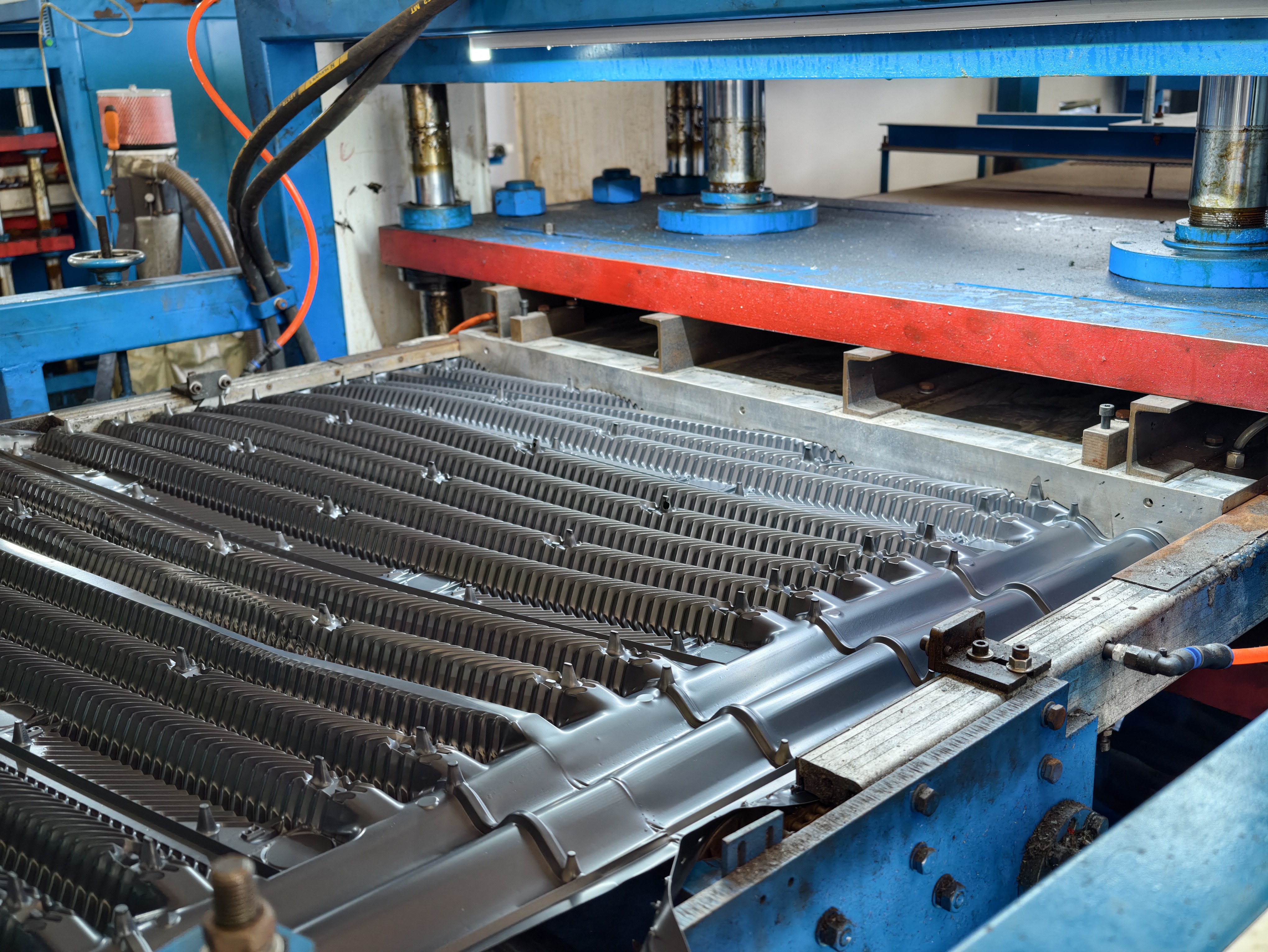
What Is Industrial Cooling Tower Fill?
Industrial cooling tower fill is the internal heat-transfer media installed inside an evaporative cooling tower. Its primary purpose is to increase the effective contact area between hot water and moving air.
How Does Industrial Cooling Tower Fill Work?
Hot process water enters the cooling tower and is distributed over the fill. The fill structure spreads the water across a large surface area while air moves through the passages.
What Happens Inside the Fill?
The basic cooling process includes:
Hot water enters the tower.
The distribution system spreads water over the fill.
Water flows across or through the fill surfaces.
Air passes through the fill.
Heat transfers from water to air.
A small portion of water evaporates.
Cooled water returns to the industrial process.
The larger effective contact area created by the fill allows the tower to reject heat more effectively within a relatively compact volume.
Why Is Fill Important in Industrial Cooling Towers?
Without properly designed fill, water may pass through the tower too quickly with insufficient contact with air.
A suitable fill can help improve:
However, fill performance depends on more than surface area. Airflow resistance, water distribution, fouling, temperature, and fill geometry must also be considered.
What Are the Main Types of Industrial Cooling Tower Fill?
Industrial cooling tower fill can generally be divided into film fill and splash fill, with different configurations designed for different operating conditions.
What Is Film Fill?
Film fill uses closely spaced sheets or surfaces to spread water into a thin film.
How Does Film Fill Improve Heat Transfer?
As water flows over the fill surfaces, it forms a relatively thin layer. This increases the effective water-air contact area and promotes heat and mass transfer.
Film fill is commonly used when the circulating water is relatively clean.
What Is Splash Fill?
Splash fill uses specially shaped bars or grids to break falling water into smaller droplets.
When Is Splash Fill Preferred?
Splash fill can be useful for industrial cooling systems where water contains:
Suspended solids
Biological contaminants
Dirt
Process residues
Higher fouling loads
Its more open structure can provide better resistance to blockage compared with some fine-channel film fills.
What Is the Difference Between Film Fill and Splash Fill?
The selection depends heavily on water quality and thermal requirements.
| Feature | Film Fill | Splash Fill |
| Heat-transfer surface | High | Moderate |
| Compactness | High | Moderate |
| Clean-water applications | Excellent | Good |
| Fouling resistance | Application-dependent | Generally good |
| Suspended solids | Requires attention | Often more tolerant |
| Typical use | HVAC and cleaner industrial water | Heavy-duty industrial applications |
Neither type is universally better. The appropriate choice depends on the specific cooling tower operating conditions.
What Materials Are Used for Industrial Cooling Tower Fill?
The material of the fill affects its temperature resistance, chemical compatibility, mechanical strength, and service life.
Why Is PVC Used for Cooling Tower Fill?
PVC cooling tower fill is one of the most widely used options for conventional cooling applications.
What Are the Benefits of PVC Fill?
PVC offers:
Good corrosion resistance
Lightweight construction
Cost-effective manufacturing
Good formability
Suitable mechanical strength
Large availability
Good performance in many conventional cooling applications
PVC film fill is particularly common in HVAC and industrial cooling systems with moderate water temperatures.
When Should PP Cooling Tower Fill Be Considered?
PP cooling tower fill can be considered for applications requiring greater temperature resistance than conventional PVC products can provide.
What Are the Advantages of PP?
Polypropylene can provide:
Higher temperature resistance
Good chemical resistance in suitable environments
Lightweight construction
Good mechanical properties
Suitability for specialized industrial applications
The actual temperature and chemical limits should always be confirmed using the manufacturer's technical specifications.
Can Other Materials Be Used for Cooling Tower Fill?
Depending on the application, other materials may be used for specialized fill products.
Possible materials include:
The material should be selected based on operating temperature, water chemistry, mechanical requirements, and expected service conditions.
How Does Fill Geometry Affect Industrial Cooling Performance?
Material is only one part of fill selection. Geometry can have an equally important influence on cooling performance.
Why Does Fill Surface Area Matter?
A larger effective surface area can increase the amount of contact between water and air.
Does More Surface Area Always Mean Better Performance?
Not necessarily.
A design with extremely high surface area may also create greater airflow resistance or become more vulnerable to fouling.
Therefore, an effective fill design must balance:
Heat-transfer area
Airflow resistance
Water distribution
Fouling resistance
Mechanical strength
How Does Fill Pitch Affect Performance?
Fill pitch describes the spacing and arrangement of the formed channels.
What Are the Advantages of Narrow Channels?
Narrow channels can provide high surface area within a compact volume.
However, they may be more sensitive to:
Scale
Algae
Slime
Suspended solids
What Are the Advantages of Wider Channels?
Wider passages can improve fouling resistance and may be easier to clean.
They can be useful for industrial applications where circulating water quality is more challenging.
What Are the Main Applications of Industrial Cooling Tower Fill?
Industrial cooling tower fill is used in many industries that need to reject process or equipment heat.
Where Is Industrial Cooling Tower Fill Used in Manufacturing?
Manufacturing plants often use cooling towers to remove heat from production equipment and process water.
Applications can include:
Machinery cooling
Injection molding
Metal processing
Textile production
General process cooling
Why Is Fill Important in Manufacturing?
Stable cooling-water temperature can be essential for maintaining production efficiency and equipment reliability.
A properly selected fill helps the cooling tower continuously reject process heat.
Can Cooling Tower Fill Be Used in Chemical Processing?
Yes, provided the fill material is compatible with the water chemistry and operating temperature.
What Should Chemical Plants Consider?
Chemical processing facilities should evaluate:
PVC or PP may be suitable in many applications, but material compatibility must be verified for the specific process.
Is Industrial Cooling Tower Fill Used in Power Plants?
Cooling towers are widely used for heat rejection in power-generation systems.
What Should Power Facilities Consider?
Large-scale cooling applications require careful consideration of:
Fill selection should be integrated with the overall cooling tower design rather than treated as an isolated component.
Can Cooling Tower Fill Be Used for HVAC Systems?
Although HVAC is not always classified as heavy industrial cooling, cooling tower fill is widely used in commercial and large-building systems.
Applications include:
PVC film fill is often used where water quality and temperature are compatible with the product.
How Do Crossflow and Counterflow Fill Differ?
Cooling tower fill must also match the airflow configuration of the tower.
What Is Crossflow Cooling Tower Fill?
In a crossflow tower, air generally moves horizontally across the falling water.
What Are the Characteristics?
Crossflow cooling towers typically have:
The fill should be designed for the specific tower geometry.
What Is Counterflow Cooling Tower Fill?
In a counterflow tower, air moves upward while water flows downward.
Why Is Counterflow Fill Important?
The opposing movement of water and air can create effective heat and mass transfer throughout the fill section.
Counterflow fill is widely used in industrial and HVAC cooling towers.
Can the Same Fill Be Used for Crossflow and Counterflow Towers?
Not always.
Fill geometry, block dimensions, water distribution, airflow, and installation configuration can differ between tower designs.
Therefore, the fill should be selected according to the specific cooling tower type.
How Does Water Quality Affect Industrial Cooling Tower Fill?
Water quality is one of the most important factors when selecting fill.
What Happens When Fill Becomes Fouled?
Contamination can accumulate on fill surfaces and inside air passages.
What Problems Can Fouling Cause?
Fouling may result in:
In severe cases, damaged or blocked fill may need to be replaced.
What Types of Contamination Should Be Considered?
Common contaminants include:
Scale
Algae
Slime
Dirt
Suspended solids
Biological deposits
Water treatment and routine maintenance can help control these problems.
How Should Industrial Cooling Tower Fill Be Selected?
Choosing the correct fill requires a systematic evaluation of the operating conditions.
What Technical Data Should Be Collected?
Before selecting industrial cooling tower fill, gather:
Cooling capacity
Water flow rate
Entering water temperature
Leaving water temperature
Ambient wet-bulb temperature
Airflow rate
Tower configuration
Water quality
Fill volume
Available installation dimensions
Why Is Water Flow Important?
The fill must handle the expected water loading without causing excessive water retention or poor distribution.
How Important Is Entering Water Temperature?
Temperature is critical for material selection.
What Happens at High Temperatures?
Some polymer materials can soften or deform when exposed to temperatures beyond their recommended operating range.
For higher-temperature industrial cooling, PP or specialized high-temperature fill may be considered.
How Can Industrial Cooling Tower Fill Improve Energy Efficiency?
Cooling tower fill does not directly consume electricity, but its design can influence the energy required to achieve the desired cooling performance.
Can Fill Design Affect Fan Energy?
Yes.
Why Does Pressure Drop Matter?
As air passes through the fill, it experiences resistance.
If pressure drop is excessive, the cooling tower fan may need to work harder to maintain the required airflow.
An optimized fill should therefore balance thermal performance with acceptable air resistance.
Can Better Water Distribution Improve Efficiency?
Yes.
Uniform water distribution helps make better use of the available fill volume.
What Happens When Distribution Is Uneven?
Dry sections contribute less to heat transfer, while overloaded sections may experience excessive water loading.
Therefore, fill performance should always be evaluated together with the water distribution system.
How Should Industrial Cooling Tower Fill Be Maintained?
Proper maintenance can extend fill service life and maintain cooling performance.
How Often Should Cooling Tower Fill Be Inspected?
Inspection frequency depends on:
Water quality
Operating hours
Environmental conditions
Tower design
Process contamination
What Should Operators Look For?
Inspect for:
Cracks
Deformation
Scale
Algae
Slime
Blocked passages
Broken fill sheets
Collapsed sections
How Can PVC Cooling Tower Fill Be Cleaned?
Cleaning should be performed according to the manufacturer's recommendations.
What Maintenance Methods Can Be Used?
Depending on the contamination, maintenance may involve:
Excessive mechanical force or unsuitable chemicals should be avoided because they can damage fill surfaces.
When Should Industrial Cooling Tower Fill Be Replaced?
There is no universal replacement interval for all cooling tower fill.
What Are the Signs That Fill Needs Replacement?
Replacement may be necessary when the fill shows:
Does Fill Age Determine Replacement?
Age alone should not be the only criterion.
The actual condition of the fill and its impact on tower performance should be evaluated.
What Should You Consider When Buying Industrial Cooling Tower Fill?
Purchasing decisions should consider more than the initial price.
Should You Compare Fill Specifications?
Yes.
Compare:
Should You Evaluate the Supplier?
A reliable industrial cooling tower fill supplier should be able to provide technical information and support.
What Questions Should You Ask?
Ask whether the supplier can provide:
Why Is Customization Important?
Cooling towers can have different dimensions and internal configurations.
Customized fill blocks can help reduce:
Installation gaps
Cutting requirements
On-site modification
Material waste
Customization can be particularly useful for older cooling towers and replacement projects.
How Can You Reduce Industrial Cooling Tower Fill Replacement Costs?
Replacement cost includes more than the price of the fill itself.
What Factors Affect Total Replacement Cost?
Consider:
Fill material
Fill dimensions
Quantity
Packaging
Transportation
Installation
Cleaning
Water treatment
Expected service life
Why Is Total Cost of Ownership Important?
A cheaper fill may not always provide the lowest long-term cost if it requires frequent replacement or creates higher maintenance requirements.
A suitable fill should provide an appropriate balance between purchase price, thermal performance, durability, and maintenance.
What Are the Key Benefits of Industrial Cooling Tower Fill?
When correctly selected and maintained, industrial cooling tower fill can provide several benefits.
What Performance Benefits Can Fill Provide?
These may include:
What Operational Benefits Can It Provide?
Suitable fill can also support:
Easier maintenance
Predictable cooling performance
Reduced replacement frequency
Better use of available tower space
Actual performance depends on the entire cooling tower system and operating conditions.
How Do You Choose the Right Industrial Cooling Tower Fill?
A practical selection process can be divided into several steps.
Step 1: Identify the Cooling Tower Configuration
Determine whether the tower uses a crossflow or counterflow arrangement.
Step 2: Evaluate Water Quality
Check suspended solids, scale potential, biological growth, and chemical conditions.
Step 3: Confirm Operating Temperature
Make sure the selected material is suitable for the actual water temperature.
Step 4: Select the Fill Type
Choose between film fill, splash fill, or another design based on the application.
Step 5: Check Dimensions
Confirm fill height, width, length, thickness, and support requirements.
Step 6: Compare Technical Performance
Evaluate surface area, airflow resistance, water loading, and fouling characteristics.
Step 7: Select a Suitable Supplier
Choose a supplier capable of providing consistent quality, customization, technical information, and replacement support.
Conclusion: Why Is Industrial Cooling Tower Fill So Important?
Industrial cooling tower fill is a fundamental component of modern evaporative cooling systems. By increasing the effective contact area between water and air, it helps cooling towers reject heat efficiently in industrial processes, HVAC systems, manufacturing facilities, power plants, and other applications.
PVC remains a widely used material for conventional cooling tower fill because of its practical balance of cost, weight, formability, and performance. PP can be considered for applications requiring higher temperature resistance, while splash fill may be suitable for water systems with greater fouling potential.
The right selection depends on the complete operating environment. Cooling tower type, water quality, temperature, airflow, fill geometry, pressure drop, maintenance requirements, and replacement conditions should all be considered before purchasing.
For new installations or industrial cooling tower fill replacement, working with an experienced supplier and providing accurate operating data can help ensure that the selected fill matches the cooling tower and its application.


