How To Choose The Right Fills for Cooling Tower?
Choosing the right fills for cooling tower systems is essential for achieving efficient heat transfer, stable cooling performance, and reliable long-term operation. Cooling tower fill is the internal media that brings circulating water and air into close contact, making it one of the most important components inside an evaporative cooling tower.
The wrong fill selection can lead to poor heat transfer, excessive pressure drop, frequent clogging, premature damage, and increased maintenance costs. By contrast, properly selected cooling tower fill media can help improve thermal performance while maintaining suitable airflow and water distribution.
So, how should you choose the right fills for cooling tower applications? This guide explains the key factors, including fill type, material, cooling tower design, water quality, operating temperature, dimensions, maintenance requirements, and application conditions.
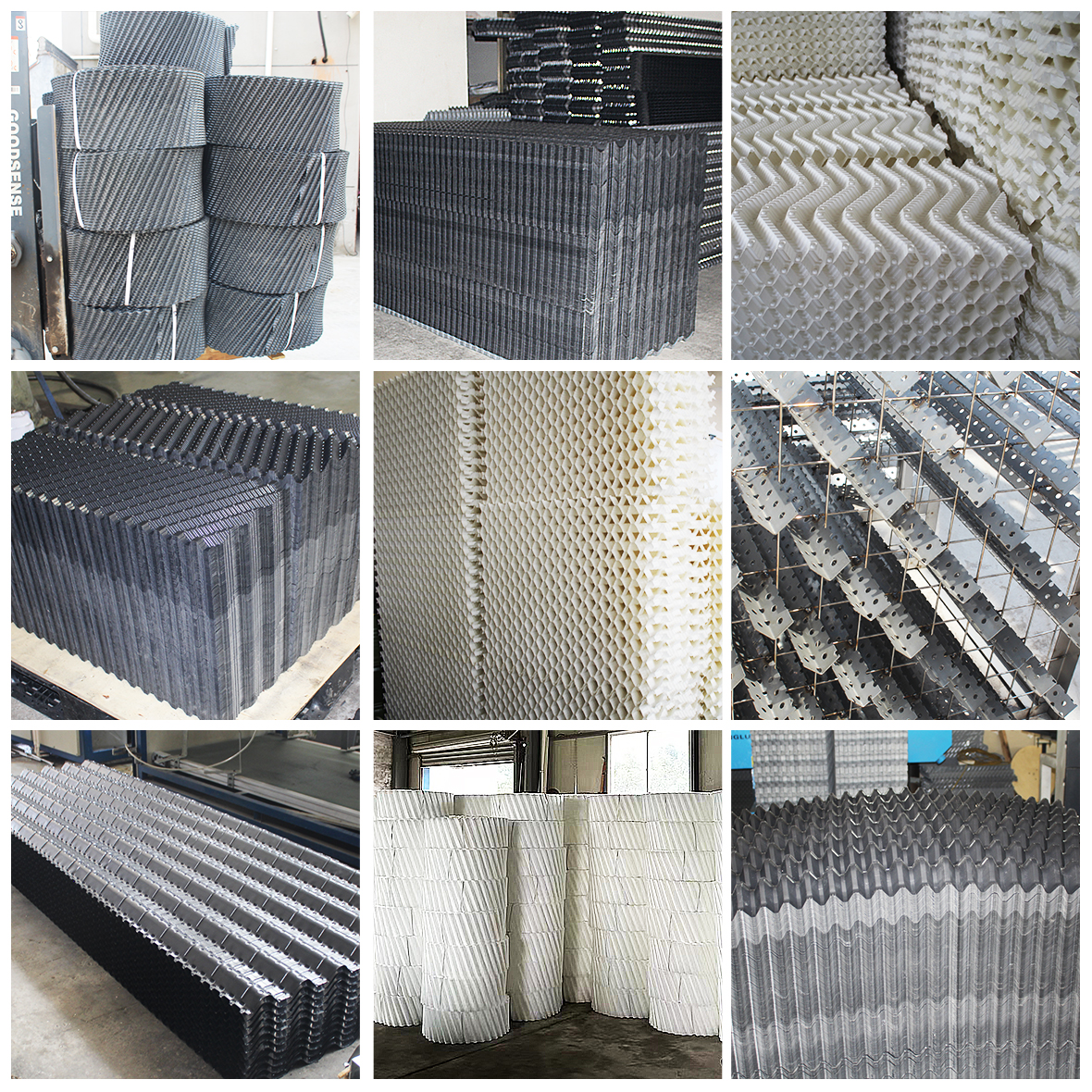
What Are Fills for Cooling Tower?
Fills for cooling tower systems are specially designed internal media used to increase the contact area between water and air.
When hot water enters a cooling tower, the distribution system spreads the water over the fill. Air passes through or across the fill while the water moves downward. This interaction promotes heat and mass transfer, allowing part of the water to evaporate and carry heat away from the system.
Why Is Cooling Tower Fill Important?
Cooling tower fill directly affects the thermal performance of the tower.
Increase the water-to-air contact area
Improve heat transfer
Promote more uniform water distribution
Increase evaporation efficiency
Support the required cooling range
Help maintain stable outlet water temperatures
Improve the use of available tower volume
A well-designed fill media system can therefore make a major difference in overall cooling tower operation.
What Types of Fills for Cooling Tower Are Available?
The first step in selecting cooling tower fill is understanding the major fill types.
What Is Film Fill?
Film fill uses closely spaced sheets with specially formed surfaces. Water spreads across the sheets in thin layers, creating a relatively large effective surface area for contact with air.
Film fill is widely used in HVAC and industrial cooling towers where circulating water is relatively clean.
What Are the Advantages of Film Fill?
Film fill can offer:
High effective surface area
Good heat transfer efficiency
Lightweight construction
Compact design
Efficient use of tower volume
However, closely spaced film fill can be more sensitive to fouling when water contains high levels of suspended solids or biological contaminants.
What Is Splash Fill?
Splash fill uses bars, grids, or other structures to break falling water into droplets and redistribute it as it moves through the tower.
Splash fill can be suitable for applications where fouling resistance and water passage are more important than maximum surface density.
When Should Splash Fill Be Considered?
Splash fill may be considered for:
Poorer-quality circulating water
Industrial process cooling
Systems containing suspended solids
Applications with higher fouling risks
Certain replacement projects
The best choice depends on the actual operating environment rather than the fill type alone.
How Do You Choose the Right Cooling Tower Fill Material?
Material selection is another critical consideration when choosing fills for cooling tower systems.
Is PVC Cooling Tower Fill a Good Choice?
PVC cooling tower fill is widely used because it provides a practical combination of performance, durability, formability, and cost.
PVC is commonly used for film fill in many HVAC and industrial cooling applications.
Benefits of PVC Cooling Tower Fill
PVC fill can provide:
Good corrosion resistance in many applications
Lightweight handling
Good dimensional stability
Easy thermoforming
Cost-effective manufacturing
Suitable performance for many standard operating conditions
PVC is often a practical choice for cooling towers operating within the recommended temperature range of the material.
When Should PP Cooling Tower Fill Be Used?
PP, or polypropylene, is another widely used material for cooling tower fill.
It can be considered for applications where higher temperature resistance or specific chemical properties are needed.
PVC vs PP Cooling Tower Fill
| Property | PVC Fill | PP Fill |
| Typical use | HVAC and general industrial cooling | Higher-temperature or specialized applications |
| Temperature resistance | Suitable for many standard systems | Generally higher |
| Weight | Lightweight | Lightweight |
| Corrosion resistance | Good | Excellent |
| Cost | Generally economical | Often higher |
The final decision should be based on actual operating temperature, water chemistry, and process requirements.
How Does Cooling Tower Type Affect Fill Selection?
The tower configuration must be considered before selecting the fill.
What Is Counterflow Cooling Tower Fill?
In a counterflow cooling tower, water travels downward while air moves upward through the fill.
This configuration provides strong contact between air and water and is commonly used in industrial and HVAC systems.
What Should You Check for Counterflow Fill?
Consider:
What Is Crossflow Cooling Tower Fill?
In a crossflow cooling tower, water flows vertically downward while air passes horizontally through the fill.
Crossflow fill needs to work effectively with the tower's water distribution system and airflow path.
Why Does Tower Configuration Matter?
A fill designed for one tower configuration may not be directly suitable for another. Before ordering replacement or new fill media, confirm the tower type and internal dimensions.
How Does Water Quality Affect the Choice of Cooling Tower Fill?
Water quality is one of the most important factors when choosing cooling tower fill media.
Why Is Fouling a Problem?
Water can contain:
Suspended solids
Dust
Dirt
Scale-forming minerals
Algae
Biological contaminants
These materials may accumulate on the fill surface and restrict water and airflow.
How Does Fouling Affect Performance?
Heavy fouling can result in:
Lower effective heat transfer area
Increased airflow resistance
Uneven water distribution
Reduced cooling capacity
Higher maintenance frequency
Shorter fill service life
Which Fill Is Better for Dirty Water?
Film fill can provide high heat transfer efficiency but may have narrower passages that are vulnerable to blockage.
Splash fill generally has a more open structure and may be better suited to certain high-fouling conditions.
The right choice should be based on actual water quality and the tower's operating conditions.
How Does Operating Temperature Affect Fill Selection?
Temperature can strongly influence the suitability of fill material.
Why Should Temperature Ratings Be Checked?
Different plastics have different temperature resistance and mechanical properties.
PVC is widely used for standard cooling applications, while PP may be considered for certain higher-temperature environments.
What Temperature Information Should Be Provided?
When contacting a cooling tower fill supplier or manufacturer, provide:
Normal operating water temperature
Maximum water temperature
Cooling water inlet temperature
Cooling water outlet temperature
Ambient conditions
Accurate temperature data helps prevent unsuitable material selection.
How Do Fill Dimensions Affect Cooling Tower Performance?
Even a high-quality product may not perform properly if the dimensions are incorrect.
What Dimensions Need to Be Checked?
For fills for cooling tower replacement projects, measure:
Why Is Proper Fit Important?
Correct dimensions help ensure that the fill:
Fits securely inside the tower
Maintains the intended airflow path
Receives proper water distribution
Does not interfere with internal components
Can be installed safely and efficiently
For replacement projects, photos, drawings, samples, and measurements can help a manufacturer identify the correct product.
How Does Fill Design Affect Heat Transfer?
Fill geometry is closely related to cooling efficiency.
What Is Effective Surface Area?
Effective surface area refers to the area that can actually participate in water-air contact under operating conditions.
A well-designed fill spreads water effectively over its surface while allowing sufficient airflow.
Why Is More Surface Area Not Always Better?
Increasing surface density may improve theoretical contact area, but it can also increase pressure drop and fouling risk.
Therefore, a high-performance cooling tower fill media design must balance:
Heat Transfer + Airflow + Water Distribution + Fouling Resistance
How Does Airflow Resistance Affect Fill Selection?
Air must move through the fill to support evaporation and heat transfer.
What Is Pressure Drop?
Pressure drop represents the resistance encountered by air as it travels through the fill.
A fill with excessive resistance can require more fan energy to maintain the desired airflow.
What Is the Ideal Fill Design?
The ideal design provides adequate heat transfer while maintaining reasonable airflow resistance for the cooling tower fan system.
This is why fill should be selected together with fan capacity and tower operating requirements.
How Can You Choose Fills for Cooling Tower Based on Application?
Different industries can have very different cooling requirements.
HVAC Cooling Towers
Commercial and industrial HVAC systems often use film-type PVC fill where water quality is controlled.
The key goals are typically:
Stable cooling
Good thermal efficiency
Reasonable pressure drop
Easy maintenance
Long service life
Industrial Cooling Towers
Industrial systems may operate under more demanding conditions.
What Should Industrial Users Consider?
Industrial applications should evaluate:
For demanding applications, PP fill or more open splash configurations may sometimes be appropriate.
Data Center Cooling Systems
Cooling towers used for data center cooling require stable and predictable heat rejection.
The fill selection should consider water quality, maintenance requirements, airflow performance, and the need for reliable continuous operation.
How Should You Choose Cooling Tower Fill for Replacement Projects?
Cooling tower fill replacement requires special attention because the new fill must match the existing tower.
What Information Should You Send to a Fill Manufacturer?
Prepare as much of the following information as possible:
Cooling tower brand
Cooling tower model
Tower type
Existing fill dimensions
Existing fill material
Water temperature
Water flow rate
Cooling capacity
Photos
Drawings
Existing fill samples
Why Is a Sample Useful?
An existing fill sample can help confirm sheet geometry, thickness, flute structure, and material characteristics.
This is especially useful when original technical documentation is unavailable.
How Does Maintenance Affect Cooling Tower Fill Selection?
The best fill is not necessarily the most densely packed fill. Maintenance conditions should also be considered.
Can Cooling Tower Fill Be Cleaned?
Many cooling tower fill systems can be cleaned to remove deposits and biological growth.
However, the cleaning method should match the fill material and contamination type.
What Should Be Avoided During Cleaning?
Avoid:
Excessive mechanical force
Incorrect chemical cleaners
High-pressure cleaning that damages sheets
Long-term neglect of biological growth
Poor cleaning practices can deform or break fill sheets.
When Should Cooling Tower Fill Be Replaced?
Knowing when to replace fill is important for maintaining system performance.
What Are the Signs of Damaged Fill?
Replacement may be required when the fill shows:
Why Is Timely Replacement Important?
Damaged or heavily blocked fill can affect airflow and water distribution throughout the tower.
Installing suitable replacement cooling tower fill media can restore the intended operating conditions and help maintain cooling performance.
How Can You Compare Different Cooling Tower Fill Manufacturers?
When purchasing fills for cooling tower applications, supplier selection is almost as important as product selection.
What Should You Check About a Manufacturer?
Consider the manufacturer's:
Product range
Raw material quality
Manufacturing process
Dimensional control
Customization capability
Production capacity
Packaging
Export experience
Technical support
Why Is Custom Manufacturing Valuable?
Custom manufacturing allows fill dimensions and configurations to be adapted to different tower designs.
This can be particularly useful for replacement projects, OEM applications, and industrial cooling towers with non-standard dimensions.
What Questions Should You Ask Before Ordering Cooling Tower Fill?
Before placing an order, confirm the following technical information.
Product Questions
Ask about:
Fill type
Material
Thickness
Dimensions
Temperature rating
Surface configuration
Intended tower type
Performance Questions
Also check:
What About Delivery and Packaging?
For international projects, confirm:
Packaging method
Quantity per package
Container loading
Production lead time
Shipping dimensions
Export documentation
These details can affect both project cost and installation planning.
Frequently Asked Questions About Fills for Cooling Tower
What Are the Main Types of Fills for Cooling Tower?
The major categories are film fill and splash fill. The appropriate type depends on water quality, cooling tower design, heat transfer requirements, and fouling conditions.
Is PVC Suitable for Cooling Tower Fill?
PVC is widely used for cooling tower fill in many HVAC and industrial applications. Its suitability depends on operating temperature, water chemistry, and other process conditions.
What Is the Difference Between Film Fill and Splash Fill?
Film fill spreads water over thin sheets to create a large effective surface area. Splash fill breaks water into droplets using a more open structure and can be considered for applications with higher fouling potential.
Can Cooling Tower Fill Be Customized?
Yes. Custom cooling tower fill can be manufactured to specific dimensions, materials, thicknesses, and configurations depending on the manufacturer's capabilities.
How Do I Know Which Cooling Tower Fill I Need?
Start with the tower type, existing fill dimensions, water quality, operating temperature, water flow rate, airflow, and required cooling performance. A qualified manufacturer can then help determine a suitable fill design.
Conclusion
Choosing the right fills for cooling tower systems requires a complete evaluation of the application rather than focusing on one specification. Fill type, material, geometry, dimensions, water quality, operating temperature, airflow, and maintenance conditions all influence performance.
For many standard HVAC and industrial applications, PVC cooling tower fill provides a practical combination of heat transfer performance and cost efficiency. For higher-temperature or specialized conditions, PP cooling tower fill may be worth considering. Film fill and splash fill also offer different advantages depending on water quality and fouling conditions.
By selecting the right cooling tower fill media and working with an experienced manufacturer, users can improve water-air contact, support efficient heat transfer, maintain stable cooling performance, and reduce unnecessary maintenance problems.
Whether the project involves a new cooling tower, an industrial process system, or cooling tower fill replacement, accurate technical information and application-specific selection are the keys to finding the right solution.


