How to Choose a Reliable PVC Fills Manufacturer?
Choosing the right PVC fills manufacturer is an important decision for cooling tower owners, contractors, distributors, and industrial equipment buyers. Although cooling tower fill may appear to be a simple plastic component, its material, geometry, thickness, surface structure, and manufacturing quality can directly affect heat transfer, airflow, maintenance, and service life.
A reliable supplier should provide more than standard PVC sheets. The manufacturer should understand cooling tower applications, offer stable product quality, support customized dimensions, and provide technical information that helps buyers select the right cooling tower fill.
This guide explains how to evaluate a PVC fills manufacturer, what specifications should be checked before ordering, and which factors can help reduce the risk of purchasing unsuitable cooling tower fills.
What Is PVC Cooling Tower Fill?
PVC cooling tower fill is a heat-transfer component installed inside an evaporative cooling tower. It increases the contact area between circulating water and air, allowing heat to transfer more efficiently.
How Does Cooling Tower Fill Work?
Hot water enters the cooling tower and is distributed across the fill surface. Air passes through the fill at the same time.
The specially designed surface of the cooling tower fill helps spread water into thin films or controlled flow paths. This increases water-air contact and supports evaporative cooling.
Why Are PVC Fills Widely Used?
PVC is widely used for cooling tower fills because it offers a combination of:
Good heat-transfer performance
Lightweight construction
Good chemical resistance
Easy thermoforming
Competitive manufacturing cost
Good dimensional flexibility
Wide availability
For many HVAC and industrial cooling applications, PVC cooling tower fills provide a practical balance between performance and cost.
Why Does Choosing the Right PVC Fills Manufacturer Matter?
Not all PVC fills are manufactured to the same standard.
Two products may have similar dimensions but perform differently because of variations in raw materials, sheet thickness, flute geometry, surface quality, bonding, and manufacturing tolerances.
Can Manufacturing Quality Affect Cooling Performance?
Yes.
The geometry of cooling tower fills determines how water spreads across the available surface and how air moves through the fill.
Poorly manufactured fill may result in:
Uneven water distribution
Excessive airflow resistance
Reduced heat-transfer efficiency
Deformation during operation
Premature cracking
Difficult installation
Shorter service life
A reliable pvc fills manufacturer should therefore control the product from raw material selection through forming, cutting, inspection, and packaging.
What Should You Look for in a PVC Fills Manufacturer?
Before choosing a supplier, buyers should evaluate several factors instead of focusing only on price.
Does the Manufacturer Have Cooling Tower Experience?
A manufacturer with specific experience in cooling tower components is generally better positioned to understand the relationship between fill geometry and tower operation.
What Products Does the Manufacturer Supply?
A professional supplier may offer several types of cooling tower fills, such as:
PVC film fill
PP film fill
Crossflow fill
Counterflow fill
Splash fill
High-temperature fill
Replacement fill
Customized fill
A broader product range can be useful when a project has unusual water quality, temperature, or dimensional requirements.
Does the Manufacturer Understand Different Tower Designs?
Cooling tower fills are not universal.
The requirements for a crossflow tower can differ from those of a counterflow tower.
The manufacturer should be able to discuss:
Water flow
Airflow
Fill height
Fill width
Sheet thickness
Flute design
Operating temperature
Water quality
How Can You Check the Quality of PVC Cooling Tower Fills?
Quality inspection should be an important part of supplier evaluation.
What Raw Material Does the Manufacturer Use?
The quality of PVC resin and additives can affect the durability and performance of cooling tower fills.
Why Is Raw Material Consistency Important?
Inconsistent raw materials can lead to variations in:
Thickness
Color
Flexibility
Strength
Heat resistance
Forming quality
Buyers should ask whether the manufacturer uses controlled and consistent PVC materials for production.
Is the PVC Fill Thickness Consistent?
Sheet thickness is another important specification.
If the sheet is thinner than expected, it may have insufficient mechanical strength. If it is significantly thicker, it may increase material consumption without necessarily improving tower performance.
A professional PVC fills manufacturer should have suitable equipment and inspection procedures for controlling thickness.
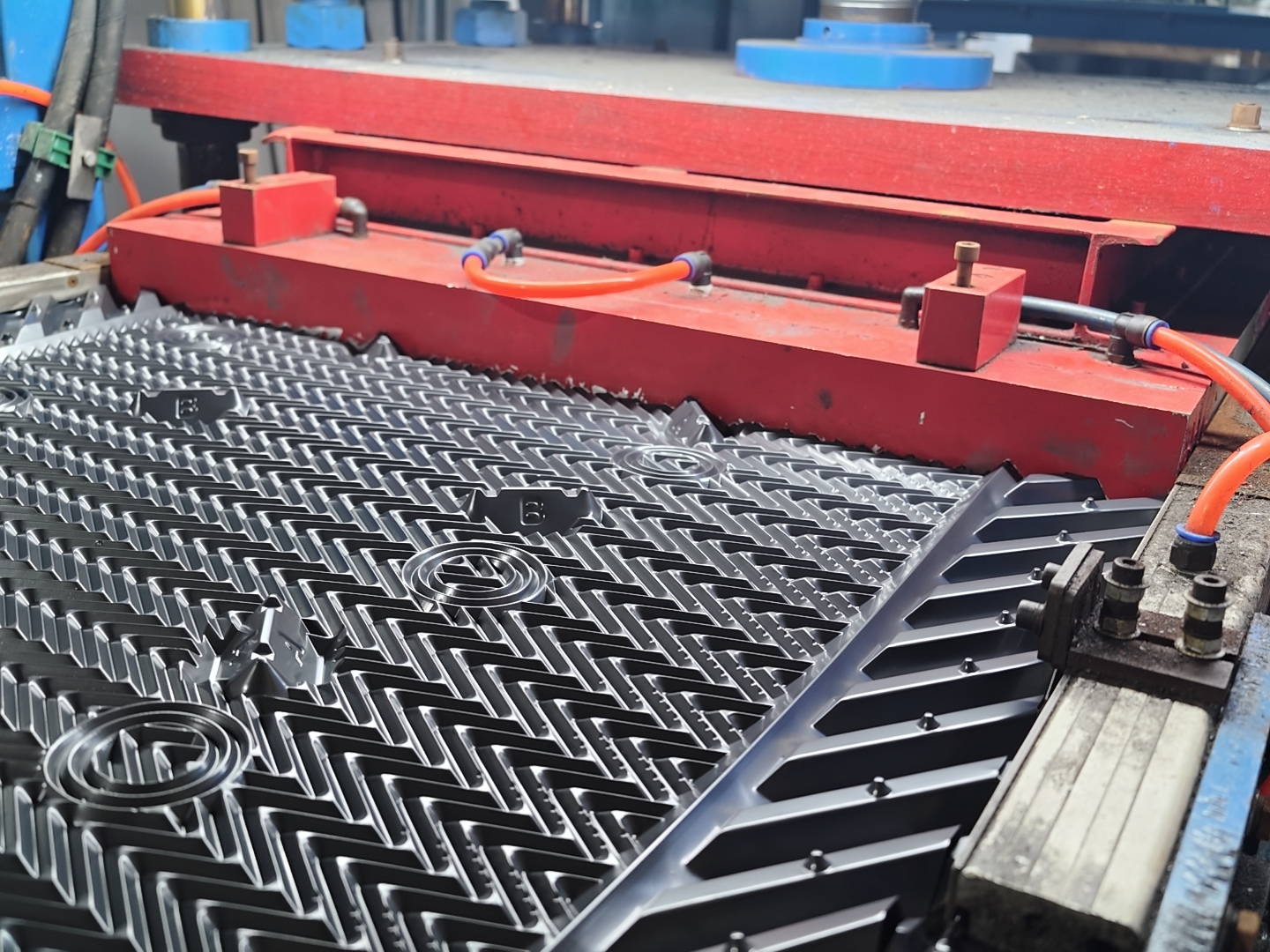
Does the Fill Have a Consistent Flute Pattern?
The flute pattern is an important part of cooling tower fill design.
A consistent flute pattern helps maintain predictable:
Water flow paths
Air passages
Contact area
Structural strength
Fill block dimensions
Manufacturers should maintain consistent forming temperatures, tooling, and production parameters.
Which PVC Cooling Tower Fill Design Should You Choose?
There is no single fill design that is suitable for every cooling tower.
What Is Cross-Fluted PVC Fill?
Cross-fluted fill uses intersecting or angled channels to increase water-air contact.
It is widely used in applications where high heat-transfer efficiency is required.
What Are Its Advantages?
Depending on the design, cross-fluted cooling tower fill can provide:
Large contact area
Good water distribution
Effective heat transfer
Compact installation
However, water quality must also be considered because some high-efficiency film fills are more sensitive to fouling.
What Is Vertical-Fluted Fill?
Vertical-fluted cooling tower fills use relatively straight vertical channels.
Why Can Vertical Flutes Be Useful?
They can provide relatively open water and air passages, which may be beneficial in applications where fouling resistance is important.
This makes vertical-fluted fill worth considering for certain industrial cooling environments.
How Important Is Water Quality When Selecting Cooling Tower Fills?
Water quality is one of the most overlooked factors when purchasing cooling tower fills.
What Happens When Water Contains Too Much Suspended Solids?
Suspended solids can accumulate on the fill surface and gradually block passages.
Potential consequences include:
What About Biological Growth?
Cooling towers can provide conditions favorable to biological growth when water treatment is inadequate.
Biofilm can cover fill surfaces and interfere with water-air contact.
Therefore, the right fill should be selected together with an appropriate water-treatment and maintenance program.
How Should You Evaluate a PVC Fills Manufacturer's Customization Ability?
Standard fill dimensions may not fit every cooling tower.
This is especially true when replacing fill in older towers.
Can the Manufacturer Produce Custom Dimensions?
A capable manufacturer should be able to discuss customized:
Fill height
Fill width
Sheet thickness
Flute geometry
Block dimensions
Hanging configuration
Cut sizes
Why Is Customization Important for Replacement Projects?
An existing tower may have a unique fill support system.
If the replacement fill does not match the original dimensions, installation may require expensive modifications.
A manufacturer that can produce customized cooling tower fills can make replacement projects easier and more predictable.
What Information Should You Send to a PVC Fills Manufacturer?
Providing accurate information before requesting a quotation can significantly improve supplier response.
What Specifications Are Needed?
Ideally, provide:
Cooling Tower Information
Fill Information
Fill height
Fill width
Sheet thickness
Fill block dimensions
Flute type
Material
Quantity
Operating Information
Water flow rate
Hot water temperature
Cold water temperature
Cooling range
Water quality
Operating environment
Photos and Drawings
Photos of existing cooling tower fills can be particularly useful.
A drawing or sample can provide even more accurate information.
How Does a Professional PVC Fills Manufacturer Control Production?
A reliable supplier should have a structured manufacturing process.
Step 1: Raw Material Preparation
PVC materials are prepared according to the required product specifications.
Step 2: Sheet Extrusion
The PVC material is processed into sheets with controlled thickness.
Why Is Extrusion Important?
Poor extrusion control can result in uneven sheet thickness and inconsistent material properties.
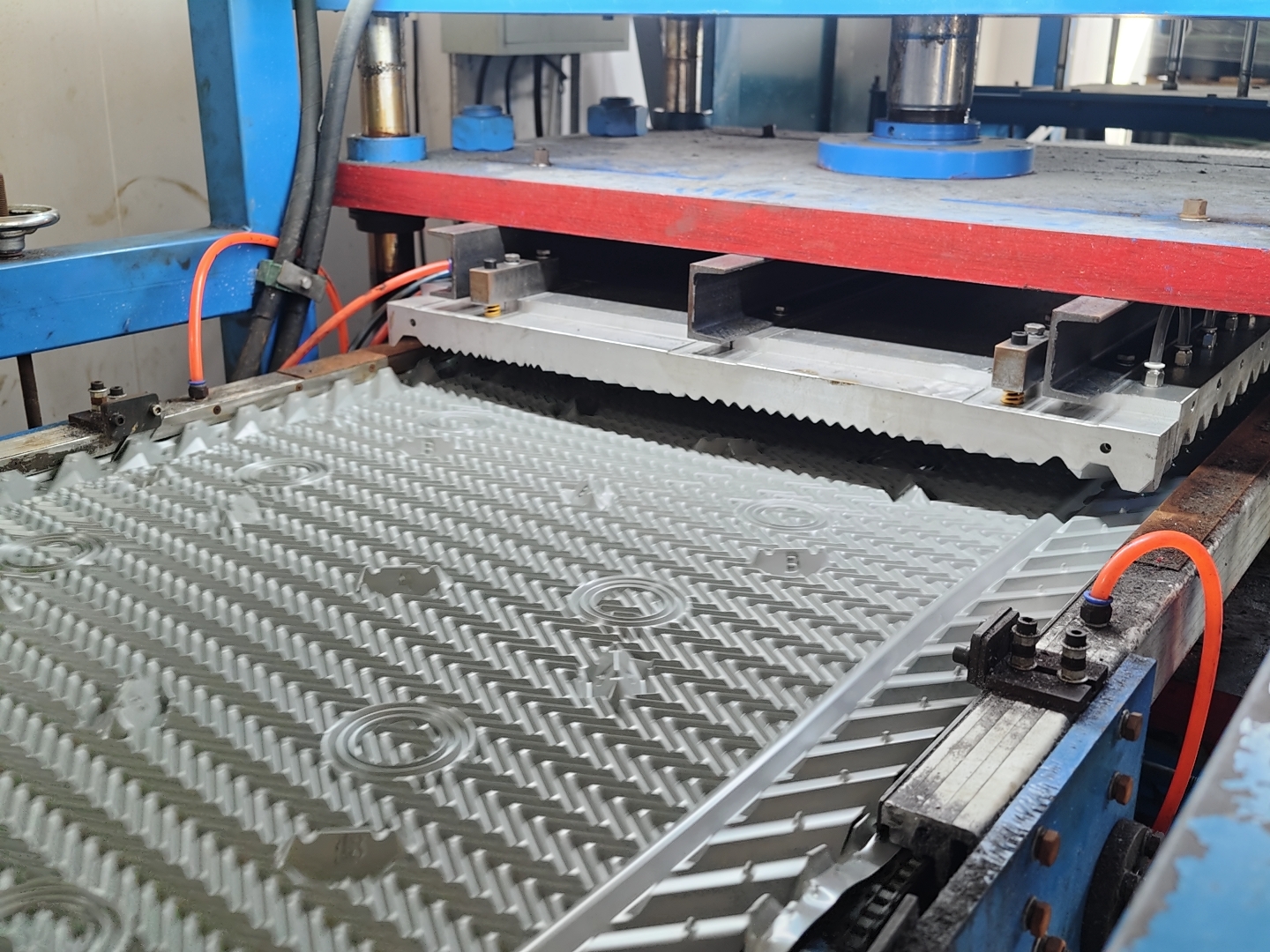
Step 3: Thermoforming
The flat PVC sheet is heated and formed into the required flute pattern.
What Should Be Controlled?
Important parameters include:
Forming temperature
Tooling condition
Forming pressure
Cooling process
Sheet thickness
Flute dimensions
Step 4: Cutting and Assembly
The formed sheets are cut to the required dimensions.
Depending on the product design, sheets may then be bonded or assembled into fill packs.
Step 5: Quality Inspection
The finished cooling tower fill should be inspected before packaging.
Typical inspection items include:
Dimensions
Thickness
Appearance
Flute geometry
Bonding quality
Deformation
Quantity
What Certifications Should a PVC Fills Manufacturer Have?
Certifications can provide useful information about a company's quality-management system, but buyers should not rely on certificates alone.
Should You Ask for ISO Certification?
If the manufacturer claims ISO certification, buyers can request the relevant certificate and verify that it applies to the appropriate company and production scope.
What Else Should You Check?
Consider asking for:
A combination of documentation and actual product inspection provides a better basis for supplier evaluation.
Should You Order Samples Before Buying Large Quantities?
For large cooling tower projects, samples can be useful.
What Can a Sample Tell You?
A sample allows buyers to check:
Why Is Sampling Especially Important for Customized Fill?
Customized products involve greater risk because the product may be manufactured specifically for one tower.
A sample can help confirm the design before mass production.
How Important Is Production Capacity?
Production capacity matters when a project requires a large quantity of cooling tower fills.
What Should Buyers Ask?
Consider asking:
What is the monthly production capacity?
How many production lines are available?
What is the normal lead time?
Can the manufacturer handle urgent replacement orders?
How does the company manage large-volume orders?
Why Does Lead Time Matter?
Cooling tower fill replacement is sometimes part of planned maintenance shutdowns.
If the fill arrives late, the entire maintenance schedule may be affected.
Therefore, delivery reliability can be as important as the product price.
How Can You Compare PVC Fills Manufacturer Prices?
Price should be compared carefully.
Is the Cheapest Cooling Tower Fill Always the Best Option?
Not necessarily.
A lower quotation may reflect differences in:
PVC material
Sheet thickness
Product dimensions
Fill geometry
Packaging
Quantity
Quality control
Shipping terms
What Is a Better Way to Compare Suppliers?
Instead of comparing unit price alone, compare the complete quotation.
Consider:
Product Cost + Packaging + Freight + Installation + Expected Service Life + Maintenance Requirements
This provides a more realistic total-cost comparison.
What After-Sales Service Should a PVC Fills Manufacturer Provide?
Good technical support can reduce problems after delivery.
What Should Technical Support Include?
A professional supplier should be able to assist with:
Can the Supplier Help With Replacement Projects?
Ideally, yes.
For replacement projects, the supplier should be able to review existing fill dimensions and recommend a compatible product.
What Are the Most Common Mistakes When Buying Cooling Tower Fills?
Many purchasing problems can be avoided before placing an order.
Mistake 1: Choosing Only by Price
Low-cost fill may not provide the required material quality or dimensional accuracy.
Mistake 2: Ignoring Water Quality
A high-efficiency film fill may perform poorly if the operating water causes rapid fouling.
Mistake 3: Ordering Without Measuring
Even a small dimensional mismatch can create installation problems.
Mistake 4: Ignoring Operating Temperature
PVC and other materials have different temperature limitations.
Mistake 5: Buying Without a Sample
For customized cooling tower fills, skipping sample confirmation can increase project risk.
How Can You Build a Reliable Long-Term Relationship With a PVC Fills Manufacturer?
For distributors and cooling tower maintenance companies, supplier selection should be considered a long-term decision.
Can a Manufacturer Support Repeat Orders?
A reliable supplier should maintain consistent:
Product dimensions
Material specifications
Flute patterns
Packaging
Quality standards
This is particularly important for customers who purchase replacement cooling tower fills regularly.
Why Is Product Consistency Important?
If every production batch has different dimensions or material properties, installation and performance can become unpredictable.
Consistent manufacturing helps simplify future replacement projects.
What Is the Future of PVC Cooling Tower Fills?
The cooling tower industry is increasingly focused on efficiency, reliability, water conservation, and maintenance reduction.
Will Cooling Tower Fill Become More Efficient?
Manufacturers continue to optimize fill geometry to increase water-air contact while managing airflow resistance.
Will Customized Fill Become More Popular?
Yes, especially in the replacement market.
Many existing cooling towers have been operating for years, and original fill may no longer be readily available.
Customized cooling tower fills can provide an alternative when standard replacement products are unsuitable.
Will Fouling Resistance Become More Important?
For industrial cooling systems, this is likely to remain an important consideration.
Instead of simply maximizing surface area, future fill designs will need to balance:
Heat Transfer + Airflow + Fouling Resistance + Service Life + Maintenance
FAQ: Choosing a PVC Fills Manufacturer
What Is a PVC Fills Manufacturer?
A PVC fills manufacturer produces PVC-based cooling tower fill media used to improve water-air contact and heat transfer inside evaporative cooling towers.
How Do I Choose a Reliable PVC Fills Manufacturer?
Check the manufacturer's cooling tower experience, raw materials, production capabilities, product quality, customization options, inspection procedures, delivery capacity, and technical support.
What Is the Difference Between PVC Fills and PP Fills?
PVC is widely used because of its balance of cost, performance, and manufacturability. PP may be selected for certain higher-temperature or specialized chemical environments.
How Long Does PVC Cooling Tower Fill Last?
There is no universal service life. Actual lifespan depends on water quality, temperature, chemical conditions, UV exposure, maintenance, fouling, and operating conditions.
Can PVC Cooling Tower Fill Be Customized?
Yes. Many manufacturers can customize dimensions, thickness, flute geometry, fill height, width, and block configuration according to project requirements.
What Is the Most Important Specification When Ordering Cooling Tower Fill?
There is no single specification that determines suitability. Dimensions, material, flute design, water loading, tower configuration, water quality, and operating conditions should all be considered together.
Final Checklist: How to Choose the Right PVC Fills Manufacturer
Before placing an order, use this checklist:
Does the supplier specialize in cooling tower fill?
Can it provide PVC film fill for your tower type?
Are raw materials clearly specified?
Is sheet thickness consistent?
Is the flute geometry stable?
Can the manufacturer provide customized dimensions?
Can it supply samples?
Does it have quality-control procedures?
Can it meet your required quantity?
Is the lead time suitable?
Can it provide technical support?
Are packaging and shipping conditions clearly defined?
Can it support future replacement orders?
Conclusion
Choosing a reliable PVC fills manufacturer requires more than comparing quotations. A suitable supplier should understand cooling tower applications and provide consistent cooling tower fill with appropriate material, dimensions, geometry, and manufacturing quality.
For new cooling towers, buyers should focus on thermal requirements, airflow, water distribution, and operating conditions. For replacement projects, accurate measurements and compatibility with the existing tower are equally important.
A professional manufacturer should be able to provide standard and customized cooling tower fills, explain the differences between fill designs, support sample testing, maintain consistent production quality, and provide technical assistance throughout the project.
Ultimately, the right pvc fills manufacturer is one that can match the fill design and material to the actual cooling tower—not simply the supplier offering the lowest initial price.
Target SEO Keywords: pvc fills manufacturer, PVC fills manufacturer, cooling tower fill, cooling tower fills, PVC cooling tower fill, PVC cooling tower fills, cooling tower fill manufacturer, cooling tower fill supplier, PVC fill supplier, cooling tower fill replacement, cooling tower film fill, industrial cooling tower fill.