Industrial cooling towers operate under demanding conditions, and the performance of the fill media can directly affect heat transfer, water distribution, airflow, and overall cooling efficiency. For this reason, selecting the right PVC cooling tower fills manufacturer is an important part of designing, upgrading, or maintaining an industrial cooling system.
PVC cooling tower fills are widely used in industrial and HVAC applications because they provide a large surface area for water-air contact while offering practical durability and cost efficiency. However, standard fill products may not always match the dimensions, water loading, temperature, airflow, or installation requirements of a specific cooling tower.
A custom PVC cooling tower fills manufacturer can provide fill media designed around the requirements of different cooling tower configurations. Customization may include fill dimensions, sheet thickness, flute design, material selection, packing configuration, and replacement requirements.
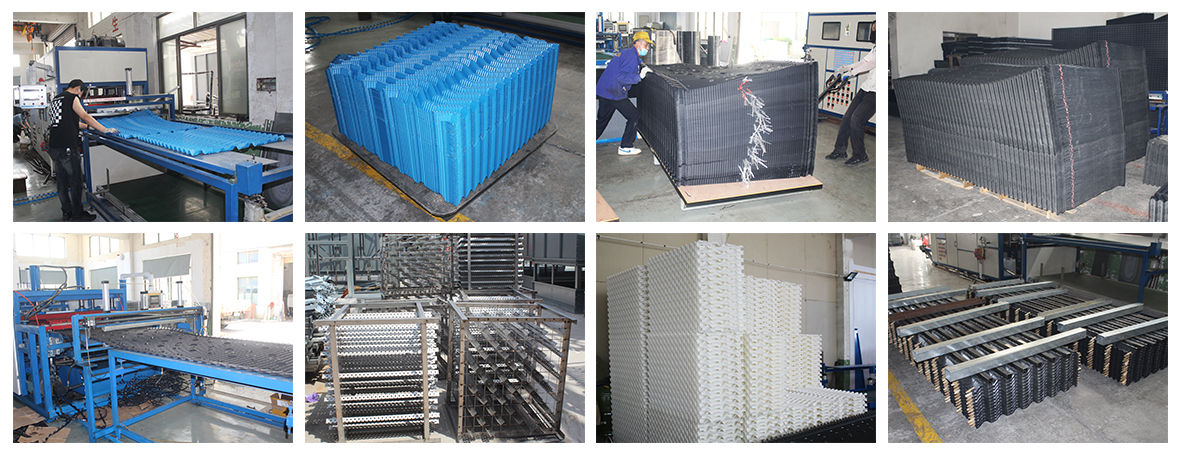
What Are PVC Cooling Tower Fills?
PVC cooling tower fills are structured heat-transfer media installed inside cooling towers. Their primary function is to increase the contact area between circulating water and air.
As hot water flows over the fill surface, it is divided into thin films or droplets. Air moving through the cooling tower removes heat from the water, allowing the cooled water to return to the industrial process.
How Does PVC Fill Improve Heat Transfer?
The design of PVC cooling tower fill creates a large effective surface area within a relatively compact volume.
Increased Water-Air Contact
The structured surface helps spread water across the fill pack, increasing contact between water and moving air.
Extended Contact Time
The fill configuration slows and distributes the water flow, allowing more opportunity for heat and mass transfer.
Compact Cooling Tower Design
High-performance fill media can provide substantial heat-transfer area without requiring an excessively large tower footprint.
Why Choose PVC for Cooling Tower Fill Media?
PVC is one of the commonly used materials for cooling tower fill because it combines processability, corrosion resistance, and cost efficiency for many applications.
What Are the Main Benefits of PVC Cooling Tower Fills?
Good Chemical Resistance
PVC can provide useful resistance to many chemicals encountered in cooling water systems, although compatibility should always be evaluated according to actual water chemistry.
Lightweight Construction
PVC fill sheets are relatively lightweight, making transportation, handling, installation, and replacement more manageable.
Flexible Manufacturing
PVC can be processed into different corrugated or structured designs, allowing manufacturers to produce fill media for various cooling tower configurations.
Cost-Effective Performance
For many industrial cooling applications, PVC provides a practical balance between heat-transfer performance, durability, and material cost.
Why Do Industrial Cooling Towers Need Custom PVC Fills?
Not every cooling tower operates under the same conditions. Water quality, thermal load, airflow, temperature, tower dimensions, and installation configuration can vary significantly.
Can Standard Fill Media Fit Every Cooling Tower?
No. Standardized fill dimensions may not be suitable for every replacement or new-build application.
An industrial cooling tower may require specific dimensions to fit an existing support structure or replacement area.
What Can Be Customized?
A professional PVC cooling tower fills manufacturer may provide customization in several areas.
Fill Dimensions
The length, width, and height of fill packs can be adjusted according to the available installation space.
Sheet Thickness
Different applications may require different sheet thicknesses depending on mechanical requirements, operating conditions, and product design.
Flute or Corrugation Design
The geometry of the fill influences water distribution, airflow, surface area, pressure drop, and fouling characteristics.
Packing Configuration
Fill sheets can be assembled into packs according to the requirements of crossflow or counterflow cooling towers.
Material Options
Depending on the application, manufacturers may offer different PVC formulations or other compatible materials for specific operating conditions.
How Does a Custom PVC Cooling Tower Fills Manufacturer Work?
A reliable manufacturer normally begins with application information rather than simply recommending a standard product.
Step 1: Understand the Cooling Tower
The manufacturer should understand the tower type, dimensions, water flow, airflow, operating temperature, and existing fill configuration.
Step 2: Evaluate Operating Conditions
Important parameters may include:
Hot water temperature
Cold water temperature
Circulating water flow
Airflow
Water quality
Suspended solids
Chemical treatment
Installation environment
Step 3: Select the Fill Design
The manufacturer can recommend a suitable fill structure based on the cooling tower's operating requirements.
Crossflow Cooling Tower Fill
Crossflow fill is typically designed for towers where air moves horizontally through the fill while water flows vertically downward.
Counterflow Cooling Tower Fill
Counterflow fill is designed for systems where air moves upward against the downward flow of water.
The appropriate fill design should match the tower's airflow and water distribution configuration.
Step 4: Confirm Dimensions and Specifications
Before production, dimensions, material specifications, thickness, flute design, and packing requirements should be confirmed.
Step 5: Manufacture and Inspect
The fill media is produced according to the approved specifications and inspected before shipment.
What Quality Should You Expect from a PVC Cooling Tower Fills Manufacturer?
Quality control is important because cooling tower fill operates continuously in a wet and often chemically treated environment.
What Should Be Checked During Production?
Material Quality
The manufacturer should maintain consistent raw material quality to support stable product performance.
Sheet Thickness
Consistent thickness helps maintain predictable mechanical properties and product dimensions.
Surface and Forming Quality
The fill surface should have consistent forming and bonding characteristics without obvious defects that could interfere with water distribution.
Dimensional Accuracy
Accurate dimensions are particularly important for replacement projects where the new fill must fit an existing support structure.
How Does Fill Design Affect Industrial Cooling Performance?
A cooling tower fill is more than a simple plastic sheet. Its geometry influences the interaction between water and air.
Surface Area
A larger effective surface area can increase opportunities for heat and mass transfer.
Water Distribution
The fill should encourage relatively uniform water spreading across the available surface.
Airflow Resistance
A highly restrictive design can increase pressure drop and fan energy requirements.
Fouling Resistance
In applications with suspended solids or poor water quality, fill geometry should also be evaluated for its tendency to accumulate deposits.
How Can Custom PVC Fill Help Cooling Tower Replacement Projects?
Industrial cooling towers may remain in operation for many years. Eventually, fill media can become damaged, clogged, deformed, or severely scaled.
Why Is Custom Replacement Fill Important?
Existing towers may use dimensions or configurations that are no longer available as standard products.
A custom manufacturer can reproduce or adapt fill dimensions to match the existing tower.
Replacement Without Major Structural Modification
Properly dimensioned replacement fill can help reduce the need for extensive modifications to existing support structures.
Improved Maintenance Planning
Custom replacement products can be manufactured according to the tower's existing configuration and future maintenance requirements.
Support for Different Cooling Tower Brands
Experienced fill manufacturers may produce compatible replacement media for various cooling tower designs, provided the required specifications are available.
What Industrial Applications Use PVC Cooling Tower Fills?
PVC cooling tower fill is used across a broad range of industrial cooling applications.
Power Generation
Cooling towers in power-related facilities require reliable heat rejection and stable water circulation.
Chemical Processing
Chemical plants often operate cooling systems under demanding water and temperature conditions.
Petrochemical Facilities
Process cooling systems may use cooling towers to remove heat from production equipment and circulating water.
Steel and Metal Processing
Industrial production equipment can generate substantial amounts of heat that require continuous cooling.
HVAC and Large Commercial Facilities
Large buildings, factories, and centralized HVAC systems can also use PVC fill media to improve cooling tower heat transfer.
How Should PVC Cooling Tower Fills Be Maintained?
Even high-quality fill media requires proper maintenance.
Control Water Quality
Scale, algae, sediment, and biological growth can reduce the effective surface area of cooling tower fill.
Inspect Fill Regularly
Routine inspection can identify:
Clogging
Scaling
Algae
Broken sheets
Deformation
Excessive deposits
Material deterioration
Clean the Fill Properly
Cleaning methods should match the type of contamination and the fill material.
Avoid Excessive Mechanical Force
Aggressive pressure washing or improper mechanical cleaning can damage thin fill sheets.
Use Compatible Chemicals
Chemical cleaning agents should be compatible with PVC and the cooling tower's water treatment system.
How Do You Choose the Right PVC Cooling Tower Fills Manufacturer?
Selecting a manufacturer involves more than comparing product prices.
Does the Manufacturer Have Customization Capability?
A manufacturer should be able to work with different dimensions, configurations, and industrial requirements.
Can the Manufacturer Provide Technical Support?
Technical communication is especially important for replacement projects where existing fill specifications may be incomplete.
Does the Manufacturer Have Quality Control?
Ask about material control, production inspection, dimensional inspection, and packaging procedures.
Can the Manufacturer Handle International Orders?
For global industrial projects, consider production capacity, packaging, export experience, lead times, and shipping arrangements.
What Should You Provide When Requesting a Custom PVC Fill Quote?
Providing detailed information can make the quotation process faster and more accurate.
Basic Cooling Tower Information
Provide:
Cooling tower type
Manufacturer or model
Existing fill dimensions
Fill height
Fill width
Fill length
Required quantity
Operating Information
Where available, also provide:
Water flow rate
Hot water temperature
Cold water temperature
Airflow
Water quality
Operating environment
Photos and Drawings
Photos of the existing fill, support structure, water distribution system, and installation area can help a manufacturer understand the replacement requirements.
Technical drawings are even more useful when custom dimensions are required.
Why Is Packaging Important for PVC Cooling Tower Fill?
PVC fill is relatively lightweight but can occupy considerable volume.
For international transportation, proper packaging can help protect the fill from deformation and reduce unnecessary shipping volume.
What Should Good Packaging Provide?
Packaging should help protect the fill from:
For large industrial orders, manufacturers should also consider pallet dimensions and container loading efficiency.
Custom PVC Cooling Tower Fills for Long-Term Industrial Performance
Choosing a custom PVC cooling tower fills manufacturer can provide greater flexibility for industrial cooling projects where standard fill dimensions or designs are not sufficient.
The right manufacturer should be able to understand the cooling tower configuration, evaluate operating conditions, provide suitable fill designs, control manufacturing quality, and support replacement or customized projects.
For industrial users, the goal is not simply to purchase plastic fill sheets. The objective is to obtain cooling tower fill media that fits the equipment, supports effective water-air contact, maintains stable cooling performance, and remains practical to inspect and maintain.
Conclusion
PVC cooling tower fills are an important component of industrial heat rejection systems. Their design, material quality, dimensions, and installation configuration can all influence cooling tower performance.
Working with a professional custom PVC cooling tower fills manufacturer allows industrial users to obtain fill media tailored to specific tower dimensions and operating requirements.
Whether the project involves a new industrial cooling tower, an existing tower upgrade, or a complete fill replacement, customized PVC cooling tower fill can provide a practical solution when standard products do not meet the required specifications.
By considering fill design, material quality, water distribution, airflow, operating temperature, fouling conditions, customization capability, and manufacturer support, buyers can develop a more suitable cooling tower fill solution for long-term industrial operation.


