English


Views: 0 Author: jessi Publish Time: 2026-10-16 Origin: Site


Cross flow cooling tower fill is a critical component in industrial and commercial cooling systems. It provides an extensive contact surface between circulating water and incoming air, helping transfer heat and improve the cooling tower's overall performance. From large manufacturing facilities and power plants to commercial HVAC systems, the correct fill configuration can influence cooling capacity, airflow resistance, water distribution, maintenance requirements, and operating costs.
As industrial facilities continue to focus on energy efficiency and equipment reliability, choosing the right cross flow cooling tower fill has become increasingly important. A suitable fill product should match the tower's original design, operating temperature, circulating water quality, required cooling duty, and installation conditions. Buyers must also consider material selection, sheet spacing, fill geometry, service life, and replacement costs.
For cooling tower manufacturers, maintenance contractors, engineering companies, and industrial purchasing teams, understanding these factors makes it easier to compare products and identify reliable replacement solutions. This guide explains how cross flow cooling tower fill works, which materials are available, how to evaluate product quality, and what to consider when purchasing fill media for new installations or existing cooling towers.
 |
 |
Cross flow cooling tower fill is a structured heat transfer medium installed inside a cross flow cooling tower. During operation, hot circulating water is distributed over the fill and moves downward, while ambient air travels horizontally through the fill section. The interaction between air and water promotes heat transfer and evaporation, allowing the circulating water to release heat before returning to the cooling system.
The fill is not simply a supporting structure for falling water. Its surface pattern, passage dimensions, arrangement, and material properties influence how effectively water spreads, how easily air moves through the tower, and how much heat can be transferred within the available space.
The cooling process depends on the interaction between water temperature, air conditions, water distribution, and airflow.
Hot water from industrial equipment, condensers, or heat exchangers enters the cooling tower distribution system. Distribution troughs, pipes, or other water delivery components spread the water over the fill area.
Consistent water distribution is important because uneven flow can leave some sections underused while placing excessive water on others.
As water enters the fill, the structured sheets or formed surfaces encourage it to spread into thinner films and smaller streams. This increases the contact area available for heat exchange.
The effectiveness of this process depends on the fill geometry, water flow rate, surface condition, and distribution system.
Ambient air passes horizontally through the falling water. A portion of the water evaporates, transferring heat from the circulating water into the air. Sensible heat transfer also occurs when there is a temperature difference between the water and air.
Evaporation is usually a major contributor to cooling tower performance, although the exact contribution depends on operating conditions.
After passing through the fill, the cooled water collects in the basin and returns to the industrial or HVAC system. The cooling tower then repeats the cycle.
A well-matched cross flow cooling tower fill supports effective heat transfer while maintaining acceptable airflow resistance and water distribution.
The cooling tower fill influences the available heat transfer area and the interaction between air and water. If the fill becomes blocked, damaged, or poorly wetted, the effective contact area may decrease.
Structured fill surfaces help expose more water to the moving air. This can improve heat transfer compared with an arrangement that allows water to fall through the tower in large streams with limited air-water contact.
A suitable fill arrangement encourages water to spread across the fill pack. More consistent wetting helps use the available surface area effectively.
Fill geometry also affects airflow resistance. If the passages are too restrictive for the tower's fan and airflow design, system performance may be affected. Therefore, the objective is not simply to maximize surface area but to balance heat transfer with airflow requirements.
Cross flow and counterflow cooling towers use similar heat transfer principles but arrange air and water movement differently. Understanding the difference is important when specifying fill for a new tower or replacing existing media.
In a cross flow cooling tower, air travels horizontally through the fill while water moves downward. In a counterflow cooling tower, air generally moves upward against the downward-flowing water.
This difference affects tower layout, water distribution arrangements, maintenance access, and fill configuration.
Cross flow towers often use water distribution troughs or similar arrangements above the fill. Depending on the model, these components may provide convenient access for inspection and maintenance.
The fill must be designed for horizontal airflow and the tower's intended water distribution arrangement.
Counterflow towers generally direct air upward through the fill while water descends through the same general section. Their internal layout and water distribution systems differ from those of cross flow towers.
Counterflow fill should not be treated as interchangeable with cross flow fill simply because the sheet material or dimensions appear similar.
Neither configuration is automatically the best choice for every application. The appropriate design depends on the required cooling capacity, available installation space, water quality, airflow requirements, maintenance strategy, and existing equipment.
When replacing fill, evaluate the original tower arrangement and the manufacturer's design requirements. Changing the fill configuration without engineering review can affect water distribution, airflow resistance, cooling performance, and installation compatibility.
For most replacement projects, maintaining the intended tower configuration is the starting point.
Cross flow cooling tower fill can be classified by material, surface design, and heat transfer mechanism. Choosing the right type requires a clear understanding of the operating environment and the limitations of each option.
Polyvinyl chloride, commonly known as PVC, is widely used in cooling tower fill manufacturing. It can be formed into structured sheets with different surface patterns to support water distribution and heat transfer.
PVC cross flow cooling tower fill is commonly considered for conventional industrial and HVAC applications where operating conditions fall within the material's specified limits.
Potential advantages include:
Good resistance to moisture and many common cooling tower conditions
Flexible manufacturing options for different sheet patterns
Relatively economical material costs
Availability in different sheet dimensions and pack configurations
Suitability for many conventional cooling tower installations
Practical options for customized replacement projects
PVC suitability depends on the material formulation, operating temperature, chemical exposure, mechanical loading, and applicable fire performance requirements.
Excessive temperatures or incompatible chemicals may accelerate deterioration. Buyers should obtain the manufacturer's documented operating limits rather than assuming that every PVC fill product has the same temperature or chemical resistance.
PVC fill is often considered for commercial HVAC systems, general manufacturing facilities, and other cooling tower applications with compatible water quality and operating temperatures.
It can also be used in replacement projects where the original tower specifications call for PVC fill and the existing system remains suitable for that material.
Polypropylene, or PP, is another thermoplastic material used in cooling tower fill manufacturing. Depending on its grade and formulation, PP may offer useful chemical resistance and may be suitable for selected applications with demanding operating conditions.
PP cross flow cooling tower fill can offer design flexibility and resistance to many chemicals. Its suitability depends on the specific resin, service temperature, exposure conditions, and structural design.
Potential benefits include:
Material options for selected industrial environments
Good resistance to many chemicals
Flexibility in customized fill manufacturing
Potential suitability for applications where PVC is not the preferred choice
Availability in different configurations depending on supplier capabilities
PP should not automatically be considered superior to PVC. Different products can have different mechanical properties, temperature limits, fire performance, and resistance to particular chemicals.
Before selecting PP fill, buyers should provide the supplier with normal and maximum operating temperatures, water chemistry, cleaning procedures, and relevant chemical exposure details.
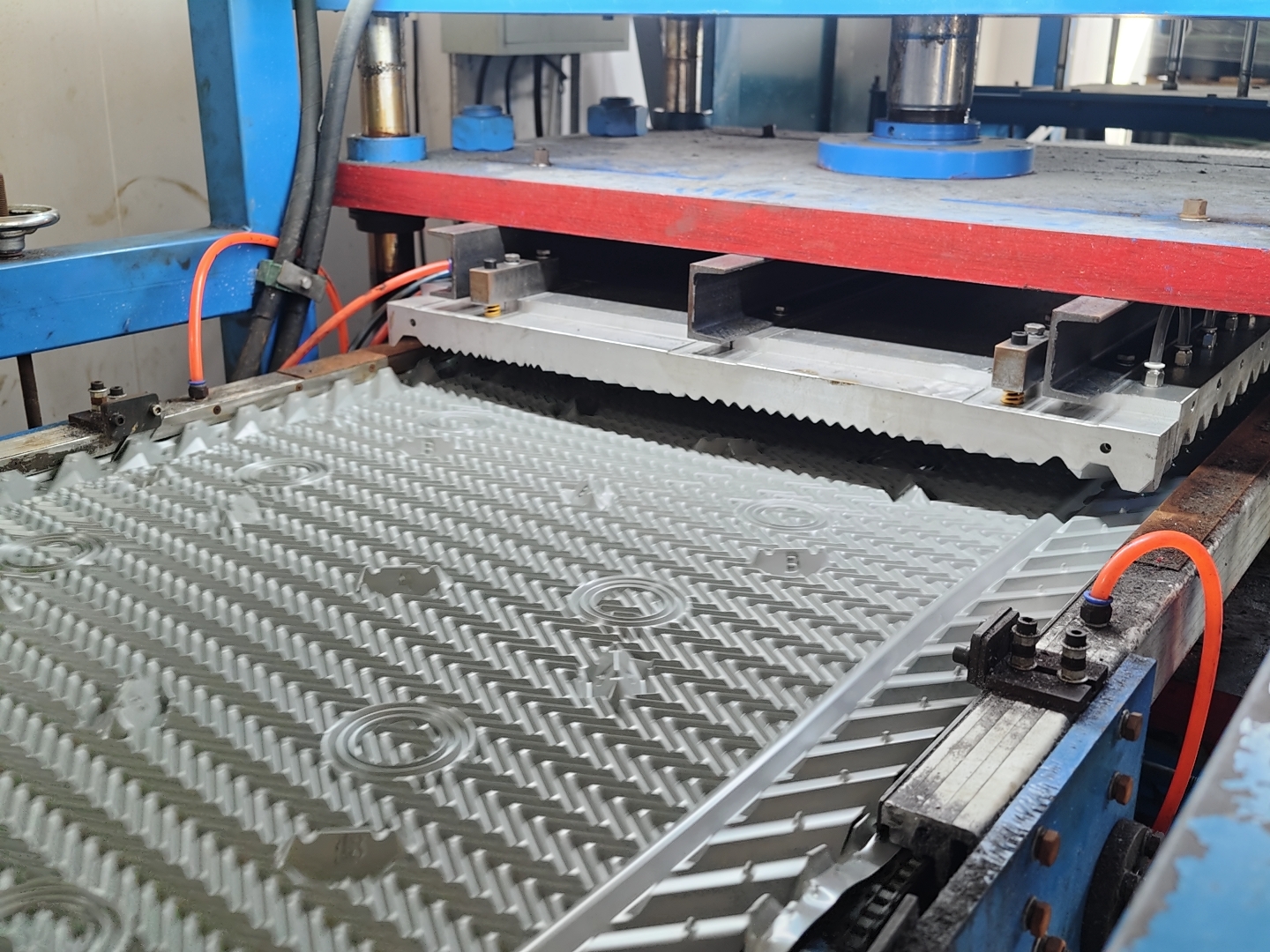
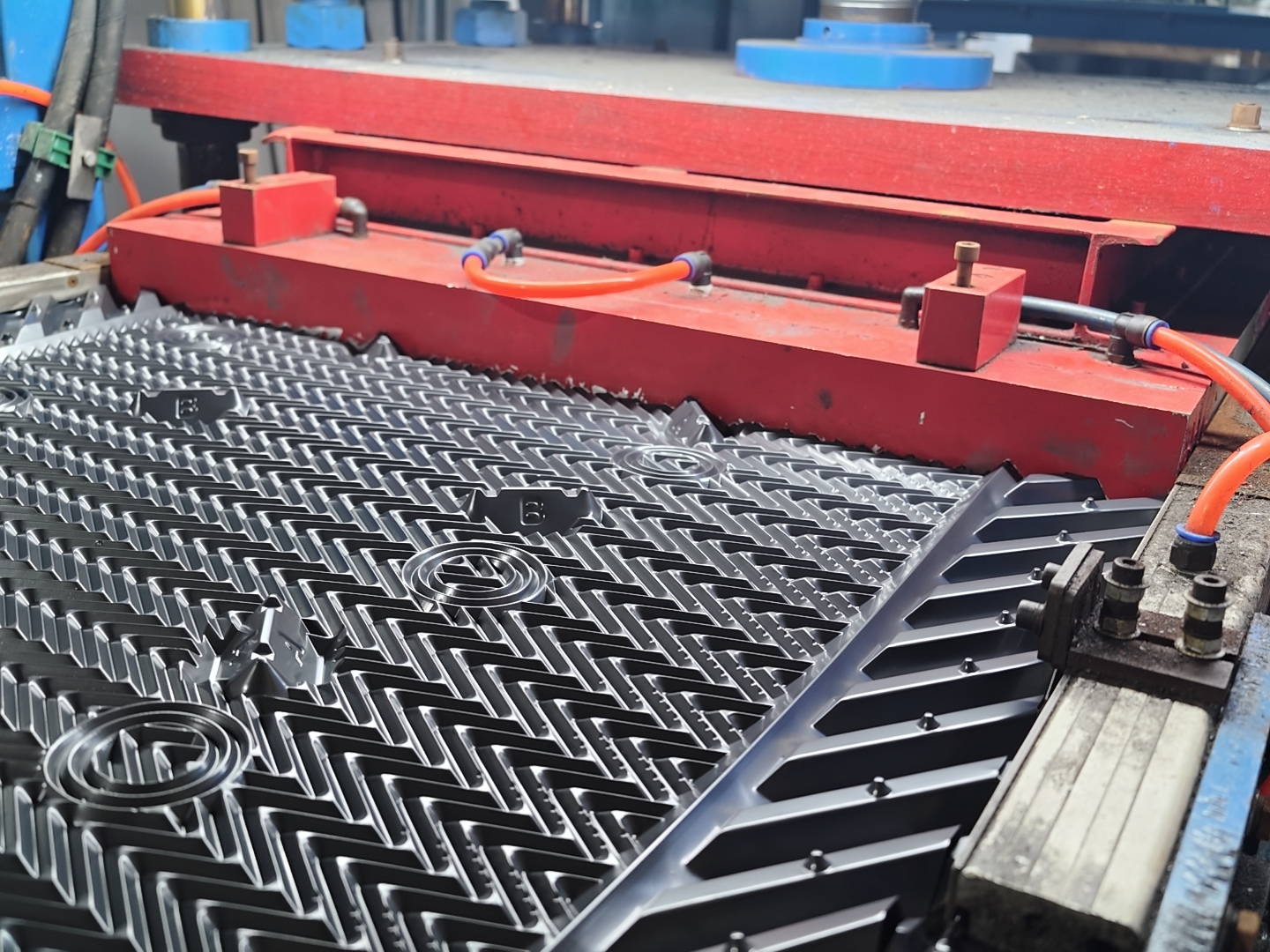
Film fill uses formed surfaces to spread water into thin films. The resulting contact area allows air and water to exchange heat effectively when the fill is correctly selected and operated.
The structured surface encourages water to spread across the fill rather than falling in large streams. This creates a greater effective contact area between the water and air.
Film fill can provide effective thermal performance, but the actual result depends on water distribution, fill geometry, airflow, and the cleanliness of the passages.
Film fill passages may become restricted by scale, sediment, biological growth, and other deposits. Facilities with poor water quality or a high suspended-solids load should evaluate fouling risk before selecting a particular design.
Effective water treatment and periodic inspection are important for maintaining performance.
Splash fill uses bars, grids, or similar structures to break falling water into droplets. This increases the exposed water surface and can be useful in selected applications where debris tolerance is important.
Splash fill may be considered when water conditions make narrow film-fill passages difficult to maintain. However, it is not a universal replacement for structured cross flow film fill.
The tower's original design, required cooling capacity, available installation space, and water distribution arrangement must be evaluated before changing fill types.
The performance of cross flow cooling tower fill depends on several related design factors. Evaluating these details can help buyers avoid selecting products based on price or appearance alone.
The surface pattern determines how water spreads and how air passes through the fill. Different designs create different combinations of contact area, water retention, and airflow resistance.
A suitable surface pattern encourages even wetting and effective heat transfer. However, greater geometric complexity does not automatically guarantee better cooling performance.
The design should be evaluated in relation to water flow, airflow, fouling risk, and the cooling tower's operating conditions.
When purchasing replacement fill, compare the new sheet configuration with the original product. Differences in surface geometry can influence water distribution and airflow, even when the replacement sheets have similar dimensions.
For customized projects, provide drawings, photographs, or physical samples when available.
The spacing between sheets influences the size of the water and air passages.
Narrow passages may provide more surface area within a given volume, depending on the geometry. However, they can also increase the risk of blockage and may create greater airflow resistance.
Wider passages may offer better tolerance for certain debris conditions and can simplify some cleaning tasks. Their thermal performance depends on the specific design and operating conditions.
The correct spacing should reflect the cooling duty, water quality, airflow capacity, and maintenance strategy. Buyers should avoid changing sheet spacing without confirming that the new configuration is suitable for the existing tower.
Water distribution is one of the most important factors in fill performance. A well-designed fill cannot deliver its intended results if water is concentrated in a few areas or fails to reach certain sections.
Dry areas reduce the effective heat transfer surface. They may result from blocked nozzles, damaged distribution troughs, incorrect water levels, or unsuitable flow rates.
Excessive water concentration in one area can lead to uneven operating conditions and may contribute to water carryover or other performance problems.
During fill replacement, inspect the water distribution system and correct underlying problems rather than installing new fill without addressing them.
Cooling tower fans must provide sufficient airflow through the tower's internal components. Fill geometry influences the resistance encountered by the moving air.
If replacement fill creates significantly greater airflow resistance than the original configuration, the fan may not deliver the intended airflow under the existing operating conditions.
Reduced airflow can affect heat rejection and may alter energy consumption. Conversely, a design that offers low resistance but insufficient contact area may not meet the required cooling duty.
Request relevant technical information from the manufacturer and confirm that the proposed fill is suitable for the tower's airflow arrangement. For critical applications, engineering review may be required to assess the effects of changing fill geometry.
Cross flow cooling tower fill is used in a wide range of facilities that require reliable heat rejection. Each industry has different water quality, operating temperature, maintenance, and reliability requirements.
Commercial buildings often use cooling towers as part of central air-conditioning systems. These installations may operate for extended periods during warm weather and must maintain stable cooling performance.
Cooling towers reject heat from condenser water. If fill passages become blocked or water distribution becomes uneven, the tower may struggle to achieve the required cold-water temperature under comparable operating conditions.
Properly selected fill, combined with regular maintenance, helps support stable operation.
Building operators should monitor water temperatures, fan operation, water distribution, and fill condition. Inspection schedules should reflect operating hours, water quality, local climate, and manufacturer recommendations.
Manufacturing facilities use cooling towers to remove heat from production equipment, process water, compressors, condensers, and heat exchangers.
Industrial water may contain suspended solids, oil residues, chemical contaminants, or other substances that affect fill performance.
The fill selection process should include a review of process conditions, water chemistry, normal and maximum temperatures, and the risk of fouling.
Unplanned cooling tower maintenance can disrupt production and increase operating costs. Purchasing teams should consider spare fill availability, supplier lead times, installation access, and maintenance requirements when planning replacement projects.
Power generation facilities may rely on cooling towers for condenser cooling and auxiliary equipment heat rejection.
Applications with high cooling loads require careful evaluation of thermal performance, airflow, water distribution, and material suitability.
The correct fill configuration should match the tower's engineering requirements rather than relying on generic descriptions such as high-efficiency or heavy-duty fill.
Replacement schedules should consider equipment condition, plant maintenance windows, access restrictions, and the consequences of reduced cooling capacity.
Where cooling performance is critical, fill specifications and installation arrangements should be confirmed well before the planned shutdown.
Chemical plants and other process facilities may use cooling towers to remove heat from production operations.
Some process environments expose cooling tower components to chemicals that are not commonly present in standard HVAC applications.
Buyers should provide accurate information about water treatment additives, potential contaminants, and cleaning chemicals. Material compatibility should be confirmed against the specific chemical concentrations and temperatures involved.
Food processing facilities and industrial utility systems may require reliable cooling for equipment, refrigeration-related systems, or process operations.
A suitable fill design should provide the required heat transfer while remaining compatible with the facility's water quality and maintenance procedures.
Where specialized hygiene, fire, or environmental requirements apply, these should be included in the technical specification before procurement.
Selecting suitable fill involves more than choosing PVC or PP. Buyers should evaluate the complete operating environment and confirm that the product matches the cooling tower's engineering requirements.
Start by identifying the cooling tower manufacturer, model, capacity, and original fill configuration.
Useful information includes:
Cooling tower brand and model
Existing fill material and type
Fill sheet dimensions and arrangement
Required cooling capacity
Circulating water flow rate
Normal and maximum water temperatures
Airflow direction and fan specifications
Water distribution arrangement
Existing fill condition and maintenance history
Providing these details helps the supplier evaluate the replacement requirements more accurately.
Accurate measurements are essential for replacement projects. Even small dimensional differences can create installation problems or interfere with adjacent components.
Measure the fill pack and available installation space. Confirm the arrangement of individual blocks, support rails, and other internal structures.
Where the original drawings are unavailable, photographs and physical samples can help the supplier understand the existing configuration.
Large cooling towers may have restricted access or require fill to be installed in separate sections. The replacement design should consider handling, lifting, and installation limitations.
Choose a material according to the operating temperature, water chemistry, mechanical requirements, and applicable safety standards.
PVC may be a practical choice for many conventional applications when operating conditions fall within the product's specified limits.
PP may be considered for selected applications where its material characteristics offer advantages. However, suitability must be verified using the manufacturer's technical information and the actual service conditions.
Water quality can strongly influence fill performance and service life.
Potential problems include:
Mineral scale from circulating water
Suspended solids and sediment
Algae and other biological growth
Corrosion products from the cooling system
Process contaminants entering the water circuit
The relative importance of each factor depends on the facility and its water treatment program.
For water conditions with a high fouling risk, evaluate passage dimensions, accessibility for cleaning, and the suitability of alternative designs. Do not select a fill product solely on the basis of nominal thermal efficiency.
The replacement product must support the cooling tower's required duty.
Important information includes hot-water temperature, target cold-water temperature, circulating water flow, ambient wet-bulb temperature, and expected operating range.
A supplier should be able to explain the technical basis for its performance claims. Actual cooling results depend on the complete tower design and operating environment, not the fill alone.
Purchase price is only one part of the overall project cost.
Compare material specifications, dimensional accuracy, manufacturing quality, packaging, lead time, shipping, installation costs, and maintenance requirements.
A fill product that fits correctly and meets the tower's requirements may help avoid repeated installation work or premature replacement. However, service life should be assessed according to the actual material and operating conditions rather than a generic promise.
Replacing fill can restore the intended heat transfer area when existing media is deteriorated or persistently blocked. A structured replacement process helps minimize installation errors and unnecessary downtime.
Fill replacement should be based on inspection and operating evidence.
If the tower cannot achieve its required cold-water temperature under comparable operating conditions, the fill may be blocked, damaged, or inadequately wetted.
Other possible causes include insufficient airflow, fan problems, excessive heat load, incorrect water flow, and poor water distribution. These factors should be investigated before deciding that fill replacement is the solution.
Cracked sheets, deformed passages, collapsed blocks, and damaged support areas may reduce the effective heat transfer surface or interfere with airflow.
Where damage is extensive, replacement may be more practical than repeated repairs.
Scale, sediment, and biological growth can restrict water and air passages. If suitable cleaning cannot restore the required condition, replacement may be necessary.
Repeated cleaning, recurring blockages, and persistent performance problems may indicate that the existing fill is approaching the end of its useful service life. The decision should consider material condition, operating data, and the cost of continued maintenance.
Record the condition of the fill, support structure, water distribution system, drift eliminators, basin, and other related components.
Identify the likely cause of deterioration, such as water quality, excessive temperature, chemical exposure, mechanical damage, or inadequate maintenance.
Provide the supplier with dimensions, photographs, technical drawings, operating conditions, and the original tower model where available.
Confirm the material, fill type, sheet configuration, quantity, block dimensions, and installation arrangement before production begins.
Follow the site's shutdown and isolation procedures. Manage stored water, provide safe access, and use suitable protective equipment.
Cooling tower fill replacement should be performed by qualified personnel following the facility's safety procedures.
Remove damaged or deteriorated fill carefully to avoid damaging support structures, water distribution components, and nearby equipment.
Inspect the exposed installation area for corrosion, structural deterioration, sediment, and other problems that may affect the new installation.
Install the replacement fill according to the approved arrangement and manufacturer instructions.
Check block alignment, support, spacing, and contact with adjacent components. Do not force incorrectly sized blocks into position or modify structural components without appropriate engineering approval.
Before returning the tower to normal service, check for obstructions, incorrect block placement, and interference with distribution components.
Verify that water can reach the intended fill area and that airflow passages remain clear.
Restart the cooling tower according to site procedures. Check for leaks, abnormal vibration, unusual airflow conditions, and uneven water distribution.
Monitor cold-water temperature and other relevant performance indicators under comparable operating conditions. Record the results to establish a reference for future maintenance.
A suitable maintenance program helps preserve heat transfer performance and reduce the likelihood of premature fill replacement.
Inspection frequency should reflect the operating environment, water quality, seasonal load, and manufacturer recommendations.
Look for scale, sediment, biological growth, deformation, cracks, and areas that are not being wetted properly.
Documenting the condition over time helps identify recurring problems and supports more informed maintenance decisions.
Inspect distribution troughs, pipes, nozzles, and related components for blockage, damage, and uneven flow.
Correcting water distribution problems can improve the use of the available fill surface and may prevent recurring performance issues.
Water treatment helps control scale, corrosion, and biological growth.
Depending on the facility's treatment program, relevant parameters may include pH, conductivity, hardness, suspended solids, and microbiological indicators.
The appropriate operating ranges should be established by qualified water treatment personnel according to system design, material compatibility, and local requirements.
If deposits repeatedly accumulate on the fill, investigate the water treatment program, filtration, makeup water quality, contamination sources, and operating practices.
Replacing fill without correcting the underlying cause may lead to similar problems with the new product.
Cleaning should remove deposits without damaging the fill.
High-pressure washing or aggressive brushing can deform or damage some fill designs. The correct cleaning method depends on the material, fill geometry, and type of deposit.
Cleaning chemicals must be compatible with the fill material and other cooling tower components. Follow supplier recommendations and site safety procedures.
Temperature trends, fan operation, water flow, and other operating indicators can reveal changes in tower performance.
Cooling tower performance depends on ambient wet-bulb temperature, heat load, airflow, and water flow. Comparing data from very different operating conditions may lead to incorrect conclusions about fill performance.
Use consistent measurement methods and document the conditions under which readings are taken.
Fill contributes to cooling tower heat transfer, but energy efficiency depends on the interaction between the fill, fans, water distribution, and the wider cooling system.
Suitable fill geometry can increase the contact area between air and water. When water distribution and airflow are appropriate, this can help the tower achieve its intended cooling duty.
Increasing surface area can also increase airflow resistance or create smaller passages that are more vulnerable to fouling.
A well-designed fill balances heat transfer, airflow, water distribution, and maintenance requirements rather than maximizing one factor in isolation.
Fill characteristics influence airflow resistance, while the cooling system's water distribution arrangement affects pump and water delivery requirements.
A replacement fill with different characteristics may change the fan's operating conditions. Confirming compatibility helps reduce the risk of unintended performance changes.
Any claimed energy savings should be supported by a comparison of actual operating conditions and measured system performance.
Deposits and blocked passages reduce the effective area available for heat exchange and can interfere with airflow.
A suitable water treatment and maintenance program helps preserve fill condition and supports more consistent cooling tower operation over time.
Manufacturing quality is important because fill sheets must fit the installation area and maintain their intended shape under service conditions.
The material grade influences thermal limits, mechanical behavior, chemical compatibility, and durability.
Buyers should request clear material information and documented operating limits. If the application has specialized requirements, the supplier should confirm whether the proposed material is appropriate.
Fill sheets and blocks should meet the agreed dimensions and configuration.
Inconsistent dimensions can make installation difficult, create gaps, or interfere with adjacent components. Product consistency is particularly important for projects involving large quantities of replacement fill.
Before dispatch, the supplier should inspect the finished product according to the agreed quality requirements.
Fill sheets and assembled blocks may be vulnerable to crushing, deformation, or handling damage. Appropriate packaging, stable stacking, and clear handling instructions help reduce transportation risks.
International buyers should confirm packaging dimensions and loading arrangements before shipment.
Selecting a suitable supplier involves evaluating technical capability, product consistency, communication, delivery arrangements, and project support.
Different cooling towers may require different fill dimensions, materials, and configurations.
Ask whether the supplier can review drawings, inspect samples, manufacture to agreed dimensions, and provide relevant product information.
For replacement work, the supplier should understand that dimensional compatibility and fill configuration are as important as the material itself.
A reliable supplier should clearly explain the proposed product and its limitations.
A useful quotation should specify:
Fill material and product type
Sheet or block dimensions
Quantity and packaging arrangement
Relevant technical specifications
Production lead time
Shipping terms and destination requirements
Any required drawings or installation information
Clear documentation makes it easier to compare quotations and reduces misunderstandings during production.
Large replacement projects may require substantial quantities of fill within a limited maintenance window.
Confirm production lead time, inspection arrangements, packaging, loading, and shipping schedules before placing the order.
Where downtime is expensive, include realistic transport and installation allowances in the project plan.
Technical support can be valuable when installation conditions differ from the original assumptions.
Before ordering, confirm how the supplier will handle dimensional questions, product inspection, transportation damage, and technical inquiries. Written specifications and clear communication help resolve issues efficiently.
A careful purchasing process can prevent costly errors and reduce the risk of poor replacement performance.
A lower price may not reflect differences in material grade, dimensions, fill geometry, packaging, or technical support.
Request quotations based on the same material, dimensions, quantity, and required configuration. Otherwise, the apparent price difference may not represent a meaningful comparison.
Selecting a fill design without considering suspended solids, scale, and biological growth can lead to recurring fouling.
Provide information about water quality and maintenance practices before the supplier recommends a product.
Material names alone do not establish performance. Products can differ in formulation, sheet thickness, geometry, manufacturing quality, and operating limits.
Confirm the actual specifications of the proposed product rather than relying on broad descriptions such as premium PVC or high-performance PP.
A fill pack may have the correct external dimensions but still differ in surface geometry or airflow characteristics.
Review the original fill arrangement, support structure, water distribution system, and airflow requirements before approving a replacement.
Repeated replacement without addressing poor water treatment, excessive temperatures, or incompatible cleaning methods may lead to premature damage again.
Review the operating history and identify changes that can help protect the new fill and improve long-term reliability.
Its main function is to increase the effective contact area between circulating water and air, supporting heat transfer and evaporation inside the cooling tower.
Many suppliers can manufacture fill to specified dimensions and configurations, subject to their production capabilities. Buyers should provide drawings, measurements, photographs, and operating details to confirm compatibility.
Neither material is always better. PVC is commonly used in many conventional cooling tower applications, while PP may suit selected environments depending on its grade and operating conditions. Material selection should be based on documented temperature limits, chemical compatibility, and mechanical requirements.
Common signs include severe physical damage, persistent blockage, deformed sheets, and reduced cooling performance that cannot be restored through appropriate maintenance. Other possible causes of poor cooling should be investigated before replacement is approved.
Service life varies with material quality, operating temperature, water chemistry, mechanical loading, and maintenance practices. There is no universal replacement interval suitable for every cooling tower. Periodic inspection and performance monitoring provide a more reliable basis for planning.
Suitable replacement fill can help restore the intended heat transfer area and water distribution when the existing fill is deteriorated or blocked. Actual results depend on the complete cooling tower, including airflow, water flow, fan condition, heat load, and ambient conditions.
Provide the cooling tower manufacturer and model, existing fill dimensions, material, required quantity, operating temperatures, circulating water conditions, and photographs or drawings when available. More complete information helps the supplier evaluate the replacement requirements.
Not necessarily. Drift eliminators and fill perform different functions. However, a fill replacement project is a practical opportunity to inspect drift eliminators, water distribution components, supports, and other internal parts. Replace any component that is damaged or no longer meets the system's requirements.
Cross flow cooling tower fill is a key component in the thermal performance of industrial and commercial cooling towers. Its material, geometry, passage dimensions, and installation arrangement influence heat transfer, airflow resistance, water distribution, and maintenance requirements.
Choosing the right product requires a complete review of the existing cooling tower and its operating conditions. Buyers should evaluate PVC and PP material options, water quality, operating temperature, fouling risk, airflow requirements, and dimensional compatibility before selecting a replacement.
For maintenance contractors, cooling tower operators, engineering companies, and industrial purchasing teams, a successful project starts with accurate measurements and clear technical specifications. Working with a capable cross flow cooling tower fill supplier can help simplify product selection, customization, quality verification, and delivery planning.
Whether the project involves a new cooling tower installation or the replacement of deteriorated fill, prioritize verified specifications, suitable material selection, and proper maintenance planning. The right cross flow cooling tower fill can help restore intended heat transfer performance, support stable operation, and contribute to more predictable long-term maintenance costs.


