English


Views: 0 Author: jessi Publish Time: 2026-10-14 Origin: Site


Cooling tower fill plays a critical role in heat transfer, cooling efficiency, and overall system performance. In industrial plants, commercial HVAC systems, power stations, and process cooling facilities, damaged or inefficient fill can reduce cooling capacity, increase energy consumption, and create additional maintenance costs. Choosing a reliable BAC cooling tower fill replacement manufacturer is therefore essential for maintaining stable operation and extending the service life of cooling tower equipment.
For global projects, replacement fill must meet specific requirements for dimensions, material quality, thermal performance, water distribution, and installation compatibility. Whether a facility needs a complete fill replacement or a partial upgrade, working with an experienced manufacturer can help simplify procurement and improve project efficiency.
This article explores BAC cooling tower fill replacement, material selection, manufacturing quality, customization options, installation considerations, and how international buyers can select the right supplier for their projects.
 |
 |
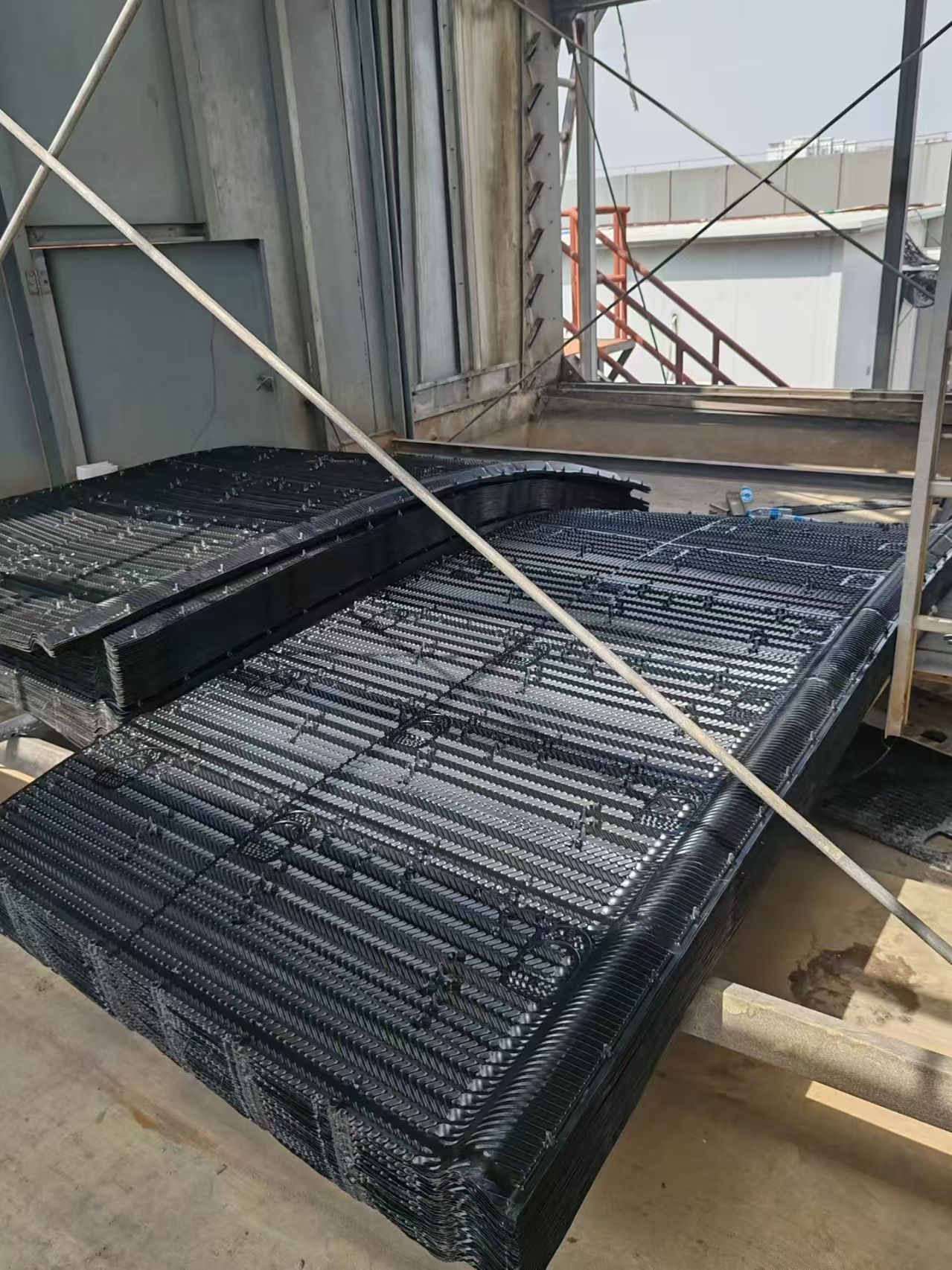
Cooling tower fill is the heat exchange medium installed inside a cooling tower. It increases the contact area between circulating water and air, allowing heat to transfer more efficiently through evaporation and sensible heat exchange.
Over time, existing fill may become damaged by scale, biological growth, chemical exposure, high temperatures, or mechanical stress. When cleaning and routine maintenance can no longer restore performance, replacing the fill becomes a practical solution.
Several operating conditions can indicate that existing fill needs to be inspected or replaced.
When fill surfaces become blocked by mineral deposits, dirt, or biological growth, water distribution and air contact can deteriorate. This may reduce cooling performance and prevent the tower from meeting its design requirements.
Plastic fill can deform because of excessive operating temperatures, unsuitable chemicals, aging, or mechanical loading. Collapsed sheets and damaged support areas may interfere with water flow and airflow.
Blocked or deformed fill can restrict airflow through the tower. Higher air resistance may increase fan power consumption or reduce the amount of air passing through the heat exchange section.
Repeated cleaning, frequent repairs, and persistent fouling can increase operating expenses. In these situations, a complete or partial fill replacement may provide a more economical long-term solution.
A specialized manufacturer can supply replacement fill media designed around the existing cooling tower configuration and project requirements.
Typical services include:
PVC and PP cooling tower fill manufacturing
Replacement fill dimensions and configuration assessment
Custom cutting and sheet assembly
Material selection for different operating temperatures
Technical documentation and product inspection
Packaging suitable for international transportation
Export support for distributors, contractors, and industrial end users
The exact scope depends on the manufacturer, the cooling tower model, and the technical information available for the project.
For international cooling tower projects, product compatibility and consistent quality are just as important as the purchase price. A professional manufacturer can help buyers evaluate the technical requirements before production begins.
Replacement fill must fit the available space inside the cooling tower. Incorrect dimensions can create gaps, obstruct water distribution, or complicate installation.
Before placing an order, buyers should verify:
Fill block length, width, and height
Individual sheet dimensions and thickness
Sheet flute geometry and spacing
Module arrangement and assembly method
Fill support and installation requirements
Available clearance for water distribution and airflow
Whenever possible, provide the original fill drawings, equipment model, photographs, or physical samples. These references help reduce uncertainty during replacement planning.
Manufacturing consistency affects the durability, fit, and performance of replacement fill. Reliable production processes should control material thickness, sheet forming, flute geometry, cutting accuracy, and assembly quality.
A structured quality control process may include incoming material inspection, forming parameter checks, dimensional verification, visual inspection, and final packaging checks.
For large international orders, buyers should also confirm the manufacturer's batch identification, inspection records, and agreed acceptance criteria.
Cooling towers installed in different countries and industries may operate under different environmental and process conditions. A manufacturer with customization capabilities can adapt replacement products to project-specific requirements.
Depending on the product design and manufacturing capability, customization may cover:
Fill sheet thickness
PVC or PP material selection
Sheet and block dimensions
Fill geometry and assembly configuration
Packaging and pallet dimensions
Order quantities and delivery schedules
Customization should be based on verified engineering requirements rather than appearance alone. A replacement product that looks similar to the original may still differ in airflow resistance, wetting characteristics, or thermal performance.
Selecting the appropriate fill type is a major step in replacement planning. The correct solution depends on the original cooling tower design, circulating water quality, operating temperature, and maintenance conditions.
Polyvinyl chloride (PVC) is widely used in cooling tower fill applications because it offers a practical balance of cost, formability, and corrosion resistance under suitable operating conditions.
PVC cooling tower fill can provide:
Good heat transfer characteristics when properly designed
Lightweight construction for easier handling
Resistance to moisture and many common cooling water conditions
Flexible sheet forming for different fill configurations
Competitive material and replacement costs
PVC is often suitable for HVAC cooling towers and many industrial applications. However, its suitability must be confirmed against the actual operating temperature, water chemistry, fire-performance requirements, and manufacturer specifications.
Polypropylene (PP) fill can be appropriate for applications where operating temperatures or chemical conditions make standard PVC unsuitable.
PP may be worth evaluating when a cooling tower operates under elevated temperatures or requires compatibility with particular process-water conditions.
Before selecting PP, buyers should verify its temperature rating, chemical resistance, mechanical properties, and compatibility with the existing tower design. PP is not automatically the best option for every high-temperature or chemically aggressive application.
Cooling tower fill can generally be divided into film fill and splash fill according to how water contacts air.
Film fill spreads water into thin films across structured surfaces. This increases the contact area between water and air and can provide high heat transfer performance in applications with suitable water quality.
Film fill is commonly used in HVAC and industrial cooling systems where effective heat exchange and compact installation are important.
Splash fill breaks falling water into smaller droplets as it moves through successive splash bars or grids. This design can be useful in certain applications where suspended solids or fouling risks make conventional film fill less suitable.
The final choice should consider the original tower configuration, water quality, maintenance strategy, and thermal requirements.
A reliable BAC cooling tower fill replacement manufacturer should evaluate more than the external dimensions of the product. Heat transfer, airflow, water distribution, and structural stability must all be considered.
Cooling tower fill needs to distribute water effectively across its active surface while maintaining appropriate airflow.
The fill's flute pattern, surface characteristics, and passage geometry influence water spreading, contact time, and air-water interaction. Poor water distribution can leave parts of the fill underutilized, reducing effective heat exchange.
Fill geometry also affects the pressure drop across the heat exchange section. A design with excessive airflow resistance may increase fan energy requirements or reduce airflow if the existing fan system cannot compensate.
Replacement fill should therefore be evaluated against the original tower's thermal and hydraulic design conditions.
Fill media must maintain its shape under normal operating loads, water flow, and environmental exposure.
Sheet thickness is one factor affecting stiffness and durability, but it should not be considered independently of the material grade, flute geometry, support spacing, and operating conditions.
The expected service life depends on water chemistry, temperature, biological activity, cleaning procedures, UV exposure where relevant, and maintenance practices. No replacement material can guarantee a specific lifespan without considering these variables.
Fill replacement should not compromise other cooling tower components.
Before installation, inspect support grids, structural members, spray nozzles, distribution pipes, and drift eliminators. Damaged supports or uneven water distribution can reduce the performance of newly installed fill.
Drift eliminators reduce the amount of liquid water carried out of the tower with exhaust air. They perform a different function from fill media, although both components influence tower operation.
When replacing fill, confirm that the new configuration maintains appropriate clearances and does not obstruct the drift eliminator system.
Global replacement projects may involve a wide range of operating environments. Understanding the application helps manufacturers recommend suitable materials and configurations.
Commercial buildings, shopping centers, hospitals, and office complexes often use cooling towers as part of their central air conditioning systems.
Building operators typically seek stable cooling performance, manageable maintenance costs, and reliable operation during periods of high cooling demand.
PVC film fill may be suitable for many of these applications when the water quality and operating conditions meet the material requirements.
Power plants and energy facilities may rely on cooling towers for continuous heat rejection.
Replacement planning should account for cooling duty, water temperature, operating schedules, mechanical loads, and installation downtime. Where operations are continuous, accurate dimensional verification and advance production planning can reduce the risk of installation delays.
Chemical processing, metalworking, plastics manufacturing, food processing, and other industrial facilities may have specific cooling requirements.
Industrial circulating water can contain suspended solids, scale-forming minerals, treatment chemicals, or contaminants from process leakage. Buyers should evaluate fouling risk and chemical compatibility before selecting replacement fill.
In demanding environments, the fill design and cleaning strategy should be considered together.
Some water treatment and wastewater facilities use cooling towers or related evaporative cooling systems.
Where suspended solids or biological growth are significant, fill passages may become blocked more rapidly. Splash fill or a suitable fouling-resistant configuration may deserve consideration, depending on the original tower design and required cooling performance.
Choosing the right supplier requires a combination of technical evaluation, production verification, and commercial assessment.
Look for a supplier with experience producing cooling tower fill for industrial and commercial applications.
Ask whether the manufacturer can:
Produce the required fill dimensions and geometry
Explain the differences between PVC and PP options
Provide material specifications and inspection documentation
Confirm compatibility with the existing tower configuration
Handle the required production volume
Prepare export packaging for the destination market
Request relevant project references where available. Experience with a similar application can be more useful than a general claim of manufacturing capability.
A quotation should clearly identify the proposed product and its technical characteristics.
The quotation should specify material type, sheet thickness, dimensions, fill configuration, quantity, packaging, production lead time, and applicable inspection requirements.
If the product is intended to replace a specific BAC fill assembly, confirm which original specifications have been verified and which still require technical approval.
The lowest initial quotation does not always represent the lowest overall project cost.
Consider the following:
Unit price and minimum order quantity
International freight and insurance
Export packing and pallet requirements
Import duties and local handling charges
Installation labor and downtime
Expected maintenance requirements
Product conformity and inspection costs
A technically appropriate replacement that arrives on schedule and installs correctly may provide better overall value than a cheaper product requiring extensive modification.
International projects involve coordination between buyers, manufacturers, logistics providers, and installation contractors.
A reliable supplier should provide clear responses to technical questions, communicate production progress, and confirm shipping documentation and packaging arrangements.
Depending on the destination and contract, buyers may require a commercial invoice, packing list, certificate of origin, material specifications, inspection report, or other shipping and compliance documents.
Confirm the required documentation before production and shipment.
Accurate project information allows the manufacturer to evaluate compatibility and prepare a more reliable quotation.
Provide as many of the following details as possible:
Cooling tower brand and model
Original fill type and material
Fill block dimensions and quantity
Individual sheet dimensions, if available
Operating water temperature and air conditions
Water quality and treatment information
Required material, such as PVC or PP
Installation location and project application
Photographs, physical samples, equipment nameplates, and measurements of the existing fill can help with preliminary identification.
However, photographs alone may not reveal internal flute geometry, material thickness, or thermal design characteristics. Critical dimensions and specifications should be verified before manufacturing.
Buyers should also communicate the destination country, required delivery date, estimated order quantity, preferred packaging, and any special shipping requirements.
For large projects, it is useful to confirm whether the quotation covers loose sheets, assembled fill blocks, or another delivery configuration. These options can have different implications for packaging volume, freight cost, and on-site labor.
A structured workflow helps reduce technical uncertainty and improve coordination between the supplier and the installation team.
Identify the reason for replacement and inspect the existing fill, support structure, water distribution system, and drift eliminators.
Decide whether the project requires a full fill replacement or a partial replacement. If the fill has failed because of unsuitable water treatment, excessive temperature, or structural problems, address the underlying cause as well.
Collect drawings, dimensions, material specifications, and operating conditions. The manufacturer and buyer should agree on the fill configuration and the acceptance criteria before production.
Check that the proposed fill will fit the existing tower and that its geometry and material are appropriate for the intended operating conditions.
The manufacturer produces the sheets or fill blocks according to the approved specifications.
Inspection may include dimensional checks, visual examination, quantity verification, packaging review, and confirmation of the agreed material documentation.
Before installation, arrange access equipment, lifting or handling tools, and the necessary safety measures.
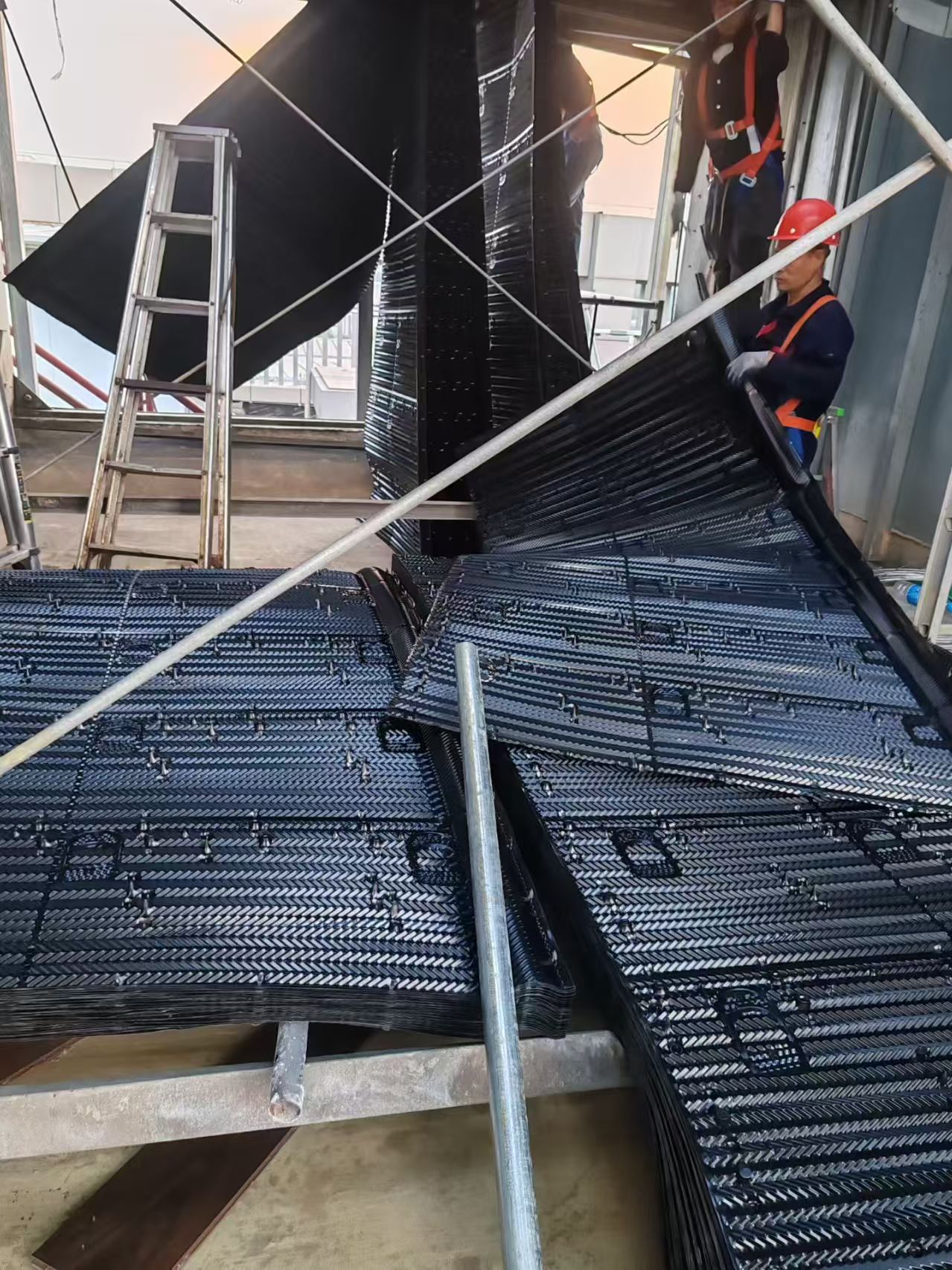
Existing fill should be removed according to the site's maintenance procedures. Workers should follow applicable lockout/tagout requirements, confined-space procedures where relevant, and chemical or biological exposure controls.
Install the fill according to the approved arrangement and the manufacturer's instructions.
Verify that the fill is properly supported, positioned, and secured. Check clearances, water distribution, and surrounding components before returning the tower to service.
After installation, inspect the system for abnormal water flow, leaks, vibration, and other operating issues.
Where operating conditions permit, compare cooling performance, water temperatures, fan operation, and pressure drop with the appropriate baseline or design expectations. Record the results to support future maintenance.
Even a well-manufactured product can underperform if the replacement process overlooks important engineering factors.
Low-cost fill may have unsuitable material properties, inconsistent dimensions, or a geometry that does not match the original design.
Better approach: Compare technical specifications, inspection requirements, material suitability, and total delivered cost.
A material that performs well in one cooling tower may deform or deteriorate under a different temperature profile.
Better approach: Confirm the maximum continuous operating temperature, temperature fluctuations, and material-specific limitations before ordering.
Severe fouling may recur quickly if the underlying water treatment problems remain unresolved.
Better approach: Review scale formation, suspended solids, biological growth, and chemical treatment practices during replacement planning.
Installing new fill on damaged or unsuitable supports can create uneven loading and premature failure.
Better approach: Inspect the support grid and associated components before installation.
Similar-looking fill products may differ in sheet thickness, flute geometry, airflow resistance, and heat transfer characteristics.
Better approach: Verify the engineering specifications and compatibility requirements rather than relying on appearance alone.
There is no universal replacement interval for every BAC cooling tower. Service life depends on material, water quality, operating temperature, maintenance, and mechanical conditions.
Persistent fouling, cracking, deformation, collapsed fill sections, restricted airflow, and declining cooling performance may indicate that an inspection or replacement is necessary.
Replacement fill can often be customized to fit an existing cooling tower configuration, provided that the necessary technical information is available.
The manufacturer should receive the tower model, fill dimensions, original specifications, photographs, or samples. Compatibility should be confirmed before production rather than assumed from the brand name alone.
Neither material is universally superior. PVC is widely used in many conventional cooling tower applications, while PP may be appropriate for certain higher-temperature or chemically demanding conditions.
Compare the actual operating temperature, chemical exposure, mechanical requirements, water quality, and manufacturer specifications.
Manufacturers with established export processes can support overseas projects through customized production, inspection, export packaging, and shipping coordination.
Check production capacity, lead time, packing dimensions, delivery terms, technical documentation, and the supplier's ability to meet the destination country's import requirements.
Replacement may improve cooling performance when existing fill is damaged, blocked, or significantly deteriorated. However, the result depends on the fill design, tower condition, water distribution, airflow, and operating requirements.
A suitable replacement may help restore airflow when the original fill is excessively blocked or damaged. Actual energy savings should be verified through operating measurements rather than assumed from the material change alone.
Selecting a reliable BAC cooling tower fill replacement manufacturer is an important step in maintaining cooling tower efficiency and supporting long-term industrial operation. Buyers should prioritize dimensional compatibility, suitable PVC or PP materials, manufacturing consistency, heat transfer performance, and dependable international delivery.
For global cooling tower projects, successful replacement begins with accurate technical information and a clear understanding of the operating environment. By evaluating product specifications, inspecting supporting components, and working with an experienced manufacturing partner, project teams can reduce installation risks and improve the reliability of their cooling systems.
If you are sourcing replacement fill for a BAC cooling tower, prepare the original fill dimensions, material requirements, operating conditions, and estimated quantity before requesting a quotation. These details will help the manufacturer assess the application and propose a suitable replacement solution for your project.


