When a cooling tower cannot deliver the cooling performance you expect, the problem may not be the entire system. Sometimes, a worn fan blade, clogged fill pack, damaged drift eliminator, or poorly performing water distribution component is enough to affect the operation of the whole tower.
That is why choosing the right cooling tower parts factory matters.
A reliable supplier does more than provide replacement components. It helps you identify the correct parts, check dimensions, select suitable materials, and find practical solutions for your cooling tower maintenance or upgrade project.
Whether you are building a new cooling tower, replacing old components, or maintaining an existing industrial cooling system, every part deserves attention.
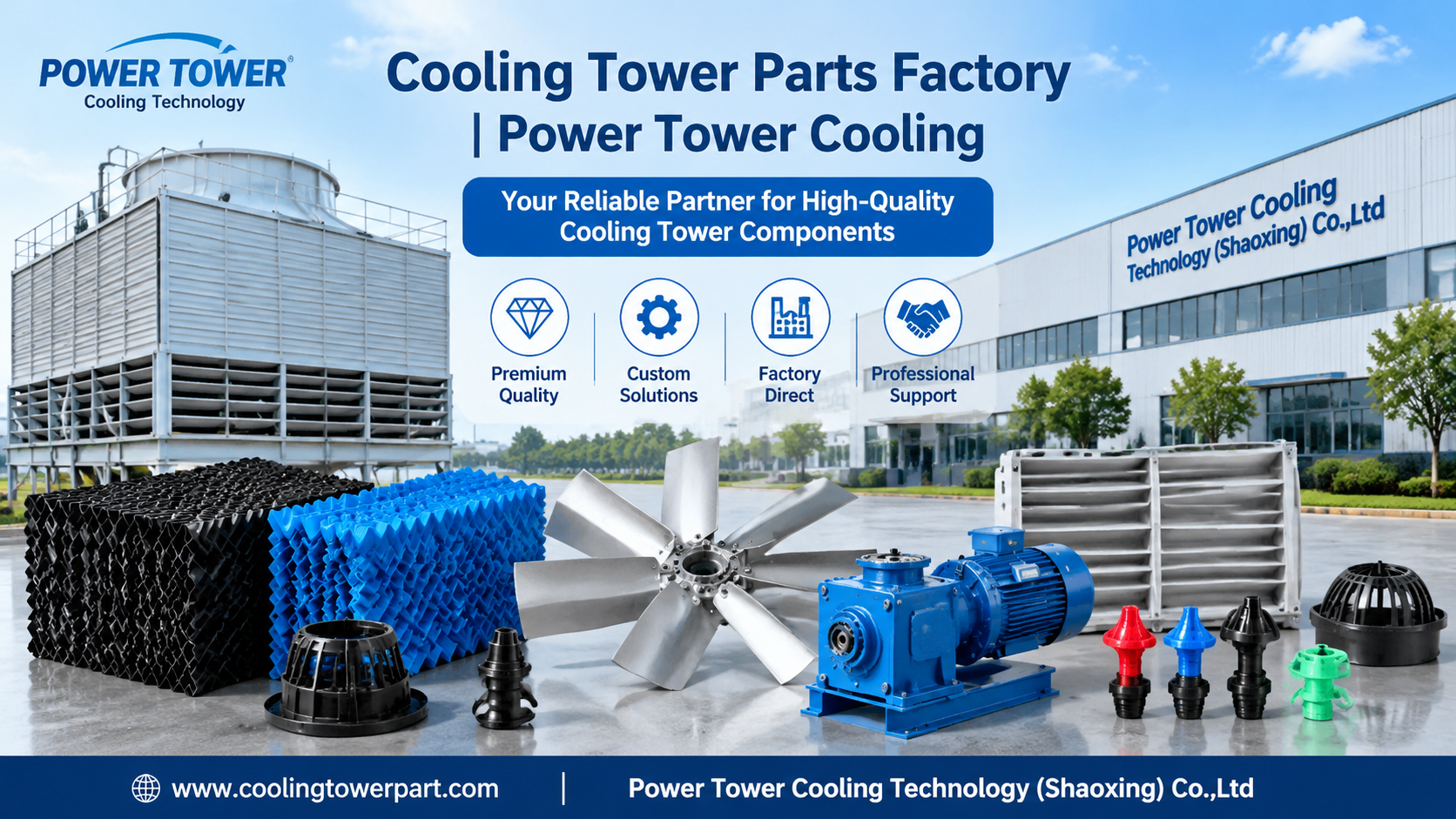
Power Tower Cooling Technology (Shaoxing) Co.,Ltd specializes in cooling tower parts and replacement solutions. Through its website, www.coolingtowerpart.com, the company provides product options for customers looking for cooling tower fill, drift eliminators, fans, motors, speed reducers, nozzles, and other cooling tower accessories.
In this guide, we will explore the main cooling tower components, explain how to choose suitable replacement parts, and discuss what you should look for when working directly with a cooling tower parts manufacturer.
Why Cooling Tower Parts Matter
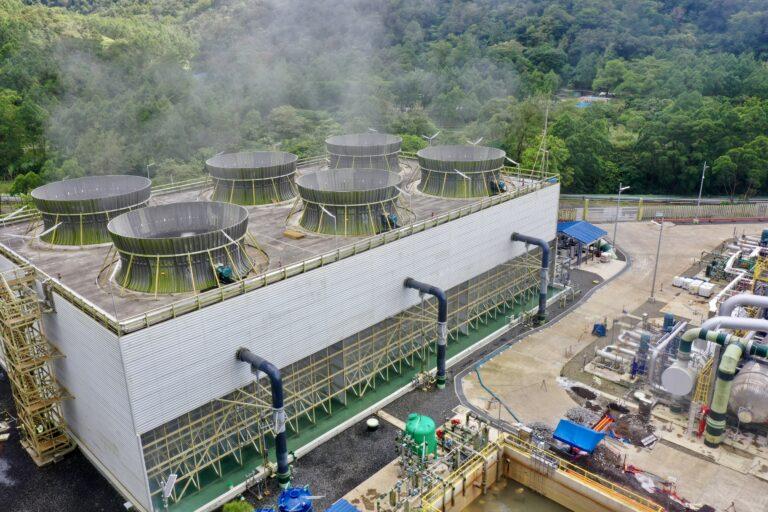
A cooling tower is a complete heat-rejection system made up of many components. Each part has a specific function, and all of them need to work together to achieve reliable cooling performance.
For example, cooling tower fill increases the contact area between water and air. Fans move air through the tower. Water distribution systems spread hot water over the fill, while drift eliminators help prevent water droplets from escaping with the discharged air.
What happens when one component stops working properly?
A damaged fan can reduce airflow. Clogged fill can restrict air and water movement. Blocked nozzles can create uneven water distribution. Worn mechanical components may increase vibration, noise, and maintenance requirements.
These problems can affect cooling efficiency and increase operating costs.
Think of a cooling tower as a team. Every component has a job, and even a small problem can affect the performance of the entire system. Choosing suitable parts and replacing damaged components at the right time helps keep the system operating reliably.
What Does a Cooling Tower Parts Factory Do?
A cooling tower parts factory manufactures or supplies components used in cooling tower construction, operation, maintenance, and refurbishment.
Depending on its product range and manufacturing capabilities, a specialist supplier may provide standard components, customized parts, OEM-compatible products, and replacement solutions for different cooling tower designs.
For buyers, working with a specialist factory can make technical communication easier. Instead of purchasing parts based only on appearance, you can discuss dimensions, materials, operating conditions, and installation requirements.
Manufacturing and Supplying Essential Components
Cooling tower parts cover both thermal and mechanical systems.
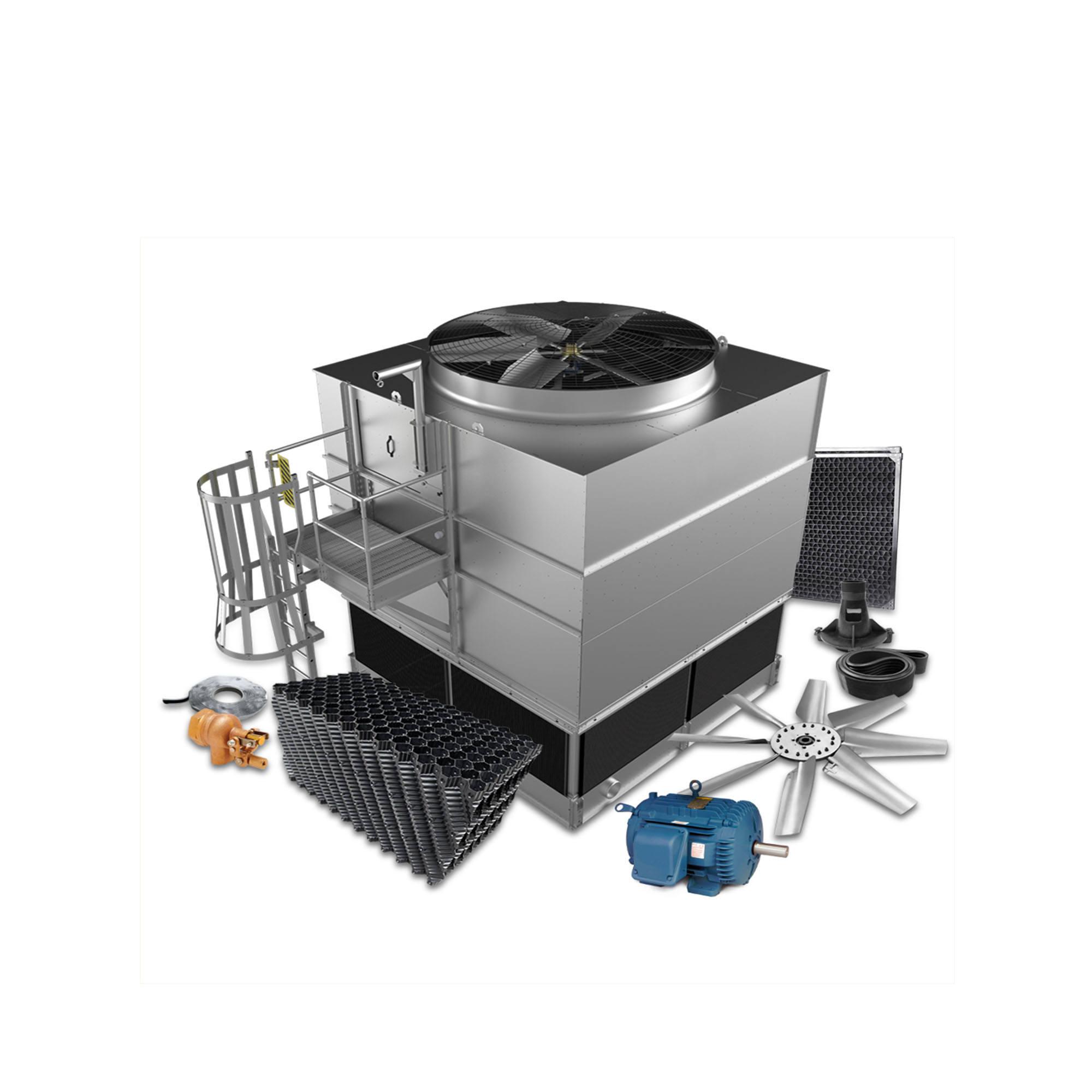
Common products include:
Cooling tower fill
Drift eliminators
Cooling tower fans and fan blades
Fan hubs and drive components
Motors and speed reducers
Spray nozzles and sprinkler heads
Water distribution pipes
Air inlet louvers
Fan stacks and casing components
Belts, pulleys, pumps, and other accessories
These components are used in different cooling tower types and applications. A specialist supplier can help buyers identify the product category and technical information needed for a particular project.
Supporting New Projects and Replacement Work
Cooling tower components are required throughout the life of a cooling system.
For new projects, engineers need parts that match the tower design and operating requirements. During routine maintenance, operators may need to replace worn or damaged components. During a retrofit, buyers may need compatible alternatives for old or discontinued products.
Replacement work can be challenging. Original drawings may be unavailable, equipment labels may have faded, and the original manufacturer may no longer supply the same component.
In these situations, photographs, samples, measurements, and technical drawings become especially useful. Providing accurate information helps the supplier assess whether a replacement product is suitable.
Main Cooling Tower Parts and Their Functions
Before contacting a cooling tower parts factory, it helps to understand the function of each component. This knowledge makes it easier to explain your requirements and avoid ordering an unsuitable product.
1. Cooling Tower Fill
Cooling tower fill is one of the most important internal components in a wet cooling tower.
Its main purpose is to increase the contact area between water and air. As hot circulating water flows through the fill, air passes through the same section. A small portion of the water evaporates, removing heat from the remaining water.
Without suitable fill, water may flow through the tower too quickly, reducing the contact time and heat-transfer area.
Properly selected fill helps improve water distribution and supports effective heat transfer.
Common cooling tower fill types include:
PVC film fill
PP film fill
Crossflow fill
Counterflow fill
Splash fill
The right choice depends on the cooling tower design, water quality, operating temperature, fouling risk, and thermal requirements.
Film Fill vs. Splash Fill
Film fill spreads water into thin layers across structured surfaces. It provides a large contact area between water and air and is commonly used in applications where water quality and operating conditions are suitable.
Splash fill works differently. It breaks falling water into smaller droplets as the water strikes bars, grids, or other surfaces. Its more open structure can be useful in certain applications where suspended solids or fouling are concerns.
Neither type is automatically the best choice for every cooling tower.
Film fill may be suitable for applications requiring a high heat-transfer surface area, while splash fill may be considered for more challenging water conditions. The final selection should take into account water quality, temperature, airflow, and the tower's design.
2. Cooling Tower Drift Eliminators
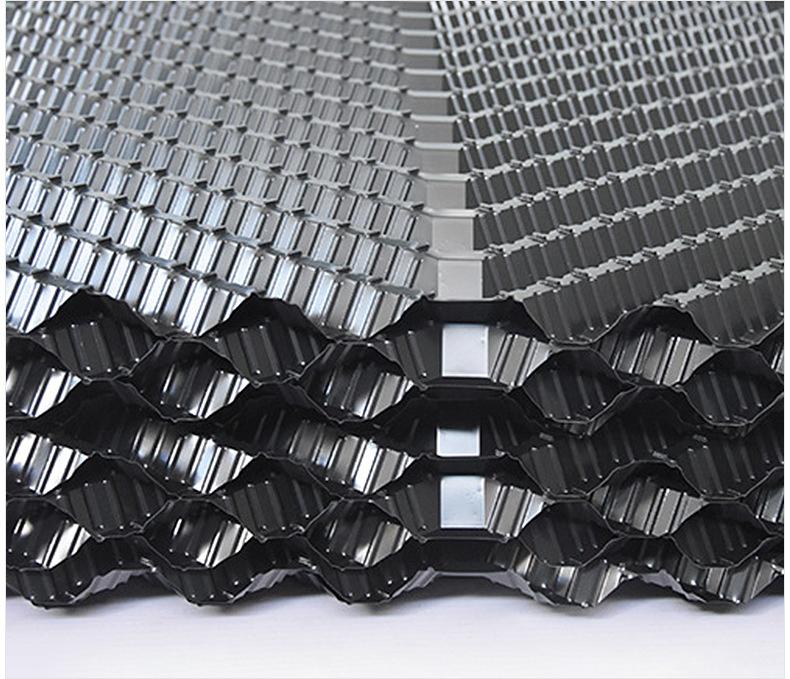
Drift eliminators reduce the amount of water droplets carried out of the cooling tower by moving air.
As air passes through the eliminator passages, it changes direction. Many water droplets strike the surfaces, collect, and drain back into the tower.
Why is this important?
Water lost through drift means additional makeup water and potentially lost water treatment chemicals. Excessive drift can also create wet areas around the cooling tower and affect nearby equipment.
When replacing drift eliminators, check:
Overall length, width, and height
Blade profile and spacing
Material and thickness
Airflow direction
Installation and support arrangement
A replacement must fit properly without creating an unsuitable restriction to airflow.
3. Cooling Tower Water Distribution Systems
A cooling tower needs to distribute hot water evenly over the fill or splash section.
Depending on the tower design, the water distribution system may use spray nozzles, distribution pipes, sprinkler heads, or other water delivery components.
If water distribution is uneven, some areas of the fill may receive too much water while others remain dry. This reduces the effective use of the fill and may contribute to localized scaling or fouling.
When selecting replacement nozzles or sprinkler components, confirm the following details:
Connection size
Spray pattern
Operating pressure
Required water flow
Material
Installation position
A nozzle that physically fits the pipe may still produce an unsuitable spray pattern. Always check its operating characteristics.
4. Cooling Tower Fans and Fan Components
Cooling tower fans move air through the tower and help maintain the airflow needed for heat rejection.
Depending on the design, cooling towers may use axial or centrifugal fans. The complete fan system may include blades, hubs, shafts, bearings, belts, pulleys, fan stacks, and other drive components.
When a fan becomes damaged or unbalanced, vibration and noise may increase. Airflow may become unstable, and mechanical stress can affect other connected components.
When selecting replacement fan parts, do not consider diameter alone. You should also check:
Correct selection helps maintain suitable airflow and reliable mechanical operation.
5. Cooling Tower Motors and Speed Reducers
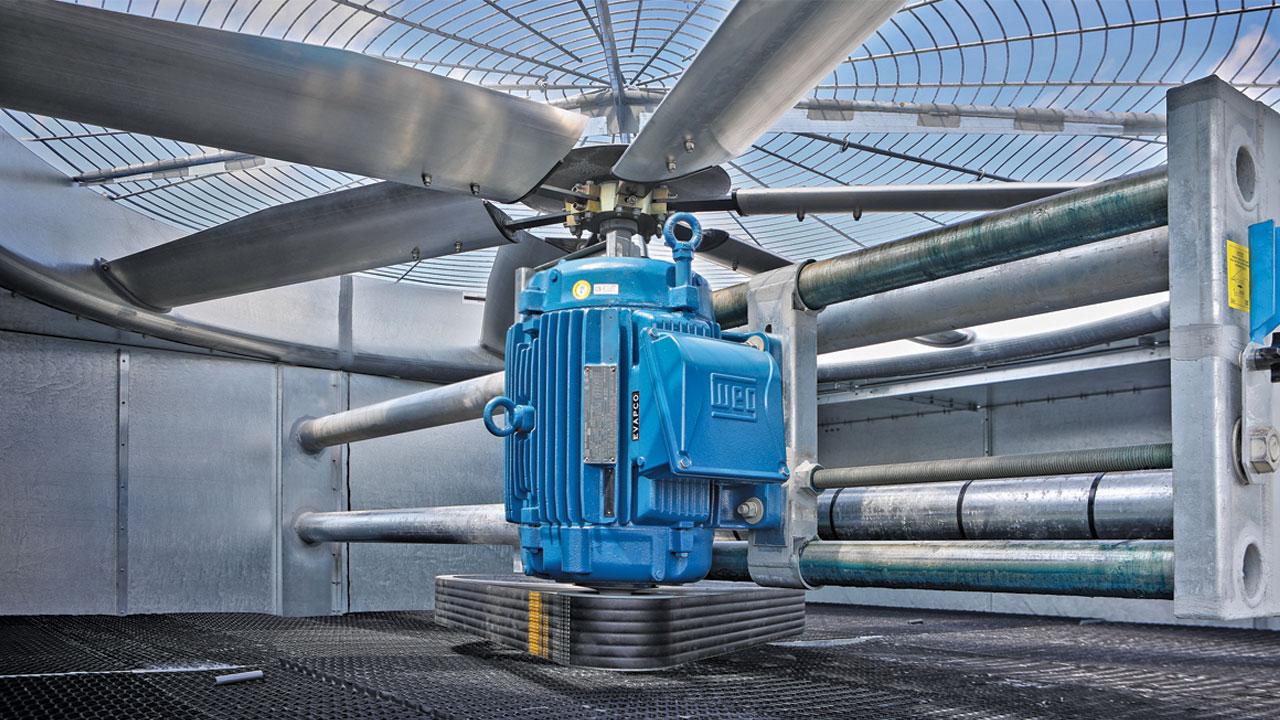
Many mechanical-draft cooling towers use motors and speed reducers to drive the fan.
The motor supplies mechanical power, while the speed reducer adjusts rotational speed and transmits torque to the fan system.
Before ordering a replacement motor or reducer, check the original equipment information carefully.
Important details may include motor power, voltage, frequency, rotational speed, mounting arrangement, shaft dimensions, gear ratio, and connection details.
You should also confirm whether the existing tower uses a direct-drive system, belt drive, or gearbox arrangement.
A replacement component must be compatible with the complete drive system, not just one visible dimension.
6. Air Inlet Louvers, Fan Stacks, and Structural Parts
Structural and airflow components help maintain the tower's shape and guide air and water through the intended paths.
Air inlet louvers control the entry of air and can help reduce water splash-out in suitable designs. Fan stacks guide discharged air and support the fan assembly. Casing and structural components provide support for the tower internals.
When replacing these components, check dimensions, material, installation location, support requirements, and exposure to outdoor conditions.
A component that looks similar to the original may not have the same strength or resistance to weather, moisture, chemicals, or sunlight.
How to Choose the Right Cooling Tower Parts
Choosing the correct cooling tower parts starts with accurate information.
The more details you provide, the easier it becomes for a supplier to evaluate compatibility and recommend a suitable product.
Check the Cooling Tower Type and Model
First, identify the cooling tower type.
Is it a crossflow or counterflow tower? Is it induced draft or forced draft? Is it an open-circuit or closed-circuit cooling system?
Record the manufacturer, model number, serial number, and approximate installation year if available.
Also, identify the exact location of the component you want to replace.
A fill pack designed for one airflow arrangement may not be suitable for another. Similarly, fan blades and mechanical drive parts need to match the original system's design requirements.
If you cannot identify the model, provide clear photographs of the complete cooling tower and the existing component.
Consider Water Quality and Operating Conditions
Water quality is especially important when selecting cooling tower fill, nozzles, and other components that come into contact with circulating water.
Consider the following factors:
For example, a cooling tower using relatively clean HVAC water may have different fill requirements from a tower handling industrial process water.
Operating conditions also matter. Provide the hot-water temperature, cold-water temperature, flow rate, and application details where possible.
If the system handles wastewater or chemically challenging process water, explain this clearly before choosing the replacement material.
Verify Dimensions and Material Compatibility
Never assume that two cooling tower parts are interchangeable simply because they look similar.
Measure the existing component carefully. For cooling tower fill, record the block length, width, height, sheet spacing, and installation orientation.
For drift eliminators, measure the overall dimensions and check the blade profile and support arrangement.
For mechanical parts, record shaft sizes, mounting holes, connection types, and other critical dimensions.
Material selection is equally important.
PVC and PP are common materials for cooling tower plastic components, but their suitability depends on operating temperature, chemical exposure, mechanical requirements, and product design.
For metal components, consider corrosion resistance and the surrounding environment.
Whenever possible, send a technical drawing or physical sample to the supplier. If these are unavailable, clear photographs with a measuring reference can still help.
Why Work Directly with a Cooling Tower Parts Factory?
Working directly with a specialist factory can make the purchasing process more straightforward.
You can discuss technical requirements, dimensions, materials, and production details with the supplier instead of passing every question through several trading layers.
More Direct Technical Communication
Direct communication helps reduce misunderstandings.
For example, when ordering replacement fill, you can discuss block dimensions, fill type, material, and operating conditions. When ordering a fan component, you can provide the original specifications and ask the supplier to review compatibility.
This is especially useful for older cooling towers where original documentation may be incomplete.
Clear communication before production can help prevent incorrect orders, unnecessary delays, and additional replacement costs.
Flexible Specifications and Customization
Not every cooling tower uses standard dimensions.
Older equipment, non-standard installations, and retrofit projects may require specially sized fill packs, drift eliminators, or other components.
A supplier offering OEM and ODM services may be able to discuss customized dimensions, materials, or configurations for selected products.
However, customization depends on the actual manufacturing capabilities and product category. Buyers should provide drawings, samples, and detailed specifications and request written confirmation before placing an order.
Consistent Quality and Supply Planning
For maintenance contractors, distributors, and industrial operators, supply continuity is important.
A dependable supplier should be able to clarify product specifications, inspection requirements, packaging, lead time, and repeat-order arrangements.
Before confirming an order, make sure the quotation includes:
A clear written agreement helps both parties understand what is being supplied.
Cooling Tower Parts for Different Industries
Cooling towers serve many industries, but operating conditions vary considerably.
A component suitable for a commercial HVAC system may not be the right choice for a heavy industrial process.
HVAC and Commercial Buildings
Hotels, hospitals, office buildings, shopping centers, and district cooling systems use cooling towers to reject heat from chillers and other equipment.
Common maintenance requirements include fill replacement, drift eliminator inspection, nozzle cleaning, fan maintenance, and water distribution checks.
For HVAC applications, buyers should consider cooling performance, noise, water treatment, maintenance access, and seasonal operating patterns.
Power Generation and Heavy Industry
Power stations and heavy industrial facilities may operate cooling towers under demanding loads and long operating schedules.
Downtime can be expensive, so replacement components must match the original design and operating requirements.
For these projects, provide detailed technical information and confirm inspection requirements before production. Where components are critical to plant performance or safety, involve the engineering and maintenance teams in the approval process.
Chemical, Steel, and Manufacturing Plants
Chemical processing, steel production, plastics manufacturing, and other industrial operations may expose cooling tower components to high temperatures, contamination, or challenging water conditions.
In these environments, buyers should explain the process-water characteristics and any known chemical exposure.
The supplier can then assess whether the proposed material and component design are appropriate.
Remember: a low purchase price is not a real saving if the component needs to be replaced too soon.
OEM and Replacement Cooling Tower Parts
OEM parts are supplied for a particular original equipment design. Replacement parts may come from the original manufacturer or from an independent specialist offering compatible alternatives.
Both options can be suitable, depending on the project.
For older cooling towers, an OEM-compatible replacement may provide a practical sourcing option when the original component is unavailable or difficult to obtain.
However, compatibility should never be assumed based only on a brand name or product photograph.
Before purchasing, compare the technical specifications, dimensions, material, installation arrangement, and operating requirements.
Power Tower Cooling Technology offers cooling tower component categories and replacement product options for different applications. For a specific replacement project, buyers should provide the exact tower model and component details so that suitability can be reviewed.
Quality Control in Cooling Tower Parts Manufacturing
Quality control should begin before production and continue through inspection and packaging.
The first step is to establish a clear specification. Material, dimensions, geometry, quantity, and application requirements should be confirmed before manufacturing begins.
For plastic cooling tower components, relevant checks may include:
For mechanical components, inspection may involve dimensional accuracy, machining quality, assembly, balance where applicable, and operational checks according to the product type.
Buyers should ask what inspection records or material documents are available for their orders.
If your project has special requirements, such as a specific material grade or dimensional tolerance, include them in the purchase specification rather than relying on a verbal agreement.
Certifications and quality-system claims should also be verified against current documents and the exact legal entity named on those documents.
Installation, Maintenance, and Service Life
Even a well-made component can fail early if it is installed incorrectly or operated outside its intended conditions.
Always follow the supplier's installation guidance and the cooling tower manufacturer's maintenance instructions.
For fill replacement, inspect the support structure, remove loose debris, check the water distribution system, and install the new blocks in the correct orientation.
For drift eliminators, confirm that the sections fit properly and have adequate support.
For fan and drive components, check alignment, fasteners, vibration, and operating clearances.
Routine maintenance should include inspections for:
Scaling and biological growth
Corrosion and material damage
Cracks and deformation
Loose connections
Unusual noise or vibration
Blocked nozzles
Uneven water distribution
Damaged fill or drift eliminators
Keep records of inspections and replacements. These records make it easier to identify recurring problems and plan future maintenance.
Service life is not determined by material alone. Water chemistry, operating temperature, UV exposure, operating hours, cleaning methods, installation quality, and maintenance practices all play a role.
Why Choose Power Tower Cooling Technology?
When searching for a cooling tower parts factory, buyers need a supplier that understands both the products and the practical challenges of replacement work.
Power Tower Cooling Technology (Shaoxing) Co.,Ltd focuses on cooling tower parts and replacement solutions for industrial and commercial applications.
Its product categories cover a range of cooling tower components, including:
Cooling tower fill
Drift eliminators
Cooling tower fans and fan-related components
Motors and speed reducers
Spray nozzles and sprinkler heads
Air inlet louvers
Fan stacks
Belts, pumps, coils, and other accessories
This product coverage can support sourcing discussions for new installations, maintenance, and refurbishment projects.
Here are several reasons to contact Power Tower:
1. Specialist product focus
The company focuses on cooling tower components and related replacement products, making it a relevant supplier for customers sourcing parts for existing systems.
2. Multiple product categories
Buyers can discuss different component requirements, including fill, drift eliminators, nozzles, fan-related parts, motors, and reducers.
3. Replacement project support
You can provide drawings, dimensions, photographs, or samples to help identify the required component.
4. Customization discussions
For non-standard projects, ask about available dimensions, materials, configurations, and production capabilities.
5. Direct supplier communication
Discuss specifications, quantities, lead times, packaging, and delivery requirements before confirming your order.
To learn more about the product range, visit Power Tower Cooling Technology.
How to Request a Cooling Tower Parts Quote
A detailed inquiry helps a factory provide a more accurate quotation.
Before sending your request, prepare as much of the following information as possible:
Cooling tower information: Manufacturer, model, type, and installation year.
Part name: Fill, drift eliminator, nozzle, fan blade, motor, reducer, or another component.
Dimensions: Length, width, height, thickness, diameter, connection size, and other relevant measurements.
Material requirements: PVC, PP, metal, or another specified material, where applicable.
Operating conditions: Water temperature, water quality, flow rate, and application details.
Quantity: Required quantity and whether the order is for one project or repeat supply.
Reference files: Drawings, photographs, samples, or old part numbers.
Delivery details: Destination country, required delivery date, and preferred shipping terms.
For example, if you need replacement cooling tower fill, send the tower type, fill block dimensions, existing fill photographs, water conditions, and required quantity.
If you need a motor or speed reducer, provide the nameplate information and mechanical connection details.
A useful rule is simple: do not send only a message saying, "I need cooling tower parts." Explain which part you need and where it will be used.
Better information leads to a more useful technical review and quotation.
Frequently Asked Questions
What parts can I buy from a cooling tower parts factory?
Depending on the factory's product range, you may be able to source cooling tower fill, drift eliminators, nozzles, fans, fan drive components, motors, speed reducers, fan stacks, louvers, belts, coils, pumps, and other accessories.
Always confirm availability and specifications for each item before ordering.
How do I find the correct replacement cooling tower fill?
Identify the tower type and model, measure the existing fill blocks, record the operating temperatures and water quality, and provide photographs or drawings.
The supplier can use this information to assess the suitable fill type, material, and configuration.
Can cooling tower parts be customized?
Some manufacturers offer customized dimensions, materials, or configurations for selected products.
Customization depends on the component type and the factory's manufacturing capabilities. Send drawings, samples, or detailed measurements and request written confirmation of the proposed specifications.
Should I replace fill and drift eliminators at the same time?
Not always.
The decision depends on their condition, maintenance requirements, and the cooling tower's performance.
If both components are old, damaged, or heavily fouled, inspecting them together can help you plan a more complete refurbishment.
What information is needed for a cooling tower parts quotation?
Provide the tower model, part name, dimensions, material requirements, quantity, application, operating conditions, reference photographs or drawings, and delivery destination.
For mechanical parts, include nameplate and connection details whenever possible.
Why buy directly from a cooling tower parts factory?
Direct sourcing can make technical communication and specification confirmation more straightforward.
It may also provide more flexibility for customized or repeat orders. Compare suppliers based on product suitability, quality documentation, delivery terms, and support—not price alone.
Conclusion: Work with a Cooling Tower Parts Factory That Understands Your Project
Cooling tower performance depends on many components working together.
Fill supports heat transfer. Drift eliminators help retain water droplets. Nozzles distribute water. Fans and drive systems maintain airflow. Structural and accessory parts keep the system operating as intended.
Choosing the right replacement is about more than finding a part with a similar appearance. You need to consider the tower model, dimensions, materials, water quality, operating conditions, and installation requirements.
When these details are checked carefully, you can reduce purchasing mistakes, improve maintenance planning, and help protect the performance of your cooling tower.
Power Tower Cooling Technology (Shaoxing) Co.,Ltd provides cooling tower components and replacement product options for customers seeking a specialist supplier.
If you are sourcing cooling tower fill, drift eliminators, nozzles, fan components, motors, speed reducers, or other tower accessories, prepare your technical information and discuss your application with the supplier.
Visit https://www.coolingtowerpart.com to explore the product range and contact Power Tower about your cooling tower parts requirements.


