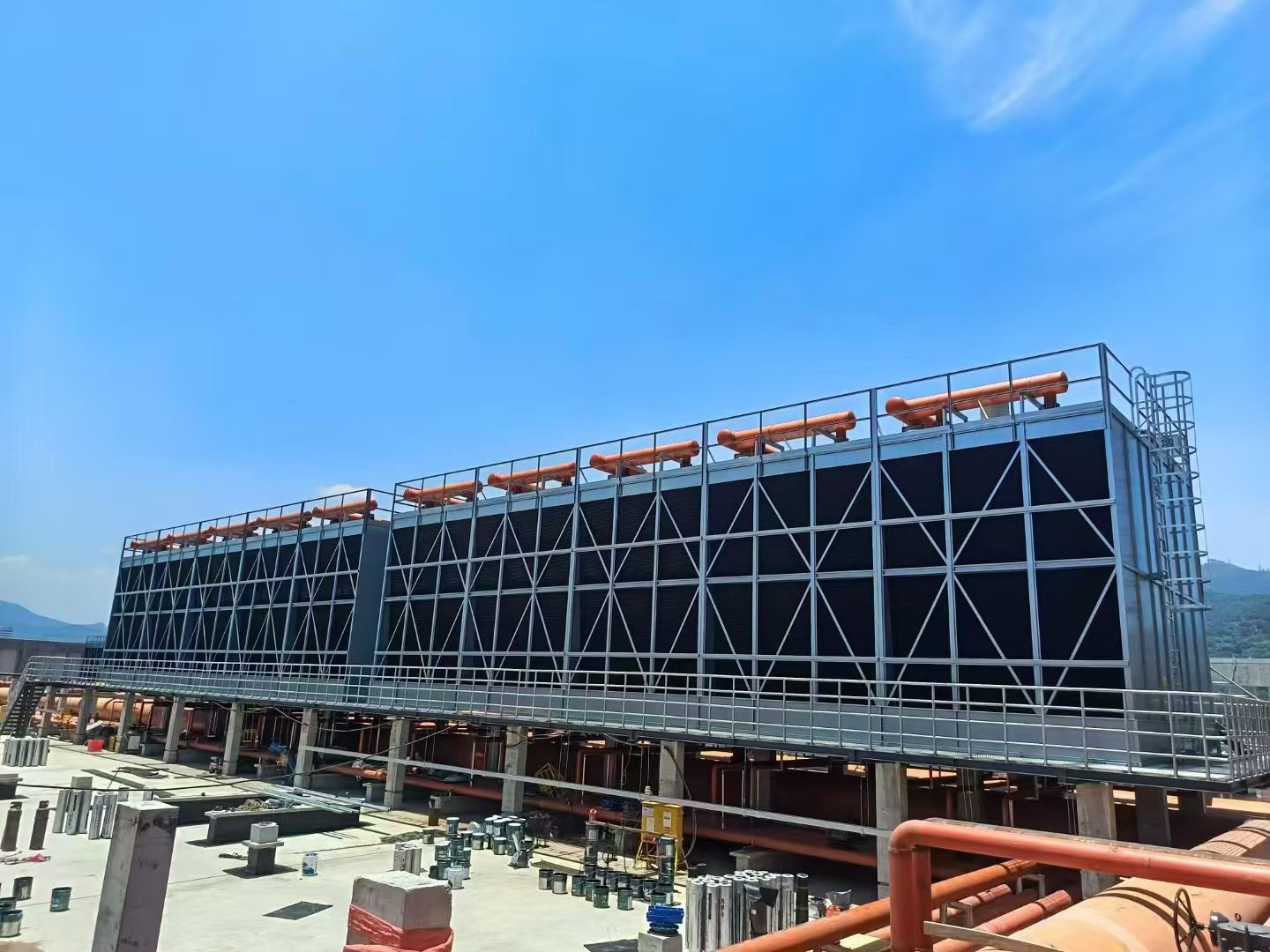
When a cooling tower starts losing efficiency, the problem may not be the fan, pump, or water distribution system. Sometimes, the real issue is hidden inside the tower: worn, clogged, or damaged fill media. Replacing old fill with the right PVC filler cooling tower replacement parts can help restore heat-transfer performance, improve water distribution, and support more reliable industrial operation.
Power Tower Cooling Technology (Shaoxing) Co., Ltd. provides cooling tower replacement part solutions through its website, www.coolingtowerpart.com. For industrial buyers, maintenance teams, and cooling tower contractors, choosing the right replacement fill is essential for maintaining system performance and controlling long-term operating costs.
Among the available options, S-wave and oblique-wave cooling tower fill are worth considering for compatible cooling tower designs. These structured PVC fill products create contact surfaces and flow passages that help water and air exchange heat. However, how do these two fill types differ? When should you replace existing fill, and what should you check before placing an order?
Let's explore everything you need to know about PVC cooling tower fill replacement parts and how to select the right solution for your application.
1. What Is PVC Filler in a Cooling Tower?
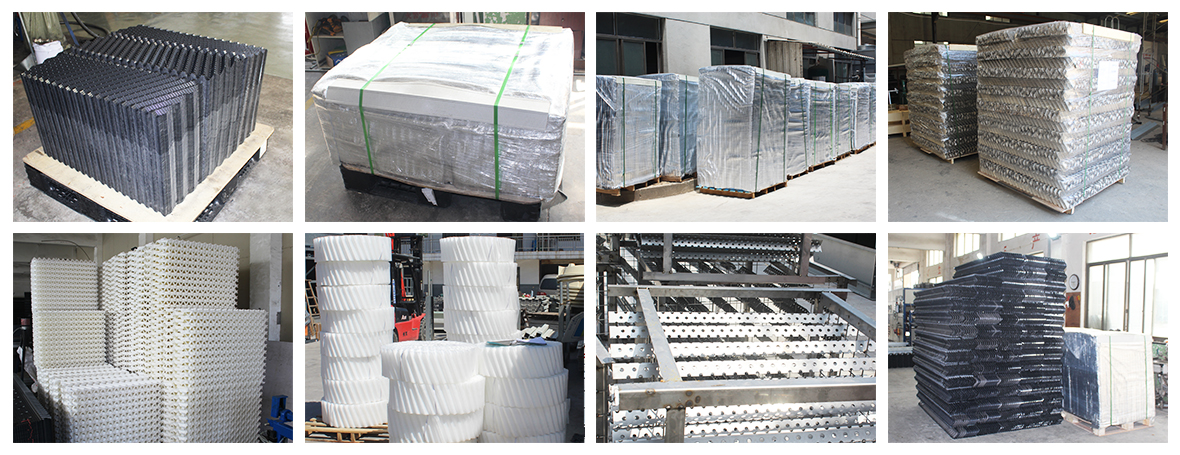
PVC filler, also known as PVC cooling tower fill or fill media, is a specially formed plastic component installed inside a cooling tower. Its primary purpose is to increase the contact area between circulating water and air, allowing heat to transfer more effectively.
Without fill media, water would fall through the tower in relatively large streams or droplets, limiting the available contact area. Fill changes that process by spreading water across structured surfaces or directing it through a network of passages.
Think of fill as the working surface of a cooling tower. The more effectively it distributes water and allows air to move through it, the better the tower can perform within its design limits.
PVC is widely used for cooling tower fill because it is relatively lightweight, easy to form into different geometries, and resistant to many common operating environments when used within its material limits.
How PVC Cooling Tower Fill Works
Warm water enters the cooling tower and flows over the fill surfaces. As the water spreads into thinner films or smaller streams, it comes into closer contact with the moving air.
A portion of the water evaporates, removing heat from the remaining water. The cooled water then collects in the basin and returns to the industrial process or HVAC system.
Several factors influence this process:
Surface area: More effective water-to-air contact can improve heat transfer.
Airflow: The fill must allow sufficient air to pass through its channels.
Water distribution: Water should spread evenly across the available fill area.
Fouling resistance: The geometry should suit the circulating water's quality and solids content.
Material durability: The fill must withstand the actual temperature and chemical conditions.
A well-designed fill pack balances these factors rather than maximizing only one of them.
Why PVC Is Widely Used
PVC cooling tower fill offers several practical advantages. Its relatively low weight makes handling and installation easier, while its formability allows manufacturers to produce different corrugated profiles and pack configurations.
PVC also provides useful resistance to many common water-treatment environments. However, its performance depends on the specific formulation, operating temperature, chemical exposure, and mechanical loading.
Standard PVC is not suitable for every high-temperature application. Buyers should therefore confirm the allowable operating conditions before selecting a replacement product.
2. Understanding S-Wave and Oblique-Wave Cooling Tower Fill
S-wave and oblique-wave cooling tower fill refer to structured fill designs with different surface profiles and flow-channel arrangements. Their exact geometries can vary between manufacturers, so buyers should verify technical drawings and specifications rather than relying on product names alone.
Both types are intended to support water distribution and heat exchange, but differences in corrugation and channel orientation can influence airflow, drainage, and fouling behavior.
The right choice depends on the cooling tower's original design, thermal requirements, water quality, and available installation space.
What Is S-Wave Cooling Tower Fill?
S-wave PVC fill is characterized by a curved or alternating corrugated profile, with the precise geometry depending on the product design.
S-wave cooling tower fill uses formed surfaces that resemble a series of alternating curves. These surfaces help guide water through the fill pack while creating passages for airflow.
Depending on the specific design, S-wave fill can promote water-film formation and increase the contact area between air and water.
When purchasing S-wave PVC fill replacement parts, check the following specifications:
Fill pack length, width, and height
PVC sheet thickness
Wave profile and flute pitch
Channel geometry and orientation
Pack assembly and bonding method
Operating temperature and material compatibility
A replacement that looks similar to the original is not necessarily a direct substitute. Even small differences in channel geometry may influence airflow resistance and thermal performance.
What Is Oblique-Wave Cooling Tower Fill?
Oblique-wave cooling tower fill generally features angled or inclined corrugations that guide the movement of water and air through the fill pack.
The geometry influences how water spreads across the surfaces, how air passes through the channels, and how effectively the fill drains during operation.
Depending on its design, oblique-wave fill may be suitable for applications requiring a particular balance of heat-transfer performance, airflow, and water distribution.
However, the term oblique-wave fill is not always used consistently across the industry. Different suppliers may offer products with different channel angles, flute dimensions, and sheet configurations under similar names.
For this reason, buyers should provide drawings, photographs, original part numbers, or physical samples when requesting replacement oblique-wave fill.
S-Wave vs. Oblique-Wave Cooling Tower Fill
Comparison Factor | S-Wave Fill | Oblique-Wave Fill |
Surface geometry | Typically curved or alternating wave profile | Typically angled or inclined corrugations |
Water distribution | Depends on the specific channel design | Depends on the specific channel design |
Airflow resistance | Determined by flute geometry and pack configuration | Determined by channel angle and pack configuration |
Fouling behavior | Depends on passage size and water quality | Depends on passage size and water quality |
Replacement compatibility | Must match the original tower requirements | Must match the original tower requirements |
Best selection method | Verify dimensions and performance data | Verify dimensions and performance data |
Neither design is automatically better for every cooling tower. The correct choice depends on the complete system, including its heat load, air velocity, water flow, and operating environment.
If you plan to change from S-wave to oblique-wave fill, have the proposed replacement evaluated for thermal performance and pressure drop before installation.
3. Why Do Cooling Towers Need Fill Replacement?
Cooling tower fill operates continuously under demanding conditions. Warm circulating water, airborne dust, dissolved minerals, treatment chemicals, and biological growth can gradually affect its performance.
Even high-quality fill can deteriorate if it operates outside its design limits or receives inadequate maintenance.
Replacing damaged or severely fouled fill can help restore effective water distribution and heat transfer. However, replacement should be based on inspection and operating data rather than an arbitrary schedule.
Reduced Cooling Performance
One common sign of fill problems is a decline in cooling performance.
If the tower can no longer achieve its normal cold-water temperature, clogged channels, damaged sheets, or uneven water distribution may be contributing factors.
However, these symptoms can also result from other problems, including:
Before replacing the fill, compare current operating data with the tower's normal performance. This helps determine whether fill deterioration is actually responsible for the problem.
Clogging, Scaling, and Biological Growth
Mineral scale can accumulate on fill surfaces when water chemistry promotes precipitation. Suspended solids may settle inside narrow channels, while algae and other biological growth can further obstruct water and airflow passages.
As deposits build up, water distribution becomes less uniform and airflow resistance may increase.
Cleaning can restore performance if the deposits are removable and the fill remains structurally sound. However, severely fouled, brittle, or damaged media may not withstand aggressive cleaning.
Replacing the fill without correcting the underlying water-quality problem is rarely a lasting solution. Appropriate filtration, water treatment, and regular inspections are essential for protecting the new fill.
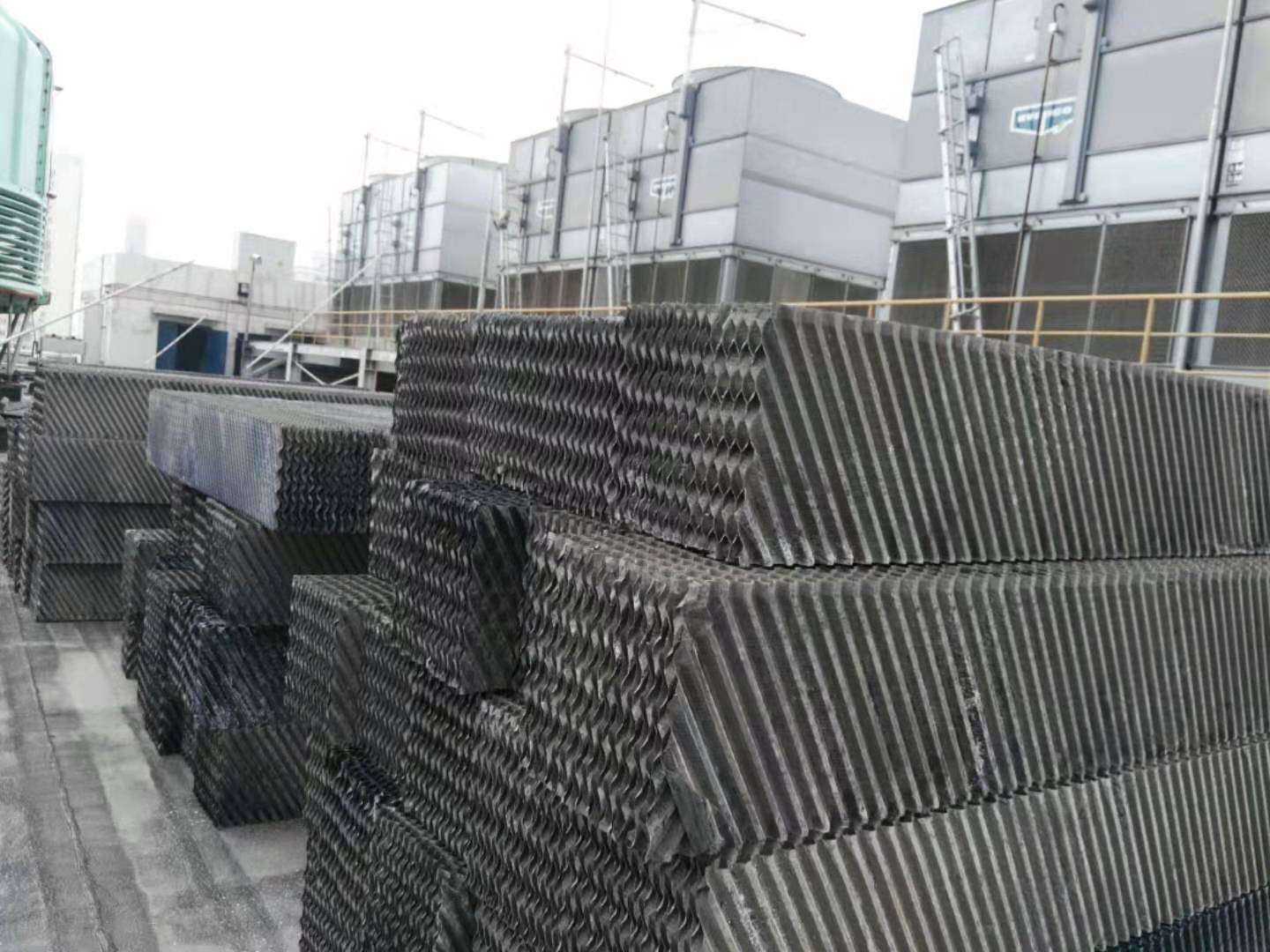
Physical Damage and Material Aging
PVC fill can crack, deform, become brittle, or separate at bonded joints after prolonged exposure to heat, unsuitable chemicals, mechanical stress, or improper cleaning.
Damaged sheets may sag or collapse, changing the designed airflow passages and allowing water to bypass the intended contact surfaces.
During inspection, look for:
Cracked or broken PVC sheets
Sagging or deformed fill packs
Separated sheet joints
Blocked or uneven flow passages
Excessive mineral deposits
Damaged supports and retaining components
If deterioration affects a substantial part of the fill assembly, replacing the affected packs may be more practical than attempting repeated repairs.
4. Types of PVC Cooling Tower Replacement Parts
A cooling tower fill replacement project may involve several components, depending on the equipment design and the extent of the damage.
Understanding the differences between these parts helps you prepare an accurate purchase list and avoid ordering components that do not fit your system.
PVC Film Fill Packs and Sheets
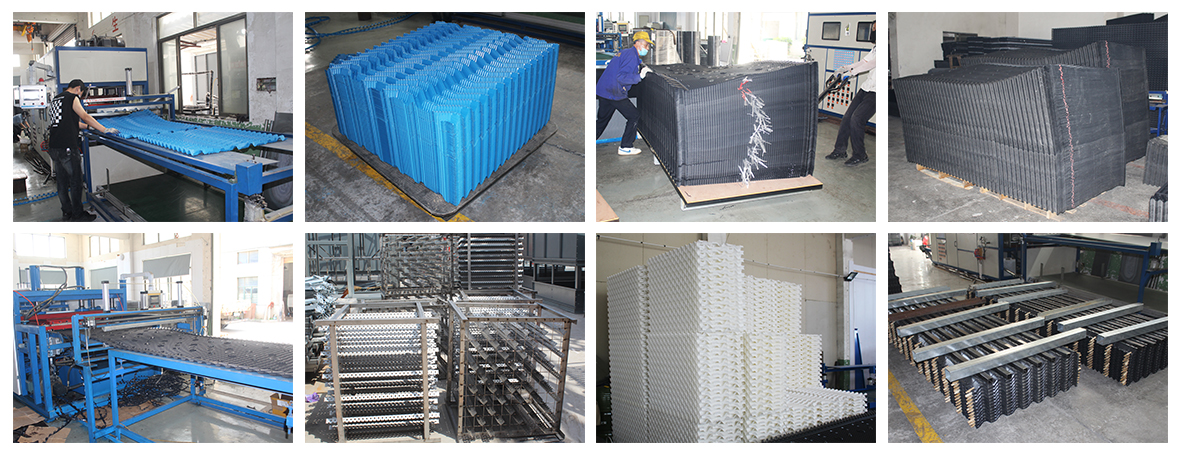
PVC film fill sheets are formed into specific corrugated profiles and assembled into packs. Depending on the cooling tower design, available configurations may include S-wave, oblique-wave, and other structured fill profiles.
Complete fill packs are often convenient when the existing media is extensively damaged. Individual sheets may be suitable for certain repairable assemblies, provided the original construction allows them to be replaced separately.
Before ordering, confirm the dimensions, thickness, flute geometry, pack configuration, and intended installation direction.
The water and airflow directions matter because incorrectly installed fill may restrict air movement or distribute water unevenly.
Fill Supports and Retaining Components
Fill supports carry the weight of the fill and the water retained during operation. Retaining components help keep the fill packs in position under water flow, airflow, and vibration.
A support structure that is corroded, bent, or weakened can undermine a new fill installation.
Inspect the support grid, attachment points, and available clearances before replacing the media. Replacement support components must be suitable for the tower's mechanical loads, temperature, and chemical environment.
Drift Eliminators and Water Distribution Components
Drift eliminators reduce the amount of liquid water carried out of the cooling tower with the exhaust air. Water distribution components, including spray nozzles and distribution pipes, help spread water across the fill.
Although these components work alongside fill media, they perform different functions.
A fill replacement project provides a useful opportunity to inspect the distribution system and drift eliminators. If spray nozzles remain blocked or drift eliminators are damaged, replacing the fill alone may not resolve water distribution problems or excessive drift loss.
5. Applications of S-Wave and Oblique-Wave Cooling Tower Fill
S-wave and oblique-wave PVC fill may be suitable for various industrial and commercial cooling applications when their design specifications match the equipment requirements.
Potential applications include:
Industrial process cooling systems
Manufacturing plants
Commercial HVAC cooling towers
Power-related industrial facilities
General industrial water-cooling systems
Cooling tower refurbishment and maintenance projects
The suitability of each fill type depends on the cooling tower's design and operating conditions.
For example, systems handling relatively clean circulating water may accommodate different fill geometries than installations exposed to high concentrations of suspended solids.
Where fouling is a major concern, passage size, cleanability, and water-treatment practices deserve particular attention.
Buyers should always verify that the selected fill meets the requirements of the specific installation rather than assuming that one design will work equally well across every industry.
6. How to Choose the Right PVC Cooling Tower Fill Replacement
Choosing replacement fill is not simply a matter of selecting a plastic sheet with the correct outside dimensions. You must also consider internal geometry, thermal requirements, water quality, and compatibility with the original cooling tower.
A poorly matched product may increase airflow resistance, reduce cooling performance, or create water distribution problems.
Before requesting a quotation, collect the original equipment model, existing fill photographs, measurements, operating temperatures, and any available technical drawings.
Check Cooling Tower Dimensions
Measure the available fill space and record the dimensions of each existing pack.
Important details include:
Pack length, width, and height
Number of packs required
Sheet thickness and corrugation profile
Installation orientation
Available support structure
Clearance around pipes and distribution equipment
Also identify whether the tower uses crossflow or counterflow construction, because water distribution and airflow arrangements differ.
Do not assume that two fill packs with identical external dimensions will provide the same performance if their internal channel geometry is different.
When original drawings are unavailable, clear photographs and physical samples can help the supplier identify the required configuration.
Evaluate Water Quality and Operating Temperature
Water quality has a major influence on fill selection and service life.
High suspended-solids concentrations can contribute to clogging. Scale-forming minerals can create deposits, while unsuitable chemical conditions may damage the material.
Operating temperature is equally important. Standard PVC fill must remain within the product's specified temperature range to maintain its intended mechanical properties.
When requesting replacement fill, provide the normal and maximum water temperatures, water-treatment information, and any known history of scaling or biological growth.
If the application exceeds the PVC product's limits, a different material or specially engineered fill may be necessary.
Match the Original Fill Design
When replacing S-wave or oblique-wave fill, compare the original profile with the proposed replacement.
Review the flute pitch, channel angle, sheet spacing, material thickness, bonding method, and intended flow directions.
Also consider the required thermal performance and allowable air-side pressure drop.
These checks help prevent a common purchasing mistake: selecting a product solely because it looks similar to the original.
If you intend to switch to a different fill profile, ask a qualified cooling tower engineer to verify its suitability before installation.
7. Benefits of High-Quality PVC Cooling Tower Fill
The right replacement fill can help maintain effective heat transfer, improve water distribution, and support stable cooling tower operation.
Its practical benefits include the following.
Improved heat-transfer performance. Properly selected fill increases effective contact between water and air, helping the cooling tower operate as intended.
More consistent water distribution. Suitable channel geometry helps spread water across the fill surface and reduces unwanted bypassing.
Convenient handling and installation. PVC's relatively low weight can simplify transportation and installation compared with heavier materials.
Potentially lower maintenance costs. Appropriate fill selection, combined with effective water treatment, can help reduce recurring problems caused by fouling and premature deterioration.
Support for reliable operation. Replacing damaged fill helps restore the intended internal arrangement and can contribute to more stable cooling performance.
These benefits depend on the condition of the overall cooling system. New fill cannot compensate for an undersized fan, a damaged pump, poor water treatment, or a malfunctioning distribution system.
8. PVC Cooling Tower Fill Replacement: Step-by-Step Guide
A planned replacement project helps reduce downtime and prevent installation mistakes. Before beginning, prepare the replacement packs, tools, access equipment, and site-specific safety procedures.
Industrial cooling towers can involve electrical, mechanical, chemical, and confined-space hazards. Replacement work should be performed by trained personnel following site safety requirements and the equipment manufacturer's instructions.
Step 1: Inspect and Prepare the Cooling Tower
Shut down and isolate the relevant equipment according to the site's lockout/tagout procedures. Confirm that fans, pumps, and automatic controls cannot start unexpectedly.
Drain or lower the water level as required, then inspect the fill section and surrounding components.
Record the original fill arrangement before removal. Photographs can help document the orientation, pack arrangement, support positions, and nearby piping.
Step 2: Remove the Old Fill and Clean the Tower
Remove damaged fill carefully to avoid harming the support structure, piping, and other components.
Handle brittle or heavily fouled material according to site safety and waste-management requirements.
Remove accumulated sludge and debris from accessible areas, then inspect the supports for corrosion, deformation, or damage.
Check the spray nozzles and water distribution system to ensure that water can reach the replacement fill evenly.
Avoid cleaning methods that may damage PVC or compromise nearby equipment.
Step 3: Install the New Fill Packs
Install each pack according to the supplier's instructions, maintaining the specified orientation, spacing, and support arrangement.
Do not force oversized packs into position or leave unintended gaps that allow water to bypass the fill.
Check that the packs are stable and that they do not obstruct distribution pipes or other equipment.
If you are installing S-wave or oblique-wave fill, pay particular attention to the specified channel direction and arrangement.
Step 4: Inspect the System and Restart
Before restarting the cooling tower, inspect the fill installation, support structure, distribution system, and surrounding components.
During controlled startup, check for abnormal vibration, leakage, uneven water distribution, and unexpected airflow restrictions.
Compare the tower's operating temperatures and other available performance data with its established baseline.
If cooling performance remains poor, investigate the entire system rather than assuming that the replacement fill is defective.
9. Maintenance Tips for Longer PVC Fill Service Life
Regular maintenance helps identify problems before they develop into expensive failures.
Start with routine visual inspections. Look for mineral deposits, blocked passages, broken sheets, deformation, and uneven water distribution.
Next, maintain an appropriate water-treatment program. Monitoring suspended solids, scaling tendencies, and biological growth can help prevent recurring fill problems.
When cleaning is necessary, use methods compatible with the PVC material and follow the supplier's recommendations. Excessive mechanical force, unsuitable solvents, and temperatures outside the product's limits can shorten service life.
It is also useful to maintain operating records, including water temperatures, cleaning dates, water quality, and observed damage. These records help identify recurring problems and determine whether cleaning, repair, or replacement is the most economical response.
Most importantly, address the cause of premature deterioration. If the existing fill repeatedly clogs because of poor filtration or inadequate water treatment, installing new fill without correcting those issues is unlikely to provide a lasting solution.
10. Why Choose Power Tower Cooling Technology for Replacement Fill?
When purchasing cooling tower replacement parts, industrial buyers need more than a product name. They need accurate specifications, suitable product configurations, and clear communication about compatibility.
Power Tower Cooling Technology (Shaoxing) Co., Ltd. serves the cooling tower replacement parts market through its website, www.coolingtowerpart.com.
For buyers investigating PVC cooling tower fill, S-wave fill, oblique-wave fill, and related replacement components, the company provides a contact point for discussing their requirements.
Before placing an order, buyers should confirm the following details directly with the supplier:
Available fill profiles and product specifications
PVC material grade and applicable temperature limits
Pack dimensions and customization options
Compatibility with the existing cooling tower
Quality documentation and inspection requirements
Minimum order quantities and production lead times
Packaging, shipping, and delivery arrangements
Providing accurate technical information at the beginning can make the purchasing process more efficient and reduce the risk of receiving an incompatible product.
11. How to Request a PVC Cooling Tower Fill Quotation
A clear quotation request helps the supplier understand your application and identify a suitable product.
When contacting Power Tower Cooling Technology through www.coolingtowerpart.com, prepare as much of the following information as possible:
Cooling tower details: Manufacturer, model, tower type, and application.
Fill type: S-wave, oblique-wave, or another existing fill profile.
Dimensions: Required pack length, width, height, and sheet thickness if known.
Quantity: Number of packs, sheets, or complete replacement sets.
Operating conditions: Normal and maximum water temperatures, circulating water quality, and known fouling problems.
Reference materials: Photographs, original part numbers, samples, or technical drawings.
Project requirements: Whether the order is for routine replacement, emergency repair, or a planned cooling tower refurbishment.
If you do not know the exact fill model, do not guess. Clear photographs and measurements can provide a useful starting point for identifying a compatible replacement.
For large projects, confirming specifications before production is especially important because fill packs may need to match the tower's original layout and support structure.
12. Frequently Asked Questions About PVC Cooling Tower Fill
How Long Does PVC Cooling Tower Fill Last?
There is no universal service life for PVC cooling tower fill. Its lifespan depends on water quality, operating temperature, chemical exposure, mechanical loading, cleaning practices, and installation quality.
Some installations operate for many years before replacement is necessary, while harsher conditions can shorten service life significantly.
Regular inspection and performance monitoring are more reliable than applying one fixed replacement interval to every cooling tower.
Can S-Wave Fill Replace Oblique-Wave Fill?
Not automatically. Both designs provide surfaces for heat transfer, but their channel geometries and airflow characteristics may differ.
Before changing profiles, confirm that the replacement fits the available space and meets the tower's thermal and hydraulic requirements.
A qualified engineer or the original equipment supplier should evaluate the proposed substitution when performance requirements are critical.
Is PVC Fill Suitable for High-Temperature Applications?
PVC fill is suitable only within the temperature and chemical limits specified for the particular product.
Elevated temperatures can affect its stiffness, dimensional stability, and service life. If your circulating water is unusually hot, provide the maximum operating temperature to the supplier and confirm whether PVC remains appropriate.
Do not choose a material based on dimensions alone.
Can PVC Cooling Tower Fill Be Customized?
Depending on the manufacturer's capabilities, replacement fill may be available in different dimensions, sheet configurations, thicknesses, and pack arrangements.
Customization must preserve the required mechanical stability and thermal performance.
Provide drawings, samples, or accurate measurements to help the supplier determine what is feasible. Confirm minimum order quantities, production lead times, and dimensional tolerances before ordering.
Should I Replace the Entire Fill Pack or Only Damaged Sheets?
The answer depends on the fill's construction and overall condition.
If the damage is limited and the assembly allows individual sheets to be replaced, localized repairs may be practical. If the fill is extensively clogged, brittle, deformed, or structurally unstable, replacing complete packs may provide a more reliable result.
Always inspect the supporting structure and investigate the cause of the damage before deciding.
13. Conclusion: Find the Right PVC Cooling Tower Fill Replacement Parts
PVC cooling tower replacement parts play an important role in maintaining effective heat rejection and reliable industrial cooling. When the original fill becomes damaged, clogged, or worn, choosing a suitable replacement can help restore water distribution and support the cooling tower's intended performance.
S-wave and oblique-wave cooling tower fill offer different structured geometries, but neither is automatically the best option for every installation. The correct choice depends on the original tower design, fill dimensions, water quality, operating temperature, airflow requirements, and maintenance conditions.
Before ordering replacement parts, inspect the existing fill, confirm the required specifications, and evaluate whether the proposed product is compatible with your cooling system.
For industrial buyers, maintenance teams, and cooling tower contractors looking for PVC fill and related replacement components, Power Tower Cooling Technology (Shaoxing) Co., Ltd. is available through www.coolingtowerpart.com.


