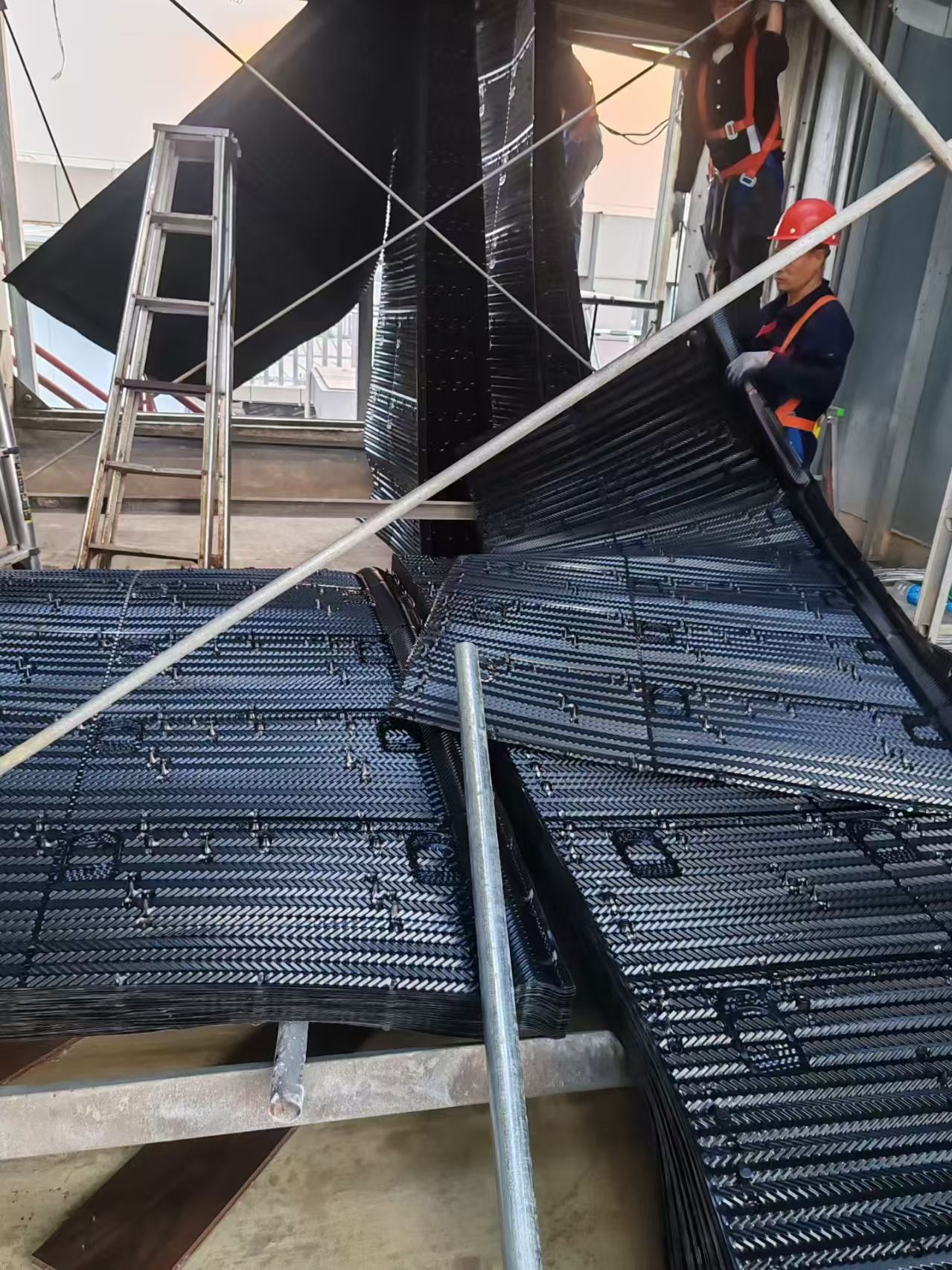
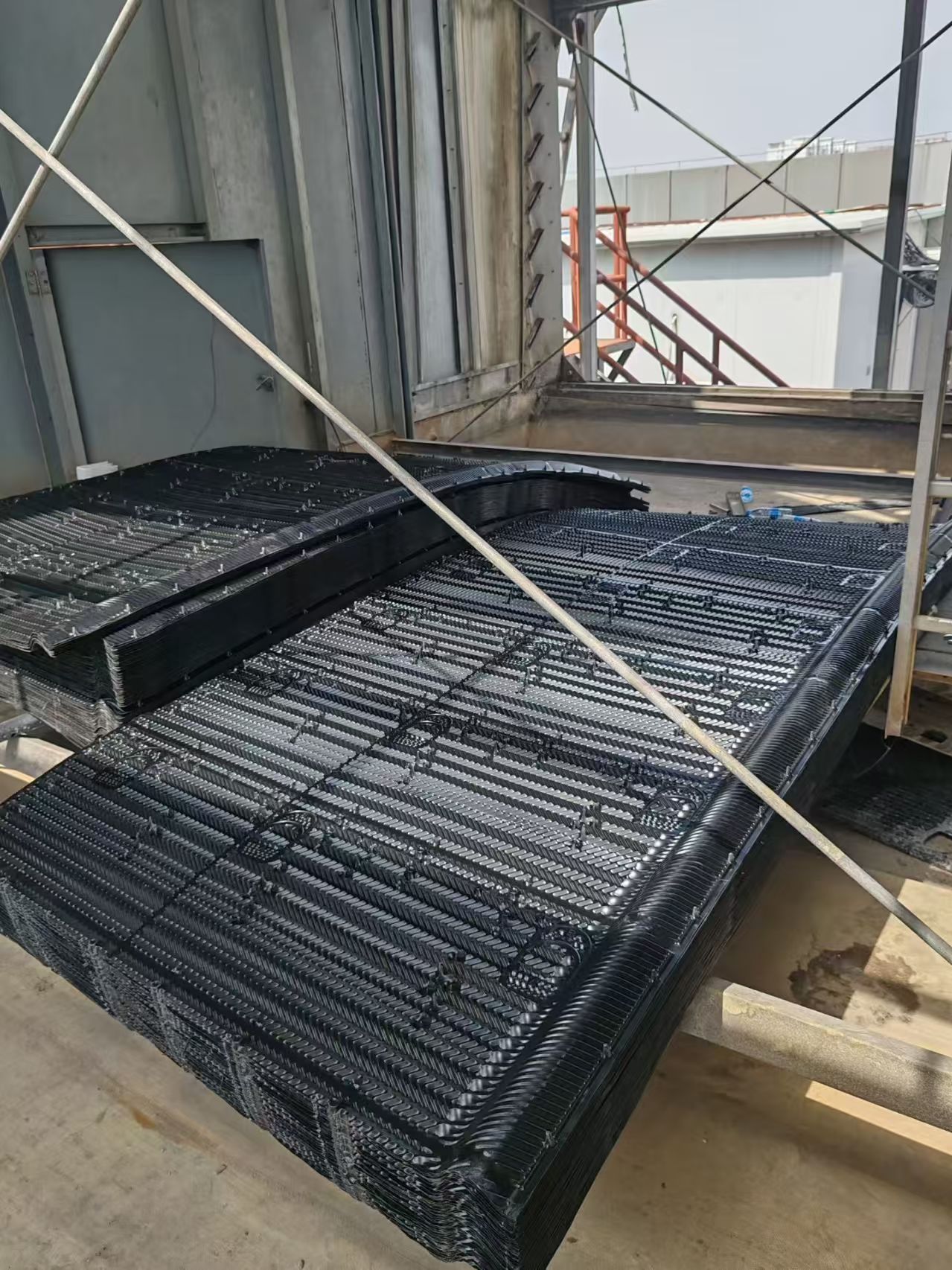
Why Is Cooling Tower Fill Replacement Important?
Cooling tower fill replacement is an essential maintenance task for industrial cooling systems, HVAC installations, power plants, chemical processing facilities, and commercial buildings. Cooling tower fill, also known as cooling tower media or fill packing, increases the contact area between water and air, allowing heat to transfer more efficiently and supporting the evaporation process.
Over time, cooling tower fill can become clogged with scale, algae, sediment, biological growth, and other contaminants. High water temperatures, chemical exposure, mechanical damage, and long-term operation may also cause the fill material to deteriorate. These problems can reduce cooling performance, increase operating costs, and place additional stress on cooling tower fans, pumps, and other components.
Replacing damaged or inefficient fill can help restore heat transfer performance, improve water distribution, and maintain stable cooling tower operation. However, successful replacement requires more than simply purchasing new fill media. Operators must evaluate the existing tower design, select suitable materials, verify dimensions, and follow proper installation procedures.
What Does Cooling Tower Fill Do?
Cooling tower fill is installed inside a cooling tower to increase the effective contact area between the circulating water and incoming air. Its structure helps distribute water across a larger surface, improving heat transfer and evaporation.
Film Fill and Splash Fill
There are two major categories of cooling tower fill: film fill and splash fill.
Film fill: Water spreads across the surfaces of closely spaced sheets, creating thin films that provide a large contact area. It is commonly used in applications requiring high thermal efficiency and compact fill arrangements.
Splash fill: Water falls over a series of bars, grids, or splash elements, breaking into smaller droplets. This design can be suitable for applications where suspended solids and fouling are significant concerns.
The appropriate replacement depends on the original cooling tower design, water quality, operating temperature, and maintenance requirements.
What Are the Benefits of Timely Fill Replacement?
Replacing worn or damaged cooling tower fill can provide several operational benefits.
Improved Heat Transfer Efficiency
New fill media with the correct geometry can improve water distribution and air-water contact. This helps the cooling tower achieve its intended thermal performance when other operating conditions are properly maintained.
Reduced Fouling and Maintenance Requirements
Replacing severely scaled, clogged, or damaged fill can make routine cleaning and inspection easier. Selecting a suitable fill design for the water quality may also reduce recurring maintenance problems.
More Stable Cooling Water Temperatures
Properly selected and installed replacement fill can help restore cooling capacity, supporting stable process temperatures and HVAC operation during periods of high cooling demand.
Longer Equipment Service Life
Maintaining appropriate cooling performance may reduce operational stress caused by inadequate heat rejection. Although fill replacement cannot prevent every equipment problem, it is an important part of an effective cooling tower maintenance strategy.
When Should Cooling Tower Fill Be Replaced?
Cooling tower fill replacement should be based on actual operating conditions, inspection results, and performance trends rather than a fixed calendar schedule alone. Different cooling towers operate under different water qualities, temperatures, chemical treatments, and mechanical conditions.
Common Signs That Cooling Tower Fill Needs Replacement
Reduced Cooling Performance
If the cooling tower consistently delivers warmer outlet water than expected, the fill may be fouled, damaged, or incorrectly distributing water. However, operators should also check airflow, fan performance, water flow, ambient wet-bulb temperature, and other possible causes before deciding to replace the fill.
Severe Scaling and Blockage
Mineral deposits can accumulate on fill surfaces and restrict the movement of water and air. When deposits cannot be removed effectively through approved cleaning procedures, replacing the affected fill may be the more practical solution.
Cracked, Warped, or Brittle Fill Sheets
PVC and PP fill media can deteriorate under unsuitable operating conditions. Cracks, deformation, broken edges, and brittle sheets may indicate that the material has lost its structural integrity.
Uneven Water Distribution
Damaged fill or incorrectly positioned media can create uneven water flow. Dry areas and concentrated water channels reduce the effective contact area and may result in inconsistent cooling performance.
Increased Pressure Drop
Severe fouling or an unsuitable fill arrangement may increase airflow resistance. If the cooling tower experiences abnormal pressure drop or reduced airflow, inspect the fill, drift eliminators, air inlets, and fan system to identify the cause.
How to Evaluate Existing Fill Before Replacement
A systematic inspection helps determine whether the fill needs cleaning, partial replacement, or complete replacement.
Visual Inspection
Inspect representative sections for scale, algae, sediment, cracks, deformation, broken supports, and collapsed fill packs. Pay particular attention to areas where water distribution is uneven or deposits are concentrated.
Performance Data Review
Compare current operating data with historical records, including:
Cooling water inlet and outlet temperatures
Water flow rate
Ambient wet-bulb temperature
Fan speed and motor operating conditions
Airflow resistance or pressure drop, where measured
Water distribution and visible bypassing
Structural and Compatibility Assessment
Check whether the existing support structure remains capable of carrying the replacement fill under normal operating conditions. Also verify compatibility with the cooling tower's water treatment chemicals, temperature range, and mechanical arrangement.
How to Select the Right Cooling Tower Fill Replacement
Choosing the correct replacement fill is one of the most important steps in the entire project. A product that fits inside the cooling tower may still perform poorly if its geometry, material, or airflow characteristics are unsuitable.
Choose the Correct Cooling Tower Fill Material
PVC and PP are two commonly used thermoplastic materials for cooling tower fill. Each offers different advantages depending on operating temperature, chemical exposure, and project requirements.
PVC Cooling Tower Fill
PVC cooling tower fill is widely used in industrial and HVAC cooling systems because it offers a practical balance of cost, formability, and thermal performance.
Typical advantages include:
Suitable for many conventional cooling tower applications
Available in different sheet thicknesses and fill configurations
Easy to manufacture into customized film fill packs
Suitable for many replacement projects involving existing PVC fill
Before selecting PVC fill, verify its allowable operating temperature, fire-performance requirements, chemical compatibility, and suitability for the intended water conditions.
PP Cooling Tower Fill
Polypropylene cooling tower fill is often considered when operating conditions require properties different from those of standard PVC fill.
Potential advantages include:
Useful temperature capability for suitable PP grades
Good resistance to many chemicals
Availability in customized sheet and packing configurations
Suitability for selected industrial applications
The exact performance depends on the PP grade, manufacturing process, sheet thickness, and operating environment. Buyers should request technical data rather than assume every PP product has the same temperature or chemical resistance.
PVC vs. PP Cooling Tower Fill
Selection factor | PVC fill | PP fill |
Typical applications | General industrial and HVAC cooling | Selected industrial and demanding operating conditions |
Cost considerations | Often economical for standard applications | Depends on grade and manufacturing requirements |
Temperature suitability | Must be verified against the specified grade | Must be verified against the specified grade |
Chemical compatibility | Depends on water chemistry and formulation | Depends on chemical type, concentration, and temperature |
Customization | Sheet thickness, geometry, and pack dimensions | Sheet thickness, geometry, and pack dimensions |
Important: Neither PVC nor PP is universally better. The correct choice depends on actual operating conditions, the original tower design, and the project's performance requirements.
Select the Appropriate Fill Type
Film Fill for High Thermal Performance
Film fill is often selected when the circulating water has relatively low suspended-solids content and the system can maintain effective water treatment.
Its closely spaced surfaces provide a large contact area within a compact volume. However, narrow passages may be vulnerable to fouling if the water contains excessive suspended solids, scale-forming minerals, or biological growth.
When Is Film Fill Suitable?
Film fill may be appropriate for:
Commercial HVAC cooling towers
Clean industrial circulating-water systems
Applications requiring high heat transfer within limited space
Replacement projects using a compatible film-fill design
Splash Fill for Fouling-Prone Applications
Splash fill breaks falling water into droplets as it passes over structural elements. Its open configuration can be advantageous in certain applications with greater suspended-solids loading.
When Should Splash Fill Be Considered?
Splash fill may be suitable for:
Industrial cooling systems with fouling concerns
Applications where water contains suspended particles
Existing towers originally designed for splash fill
Projects where ease of inspection and cleaning is important
The final choice should be based on thermal calculations, water quality, and the cooling tower manufacturer's recommendations. Splash fill should not automatically be considered suitable for every dirty-water application.
Verify Fill Dimensions and Configuration
Correct dimensions are essential for replacement projects. Incorrect measurements can cause installation gaps, airflow bypassing, uneven water distribution, and additional modification costs.
Key Dimensions to Confirm
Before ordering replacement fill, record:
Fill block length, width, and height
Individual sheet dimensions and thickness, if applicable
Sheet spacing and corrugation geometry
Fill pack orientation
Support beam spacing and loading capacity
Water distribution arrangement
Available installation clearance
Crossflow vs. Counterflow Cooling Tower Fill
Cooling tower airflow direction affects the fill arrangement and replacement requirements.
Crossflow cooling towers generally allow air to move horizontally through the fill while water flows downward. Replacement media must match the original fill geometry and the tower's water distribution and support arrangements.
Counterflow cooling towers generally direct air upward against the downward flow of water. Their fill configuration must support the intended vertical airflow and water distribution pattern.
Why Should the Original Configuration Be Preserved?
Changing from one fill design to another without engineering evaluation can alter airflow resistance, water distribution, thermal performance, and fan operating conditions. Replacement media should be selected to match the original configuration unless a qualified assessment supports a design change.
Evaluate Thermal Performance and Airflow Resistance
Fill selection involves balancing heat transfer efficiency with airflow resistance. A fill design that provides a large contact area may also restrict airflow if its channels are too narrow for the application.
Consider the Required Cooling Duty
Before finalizing a selection, determine the cooling tower's design conditions, including:
Required circulating-water flow
Hot-water inlet temperature
Cold-water outlet temperature
Design wet-bulb temperature
Required heat rejection
Available fill volume
Fan and motor operating limits
Avoid Choosing Fill by Surface Area Alone
A larger nominal surface area does not automatically guarantee better cooling performance. Effective performance also depends on water distribution, airflow, fill geometry, fouling tendency, and operating conditions.
Request performance data or an engineering assessment when the replacement differs significantly from the original fill.
Cooling Tower Fill Replacement Installation Process
Proper installation is essential for achieving the expected performance of new fill media. Even high-quality products may underperform when installed with incorrect spacing, poor alignment, or unsuitable support arrangements.
Step 1: Inspect and Prepare the Cooling Tower
Before removing the old fill, review the maintenance plan, tower drawings, and replacement specifications.
Shut Down and Isolate the Equipment
The cooling tower should be shut down according to the site's approved maintenance and lockout/tagout procedures. Isolate relevant electrical and mechanical equipment, including fans and pumps where applicable.
Allow hot water and surfaces to cool to safe temperatures. Manage residual water and chemical exposure according to site procedures.
Establish Safe Working Conditions
Cooling tower maintenance may involve wet surfaces, elevated work areas, chemical residues, and confined or restricted spaces.
Before work begins:
Confirm the required work permits and risk assessments.
Use suitable personal protective equipment.
Provide safe access platforms and fall protection.
Follow applicable confined-space procedures where required.
Control exposure to biological aerosols and contaminated deposits.
Ensure lifting equipment is suitable for the load.
Never enter or work inside a cooling tower while associated equipment can start unexpectedly.
Step 2: Remove the Existing Fill
Careful removal protects the tower structure and makes it easier to inspect the underlying components.
Remove Damaged Fill Packs Systematically
Remove old fill in manageable sections, following the approved dismantling sequence. Avoid damaging support beams, distribution pipes, drift eliminators, and other components that will remain in service.
Record any unusual deformation, sediment accumulation, or damage discovered during removal.
Dispose of Waste Materials Properly
Old fill may contain biological deposits, treatment chemicals, and other contaminants. Separate and dispose of removed materials in accordance with local environmental regulations and site waste-management requirements.
Step 3: Clean and Inspect the Internal Structure
Once the old fill has been removed, clean the installation area and inspect the supporting structure.
Inspect Support Beams and Fasteners
Look for corrosion, cracks, deformation, loose connections, and weakened support points. Replace or repair defective components before installing new fill.
Check Water Distribution Components
Inspect spray nozzles, distribution headers, basins, and other water delivery components for blockage or damage. Poor water distribution can reduce the effectiveness of new fill even when the media itself is installed correctly.
Confirm the Installation Area Is Ready
Remove loose debris and confirm that the fill supports are level and correctly positioned. Verify the required installation dimensions before moving the new fill into place.
Step 4: Install the Replacement Fill
Follow the fill manufacturer's installation drawings and the cooling tower's original configuration.
Position Fill Packs Correctly
Install fill blocks in the specified orientation. Maintain the required spacing, alignment, and contact between adjacent packs to minimize unintended gaps and bypassing.
Do not force oversized blocks into the available space or compress the media beyond the manufacturer's specifications.
Maintain Proper Support
Ensure that the fill is adequately supported and that loads are distributed as designed. Improper support can cause sagging, deformation, or localized failure during operation.
Verify Water and Airflow Paths
Confirm that the fill does not obstruct intended water distribution or airflow routes. Check that the installation remains compatible with drift eliminators, air inlets, spray systems, and other internal components.
Step 5: Inspect the Installation Before Startup
Before restarting the cooling tower, carry out a detailed installation check.
Installation Checklist
Fill dimensions match the approved specifications.
Fill blocks are correctly oriented.
Support beams and connections are secure.
No large unintended gaps exist between fill packs.
Water distribution components are unobstructed.
Drift eliminators and other internal components are correctly installed.
Tools, packaging, and debris have been removed.
All guards and access covers are restored.
Personnel and equipment are clear before startup.
Step 6: Restart and Test the Cooling Tower
Restart the system in accordance with the manufacturer's procedures and site safety requirements.
Check Water Distribution and Leakage
Observe water flow throughout the fill area and confirm that the distribution system operates correctly. Look for unusual water bypassing, abnormal pooling, and leakage.
Verify Fan Operation and Airflow
Check fan rotation, vibration, motor conditions, and airflow. If airflow resistance or fan operating conditions differ significantly from the expected range, investigate before continuing normal operation.
Measure Cooling Performance
Record hot-water and cold-water temperatures, water flow, ambient wet-bulb temperature, and other relevant operating data.
Compare the results with the design requirements and historical baseline under comparable conditions. A single temperature measurement is not enough to establish whether the replacement has achieved the required thermal performance.
Common Cooling Tower Fill Replacement Mistakes to Avoid
Avoiding common mistakes can reduce project costs and help prevent premature fill failure.
Choosing Fill Based Only on Price
The lowest-priced fill may not provide the best long-term value if it has unsuitable dimensions, material properties, or thermal characteristics.
Consider Total Ownership Cost
Evaluate purchase price alongside expected service life, maintenance requirements, installation labor, shipping, and potential downtime.
A properly specified product may offer better overall value even when its initial cost is higher.
Ignoring Water Quality
Water chemistry and suspended solids strongly influence fill fouling and deterioration.
Match the Fill to the Water Conditions
Review hardness, alkalinity, suspended solids, biological growth, treatment chemicals, and operating temperature. Work with the water-treatment provider to address underlying problems that could damage the replacement media.
Replacing Fill Without Checking the Support Structure
New fill cannot compensate for damaged beams or an unstable installation base.
Complete Structural Repairs First
Inspect and repair the support system before installing replacement media. Confirm that the tower can safely support the new fill under the intended operating conditions.
Changing Fill Geometry Without Engineering Review
Different fill geometries may change airflow resistance and heat transfer characteristics.
Verify System Compatibility
If the proposed replacement differs from the original product, request a technical assessment covering thermal performance, pressure drop, water distribution, and mechanical compatibility.
Neglecting Post-Installation Maintenance
New fill can become fouled if water treatment and maintenance practices remain inadequate.
Establish a Preventive Maintenance Schedule
Inspect fill condition periodically, monitor operating temperatures, maintain water treatment, and investigate performance changes early. Maintenance frequency should reflect actual water quality, operating hours, and the manufacturer's recommendations.
How Much Does Cooling Tower Fill Replacement Cost?
Cooling tower fill replacement cost varies significantly according to tower size, fill material, design complexity, labor requirements, and project location.
Main Factors Affecting Replacement Costs
Fill Material and Design
PVC and PP fill products can have different costs depending on grade, sheet thickness, geometry, fire-performance requirements, and customization.
Film fill and splash fill may also differ in material consumption, installation requirements, and thermal performance.
Quantity and Customization
Large projects may require substantial volumes of fill blocks. Custom dimensions, special configurations, and nonstandard materials can affect manufacturing time and pricing.
Labor and Equipment
Total installation expenses may include removal of old media, cleaning, structural repairs, lifting equipment, safety arrangements, and commissioning.
Transportation and Packaging
Cooling tower fill can occupy significant shipping volume. Packaging design, pallet dimensions, container loading, destination, and unloading requirements may influence the delivered cost.
How Can Buyers Obtain an Accurate Quotation?
To obtain a practical quotation from a cooling tower fill replacement supplier, prepare the following information:
Cooling tower brand and model, if known
Crossflow or counterflow configuration
Existing fill type and material
Required dimensions and total quantity
Operating water temperature
Water quality and treatment conditions
Delivery destination
Preferred delivery schedule
Photographs, drawings, or samples of the existing fill
Providing accurate specifications helps suppliers evaluate compatibility and reduces the risk of ordering unsuitable products.
How to Choose a Reliable Cooling Tower Fill Replacement Supplier
A qualified supplier should offer more than a competitive product price. Technical support, consistent manufacturing quality, accurate dimensions, and reliable delivery all contribute to a successful replacement project.
Evaluate Product Quality and Manufacturing Capabilities
Material Consistency
Ask about raw material specifications, sheet thickness tolerances, forming quality, and quality-control procedures. Confirm that the supplied material meets the requirements for the intended application.
Custom Manufacturing
For older cooling towers or nonstandard installations, customized fill dimensions may be necessary. A supplier with suitable manufacturing capabilities can help match the original arrangement when sufficient technical information is available.
Product Documentation
Request relevant product data, dimensional drawings, installation instructions, and applicable test documentation. Verify that performance claims and compliance statements are supported by appropriate evidence.
Check Technical Support and Delivery Reliability
Engineering and Installation Assistance
A supplier should be able to discuss material selection, fill configuration, dimensions, and installation requirements. Complex projects may require coordination with the cooling tower manufacturer or a qualified engineering contractor.
Packaging and Shipping Arrangements
For international projects, confirm packaging dimensions, loading plans, shipment quantities, delivery terms, and estimated lead times before placing an order.
After-Sales Communication
Clear communication helps resolve dimensional questions, installation issues, and replacement requirements. For repeat purchases, consistent product specifications and documented order details can simplify future maintenance.
Cooling Tower Fill Replacement for Different Applications
Replacement requirements vary across industries because operating temperatures, water quality, cooling loads, and maintenance priorities are different.
HVAC and Commercial Buildings
Commercial cooling towers commonly support chillers and building air-conditioning systems.
Recommended Selection Considerations
Focus on thermal performance, compatibility with the existing tower, water distribution, noise-related operating constraints, and ease of routine maintenance. Film fill is commonly used in suitable HVAC applications where water quality can be controlled.
Power Plants and Energy Facilities
Power generation facilities often rely on cooling systems that must handle substantial heat loads and demanding operating schedules.
Recommended Selection Considerations
Assess design cooling duty, water chemistry, structural support, thermal performance, and outage scheduling. Large replacement projects benefit from detailed measurements and advance coordination of manufacturing and delivery.
Chemical and Process Industries
Industrial process cooling may involve elevated water temperatures, chemical exposure, suspended solids, or variable operating conditions.
Recommended Selection Considerations
Confirm the compatibility of PVC, PP, or alternative fill materials with the actual chemical environment. Where fouling is a concern, evaluate the benefits and limitations of film and splash fill based on engineering requirements.
Steel, Cement, and Manufacturing Plants
Manufacturing facilities may experience dust, suspended solids, or challenging maintenance conditions.
Recommended Selection Considerations
Review the risk of blockage, the availability of cleaning access, and the suitability of the existing fill configuration. Improving water treatment and controlling contaminants may be just as important as choosing the replacement media.
Frequently Asked Questions About Cooling Tower Fill Replacement
How Often Should Cooling Tower Fill Be Replaced?
There is no universal replacement interval for all cooling towers. Service life depends on material quality, water chemistry, operating temperature, maintenance practices, and exposure to fouling or mechanical damage.
Regular inspections and performance monitoring provide a more reliable basis for replacement decisions than using a fixed interval alone.
Can Cooling Tower Fill Be Cleaned Instead of Replaced?
Yes. If the fill remains structurally sound and deposits can be removed safely and effectively, cleaning may restore acceptable performance.
However, replacement may be necessary when fill sheets are severely deformed, brittle, broken, persistently blocked, or no longer suitable for the operating conditions.
Can PVC Cooling Tower Fill Be Replaced With PP Fill?
Potentially, but the change should not be made based on material properties alone. Confirm dimensional compatibility, thermal performance, operating temperature, chemical resistance, fire-performance requirements, and support arrangements before switching materials.
Can Replacement Fill Improve Cooling Tower Efficiency?
Correctly selected replacement fill can help restore cooling performance when the original media is damaged, fouled, or deteriorated. The actual improvement depends on the condition of the existing fill and the performance of the entire cooling system.
Fan performance, water flow, water distribution, and ambient conditions also affect cooling efficiency.
Should All Cooling Tower Fill Be Replaced at Once?
Not necessarily. Partial replacement may be appropriate when damage is localized and the remaining fill is in good condition.
However, replacing the entire fill section may be more suitable when deterioration is widespread, different fill sections have inconsistent performance, or the project requires a uniform replacement configuration. The decision should consider thermal performance, compatibility, and long-term maintenance costs.
What Information Is Needed to Order Replacement Fill?
At minimum, provide the fill dimensions, material, configuration, quantity, and cooling tower type. Brand and model information, operating temperatures, water quality, photographs, and existing drawings can further improve selection accuracy.
Conclusion: Make Cooling Tower Fill Replacement a Planned Investment
Cooling tower fill replacement is an important opportunity to restore cooling performance, improve system reliability, and address recurring maintenance problems. Achieving the best results requires a systematic approach that covers condition assessment, material selection, dimensional verification, installation, and performance testing.
For most projects, the priority should be to match the replacement fill to the original tower design and actual operating conditions. PVC and PP film fill, as well as suitable splash fill configurations, can all serve valuable roles when correctly specified.
Working with an experienced cooling tower fill replacement supplier can simplify product selection, customized manufacturing, and international delivery. By combining appropriate fill media with effective water treatment and preventive maintenance, operators can support more stable cooling tower operation and better long-term value.