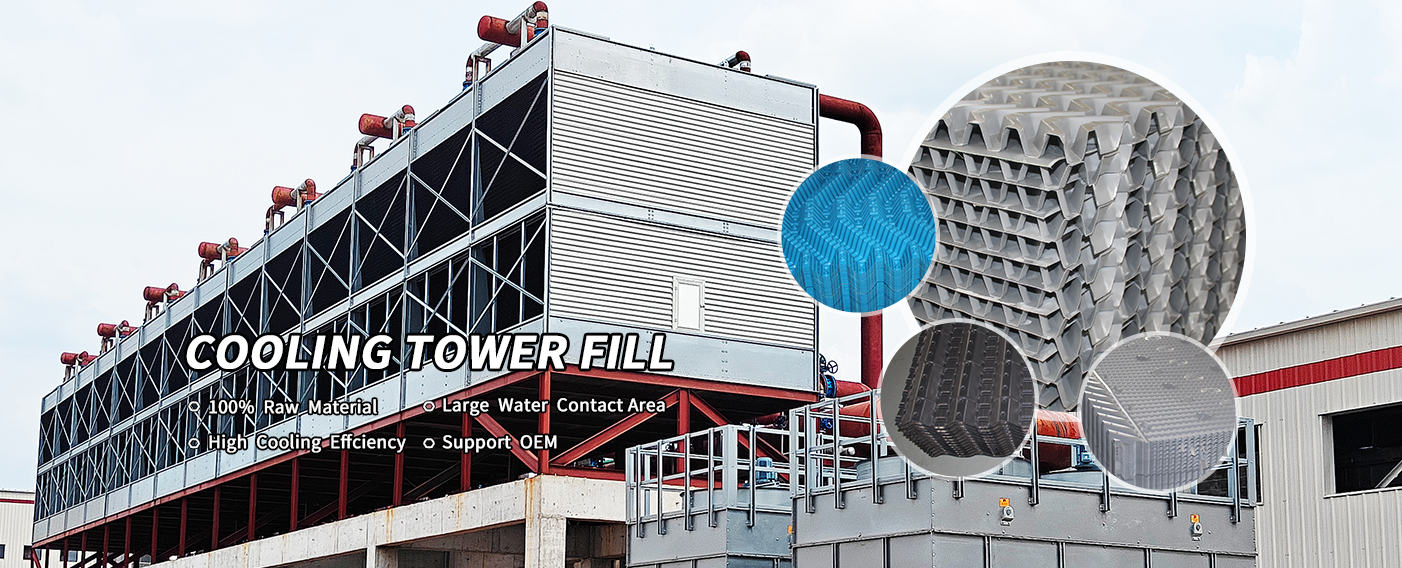
Cooling Tower Fill Media: Types, Benefits and Applications
Cooling tower fill media is one of the most important components inside an evaporative cooling tower. It creates a large contact area between circulating water and air, allowing heat to transfer more efficiently and helping the tower achieve the required outlet-water temperature.
The right cooling tower fill media can improve thermal performance, support stable operation, reduce unnecessary energy consumption, and extend the service life of the cooling system. However, different cooling towers require different fill designs. Water quality, operating temperature, airflow direction, heat load, fouling risk, and maintenance requirements all need to be considered.
This guide explains the main types of cooling tower fill media, their benefits, applications, materials, maintenance requirements, and key factors to consider when selecting fill for a new or existing cooling tower.
What Is Cooling Tower Fill Media?
Cooling tower fill media is the heat-transfer material installed inside a cooling tower. It slows and spreads the flow of water while providing a large surface area for water-air contact.
As warm water passes through the fill, air moves across or against the water flow. A small portion of the water evaporates, removing heat from the remaining water.
Why Is Fill Media Important in a Cooling Tower?
Without suitable fill media, water would have much less contact with air. This would reduce evaporation and make the tower less effective at rejecting heat.
The primary functions of cooling tower fill media include:
Increasing water-air contact area
Improving heat and mass transfer
Distributing water across a large surface
Supporting evaporation
Reducing the required tower size for a given cooling duty
Helping maintain stable cooling performance
How Does Fill Media Improve Heat Transfer?
Fill media divides water into thin films or smaller droplets. This increases the effective contact area between water and air.
The greater the contact area and contact time, the more effectively heat can be removed from the circulating water.
What Are the Main Types of Cooling Tower Fill Media?
Cooling tower fill is generally divided into film fill and splash fill. Each type has different characteristics and is suitable for different operating conditions.
What Is Film Fill?
Film fill consists of sheets with specially formed surfaces. Water spreads over these surfaces as thin films while air passes through the channels created by the sheets.
PVC film fill is particularly common in modern cooling towers.
What Are the Advantages of Film Fill?
Film fill can provide:
Where Is Film Fill Commonly Used?
Film fill is often used in:
Film fill generally performs best when the circulating water is relatively clean and suspended solids are controlled.
What Is Splash Fill?
Splash fill uses bars, grids, sheets, or other structures to break falling water into droplets.
Instead of spreading water into a thin film, splash fill repeatedly disrupts the water flow to increase contact with air.
What Are the Benefits of Splash Fill?
Splash fill is often considered when water quality is challenging.
Its potential advantages include:
Better tolerance of suspended solids
Lower risk of narrow passage blockage
Easy visual inspection
Good resistance to certain fouling conditions
Suitability for some industrial applications
When Should Splash Fill Be Considered?
Splash fill may be appropriate for cooling towers handling dirtier water, wastewater, or applications where clogging is a significant concern.
However, the appropriate selection depends on the complete system design and required thermal performance.
What Materials Are Used for Cooling Tower Fill Media?
The material of fill media affects temperature resistance, chemical compatibility, durability, weight, and cost.
PVC Cooling Tower Fill Media
PVC is one of the most widely used materials for film fill.
PVC cooling tower fill offers a practical balance of thermal performance, chemical resistance, manufacturing flexibility, and cost.
Why Is PVC Popular?
PVC can be formed into complex corrugated patterns that provide a large effective heat-transfer area.
It is commonly used in HVAC and industrial cooling applications where operating conditions fall within the material's recommended limits.
PP Cooling Tower Fill Media
Polypropylene, or PP, is another thermoplastic used for cooling tower fill.
PP can provide good chemical resistance and may be selected for applications involving conditions where its material properties provide an advantage over standard PVC.
When Should PP Be Considered?
PP may be worth evaluating when the cooling tower operates at elevated temperatures or under specific chemical conditions.
The exact material selection should be based on the manufacturer's temperature and chemical-resistance data.
FRP Cooling Tower Fill Media
Fiberglass-reinforced plastic, or FRP, can provide high mechanical strength and durability.
FRP is used in certain specialized cooling environments where structural performance and long-term durability are important considerations.
How Does Counterflow Cooling Tower Fill Work?
In a counterflow cooling tower, water travels downward while air moves upward through the fill.
This opposing flow arrangement creates effective contact between the two streams.
What Are the Advantages of Counterflow Fill?
Counterflow fill can provide:
Efficient heat and mass transfer
Compact tower dimensions
High thermal performance
Effective use of tower height
Flexible application in industrial cooling
What Fill Is Commonly Used in Counterflow Towers?
PVC film fill is frequently used in counterflow cooling towers when the water quality and operating conditions are suitable.
For systems with high suspended solids, alternative fill designs may be more appropriate.
How Does Crossflow Cooling Tower Fill Work?
In a crossflow tower, air moves horizontally through the fill while water flows vertically downward.
The airflow and water flow therefore cross one another.
What Are the Benefits of Crossflow Fill?
Crossflow cooling towers can offer:
Convenient maintenance access
Straightforward water distribution
Accessible fill sections
Flexible tower configurations
Where Is Crossflow Fill Commonly Used?
Crossflow fill is widely used in commercial HVAC and industrial cooling applications.
The appropriate fill geometry depends on the tower manufacturer, airflow requirements, water distribution system, and thermal design.
What Are the Main Benefits of Cooling Tower Fill Media?
The performance of a cooling tower is strongly influenced by its fill design.
1. Increased Heat-Transfer Area
Fill creates a much larger effective surface area than an open water stream.
This allows more water to interact with air during the cooling process.
2. Improved Cooling Efficiency
Efficient fill can help the tower achieve the required water temperature within a reasonable tower footprint.
3. Better Water Distribution
Properly designed fill helps distribute water over a large area instead of allowing water to fall through the tower in concentrated streams.
4. Compact Cooling Tower Design
High-performance fill can increase the amount of heat rejected per unit volume of tower fill.
This can help designers achieve the required cooling capacity without excessively increasing tower size.
5. Potential Energy Savings
Efficient heat transfer can contribute to lower fan or pump requirements when the complete system is properly designed.
However, actual energy savings depend on tower design, fan operation, water flow, ambient conditions, and system controls.
6. Flexible Applications
Different fill materials and geometries allow cooling towers to be adapted to:
How Does Fill Design Affect Cooling Tower Performance?
The geometry of fill media is just as important as the material.
What Characteristics Should Good Fill Media Have?
An effective fill design should balance:
Does More Surface Area Always Mean Better Cooling?
Not necessarily.
A very dense fill may provide a large theoretical surface area, but it can also increase pressure drop and make the passages more susceptible to blockage.
The goal is to achieve the right balance between thermal performance and operating reliability.
How Does Water Quality Affect Cooling Tower Fill Selection?
Water quality is one of the most important factors when choosing fill media.
What Happens When Fill Becomes Clogged?
Dirt, scale, algae, sludge, and suspended solids can accumulate on fill surfaces.
As deposits build up, they may:
Reduce airflow
Restrict water movement
Reduce effective heat-transfer area
Create uneven water distribution
Increase pressure drop
Reduce cooling performance
Which Fill Is Better for Dirty Water?
Applications with high levels of suspended solids may require fill with larger passages or splash-type characteristics.
Film fill with narrow channels may be more vulnerable to blockage when water treatment is inadequate.
Why Is Water Treatment Important?
Even high-quality fill can lose performance if the circulating water is poorly controlled.
A proper water-treatment program should address:
What Industries Use Cooling Tower Fill Media?
Cooling tower fill has applications across many industries.
HVAC and Commercial Buildings
Large commercial buildings use cooling towers to reject heat from chilled-water systems.
Typical applications include:
Office buildings
Hotels
Shopping centers
Hospitals
Airports
Universities
Why Is Fill Important for HVAC Cooling Towers?
Efficient fill helps the tower remove heat from condenser water before the water returns to the chiller.
This supports stable chiller operation and overall HVAC performance.
Industrial Process Cooling
Manufacturing facilities often require continuous cooling for equipment and processes.
Cooling tower fill can support cooling systems used in:
Plastics manufacturing
Chemical processing
Steel production
Machinery manufacturing
Food processing
Textile production
How Does Fill Support Process Cooling?
The fill provides the water-air contact needed to reject process heat.
Proper fill selection can help maintain the desired circulating-water temperature while accommodating the specific water quality and operating environment.
Power Generation
Power facilities can use large cooling towers to reject waste heat from condensers and other equipment.
What Matters Most in Power Plant Applications?
Large-scale systems require careful evaluation of:
Thermal capacity
Water chemistry
Temperature
Fill durability
Fouling
Maintenance requirements
Structural performance
Data Centers
Data centers generate continuous heat and require reliable heat-rejection systems.
Why Is Fill Selection Important for Data Centers?
Cooling interruptions can have serious operational consequences. Therefore, fill performance, water distribution, fouling resistance, and maintenance accessibility should all be considered during system design.
How Should You Choose the Right Cooling Tower Fill Media?
Choosing fill should begin with the actual operating conditions rather than the fill material alone.
What Questions Should You Ask Before Selecting Fill?
Consider the following:
Is the tower counterflow or crossflow?
What is the circulating-water temperature?
What is the required cooling capacity?
How clean is the circulating water?
What is the suspended-solids concentration?
Is scaling a major concern?
What is the airflow requirement?
What fill dimensions are required?
What material is compatible with the water chemistry?
How frequently can the tower be maintained?
Should You Choose Film Fill or Splash Fill?
The answer depends primarily on water quality and thermal requirements.
Choose Film Fill When:
Water quality is relatively clean
High heat-transfer efficiency is required
Compact tower design is important
Regular water treatment is available
Consider Splash Fill When:
Suspended solids are relatively high
Fouling is a major concern
Larger water passages are preferred
The application can accommodate the required fill volume
How Do You Maintain Cooling Tower Fill Media?
Proper maintenance is essential for maintaining fill performance.
What Should Be Inspected Regularly?
Inspect for:
How Can Fouling Be Reduced?
Operators can reduce fouling through:
When Should Cooling Tower Fill Be Cleaned?
Cleaning should be considered when deposits begin to interfere with water distribution, airflow, or thermal performance.
The cleaning method should be compatible with the fill material and manufacturer's recommendations.
When Should Cooling Tower Fill Media Be Replaced?
Fill media should be replaced when cleaning and maintenance can no longer restore acceptable performance.
What Are Common Signs of Fill Replacement?
Look for:
Is There a Fixed Cooling Tower Fill Replacement Interval?
Not necessarily.
The service life of fill depends on water quality, operating temperature, UV exposure, chemical conditions, mechanical stress, maintenance, and operating hours.
A condition-based inspection is generally more useful than relying only on a fixed replacement schedule.
How Can You Improve the Service Life of Cooling Tower Fill?
Several maintenance practices can help extend fill life.
Maintain Proper Water Treatment
Control scale, biological growth, corrosion, and suspended solids.
Keep Spray Nozzles Clean
Blocked or damaged nozzles can cause uneven water distribution and overload certain areas of the fill.
Monitor Operating Temperature
Avoid operating fill outside its recommended temperature range.
Inspect Fill Supports
Damaged supports can cause fill blocks to deform or collapse.
Clean Before Severe Fouling Develops
Early cleaning is usually easier than attempting to restore heavily blocked fill.
How Do You Select a Cooling Tower Fill Media Supplier?
Choosing a reliable supplier is particularly important for replacement projects.
What Technical Information Should a Supplier Provide?
A professional supplier should be able to provide information about:
Can Cooling Tower Fill Be Customized?
Yes. Cooling tower fill can often be supplied in different sheet dimensions, block sizes, thicknesses, and configurations.
Customization can be useful when replacing original fill in an existing cooling tower.
What Information Is Needed for Custom Fill?
Provide as much information as possible, including:
This information helps the supplier determine whether the proposed cooling tower fill media is suitable.
Cooling Tower Fill Media: Key Takeaways
Cooling tower fill media plays a central role in evaporative heat rejection. By increasing the contact area between water and air, fill allows cooling towers to transfer heat more effectively.
The main options include film fill and splash fill, while common materials include PVC, PP, and FRP. PVC film fill is widely used because it provides an effective balance of heat-transfer performance, weight, chemical resistance, and cost.
However, the best fill depends on the application. Clean-water HVAC systems may favor high-performance film fill, while applications with significant suspended solids may require a more fouling-resistant design.
When selecting cooling tower fill media, consider the tower configuration, water quality, temperature, heat load, airflow resistance, maintenance requirements, and expected service life. Proper selection combined with effective water treatment and regular inspection can help maintain cooling efficiency and extend the life of the entire cooling tower system.


