Cooling Tower Fan Blade Manufacturers: Types, Materials and Quality
Cooling tower fan blades are essential components in industrial cooling systems, helping move air through the tower to support heat transfer and water cooling. Their design, material selection, and manufacturing quality directly influence airflow, energy consumption, operating stability, and equipment service life. For cooling tower manufacturers, industrial plant operators, maintenance contractors, and equipment distributors, choosing a reliable cooling tower fan blade manufacturer is an important step toward achieving consistent system performance.
Professional cooling tower fan blade manufacturers provide different blade types, materials, and configurations to meet the requirements of commercial HVAC systems, power plants, chemical processing facilities, steel mills, and other industrial applications. From lightweight FRP fan blades to aluminum blades and customized replacement components, the right product must match the fan's operating conditions and mechanical design.
This article explores the main types of cooling tower fan blades, commonly used materials, essential quality standards, manufacturing processes, and purchasing considerations to help buyers make informed decisions.
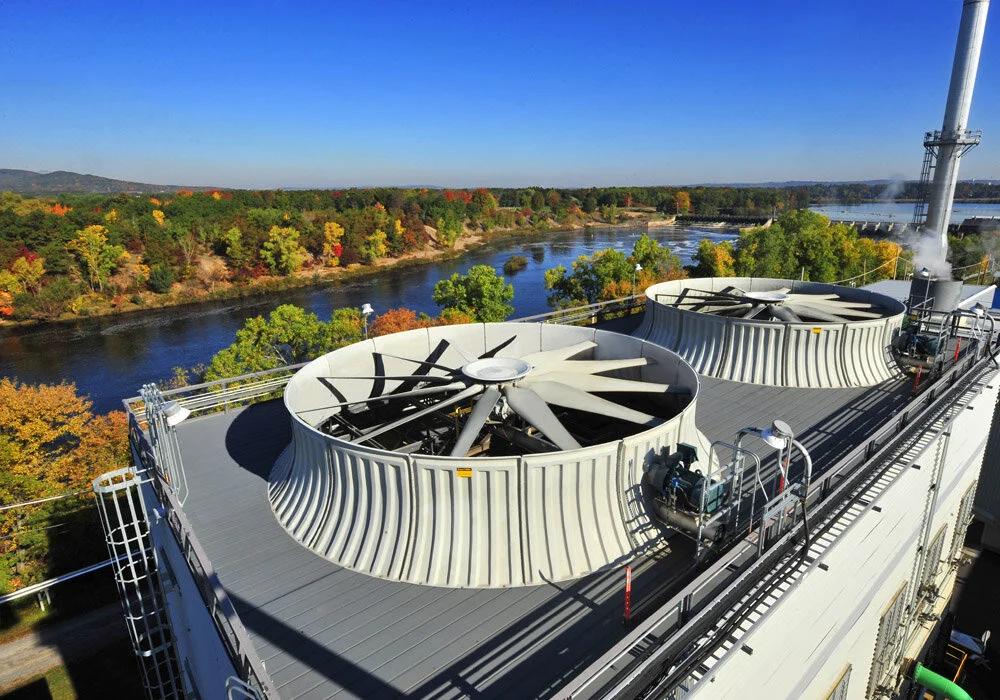
What Do Cooling Tower Fan Blade Manufacturers Produce?
Cooling tower fan blade manufacturers design and produce components that generate the airflow required for heat rejection. These blades operate as part of a complete fan assembly, which may include a hub, motor, gearbox, shaft, drive system, and fan cylinder.
The manufacturer's role extends beyond producing a blade with the correct dimensions. A suitable product must also meet the required aerodynamic, mechanical, environmental, and installation specifications.
Main Functions of Cooling Tower Fan Blades
The fan blades convert rotational energy into airflow, allowing air to pass through the cooling tower and interact with circulating water.
Supporting Heat Transfer and Cooling Performance
Effective airflow helps maintain the heat and mass transfer needed to cool circulating water. If the blades are incorrectly designed or poorly matched to the system, the fan may not deliver the required airflow.
Controlling Fan Power Consumption
Blade geometry, pitch, rotational speed, and system resistance affect the power required to operate the fan. A well-matched blade design can help reduce unnecessary energy consumption while meeting the cooling tower's operating requirements.
Why Does the Manufacturer Matter?
A qualified manufacturer should understand blade geometry, material properties, mounting interfaces, and the operating conditions of industrial cooling towers.
This technical knowledge is especially important for customized products and replacement projects, where the original blade model may be discontinued or difficult to identify.
What Types of Cooling Tower Fan Blades Are Available?
Cooling tower fan blades can be classified by material, pitch configuration, design, and manufacturing method. Buyers should identify the correct configuration before requesting a quotation.
Fiber-reinforced plastic (FRP) fan blades are widely used in industrial cooling towers because they combine relatively low weight with corrosion resistance and design flexibility.
Key Features of FRP Fan Blades
Corrosion resistance: Suitable resin systems can provide good resistance to moisture and many cooling tower environments.
Lightweight construction: Lower blade mass can help reduce mechanical loading when the complete assembly is appropriately designed.
Flexible blade design: FRP supports different blade profiles and geometries.
Customized production: Manufacturers can produce blades for different fan sizes and application requirements.
Potentially low maintenance: Properly designed FRP blades can provide reliable service under suitable operating conditions.
Where Are FRP Blades Commonly Used?
FRP blades are suitable for many industrial cooling towers, HVAC installations, and environments where moisture or corrosion is a concern. The actual suitability depends on resin selection, temperature, UV exposure, chemical compatibility, and structural requirements.
Aluminum Cooling Tower Fan Blades
Aluminum fan blades offer a combination of relatively low weight, structural strength, and established manufacturing methods.
Advantages of Aluminum Blades
Lightweight metal construction.
Good strength-to-weight characteristics for suitable designs.
Consistent dimensional manufacturing.
Compatibility with many established fan configurations.
Potential for protective coatings or other surface treatments.
Important Considerations for Aluminum Blades
The selected alloy must meet the mechanical requirements of the application. Surface treatment and corrosion protection should also be considered, particularly in humid environments containing water-treatment chemicals.
Aluminum blades are often worth evaluating when the existing fan system was designed for metal blades or when specific structural requirements favor this material.
ABS and Other Engineering Plastic Fan Blades
ABS and other engineering plastics can be used in selected cooling tower fan applications. Their suitability depends on the fan size, operating speed, mechanical load, and environmental conditions.
Material Limitations to Consider
Buyers should verify temperature resistance, UV stability, impact resistance, fatigue performance, and long-term dimensional stability.
Not every plastic is suitable for large industrial fans. Material selection should be based on product specifications rather than price or appearance alone.
Fixed-Pitch Cooling Tower Fan Blades
Fixed-pitch fan blades are manufactured or installed at a specified angle for the intended fan configuration.
Benefits of Fixed-Pitch Designs
Fixed-pitch blades can simplify installation and help maintain a consistent configuration when operating conditions remain relatively stable. They are suitable for many standard industrial cooling applications.
However, the selected pitch must match the intended airflow, fan speed, and motor capacity.
Adjustable-Pitch Cooling Tower Fan Blades
Adjustable-pitch blades allow the angle to be changed within the manufacturer's approved range.
When Are Adjustable-Pitch Blades Useful?
They can provide flexibility during commissioning or when a compatible fan system requires pitch adjustment to meet operating requirements.
However, changing the pitch affects airflow and power demand. All blades must be set consistently, and adjustments should follow the manufacturer's procedures to prevent overload or excessive vibration.
How to Compare Different Cooling Tower Fan Blade Materials
Material selection influences blade weight, durability, corrosion resistance, manufacturing cost, and maintenance requirements. A suitable material should match the operating environment and mechanical design.
FRP vs. Aluminum vs. Engineering Plastic
| Comparison Factor | FRP | Aluminum | Engineering Plastic |
| Weight | Relatively low | Relatively low | Often low |
| Corrosion resistance | Generally good with suitable resin | Depends on alloy and protection | Depends on polymer type |
| Design flexibility | High | Depends on manufacturing process | High for molded designs |
| Temperature capability | Depends on resin system | Depends on alloy and design | Depends on polymer grade |
| Maintenance needs | Depends on exposure and damage | Depends on corrosion and coating condition | Depends on UV, temperature, and loading |
| Common selection priority | Corrosion resistance and customized profiles | Strength and metal construction | Suitable small or specialized fan applications |
Consider the Operating Environment
Cooling towers expose fan blades to moisture, changing temperatures, airborne particles, and potentially corrosive substances.
Temperature and Chemical Compatibility
Manufacturers should confirm that the material is suitable for the actual operating temperature and any chemical exposure. FRP resin systems and plastic grades have different limits, while aluminum requires appropriate consideration of corrosion conditions.
Outdoor Exposure and UV Protection
Outdoor installations may experience prolonged sunlight and weather changes. UV-resistant materials, suitable protective coatings, and appropriate maintenance can help preserve product performance.
Evaluate Total Cost Rather Than Purchase Price Alone
A lower initial price does not necessarily mean a lower lifetime cost.
What Should Buyers Include in Their Cost Comparison?
Consider purchase price, transportation, installation labor, maintenance requirements, expected service life, downtime risk, and potential effects on fan energy consumption.
The most economical blade is the one that meets the technical requirements and provides an appropriate balance between upfront cost and long-term reliability.
What Determines the Quality of Cooling Tower Fan Blades?
Product quality depends on material selection, engineering design, production consistency, dimensional accuracy, and final inspection. Reliable cooling tower fan blade manufacturers should have procedures for controlling these factors.
Material Quality and Traceability
The quality of the raw material influences blade strength, durability, and resistance to environmental damage.
What Should Be Checked for FRP Blades?
For FRP blades, important considerations include resin type, reinforcement material, laminate consistency, curing quality, and visible defects.
What Should Be Checked for Aluminum Blades?
For aluminum blades, buyers should confirm the specified alloy, material condition, surface quality, corrosion protection, and compliance with the approved design.
Material requirements should be documented clearly, especially for customized industrial projects.
Dimensional Accuracy and Manufacturing Consistency
Blades must match the approved dimensions and geometry to operate as intended.
Critical Dimensions to Inspect
Blade length and width.
Blade profile and curvature.
Mounting hole position.
Hub interface and attachment dimensions.
Blade pitch or pitch-setting range.
Overall dimensions and relevant tolerances.
Inconsistent dimensions may cause installation difficulties or uneven aerodynamic loading.
Surface Quality and Structural Integrity
Manufacturing defects can affect the strength, durability, and reliability of a blade.
Common Defects to Avoid
Depending on the material and manufacturing process, these may include cracks, delamination, deformation, surface damage, incomplete bonding, or defective protective coatings.
A visual inspection is useful but may not detect every internal defect. The inspection method should reflect the blade's design and application.
Blade Balance and Rotational Stability
Fan imbalance can increase vibration and mechanical loading on bearings, hubs, shafts, and supporting structures.
Why Is Balancing Important?
Manufacturers should identify the appropriate balancing requirements based on the fan's rotational speed, blade design, and applicable engineering standards.
Buyers should confirm whether the supplied product includes individual blade mass matching, assembly balance verification, or recommendations for balancing the complete rotating system after installation.
How Do Cooling Tower Fan Blade Manufacturers Improve Fan Efficiency?
Manufacturers can improve performance through aerodynamic design, material optimization, precision production, and compatibility checks.
Optimize Blade Profile and Pitch
The blade profile determines how air moves across the blade surface and how efficiently the fan generates airflow.
Balance Airflow and Power Consumption
A suitable design should deliver the required airflow without placing excessive load on the motor or drive system.
Increasing blade pitch does not automatically improve efficiency. The correct setting depends on the blade geometry, fan diameter, rotational speed, and airflow resistance.
Reduce Unnecessary Weight and Mechanical Loading
Lightweight blades may help reduce the mass carried by the rotating assembly, depending on the complete fan design.
Why Must Weight Reduction Preserve Strength?
A blade must withstand aerodynamic forces, centrifugal loading, vibration, and fatigue throughout its service life. Manufacturers should balance weight reduction with structural stiffness, material durability, and safe operating limits.
Improve Fan and Cooling Tower Compatibility
Even a high-quality blade can perform poorly if it does not match the fan cylinder, hub, motor, or internal cooling tower configuration.
Check Tip Clearance and Airflow Conditions
Blade-tip clearance, inlet conditions, and airflow obstruction can affect fan performance. Manufacturers should consider the complete installation geometry when recommending replacement blades.
What Manufacturing Processes Affect Cooling Tower Fan Blade Quality?
Different materials require different manufacturing processes. Buyers should understand the general production approach and how the manufacturer controls consistency.
FRP Blade Manufacturing
FRP blades may be produced using molding and composite fabrication processes selected for the blade design and production requirements.
Important Production Controls
Quality control may include checking reinforcement placement, resin distribution, curing conditions, dimensions, surface finish, and structural integrity.
Consistent production helps ensure that the finished blade matches its approved design.
Aluminum Blade Manufacturing
Aluminum blades may be formed, cast, machined, or produced through other processes depending on the design.
Important Production Controls
Manufacturers should control material specifications, blade geometry, surface treatment, mounting dimensions, and relevant mechanical properties.
The appropriate manufacturing method depends on the blade profile, load requirements, production volume, and intended service environment.
Final Inspection Before Shipment
Final inspection helps identify issues before blades reach the customer.
What Should the Inspection Cover?
Depending on the product, inspection may include:
Dimensional verification.
Surface and structural inspection.
Mounting interface checks.
Material or production documentation.
Blade mass consistency and balance requirements.
Packaging and transportation protection.
The manufacturer should clarify which checks are included in the quotation and which tests are available upon request.
How to Choose a Reliable Cooling Tower Fan Blade Manufacturer
Selecting a supplier requires evaluating technical capabilities, product quality, manufacturing experience, customization services, and delivery performance.
Check Industry Experience and Product Range
Look for manufacturers familiar with industrial cooling towers, replacement fan blades, and customized fan assemblies.
Questions to Ask Potential Suppliers
What materials and blade types do you manufacture?
Can you supply FRP and aluminum cooling tower fan blades?
Can you produce replacement blades from approved drawings?
What quality inspection procedures do you use?
Can you provide dimensional specifications and technical documentation?
What are your production lead time and warranty conditions?
Clear answers help buyers evaluate whether a supplier can meet the project's requirements.
Evaluate Customization Capabilities
Different cooling towers may require different blade diameters, profiles, pitch settings, and mounting configurations.
What Information Should You Provide?
For an accurate quotation, provide the fan diameter, blade dimensions, material preference, number of blades, hub configuration, rotational speed, motor power, and required quantity.
Existing drawings, model numbers, and photographs can help the manufacturer identify the configuration, but critical dimensions should be verified before production.
Review Delivery and After-Sales Support
Industrial projects often operate under strict maintenance schedules. Delayed replacement components can extend downtime and increase operating costs.
Check Lead Time and Packaging
Ask about production schedules, export packaging, shipping dimensions, delivery terms, and installation support.
For large blades, appropriate packaging is important to prevent damage during handling and transportation.
Compare Suppliers on a Technical Basis
Request quotations using the same specifications so that price differences can be evaluated fairly.
What Should a Complete Quotation Include?
A detailed quotation should identify material, dimensions, configuration, quantity, unit price, delivery terms, packaging, quality documentation, and warranty conditions where applicable.
Avoid selecting a supplier solely because its quotation is cheaper if the technical scope differs.
How to Select Replacement Cooling Tower Fan Blades
Replacement projects require particular attention because new blades must work safely with existing equipment.
Confirm the Original Fan Specifications
Start with the original fan model, manufacturer's drawings, and available product documentation.
Verify the Mounting Interface
Confirm the hub dimensions, mounting hole pattern, fasteners, blade orientation, and any pitch adjustment mechanism.
A blade that looks similar to the original may still be incompatible with the existing assembly.
Match the Blade to the Operating Speed and Motor
The replacement blade must operate within the approved rotational speed and power limits.
Avoid Unapproved Design Changes
Changes in blade diameter, pitch, or profile can alter airflow and motor loading. Ask the manufacturer to evaluate any proposed change rather than assuming that a different blade will improve cooling performance.
Plan Installation and Commissioning
Before installation, inspect the supporting structure, hub, drive system, and fan cylinder.
Verify Operation After Installation
Qualified personnel should check the installation, fasteners, guards, vibration, motor current, and cooling performance according to the manufacturer's commissioning procedure.
Follow the site's isolation and safety procedures whenever working on rotating equipment.
Which Industries Use Industrial Cooling Tower Fan Blades?
Cooling tower fan blades are used across a wide range of industries where reliable heat rejection is necessary.
Power Generation and Energy Facilities
Power plants and energy facilities use cooling towers to reject heat from condensers and auxiliary equipment.
Important Selection Factors
Blade reliability, airflow capacity, operating speed, and maintenance accessibility are important considerations for continuous-duty installations.
Chemical and Process Industries
Chemical plants and process facilities may expose cooling tower components to challenging environmental conditions.
Material Compatibility
Blade materials and protective systems should be selected according to humidity, chemical exposure, temperature, and the expected mechanical loading.
Steel Mills and Manufacturing Plants
Industrial manufacturing facilities often require dependable cooling for machinery, production lines, and process equipment.
Prioritize Durability and Maintenance Planning
The selected blades should meet the operating requirements and fit the plant's maintenance schedule. Replacement availability and technical support may be especially important where downtime is costly.
Commercial HVAC Systems
Commercial buildings use cooling towers to support air-conditioning systems and building services.
Focus on Stable Operation and Energy Use
Blade design, motor control, maintenance, and airflow conditions all contribute to overall system performance. The selected product should match the cooling tower's design and expected operating profile.
FAQ About Cooling Tower Fan Blade Manufacturers
Which Material Is Best for Cooling Tower Fan Blades?
FRP, aluminum, and engineering plastics each have suitable applications. FRP offers corrosion resistance and design flexibility, aluminum provides a combination of strength and low weight, and engineering plastics can suit selected fan designs. The best choice depends on temperature, environmental exposure, mechanical loading, and the original fan configuration.
How Long Do Cooling Tower Fan Blades Last?
Service life depends on material quality, operating speed, temperature, UV exposure, corrosion, vibration, maintenance, and installation quality. Regular inspections help identify damage before it becomes a serious operational problem.
Can Manufacturers Customize Cooling Tower Fan Blades?
Many manufacturers can customize blade dimensions, materials, profiles, and mounting arrangements. Customization should be based on verified specifications and an engineering assessment of compatibility.
Do High-Quality Fan Blades Reduce Electricity Consumption?
Properly designed blades can help improve aerodynamic performance and avoid unnecessary power consumption. Actual savings depend on the complete fan system, including motor efficiency, drive configuration, airflow resistance, and operating conditions.
What Should I Check Before Buying from a Manufacturer?
Verify the product material, dimensions, blade configuration, manufacturing quality, balance requirements, technical documentation, delivery schedule, and warranty conditions. For replacement projects, confirm compatibility with the original fan assembly before ordering.
Conclusion
Cooling tower fan blade manufacturers play an important role in supplying components that support industrial cooling performance, operational reliability, and energy management. Understanding the differences between FRP, aluminum, and engineering plastic blades helps buyers select suitable materials for their operating environments.
However, material selection alone is not enough. Blade geometry, pitch, dimensional accuracy, balance, manufacturing consistency, and compatibility with the complete fan assembly all affect product performance.
When choosing a cooling tower fan blade manufacturer, evaluate technical experience, quality-control procedures, customization capabilities, documentation, and delivery reliability. For replacement projects, confirm the original fan specifications and seek technical approval before making changes to the blade design.
By combining appropriate materials with reliable manufacturing and correct installation, industrial facilities can support stable airflow, reduce avoidable maintenance problems, and maintain dependable cooling tower operation.


